
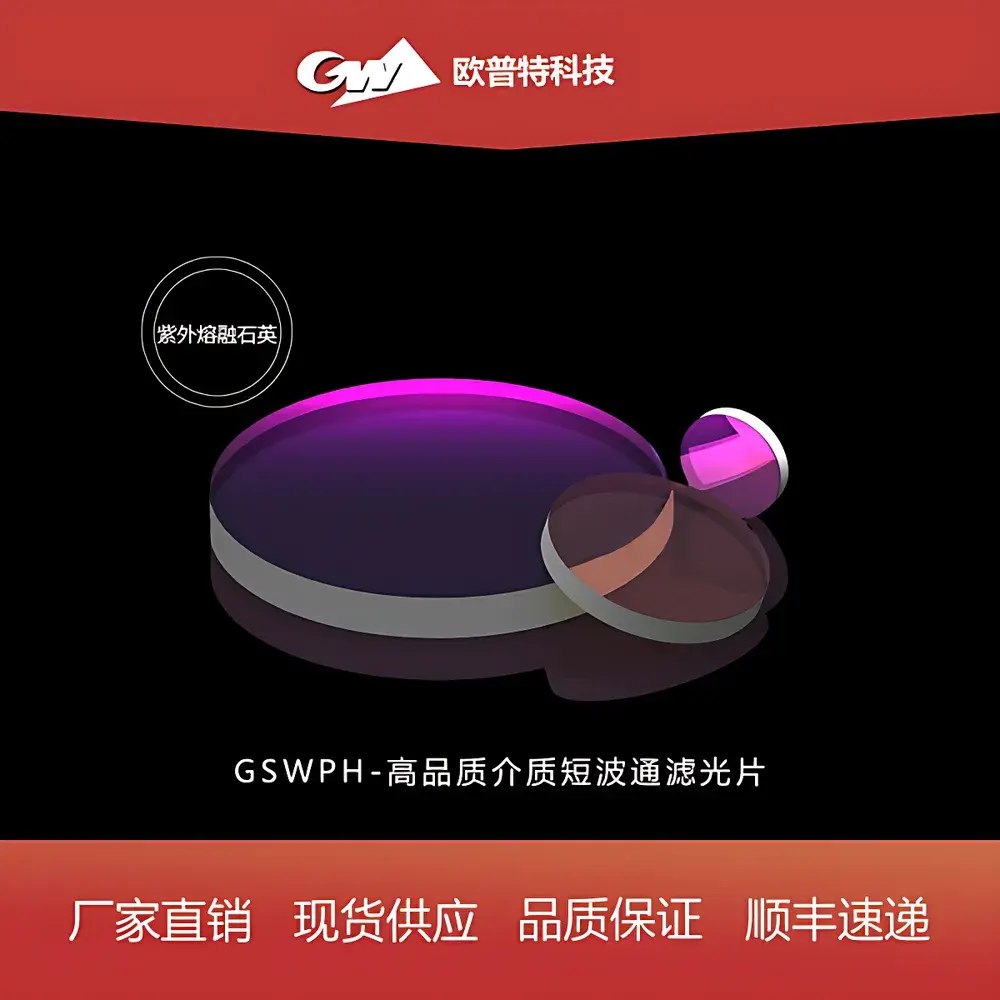
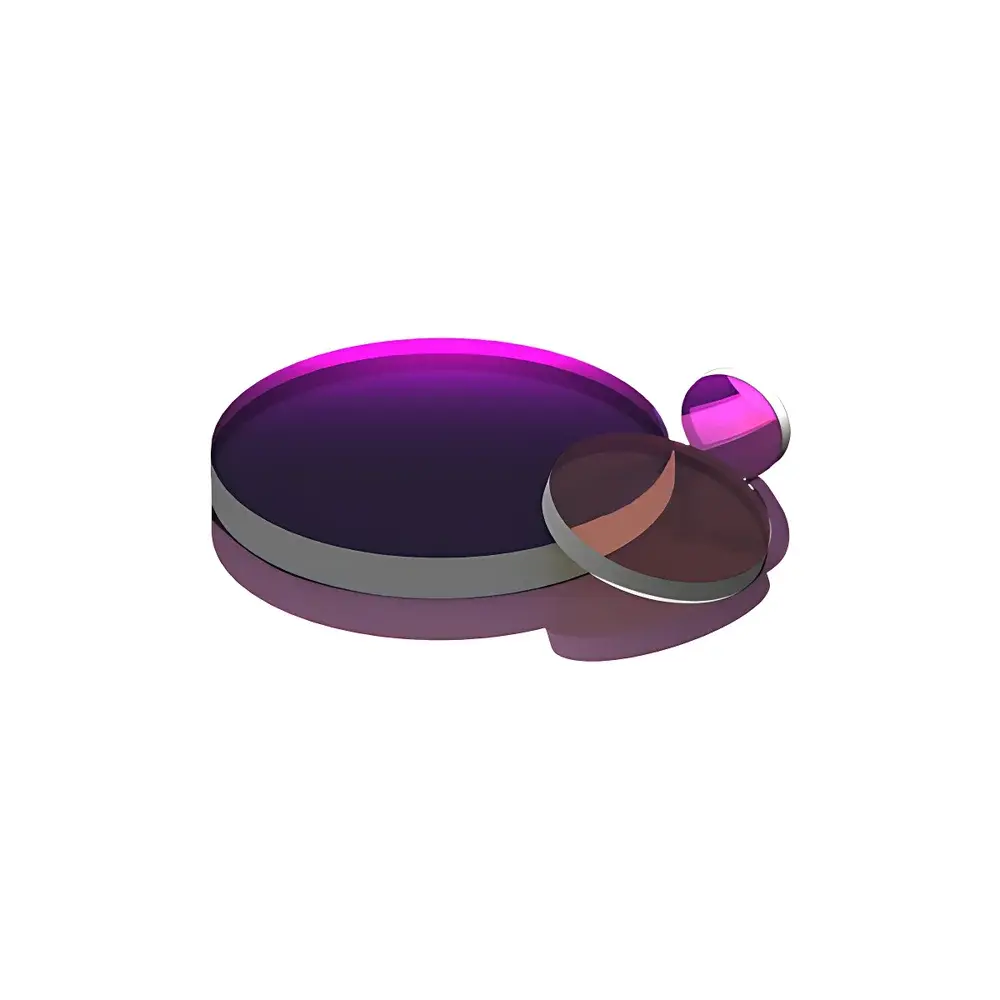
GSWPH High-Performance Shortpass Optical Filter
| Origin | Beijing, China |
|---|---|
| Manufacturer Type | Authorized Distributor |
| Product Category | Optical Component |
| Model | GSWPH |
| Diameter Options | Φ12.5 mm, Φ25 mm, Φ50 mm |
| Center Wavelength Range | 400–1100 nm |
| Transmission Band | 300–1085 nm (varies by CWL) |
| Blocking Band | 415–1530 nm (varies by CWL) |
| Substrate Material | Fused Silica or BK7 (standard) |
| Surface Quality | 60-40 scratch-dig |
| Parallelism | <3 arcmin |
| Clear Aperture | ≥90% of diameter |
Overview
The GSWPH High-Performance Shortpass Optical Filter is a precision thin-film interference filter engineered for spectral separation in demanding optical laboratory and industrial instrumentation applications. Operating on the principle of multilayer dielectric interference, the GSWPH transmits shorter wavelengths below a defined cutoff edge while providing high optical density (OD ≥4) rejection across a broad blocking band beyond the cut-on transition. Unlike absorptive filters, its hard-coated, vacuum-deposited dielectric stack ensures minimal thermal drift, negligible fluorescence, and long-term stability under continuous illumination—including UV-visible broadband sources and pulsed laser systems. Designed for integration into spectroscopic setups, fluorescence microscopes, hyperspectral imaging modules, and laser safety enclosures, the GSWPH delivers sharp spectral transitions (typical edge steepness: <15 nm at 10%–90% transmission), low wavefront distortion (500 mJ/cm², 10 ns, 1064 nm). Its performance complies with ISO 10110-7 surface quality standards and meets MIL-C-48497A environmental durability requirements for humidity, abrasion, and adhesion.
Key Features
- Precision-cut shortpass response with center wavelength (CWL) options from 400 nm to 1100 nm in 25 nm increments—each calibrated and certified per individual lot
- High transmission (>90% avg.) across designated passband; deep blocking (OD ≥4) over specified rejection range, minimizing stray light and background noise
- Available in three standard clear apertures: Φ12.5 mm (GSWPH-CWL-D12), Φ25 mm (GSWPH-CWL-D25), and Φ50 mm (GSWPH-CWL-D50), all with ±0.1 mm dimensional tolerance
- Fused silica substrate option (standard for UV-enhanced variants ≤450 nm CWL) ensures superior transmission down to 185 nm and low thermal expansion (α = 0.55 × 10⁻⁶ /°C)
- AR-coated both sides (optional) reduces surface reflection losses to <0.25% per interface across the passband, critical for multi-filter stacks and confocal configurations
- Validated for use in Class 100 cleanroom environments; coated using ion-assisted e-beam deposition for reproducible layer thickness control (±0.3% RMS) and high spectral repeatability
Sample Compatibility & Compliance
The GSWPH series is compatible with standard SM1 (1.035″-40) and SM2 (2.035″-40) lens tubes, as well as common filter holders (e.g., Thorlabs FFM1, Edmund Optics FHS series). It supports mounting in motorized filter wheels (e.g., Sutter Lambda 10-B, Prior Lumen 200) without mechanical stress-induced birefringence. All filters undergo spectral verification via NIST-traceable UV-VIS-NIR spectrophotometry (PerkinElmer Lambda 1050+) and are supplied with individual test reports including measured transmission curve, edge position accuracy (±2 nm), and blocking OD profile. The product conforms to ISO 9001:2015 manufacturing controls and satisfies key regulatory prerequisites for optical components used in ISO/IEC 17025-accredited laboratories. While not a medical device, its material composition (RoHS-compliant coatings, lead-free glass substrates) aligns with EU Directive 2011/65/EU and REACH SVHC screening protocols.
Software & Data Management
No proprietary software is required for operation; however, spectral data files (.csv, .txt) for each filter lot are provided upon request for integration into LabVIEW, MATLAB, or Python-based optical simulation workflows (e.g., PyOptica, LightPipes). Users may import measured transmission curves into Zemax OpticStudio or CODE V for system-level stray-light analysis and throughput modeling. For traceability in GLP/GMP environments, batch numbers and calibration dates are laser-etched on the filter rim and cross-referenced in digital certificates compliant with ASTM E2917-22 (Standard Practice for Calibration of Spectrophotometers). Audit-ready documentation—including coating process logs, environmental chamber validation records, and interferometric flatness maps—is available under NDA for qualified institutional purchasers.
Applications
- Fluorescence microscopy: Separating excitation light (e.g., 488 nm laser) from emission signals in widefield and TIRF configurations
- Raman spectroscopy: Rejecting Rayleigh scatter while transmitting Stokes-shifted Raman bands in backscattering geometries
- Solar simulation & photovoltaic testing: Isolating UV-A/UV-B irradiance bands for accelerated aging studies per IEC 61215 and ASTM G155
- Laser line cleanup: Pre-filtering broadband pump sources prior to DPSS or fiber laser cavities
- Environmental sensing: Enabling multi-spectral channel discrimination in UAV-mounted spectrometers for NDVI, chlorophyll-a, and turbidity quantification
- Machine vision inspection: Enhancing contrast in semiconductor wafer defect detection under structured UV illumination
FAQ
What is the typical damage threshold for the GSWPH filter under CW laser illumination?
For fused silica substrates with standard dielectric coatings, the CW laser-induced damage threshold exceeds 10 kW/cm² at 532 nm (measured per ISO 21254-2). BK7 versions are rated for ≤5 kW/cm² under identical conditions.
Can the GSWPH be used in vacuum or cryogenic environments?
Yes—fused silica variants are qualified for UHV (≤10⁻⁹ Torr) and operate stably from 77 K to 350 K. Coating adhesion and spectral shift remain within specification per MIL-STD-810G Method 502.6.
Is custom center wavelength or non-standard diameter available?
Custom CWLs (±1 nm tolerance) and diameters up to Φ75 mm are available under OEM agreement with minimum order quantity (MOQ) of 25 units and extended lead time (12–14 weeks).
Do you provide spectral measurement uncertainty budgets?
Yes—each certificate includes expanded uncertainty (k=2) for peak transmission (±0.8%), edge position (±0.9 nm), and blocking OD (±0.15 OD units), derived per GUM (JCGM 100:2008) and validated against NIST SRM 2036.
How should the filter be cleaned to avoid coating damage?
Use spectroscopic-grade acetone followed by methanol, applied with lint-free polyester wipes (Texwipe TX609) using gentle dragging motion—not circular wiping. Never use ultrasonic baths or abrasive solvents such as xylene or chloroform.





