
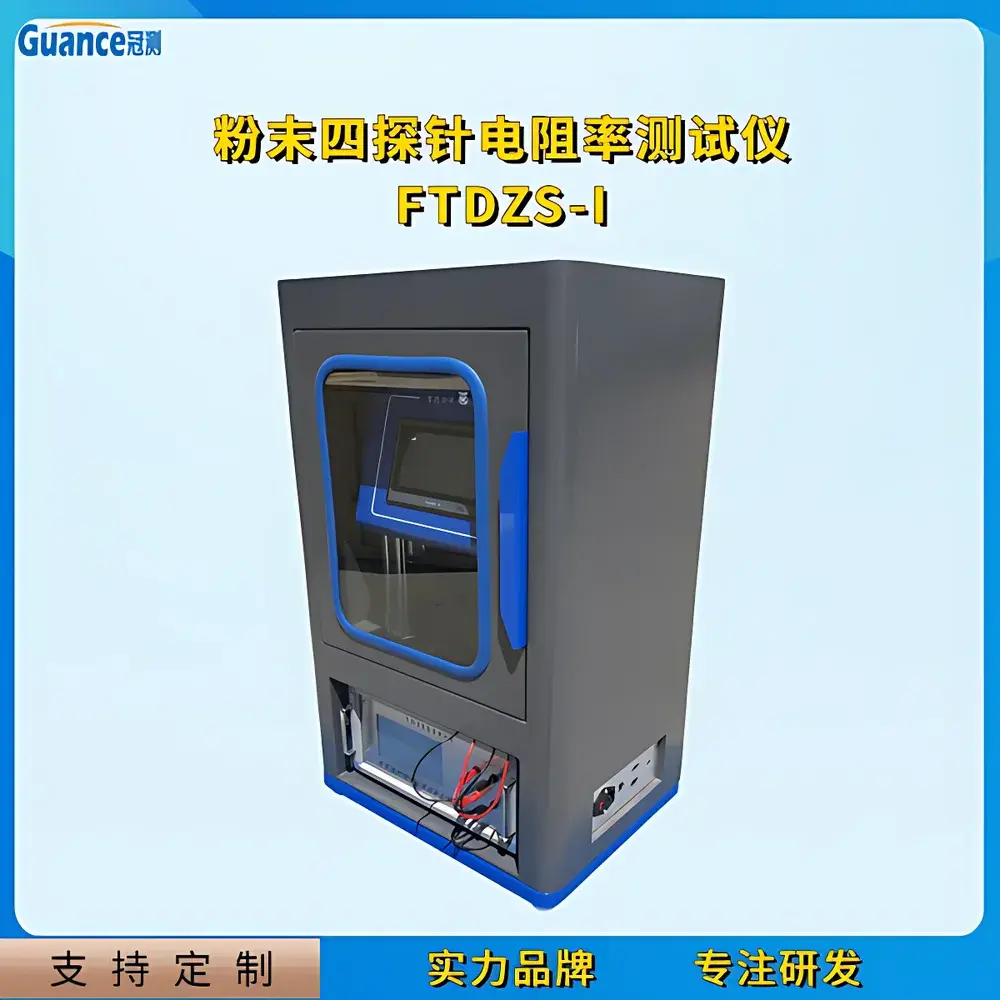
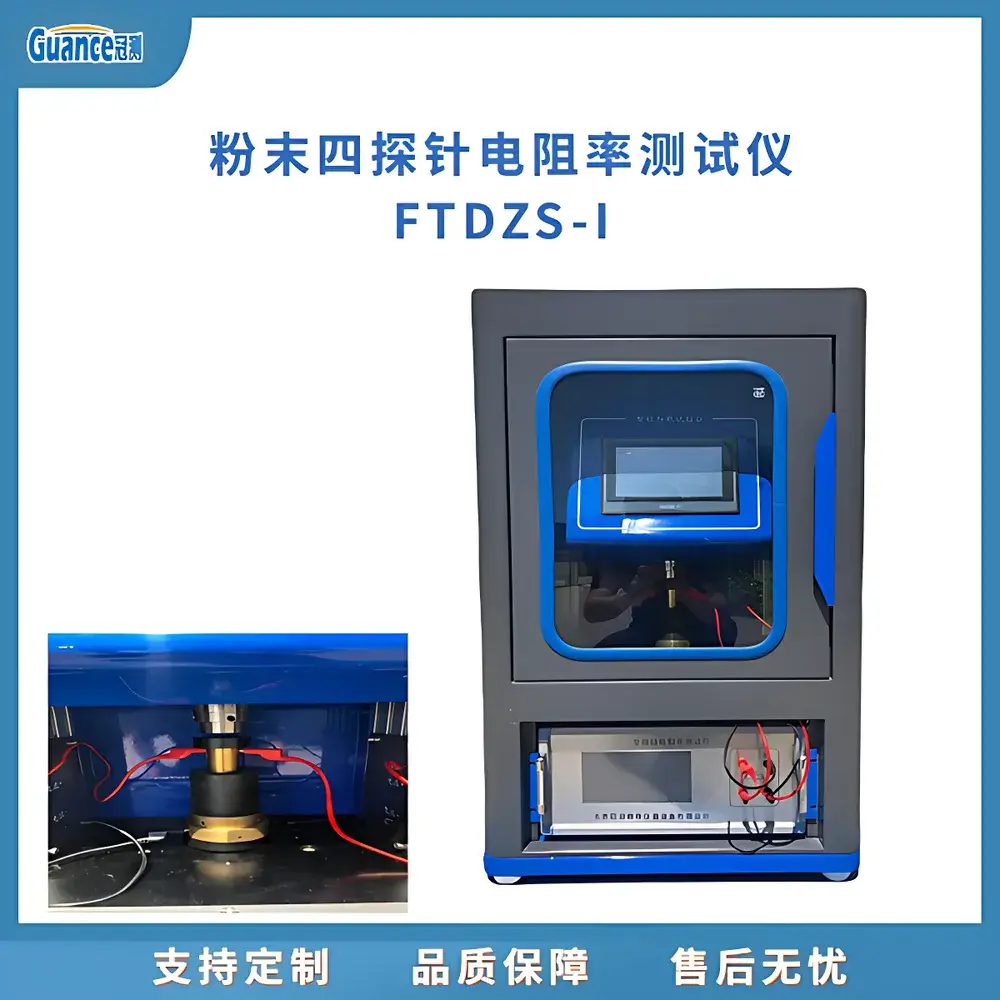
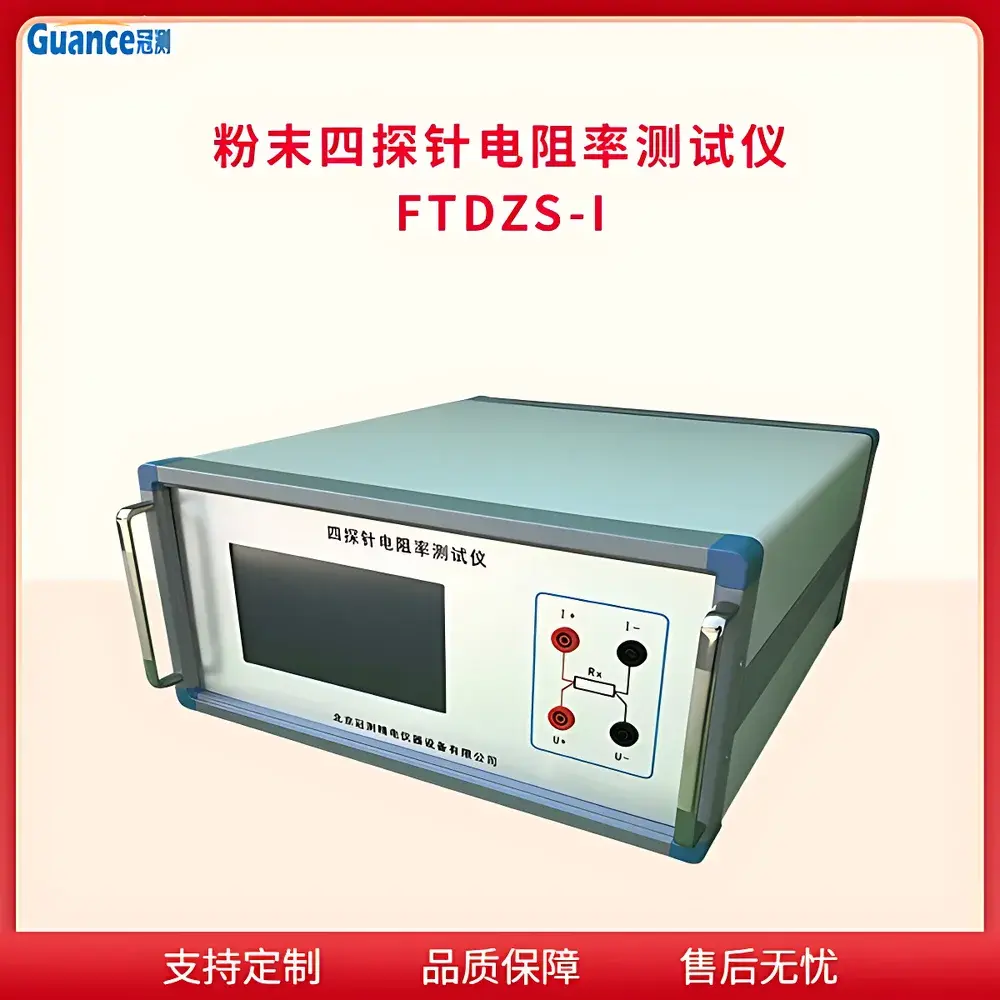
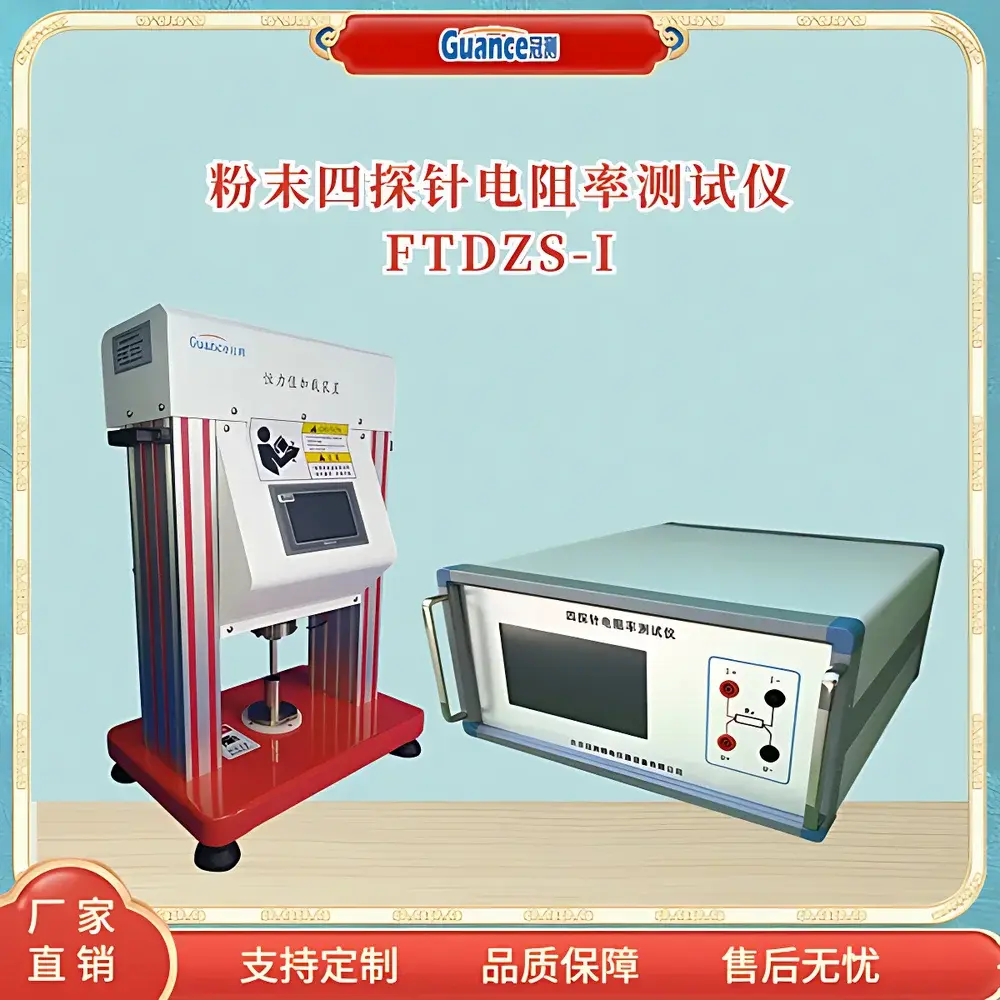
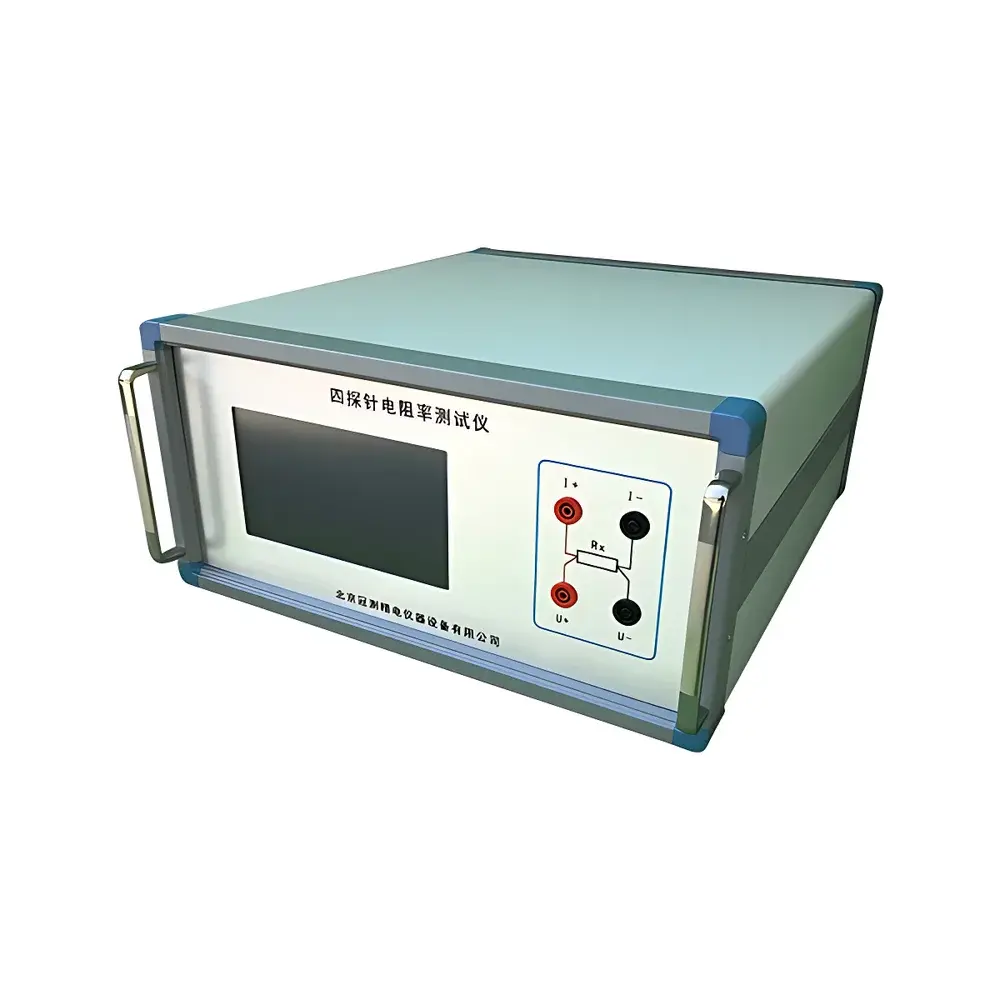
GuanCe FTDZS-I Four-Point Probe Powder Resistivity Tester
| Brand | GuanCe |
|---|---|
| Origin | Beijing, China |
| Manufacturer Type | Authorized Distributor |
| Regional Classification | Domestic (China) |
| Model | FTDZS-I |
| Price | USD 2,150 (FOB Beijing) |
Overview
The GuanCe FTDZS-I Four-Point Probe Powder Resistivity Tester is a dedicated instrumentation system engineered for the precise determination of volume resistivity in granular and powdered materials under controlled compaction conditions. Unlike bulk solid or thin-film measurements, powder resistivity is highly sensitive to particle packing density, interparticle contact area, and surface oxide layers — variables that necessitate standardized mechanical consolidation prior to electrical characterization. This instrument implements the classical four-point probe (4PP) method in accordance with ASTM F1529–21 *Standard Test Method for Electrical Resistivity of Powder Metallurgy (P/M) Materials* and ISO 30401:2018 *Powder Metallurgy — Determination of Electrical Resistivity of Sintered Parts and Powders*. By decoupling current injection and voltage sensing electrodes, the 4PP configuration eliminates lead resistance and contact potential errors, enabling high-reproducibility measurements across resistivity ranges from 10−5 Ω·cm to 106 Ω·cm — suitable for conductive metals, semiconducting carbides, graphite-based composites, and battery electrode powders.
Key Features
- Integrated dual-module architecture: main console housing a precision DC constant-current source (0.1 µA–100 mA, programmable in 0.1 µA steps) and a 6½-digit DC nanovoltmeter (resolution: 10 nV, accuracy: ±0.005% of reading + 2 µV)
- Motorized, force-controlled powder compaction stage with calibrated load cell (range: 0–10 kN, resolution: 0.1 N), compliant with ASTM D7131–19 for powder densification protocols
- Touchscreen HMI (7-inch capacitive display) supporting intuitive test setup, real-time data visualization, and on-device calibration verification
- Modular probe assembly featuring tungsten-carbide tipped collinear four-point probes (spacing: 1.0 mm, tip diameter: 0.3 mm), replaceable and traceably certified per ISO/IEC 17025
- Robust aluminum alloy chassis with EMI-shielded enclosure, meeting IEC 61326-1:2023 for electromagnetic compatibility in laboratory environments
- USB and RS-232 interfaces for external control; optional Ethernet module available for LAN integration into centralized QA/QC networks
Sample Compatibility & Compliance
The FTDZS-I accommodates standard cylindrical die cavities (diameter: 12.7 mm or 25.4 mm; height up to 30 mm), compatible with ASTM B312–22 and GB/T 3048.2–2007 sample holders. It supports both loose-fill and vibration-compacted (per ISO 3953:1993) powder states, with programmable dwell time and pressure ramp profiles. The system complies with GLP documentation requirements through embedded audit trail logging (user ID, timestamp, parameter settings, raw voltage/current pairs). All electrical safety design conforms to IEC 61010-1:2010 Ed.3 for laboratory measurement equipment. Calibration certificates are issued traceable to NIM (National Institute of Metrology, China) standards.
Software & Data Management
The embedded firmware includes built-in calculation algorithms for volume resistivity ρ (Ω·cm) using the geometric correction factor K = 2πs (where s = probe spacing) and the measured resistance R (Ω), corrected for sample height h and cross-sectional area A: ρ = K × R × (h/A). Raw data export is supported in CSV format via USB flash drive. Optional PC software (Windows 10/11 compatible) provides advanced features including batch statistical analysis (mean, SD, CV%), trend charting over time, report generation per ISO/IEC 17025 Annex A.3, and digital signature-enabled PDF certification. Data integrity safeguards include write-protected storage, automatic backup on power loss, and configurable user access levels (Operator, Technician, Administrator).
Applications
- Quality control of anode/cathode active materials (e.g., LiCoO₂, graphite, silicon composites) in lithium-ion battery manufacturing
- Resistivity mapping of metal injection molding (MIM) feedstocks and sintered P/M parts pre-sintering
- R&D evaluation of conductive additives (carbon black, CNTs, graphene) dispersion homogeneity in polymer composites
- Process validation of thermal reduction treatments in tungsten carbide and molybdenum powder production
- Regulatory testing for USP “Electrical Conductivity of Pharmaceutical Excipients” where powder conductivity influences electrostatic handling risk assessment
FAQ
What compaction pressure range does the FTDZS-I support?
The system delivers adjustable axial loads from 0.1 kN to 10 kN, corresponding to pressures of 0.1–80 MPa for a 12.7-mm-diameter die cavity.
Is the instrument compliant with FDA 21 CFR Part 11 for electronic records?
Yes — optional software package includes Part 11-compliant audit trail, electronic signatures, and role-based access control.
Can the probe spacing be customized for non-standard powder geometries?
Probe assemblies are field-replaceable; custom spacings (0.5 mm, 2.0 mm, 5.0 mm) are available upon request with NIST-traceable calibration.
Does the system require external grounding or shielding?
No — integrated Faraday cage and low-noise analog front-end eliminate need for external shielded rooms; standard lab grounding suffices.
How often must the system be recalibrated?
Annual recalibration is recommended; internal self-diagnostic routines verify source stability and meter linearity before each test sequence.



