
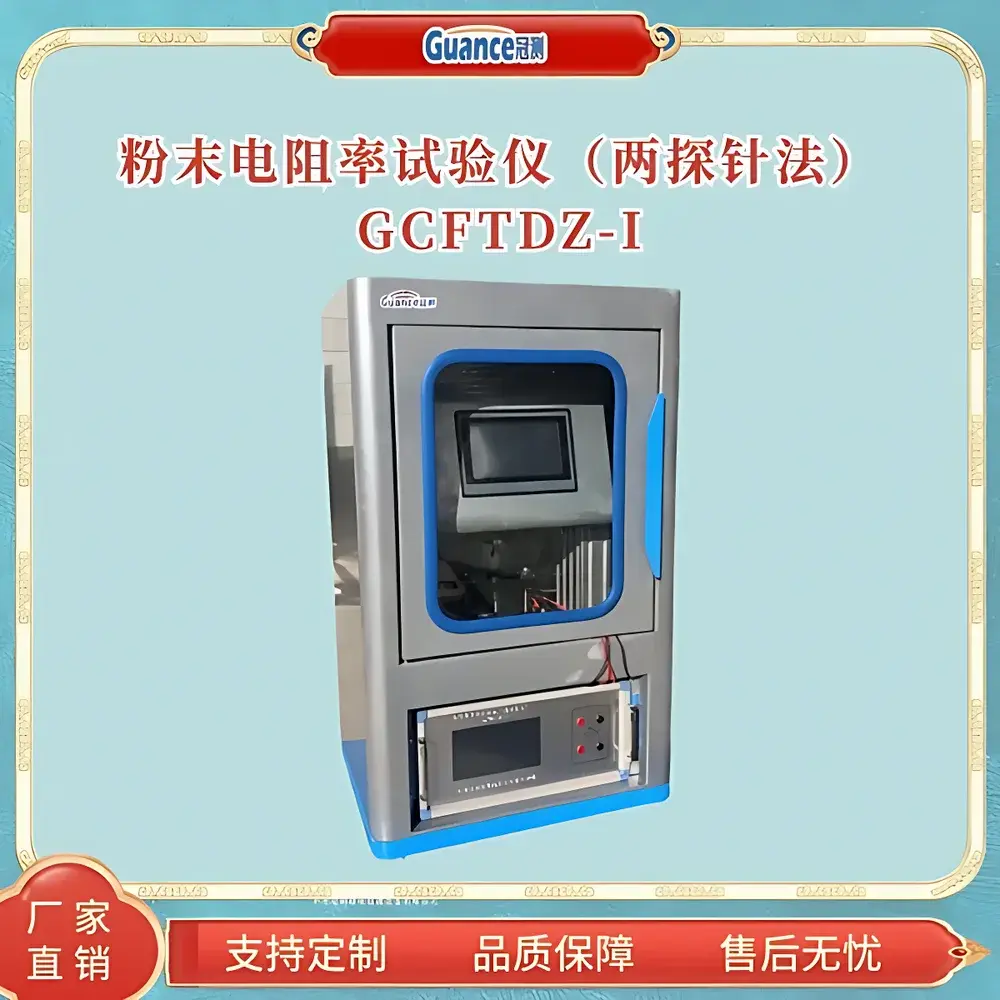
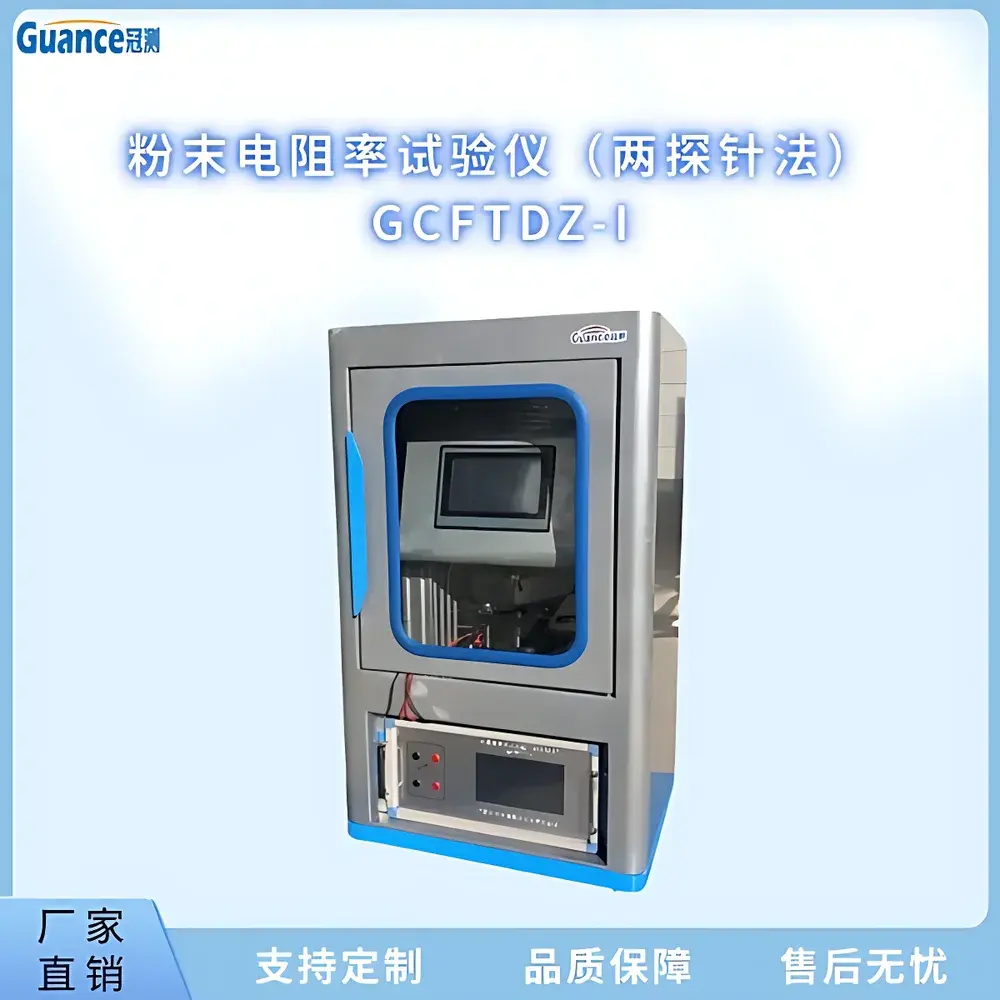
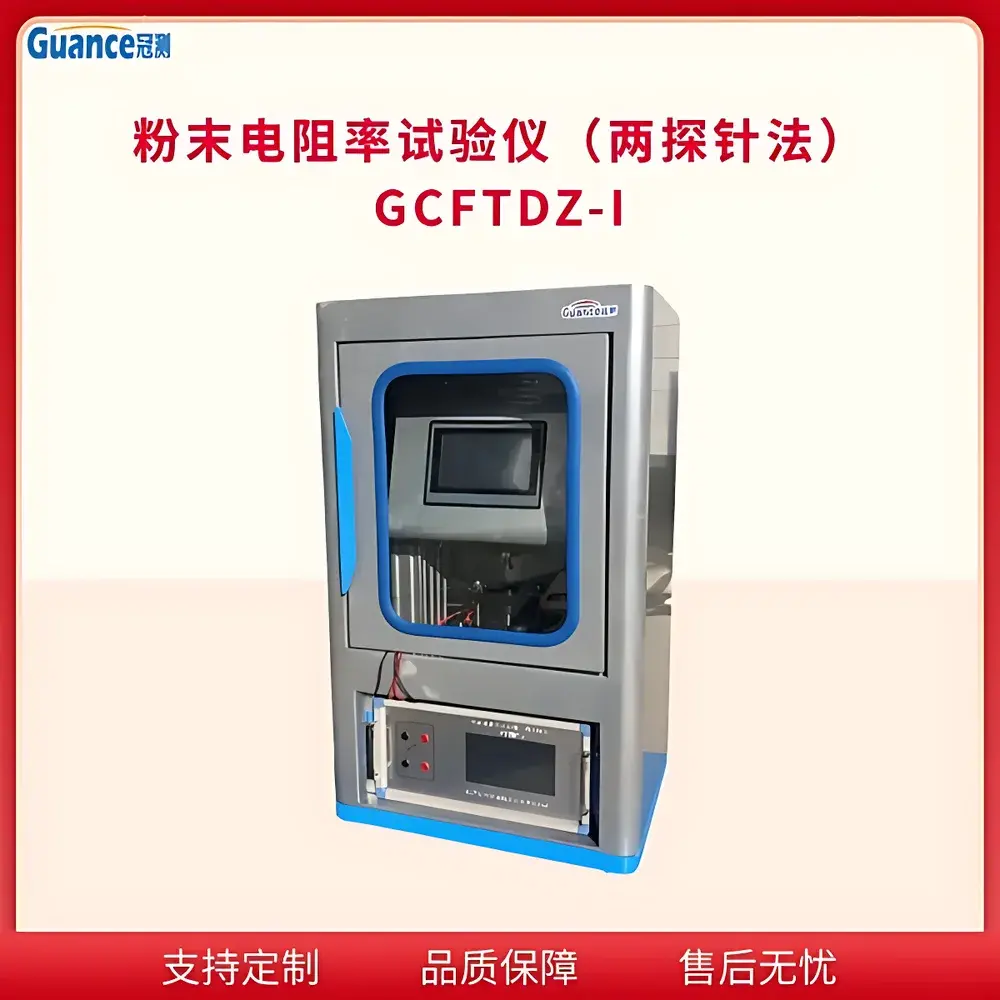
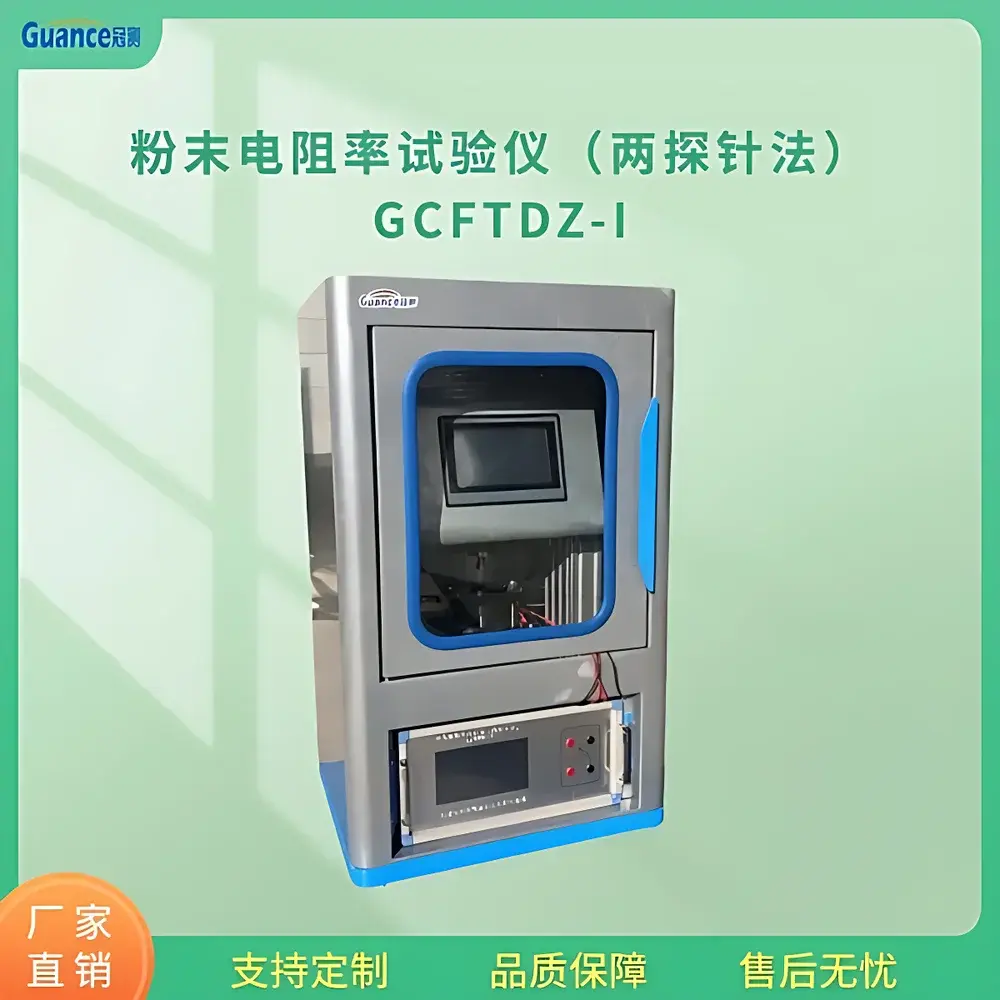
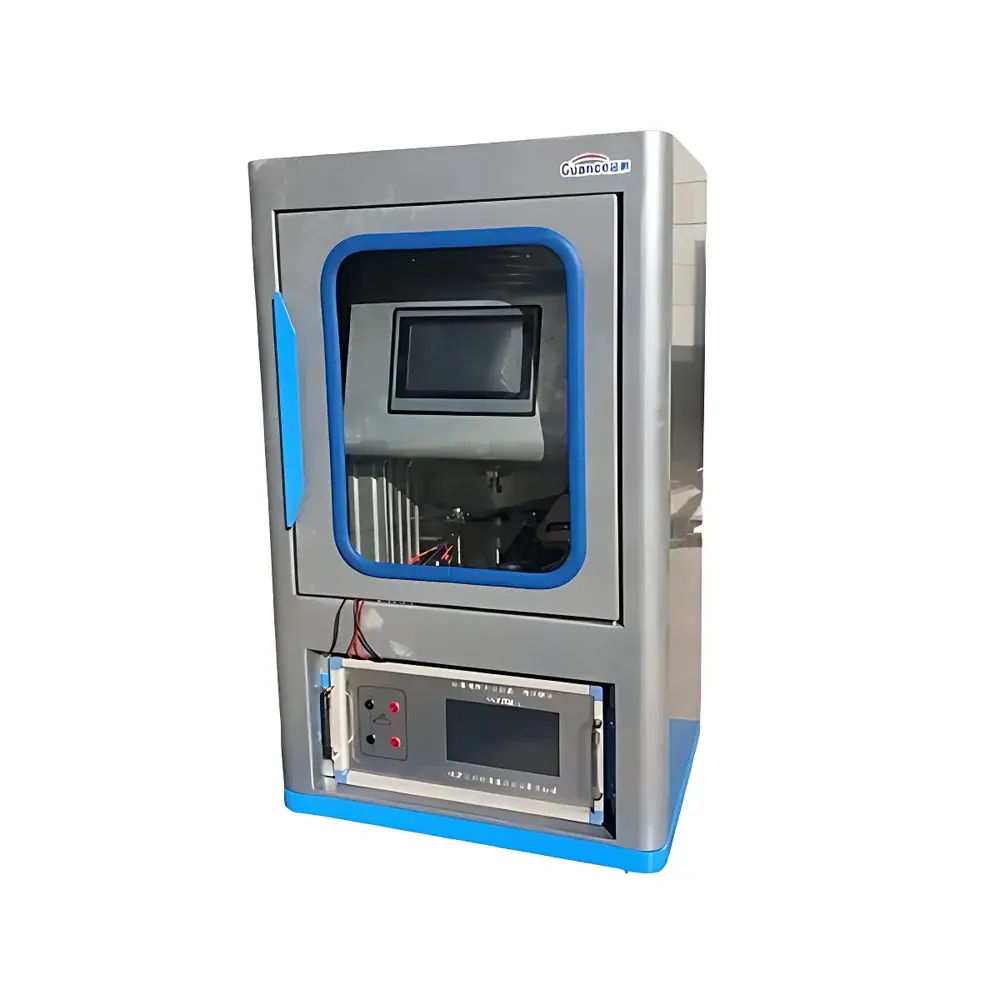
GuanCe GCFTDZ-I Powder Resistivity Tester for Calcined Anthracite (Two-Point Probe Method)
| Brand | GuanCe Instruments |
|---|---|
| Origin | Beijing, China |
| Manufacturer Type | Authorized Distributor |
| Country of Origin | China |
| Model | GCFTDZ-I |
| Price | USD 2,100 (FOB) |
| Load Capacity | 0–5 kN (max. 3.9 MPa) |
| Force Accuracy | ±0.5% FS |
| Electrode Diameters | φ16.0 mm & φ30.0 mm |
| Current Source Range | 10 μA to 10 A (8 ranges) |
| Resistance Measurement Range | 10⁻⁶ Ω to 10⁵ Ω |
| Resistance Resolution | 10⁻⁸ Ω |
| Resistance Accuracy | ±0.5% |
| Voltage Range | 2 mV–2 V (4 ranges) |
| Voltage Accuracy | ±0.1% |
| Height Resolution | ±1 μm |
| Power Supply | 220 V / 50 Hz |
| Power Consumption | 1 kW |
| Dimensions (L×W×H) | 550 × 450 × 960 mm |
| Weight | ~75 kg |
Overview
The GuanCe GCFTDZ-I Powder Resistivity Tester is an automated, PLC-controlled instrumentation system engineered for precise and standardized measurement of electrical resistivity in fine carbonaceous powders—specifically calcined anthracite, calcined petroleum coke, graphitized coke, needle coke, graphite, carbon black, and baked carbon fragments. It operates on the two-point probe (collinear electrode) principle in accordance with GB/T 24521–2018, “Method for Determination of Electrical Resistivity of Carbon Raw Materials and Coke.” The instrument applies controlled uniaxial compressive stress to a dried, sieved powder sample within a precision die cavity, then measures the resulting voltage drop across fixed electrodes under a programmable constant current. Resistivity (ρ, in Ω·m) is calculated using the geometric correction factor derived from compressed height, cross-sectional area, and measured resistance (R), following ρ = R × A / h, where A is electrode area and h is compacted thickness. This method ensures traceable, reproducible characterization of bulk electronic conduction behavior under industrially relevant densification conditions.
Key Features
- Integrated Siemens S7-1200 PLC control architecture with deterministic real-time response and industrial-grade reliability.
- 10-inch high-resolution capacitive touch HMI interface supporting multilingual UI, parameter configuration, live data visualization, and embedded test report generation.
- Dual-electrode compatibility: interchangeable φ16.0 mm (optimized for 0.315–0.5 mm particle size) and φ30.0 mm (for 0.5–1.0 mm fractions) stainless-steel probes with precision-machined parallel surfaces.
- Servo-driven electromechanical loading system delivering smooth, noiseless, repeatable force application from 0 to 5 kN; pressure/pressure rate fully programmable with ramp-hold profiles.
- Seven operational modes: constant-force, constant-pressure, stepped-force, stepped-pressure, compression-ratio (displacement-based), auto-zero calibration, and full-cycle recovery.
- Simultaneous real-time display of 9 parameters: applied force (kN), nominal pressure (MPa), compacted height (mm), apparent density (g/cm³), source current (A), measured voltage (V), resistance (Ω), resistivity (Ω·m or μΩ·cm), and conductivity (S/m or % IACS).
- Onboard thermal-printer for immediate hardcopy output of single-test reports including timestamp, operator ID, sample ID, and all raw + derived values.
- USB-host port for exporting CSV-formatted datasets (including gradient sequences) to external storage; compatible with laboratory LIMS integration via serial or Ethernet (optional module).
Sample Compatibility & Compliance
The GCFTDZ-I is validated for use with carbonaceous materials conforming to ISO 8506, ASTM D3417, and GB/T 24521–2018 specifications. Sample preparation requires drying at 105 °C ± 2 °C for 2 h and subsequent sieving to defined granulometric bands prior to loading into the cylindrical die. The system supports compliance workflows for quality control laboratories operating under GLP or internal QA protocols. While not certified to FDA 21 CFR Part 11 out-of-the-box, audit trails—including user logins, parameter changes, test initiation timestamps, and final result exports—are fully recorded and exportable for regulatory review. All mechanical and electrical subsystems meet CE safety directives (2014/30/EU EMC, 2014/35/EU LVD) and RoHS 2011/65/EU material restrictions.
Software & Data Management
Firmware v3.2+ enables remote OTA updates via Ethernet or USB. The embedded OS maintains a non-volatile test history buffer (≥10,000 entries) with time-stamped metadata. Gradient-mode tests generate hierarchical datasets: each pressure/pressure-step includes averaged resistance, standard deviation (n ≥ 3), Δρ between consecutive steps, and %Δρ relative to baseline. Exported CSV files contain column headers compliant with ASTM E1301 conventions for statistical analysis. Optional PC software (GCDataPro v2.1) provides curve-fitting (e.g., log ρ vs. log P), comparative trend analysis across batches, and PDF report templating aligned with internal SOPs.
Applications
- QC screening of calcined anthracite feedstock for aluminum smelting anode production.
- Batch-to-batch consistency verification of graphitized coke used in lithium-ion battery anode precursors.
- R&D evaluation of compaction-induced percolation thresholds in conductive carbon-black composites.
- Correlation studies between green density, sintering shrinkage, and cold resistivity in carbon electrode manufacturing.
- Validation of raw material substitution strategies (e.g., needle coke vs. petroleum coke blends) under identical densification protocols.
- Teaching laboratories demonstrating solid-state charge transport mechanisms in disordered carbon networks.
FAQ
What standards does the GCFTDZ-I comply with?
It implements GB/T 24521–2018 as its primary reference; its mechanical and electrical performance aligns with ISO 16282-1 (powder compaction testing) and ASTM D3417 (electrical resistance of carbon blacks).
Can the instrument measure anisotropic resistivity?
No—it uses axial two-probe geometry and assumes isotropic bulk conduction; for directional measurements, four-point probe or van der Pauw configurations are required.
Is calibration traceable to national standards?
Force transducers are factory-calibrated against NIM (National Institute of Metrology, China)-certified deadweight standards; resistance electronics are verified using Fluke 752A-derived shunts traceable to NIST SRM 1971.
What maintenance is required?
Biannual inspection of electrode surface flatness (optical flat check), lubrication of lead screws, and verification of zero-force drift; no consumables beyond standard printer paper.
Does it support custom test protocols beyond the seven built-in modes?
Yes—advanced users may define custom load–hold–unload profiles via ASCII command scripting over RS-232 or Modbus TCP, subject to firmware license activation.



