
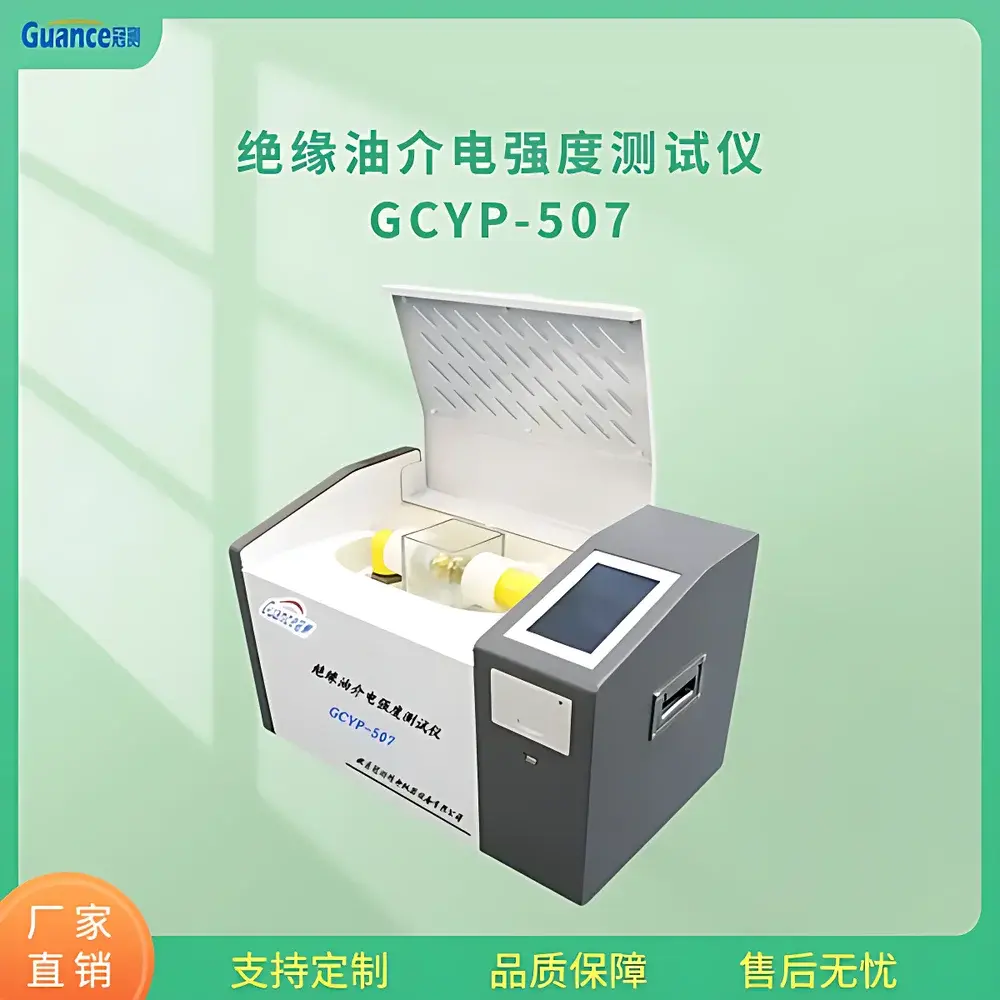
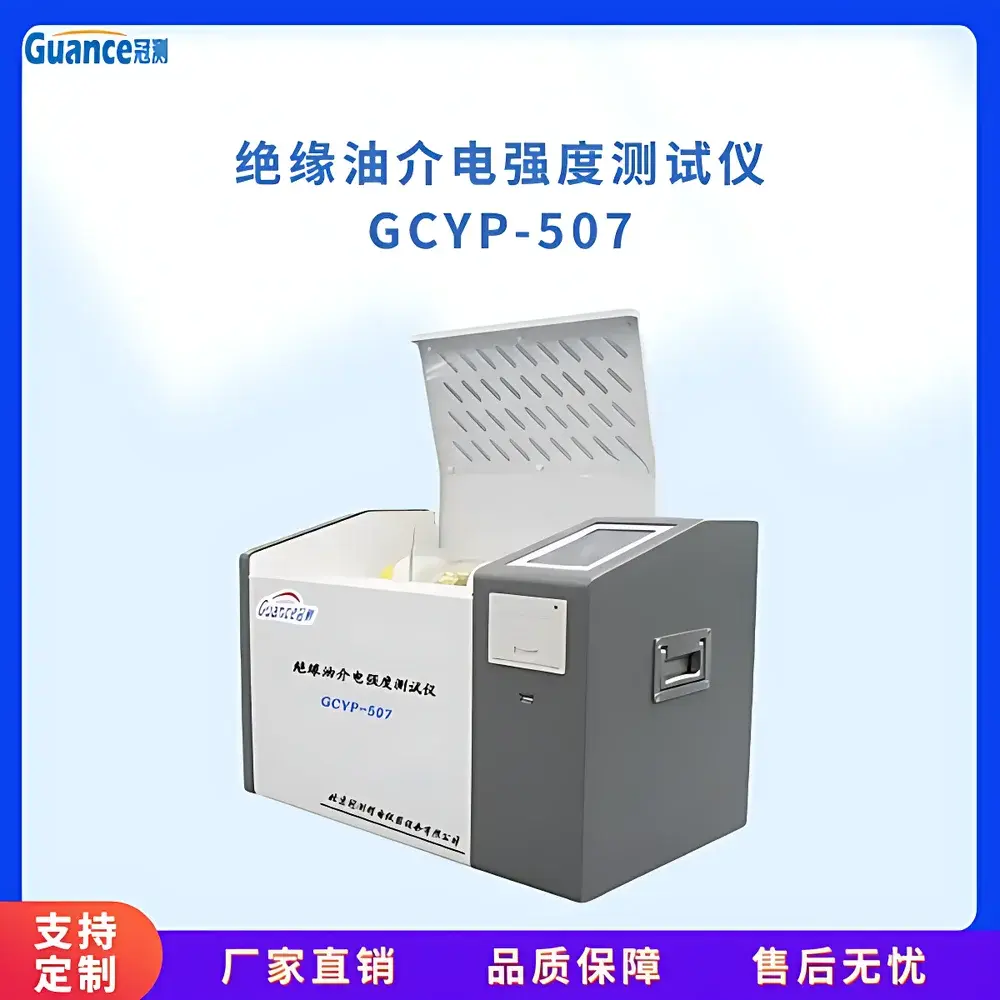
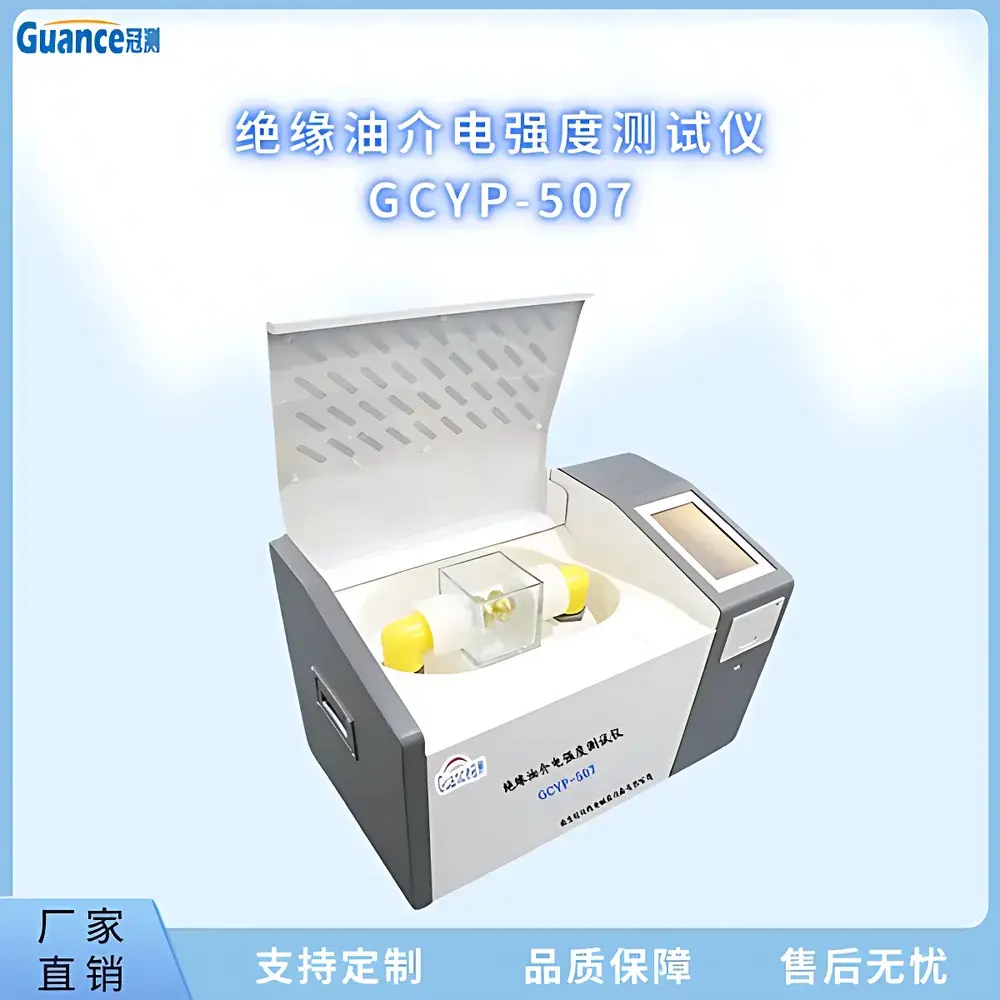
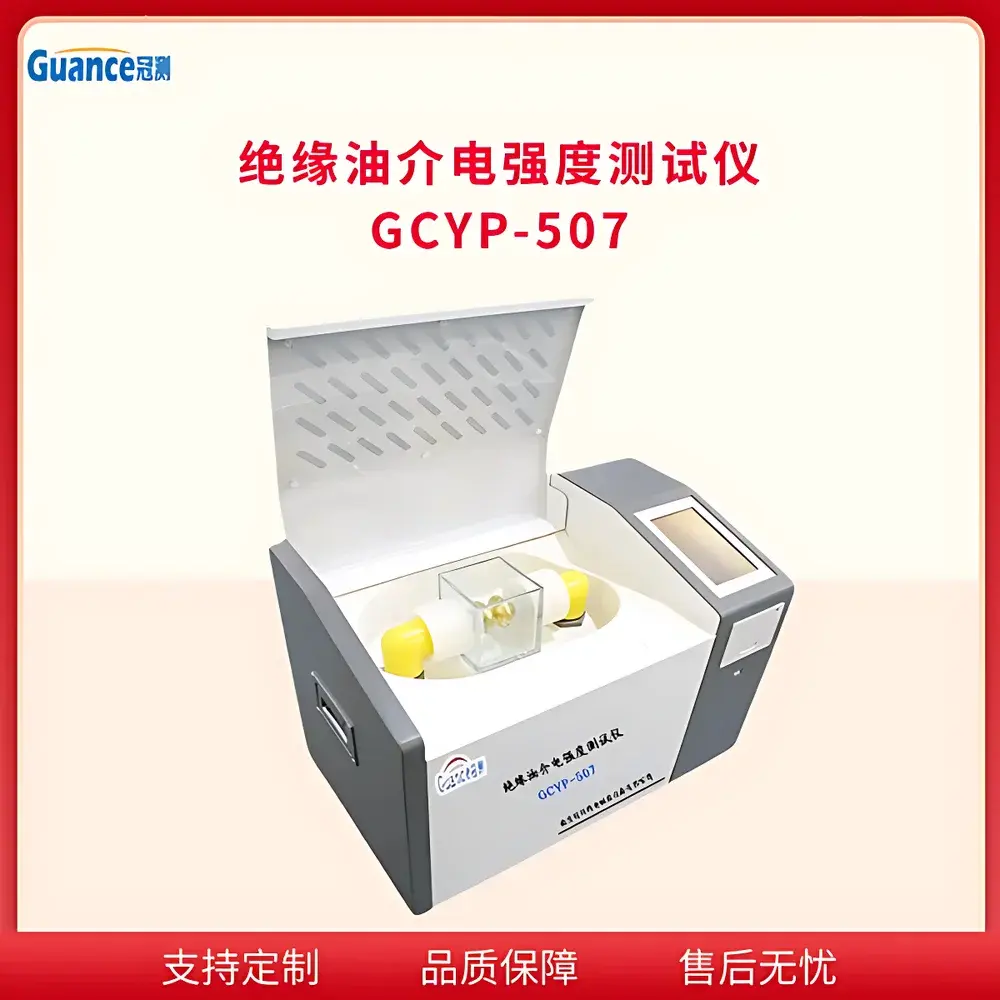
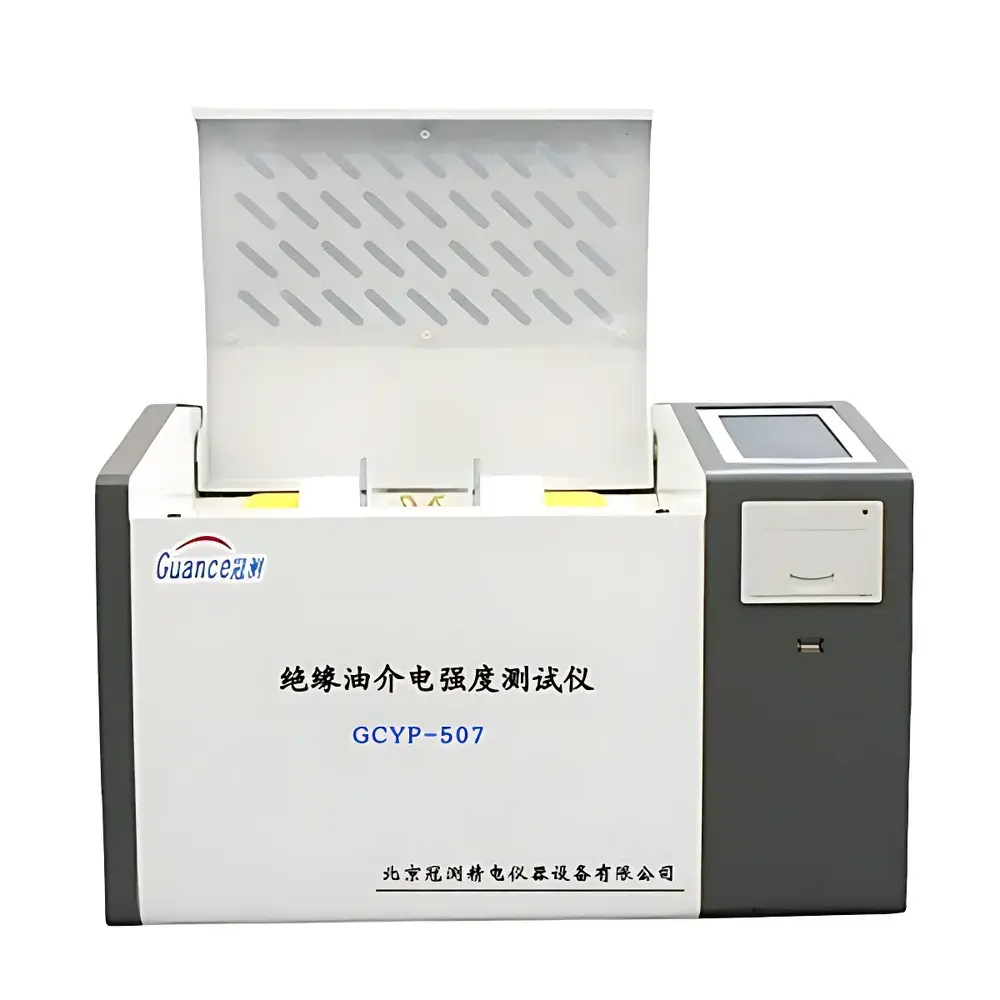
GuanCe GCYP-507.3 Insulating Oil Dielectric Strength Tester
| Brand | GuanCe Instruments |
|---|---|
| Origin | Beijing, China |
| Manufacturer Type | Authorized Distributor |
| Country of Origin | China |
| Model | GCYP-507.3 |
| Breakdown Voltage Range | 0–100 kV |
| Compliance Standards | GB/T 507–1986, GB/T 507–2002, DL 429.9, IEC 60156 |
| Communication Interface | RS-232 |
| Display | Dual-language (English/Chinese) LCD with real-time temperature & humidity monitoring |
| Optional Feature | Infrared oil temperature measurement module |
| Safety Protection | Overcurrent, overvoltage, short-circuit, and watchdog circuit protection |
| Dielectric Fluid Compatibility | Mineral insulating oils, silicone oils, and synthetic ester-based transformer oils |
Overview
The GuanCe GCYP-507.3 Insulating Oil Dielectric Strength Tester is a fully digital, microprocessor-controlled instrument engineered for precise determination of the dielectric breakdown voltage (BDV) of liquid insulating media used in high-voltage power equipment—primarily transformer oils, but also applicable to switchgear oils, capacitor fluids, and other non-aqueous dielectric liquids. Operating on the principle of stepwise voltage ramping under standardized electrode geometry (typically spherical or disk-type electrodes per IEC 60156), the instrument applies an AC voltage (50/60 Hz) across a defined oil gap until electrical breakdown occurs. The measured BDV serves as a critical indicator of contamination—such as moisture, particulate matter, or oxidation byproducts—that compromise insulation integrity and increase risk of catastrophic failure in energized assets. Designed for laboratory, substation maintenance, and third-party calibration environments, the GCYP-507.3 delivers repeatable, traceable results aligned with international test protocols and supports routine quality assurance in accordance with IEEE C57.106 and CIGRE technical guidelines.
Key Features
- Full digital control architecture using a high-reliability MCU with integrated watchdog timer—eliminates firmware lockup and ensures uninterrupted test sequences.
- Dual-language (English/Chinese) graphical LCD interface with real-time ambient temperature and relative humidity display—enables environmental correlation during BDV interpretation per ASTM D877 and IEC 60156 Annex A.
- High-fidelity high-voltage sampling at the electrode terminal—direct analog-to-digital conversion minimizes signal degradation and eliminates cumulative error from analog conditioning stages.
- Multi-standard test program library preloaded with GB/T 507–1986, GB/T 507–2002, DL 429.9, IEC 60156, and user-definable custom ramp profiles—including variable rise rate, hold time, and number of breakdown cycles per sample.
- Chemically inert oil cup fabricated from borosilicate glass and PTFE-lined stainless steel components—resists acid formation, prevents leaching, and maintains dimensional stability under repeated thermal cycling.
- Comprehensive hardware safety suite: electronic overvoltage cutoff (±5% setpoint tolerance), current-limiting circuitry (<5 mA trip threshold), automatic arc quenching, and galvanic isolation between HV stage and control logic.
- RS-232 serial interface compliant with EIA/TIA-232-F specifications—supports bidirectional communication with LIMS, SCADA, or custom QA databases for automated report generation and audit trail compliance.
Sample Compatibility & Compliance
The GCYP-507.3 is validated for use with mineral-based, silicone-based, and synthetic ester insulating oils meeting ASTM D3487, IEC 60296, and GB 2536 specifications. It accommodates standard 40 mL sample volumes in accordance with IEC 60156 requirements and supports manual or semi-automated oil handling workflows. All test procedures conform to metrological traceability frameworks outlined in ISO/IEC 17025:2017. The instrument’s firmware architecture enables full GLP/GMP-aligned operation—including operator ID logging, test parameter versioning, and timestamped result storage—facilitating FDA 21 CFR Part 11 readiness when paired with validated software clients.
Software & Data Management
While the GCYP-507.3 operates autonomously via front-panel controls, its RS-232 port enables integration with PC-based data acquisition tools supporting ASCII or Modbus RTU protocols. Raw output includes breakdown voltage (kV), test sequence ID, ambient conditions, pass/fail status per standard-defined criteria, and statistical summaries (mean, standard deviation, min/max across up to six consecutive tests). Exported datasets are compatible with Excel, MATLAB, and industry-standard PQM platforms. Audit logs retain all configuration changes, calibration events, and user actions—supporting internal quality audits and external accreditation reviews without modification to embedded firmware.
Applications
- Routine acceptance testing of new transformer oil prior to commissioning (per IEEE C57.106 Clause 6.2).
- Condition monitoring of in-service oils during scheduled maintenance intervals (e.g., annual BDV screening per IEC 60422).
- Failure root-cause analysis following thermal or electrical faults—correlating BDV trends with dissolved gas analysis (DGA) and furanic compound measurements.
- Quality control verification for oil reclamation and regeneration services—validating post-treatment dielectric performance restoration.
- Educational laboratories teaching high-voltage engineering principles and insulation diagnostics methodology.
FAQ
What standards does the GCYP-507.3 support out-of-the-box?
GB/T 507–1986, GB/T 507–2002, DL 429.9, and IEC 60156—with configurable ramp rates, dwell times, and pass/fail thresholds.
Is the oil cup included with the instrument calibrated and certified?
Yes—the electrode assembly is factory-calibrated to ±0.1 mm gap tolerance and supplied with a certificate of conformance referencing ISO 17025-accredited reference measurements.
Can the instrument be integrated into a networked QA system?
Via RS-232, it supports direct connection to local PCs or industrial gateways; Ethernet or Wi-Fi modules are available as optional accessories upon request.
Does the GCYP-507.3 meet electromagnetic compatibility (EMC) requirements for substation environments?
It complies with IEC 61000-4-2 (ESD), -4-3 (radiated RF), and -4-4 (electrical fast transients) up to Level 3, verified per EN 61326-1:2013.
How frequently should the instrument undergo metrological verification?
Annual verification against NIST-traceable high-voltage dividers is recommended; internal self-diagnostic routines execute at power-on and before each test sequence.



