
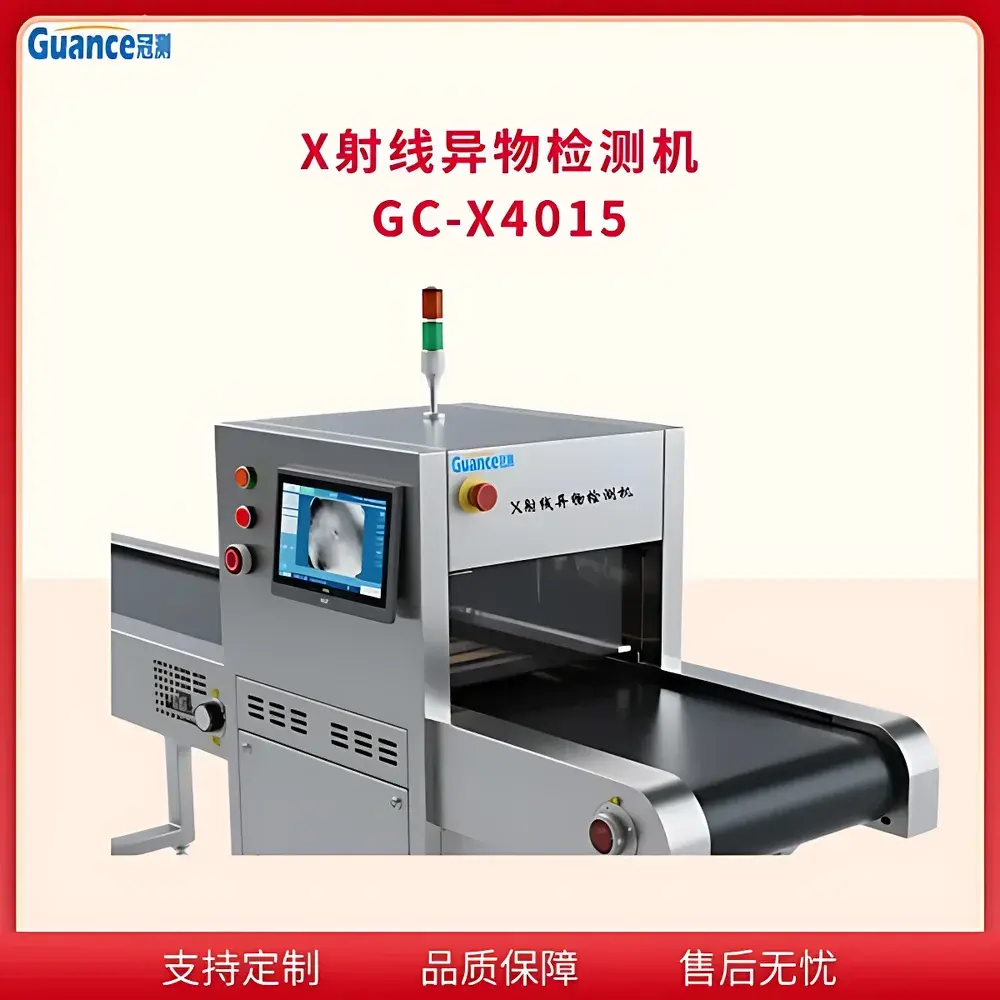

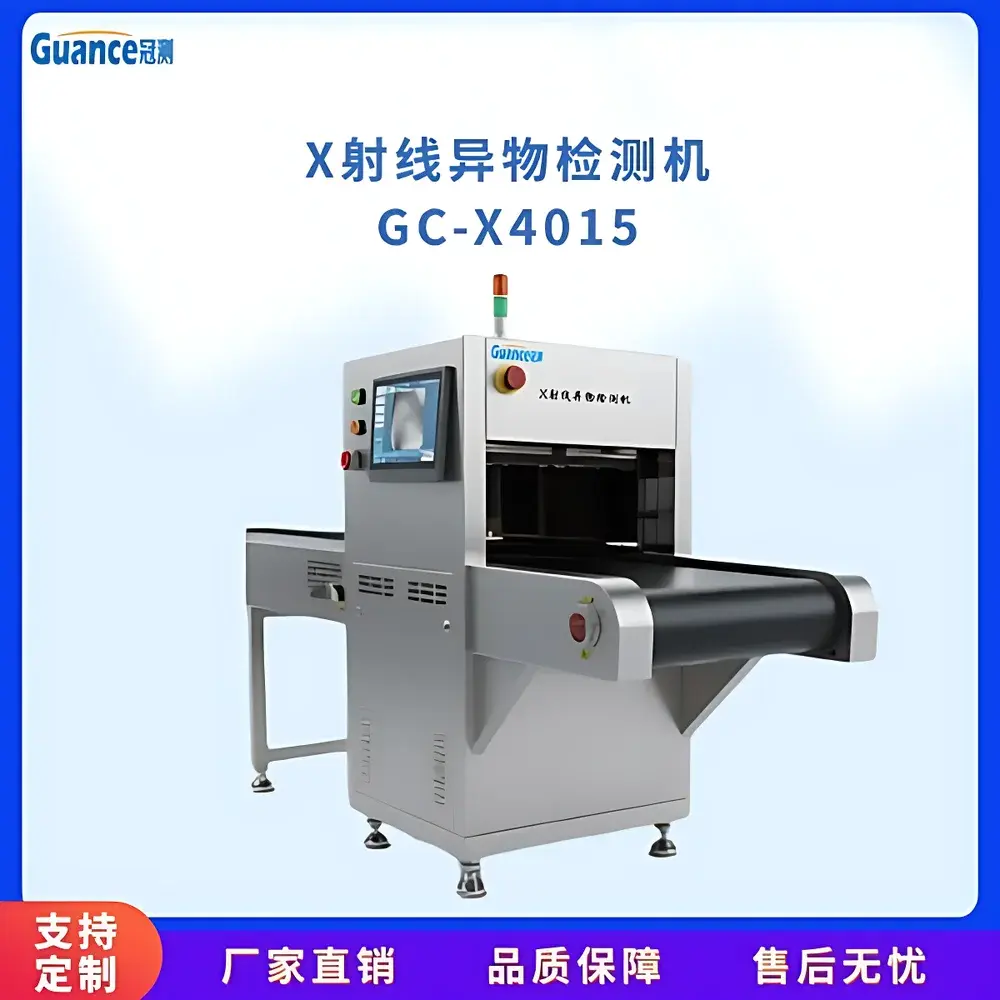
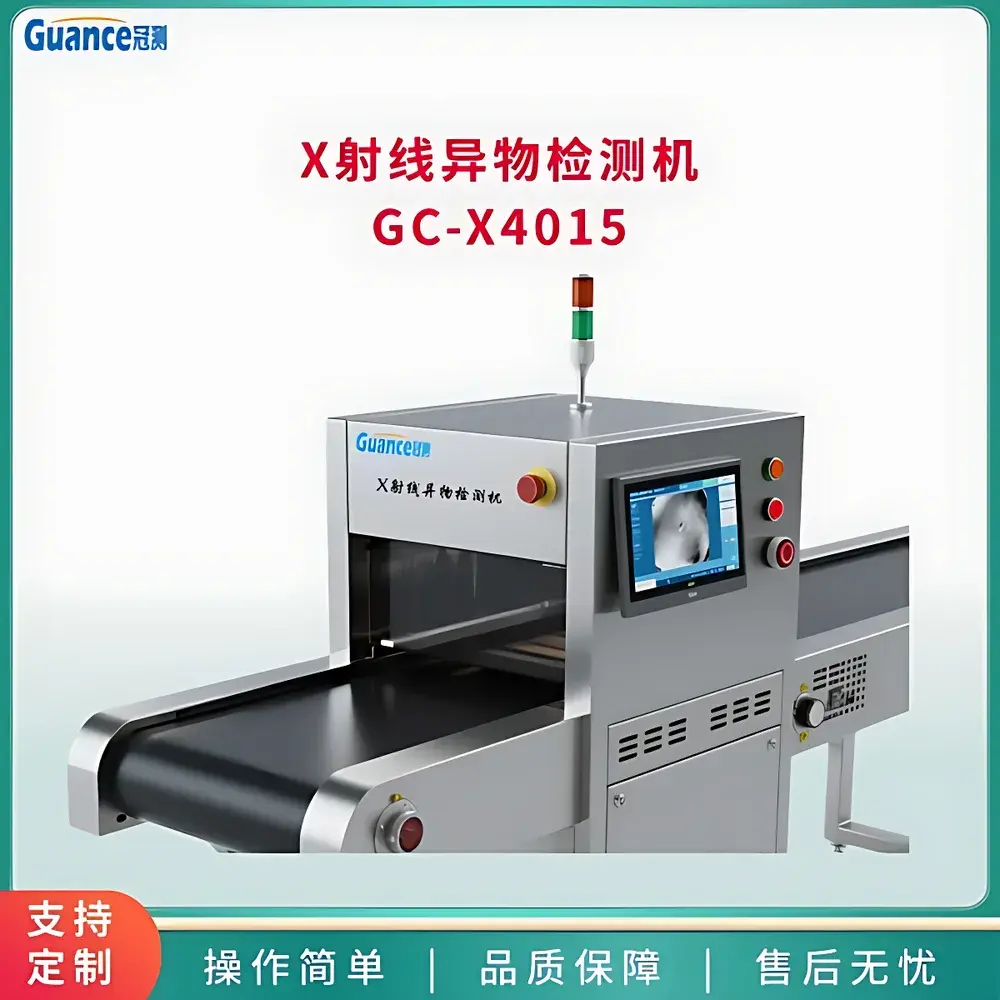
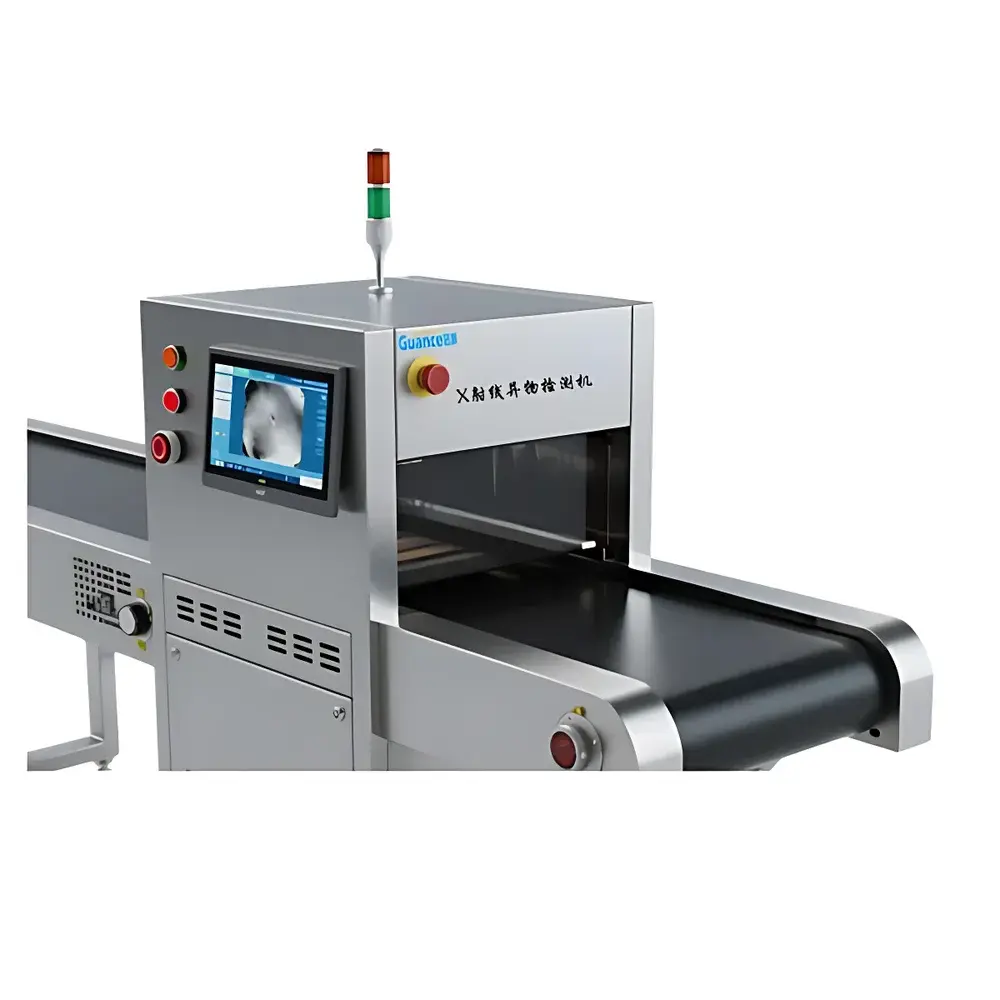
GuanCe Instruments GC-X4015 X-ray Metal Detection System
| Brand | GuanCe Instruments |
|---|---|
| Origin | Beijing, China |
| Manufacturer Type | Authorized Distributor |
| Regional Classification | Domestic (China) |
| Model | GC-X4015 |
| Power Supply | AC 220 V, 50–60 Hz |
| Automation Level | Fully Automatic |
| Detection Channel Height | 100 mm |
| Effective Detection Width | 400 mm |
| X-ray Leakage Rate | <1 µSv/h (compliant with FDA 21 CFR Subchapter J & EU CE Directive 2013/53/EU) |
| Minimum Detectable Stainless Steel Sphere | Ø0.3 mm |
| Minimum Detectable Stainless Steel Wire | 0.2 mm × 2 mm |
| Minimum Detectable Ceramic/Glass Sphere | Ø1.0 mm |
Overview
The GuanCe Instruments GC-X4015 X-ray Metal Detection System is a fully automated, industrial-grade non-destructive testing (NDT) platform engineered for high-reliability foreign object detection (FOD) in food, pharmaceutical, chemical, and consumer goods manufacturing environments. It operates on the principle of differential X-ray attenuation: a low-energy X-ray source (typically 60–90 kVp, fixed anode) emits a collimated beam through the product stream; transmitted radiation is captured by a high-resolution line-scan or area-array detector (e.g., amorphous silicon flat-panel or scintillator-coupled CMOS sensor). Variations in linear attenuation coefficients (µ) across materials—driven by atomic number (Z), density (ρ), and thickness—generate contrast in the resulting grayscale radiographic image. This enables quantitative discrimination between base product matrix (e.g., meat, cheese, powder, gel) and contaminants such as ferrous/non-ferrous metals, stainless steel, glass shards, calcified bone, ceramic fragments, stones, and dense plastics—without physical contact or sample preparation.
Key Features
- Fully automatic operation with integrated conveyor synchronization and real-time rejection interface for seamless inline integration into production lines up to 1.2 m/s belt speed.
- 15-inch industrial-grade capacitive touch display with intuitive GUI; embedded self-learning algorithm adapts contrast, thresholding, and ROI masking without manual parameter tuning.
- Dynamic region-of-interest (ROI) masking: users can define exclusion zones (e.g., metal end caps on sausages, aluminum seals on pouches) to suppress false positives while maintaining full sensitivity elsewhere.
- Comprehensive hardware and software safety architecture: interlocked cabinet doors, dual-channel radiation monitoring, automatic beam shutdown upon door opening or motion detection, and redundant emergency stop circuitry compliant with IEC 61508 SIL2 and EN 62471.
- Low-dose X-ray generator (<1 µSv/h at 5 cm from housing) certified to FDA 21 CFR Part 1020.40 (Radiation Safety Standards for X-ray Equipment) and EU CE marking under Directive 2013/53/EU (Machinery Directive) and 2013/35/EU (EMF Directive).
- Automated image archiving: all inspection frames and rejection logs are timestamped, stored locally (SSD) with optional network backup, supporting traceability per ISO 22000 and FSMA §117.320 requirements.
Sample Compatibility & Compliance
The GC-X4015 accommodates diverse product forms—including bulk solids, viscous pastes, sealed pouches (aluminum-laminated, PET/PE), glass jars, tinplate cans, and thermoformed trays—regardless of color, opacity, or packaging density. Its penetration capability supports inspection of products up to 150 mm thick (depending on material Z-eff), making it suitable for high-density items such as frozen meals, pet food, and nut-based snacks. The system meets critical regulatory benchmarks: validation protocols align with ASTM F2823–21 (Standard Guide for X-ray Inspection of Food Products), ISO/IEC 17025:2017 (for accredited lab use), and supports 21 CFR Part 11-compliant electronic records when deployed with audit-trail-enabled software modules. All mechanical and electrical design adheres to GLP/GMP-aligned installation qualification (IQ) and operational qualification (OQ) documentation frameworks.
Software & Data Management
Embedded firmware runs on a real-time Linux OS with deterministic image acquisition timing. Detection logic employs multi-threshold adaptive segmentation, edge-enhanced feature extraction, and morphological filtering to distinguish sub-pixel anomalies from texture noise. Software includes configurable pass/fail criteria per product SKU, batch-level statistical process control (SPC) reporting (e.g., defect rate trends, sensitivity drift alerts), and export of DICOM-compliant radiographs for third-party review. Data integrity safeguards include write-once storage mode, SHA-256 hash logging, and role-based user access (admin/operator/maintenance tiers). Optional OPC UA server enables MES/SCADA integration for centralized KPI dashboards and predictive maintenance scheduling.
Applications
- Food processing: detection of metal fragments, bone chips, glass splinters, and stones in ready-to-eat meals, dairy products, baked goods, confectionery, and seafood.
- Pharmaceutical solid dosage: verification of tablet/capsule integrity, identification of metallic tooling residues or desiccant fragments in blister packs.
- Consumer electronics assembly: screening of solder paste voids, component misalignment, or foreign debris inside sealed enclosures prior to final packaging.
- Chemical and agrochemical manufacturing: confirmation of absence of catalyst residues, grinding media wear particles, or packaging contaminants in granular or powdered formulations.
- Recycled material sorting: preliminary screening of mixed plastic streams for embedded ferrous/non-ferrous contaminants prior to extrusion.
FAQ
What safety certifications does the GC-X4015 hold?
The system complies with FDA 21 CFR Part 1020.40, EU CE directives 2013/53/EU (Machinery) and 2013/35/EU (EMF), and carries IEC 61000-6-2/6-4 electromagnetic compatibility certification.
Can the GC-X4015 detect non-metallic contaminants?
Yes—it reliably identifies high-Z non-metals including glass (SiO₂), ceramic (Al₂O₃), stone (CaCO₃/SiO₂), calcified bone, and dense rubber/plastic based on their X-ray attenuation signatures relative to the product matrix.
Is the system compatible with existing production line reject mechanisms?
It provides standard 24 V DC pulse outputs and Modbus TCP/IP communication for direct integration with pneumatic pushers, air jets, or robotic pick-and-place systems.
Does the software support audit trail and electronic signature functionality?
When configured with the optional GxP Module, it delivers full 21 CFR Part 11 compliance—including user authentication, change history, electronic signatures, and immutable log archiving.
What is the recommended maintenance interval?
Preventive maintenance is scheduled every 12 months or after 8,000 operating hours, including X-ray tube output calibration, detector gain normalization, and safety interlock verification per ISO 13485 Annex C protocols.



