
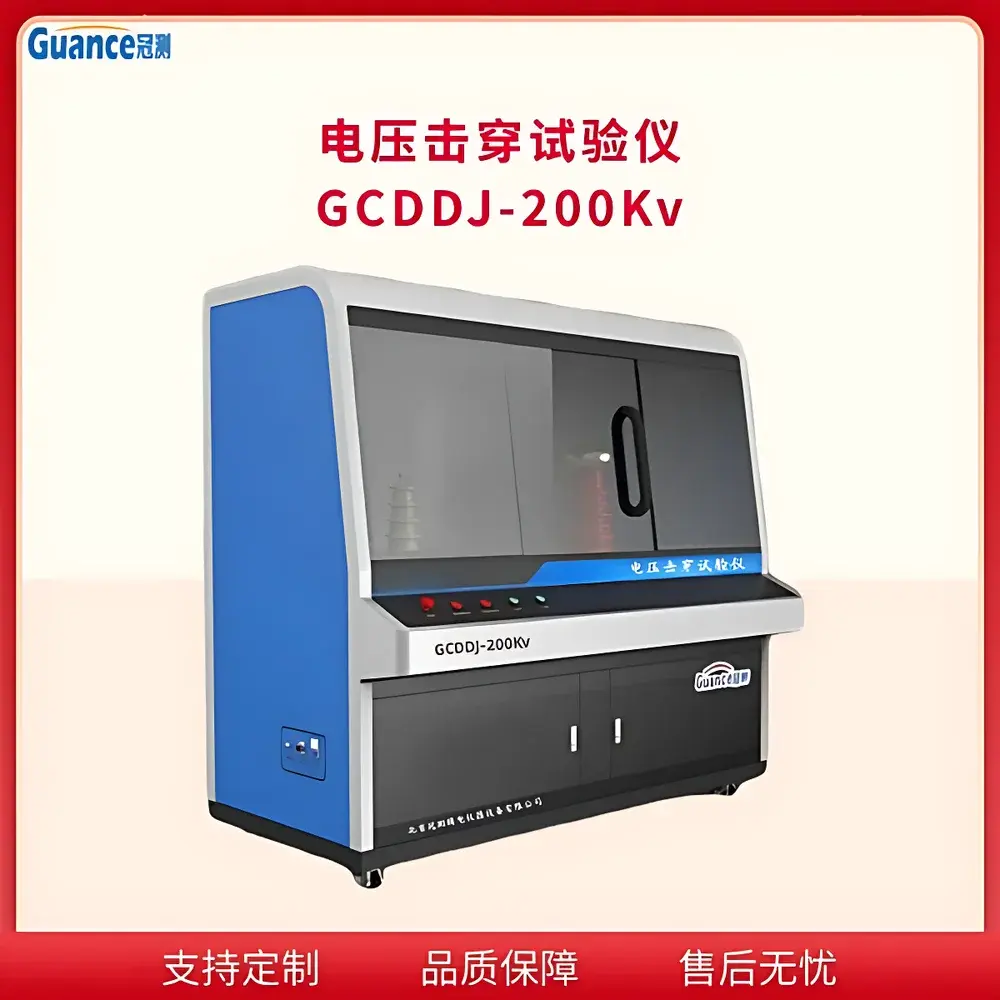
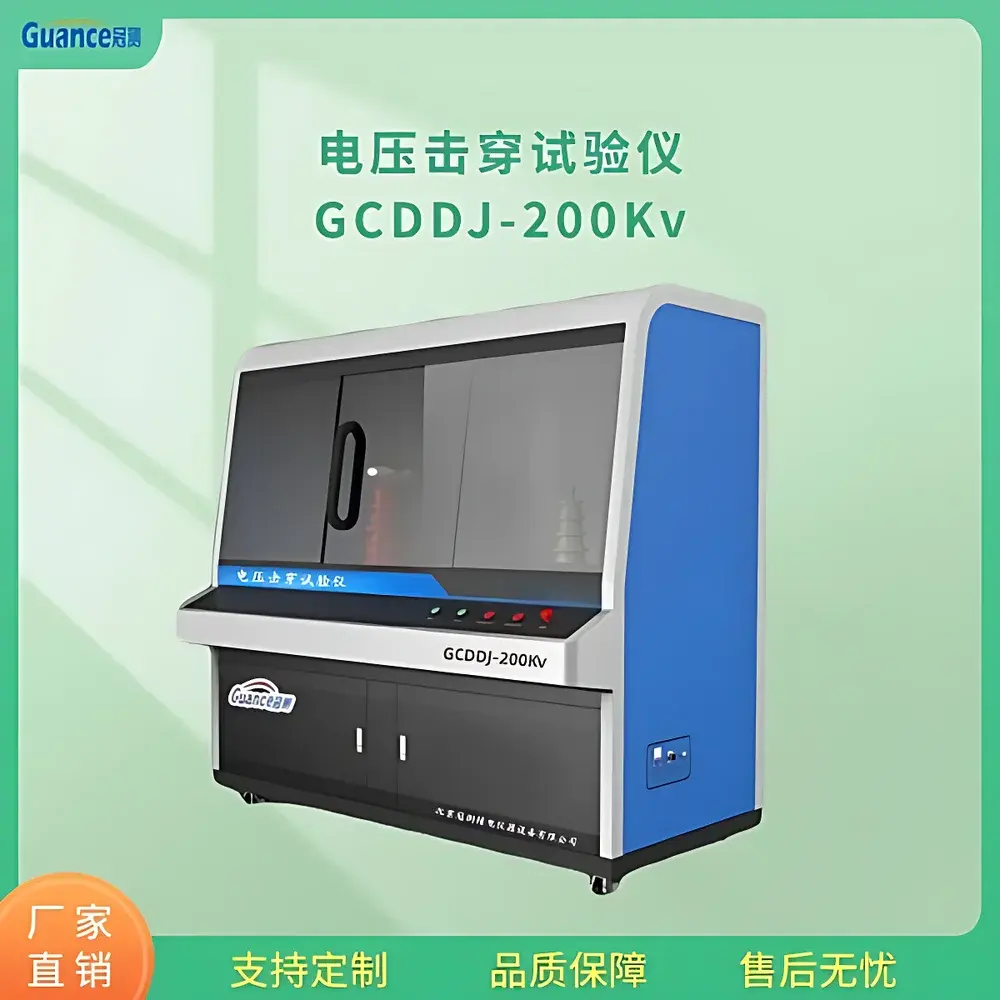
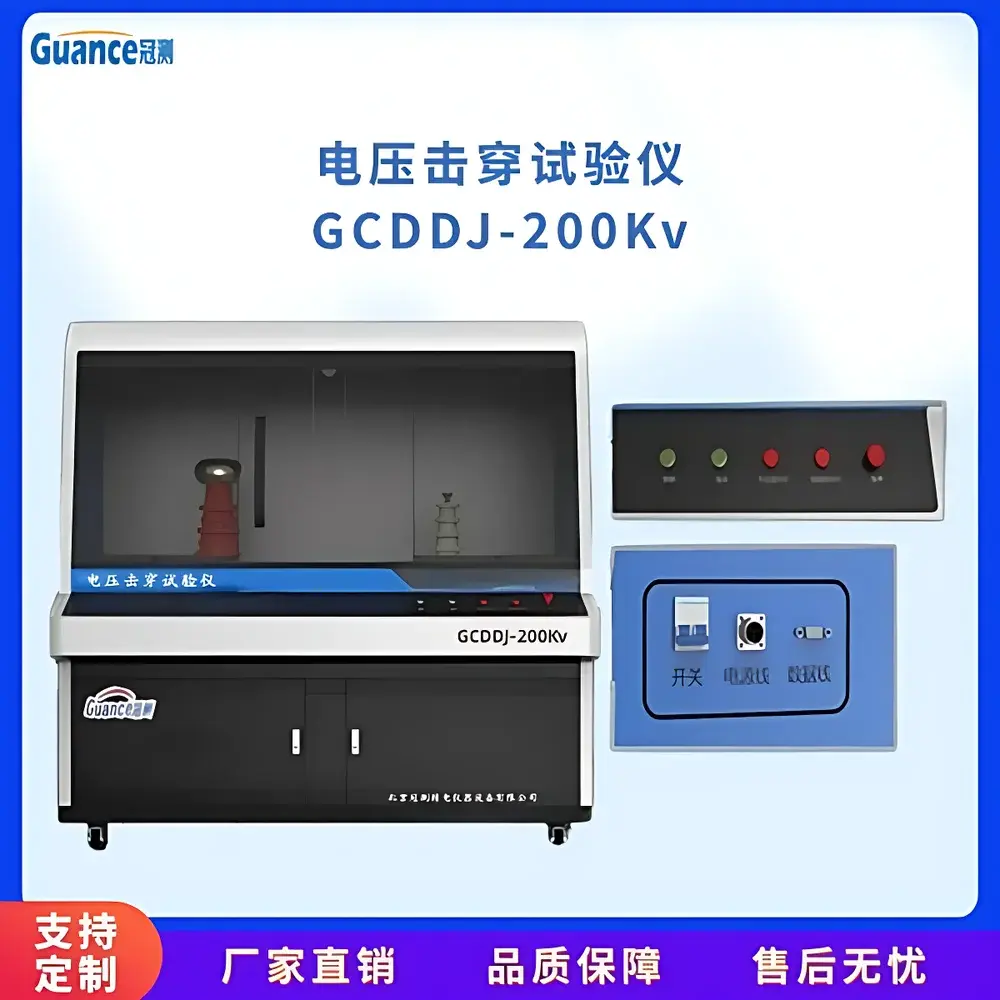
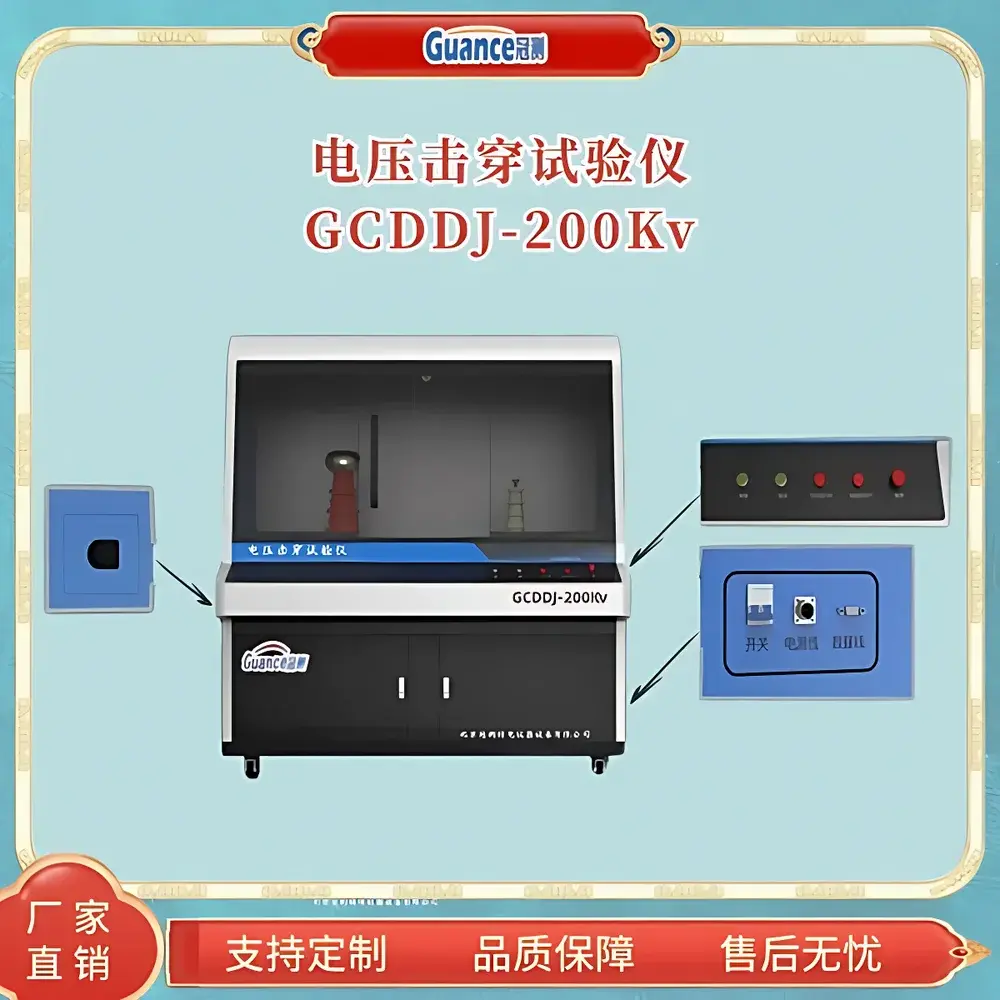
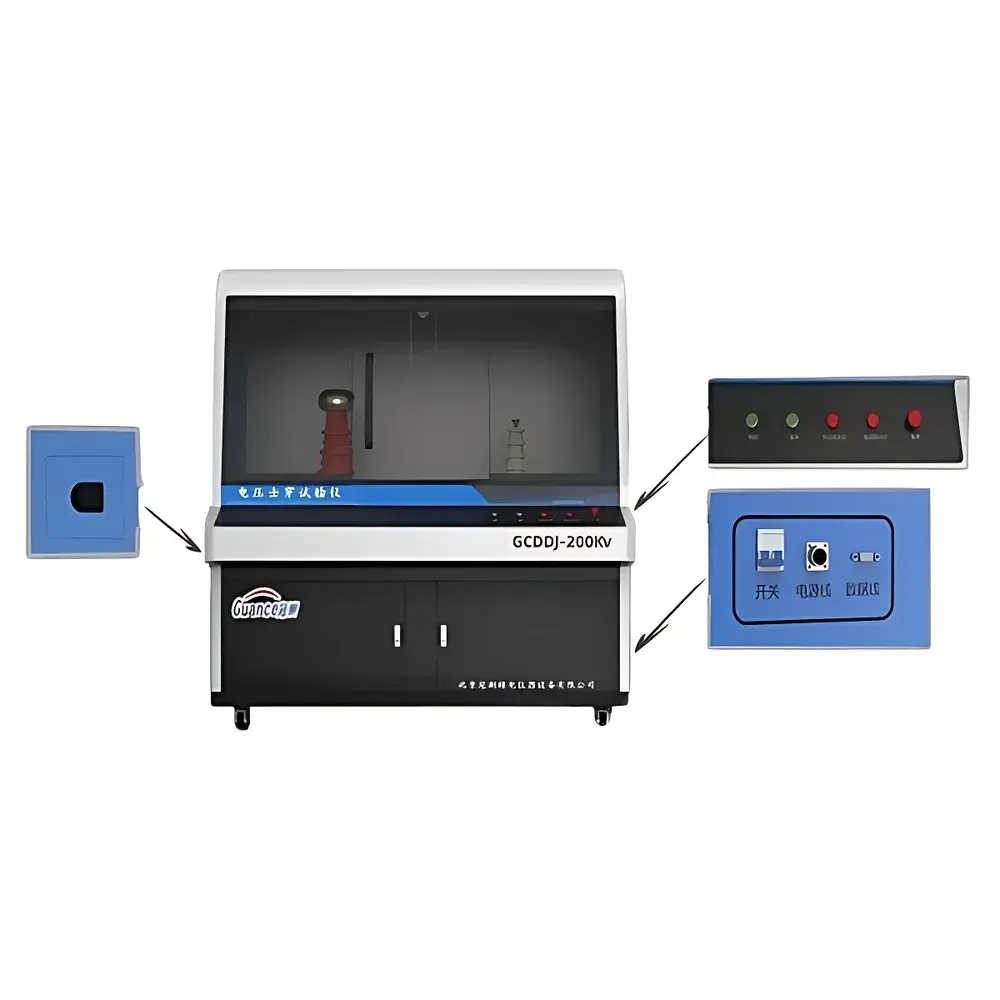
GuanCe Instruments GCDDJ-200kV Ceramic Dielectric Breakdown Tester
| Brand | GuanCe Instruments |
|---|---|
| Origin | Beijing, China |
| Manufacturer Type | Authorized Distributor |
| Country of Origin | China |
| Model | GCDDJ-200kV |
| Breakdown Voltage Range | 0–150 kV (AC/DC) |
| Output Voltage | 200 kV (AC/DC) |
| Power Rating | 5 kVA |
| Input Voltage | AC 220 V / 50 Hz |
| Ramp Rate | 0.1–5 kV/s (adjustable) |
| Voltage Accuracy | ≤ ±1.5% |
| Leakage Current Range | 0–100 mA |
| Voltage Sensor Range | 0–100 V |
| Electrode Options | φ25 mm (×2), φ75 mm (×1), customizable |
| Test Chamber Dimensions | 750 × 600 × 800 mm |
| Overall Dimensions | 1500 × 850 × 1700 mm |
| Weight | ~250 kg |
| Safety Protections | Overvoltage, overcurrent, short-circuit, and leakage current protection |
| Environmental Operating Conditions | Ambient temperature, RH ≤ 65% |
| Data Acquisition | Optically isolated digital I/O interface |
| Control System | Siemens PLC with integrated digital I/O modules |
| Software Platform | Windows-based GUI with real-time curve visualization, Excel export, and configurable test reports |
Overview
The GuanCe Instruments GCDDJ-200kV Ceramic Dielectric Breakdown Tester is a precision-engineered high-voltage testing system designed for quantitative evaluation of dielectric strength and voltage endurance in solid insulating materials. It operates on the fundamental principle of controlled voltage ramping—either AC or DC—until electrical breakdown occurs across a standardized electrode gap, enabling determination of the material’s intrinsic dielectric withstand capability under defined environmental and geometric conditions. This instrument complies with core international test methodologies including ASTM D149 (Standard Test Method for Dielectric Breakdown Voltage of Solid Electrical Insulating Materials at Commercial Power Frequencies), IEC 60243-1 (Electric Strength of Insulating Materials – Part 1: Tests at Power Frequencies), and GB/T 1408.1 (Chinese national standard equivalent to IEC 60243-1). Its architecture integrates a Siemens PLC-based control core, optically isolated data acquisition, and high-fidelity voltage/current sensing—ensuring measurement integrity in electromagnetically noisy laboratory environments.
Key Features
- Full AC/DC dual-mode operation up to 200 kV output, with programmable ramp rates from 0.1 to 5 kV/s for precise compliance with step-stress, constant-rate, and hold-time test protocols.
- Robust high-voltage generation module featuring oil-immersed transformer design with integrated EMI suppression components to minimize waveform distortion and ensure stable voltage rise.
- Real-time dual-curve visualization: simultaneous display of applied voltage vs. time and leakage current vs. time during test execution—critical for identifying pre-breakdown conduction anomalies.
- Automated breakdown detection via dual threshold logic: configurable voltage collapse or current surge triggers, with automatic test termination and timestamped event capture.
- Modular electrode configuration supporting standard disc electrodes (φ25 mm × 2, φ75 mm × 1) and custom geometries; optional motorized electrode lift mechanism for repeatable positioning in multi-sample workflows.
- Integrated safety architecture compliant with IEC 61010-1: includes interlocked pneumatic/hybrid sliding test door, multi-stage overvoltage cutoff, active discharge circuitry, and status-indicating tower lamp with color-coded visual feedback.
- Optically isolated communication path between PLC controller and host PC eliminates ground-loop interference and ensures data fidelity during long-duration or high-repetition testing.
Sample Compatibility & Compliance
The GCDDJ-200kV accommodates a broad spectrum of rigid and semi-rigid dielectrics—including technical ceramics, alumina substrates, silicon nitride insulators, glass-ceramic composites, epoxy-mica laminates, polyimide films, and silicone rubber bushings. Testing may be performed in ambient air, transformer oil immersion (standard 300 × 150 × 200 mm bath with suspended sample rack), or optionally within a heated chamber (high-temperature variant available upon request). All mechanical interfaces—including electrode spacing, sample thickness constraints, and edge guarding—are aligned with ASTM D149 Section 7 and IEC 60243-1 Annex A requirements. The system supports GLP-compliant audit trails when operated under validated software configurations, with full traceability of operator ID, parameter settings, raw sensor logs, and pass/fail determinations per test record.
Software & Data Management
The Windows-native control application provides a deterministic, deterministic user interface optimized for routine QC and R&D validation. Core capabilities include: configurable test templates for ASTM D149 Method A (short-time), Method B (step-by-step), and Method C (slow-rate); customizable report headers with company logo, test standard reference, and technician signature field; direct export of tabulated results and time-series datasets to .CSV or native Excel (.xlsx) format; and synchronized storage of oscillographic waveforms alongside metadata. All test sessions are logged with ISO 8601 timestamps, and the software enforces role-based access control (administrator/operator modes). While not natively 21 CFR Part 11 compliant, the system supports integration with third-party electronic lab notebook (ELN) platforms via OPC UA or TCP/IP API for regulated environments requiring electronic signature and audit trail validation.
Applications
This tester serves critical functions across ceramic manufacturing QA/QC labs, power electronics component qualification, aerospace insulation validation, and academic dielectric physics research. Typical use cases include: comparative screening of sintered ceramic batches for batch-to-batch consistency in breakdown voltage distribution; accelerated aging studies correlating thermal cycling with dielectric degradation; qualification of high-k ceramic capacitors for EV inverter applications; verification of glaze integrity on high-voltage insulators; and failure analysis of encapsulated semiconductor modules subjected to partial discharge stress. Its modular design permits adaptation to specialized fixtures—for instance, multi-electrode arrays for spatial mapping of local dielectric weakness—or integration into automated test cells via digital I/O triggers.
FAQ
What voltage standards does this instrument support?
It delivers AC (50 Hz) and DC outputs up to 200 kV nominal, with calibrated operational range validated from 1 kV to 150 kV for breakdown measurements per ASTM D149 and IEC 60243-1.
Is oil immersion testing included as standard?
Yes—the unit ships with a 300 × 150 × 200 mm thermostatically stable oil bath equipped with suspended sample mounting rails and grounding provisions.
Can test parameters be locked for SOP compliance?
Operator-level access restricts modification of ramp rate, hold time, and pass/fail thresholds; administrator credentials are required to alter system-level calibration or report templates.
How is electrical safety ensured during operation?
Five independent hardware interlocks monitor door position, grounding continuity, overcurrent, overvoltage, and arc detection—any fault triggers immediate de-energization and audible/visual alarm.
Does the system support automated reporting for ISO/IEC 17025 accreditation?
Raw data export and timestamped test logs meet Clause 7.8.2 documentation requirements; final report formatting must be implemented externally per laboratory-specific accreditation scope.



