
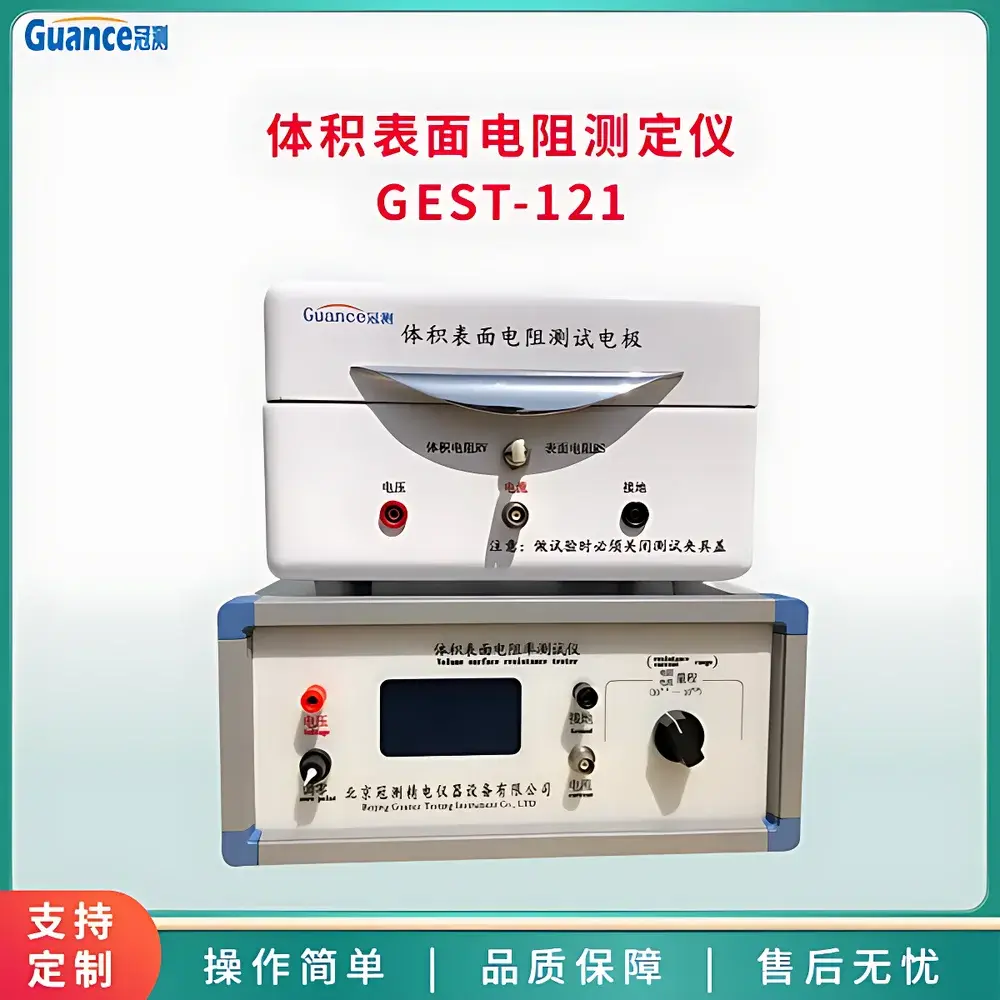
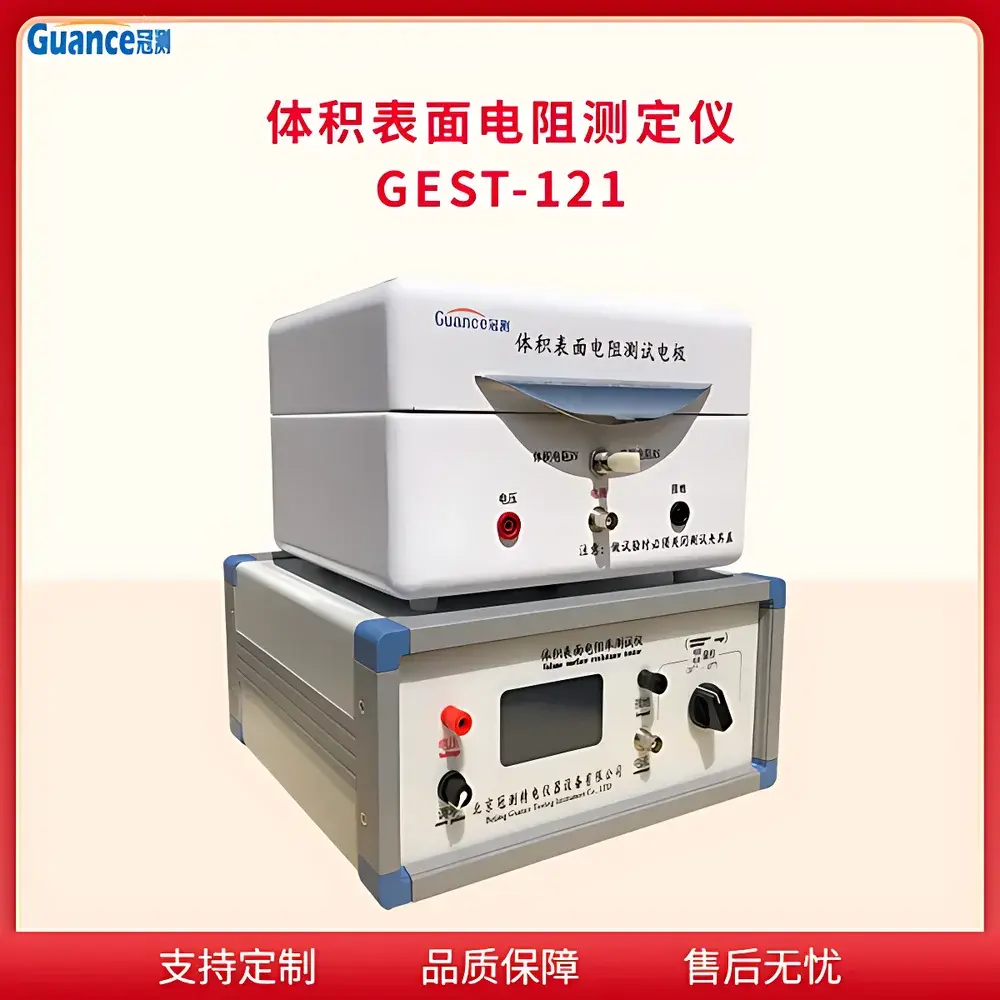
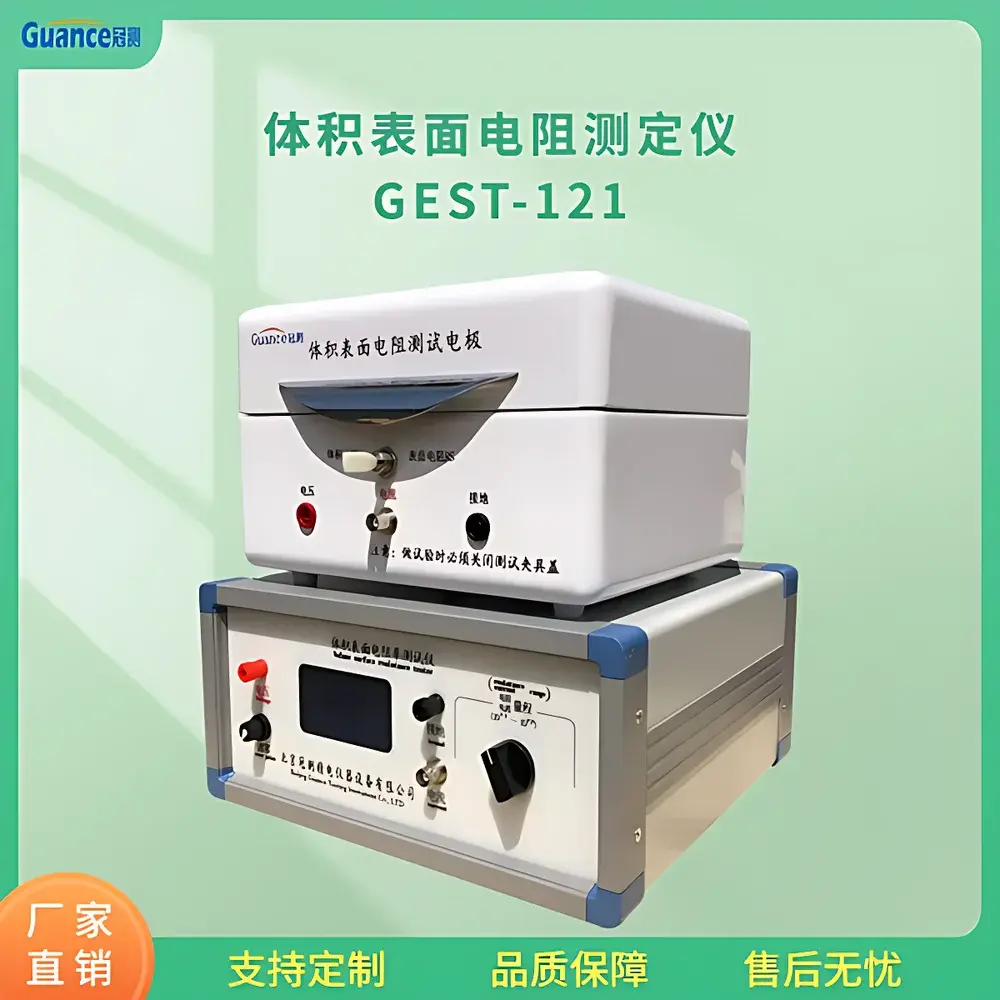
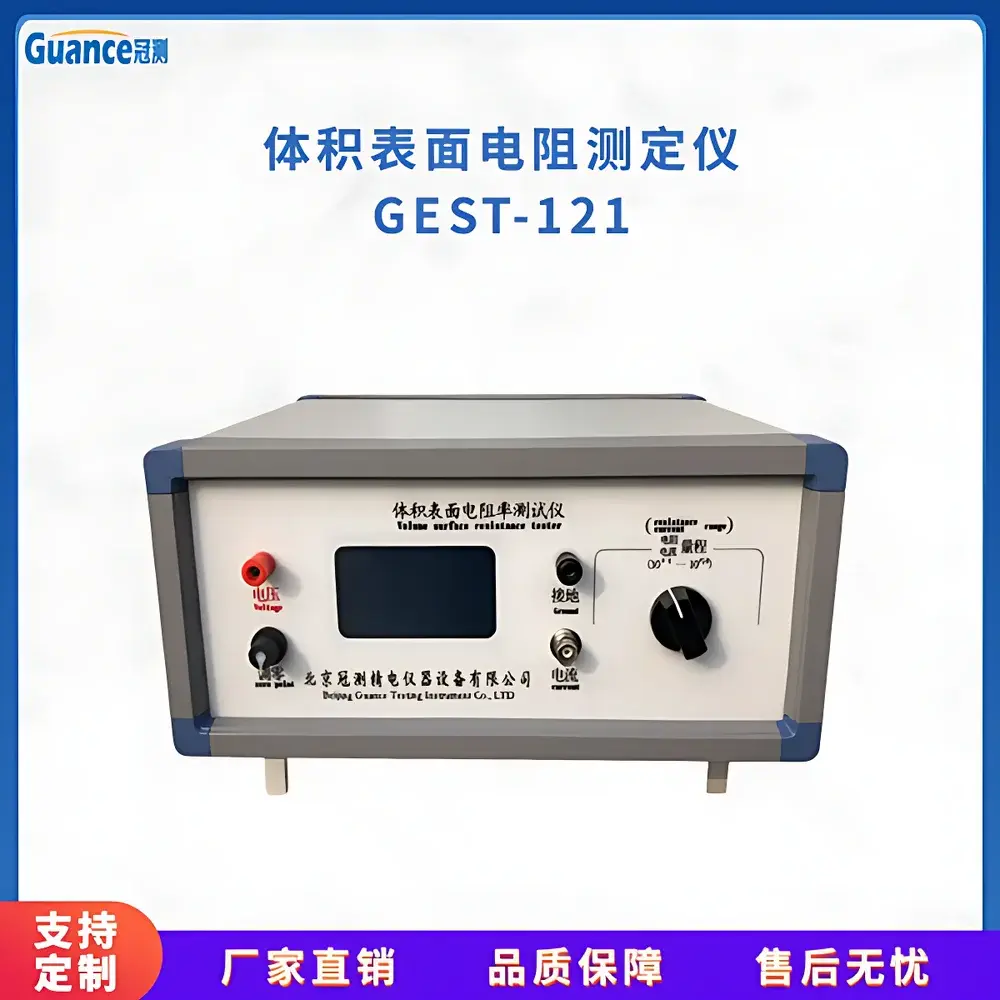
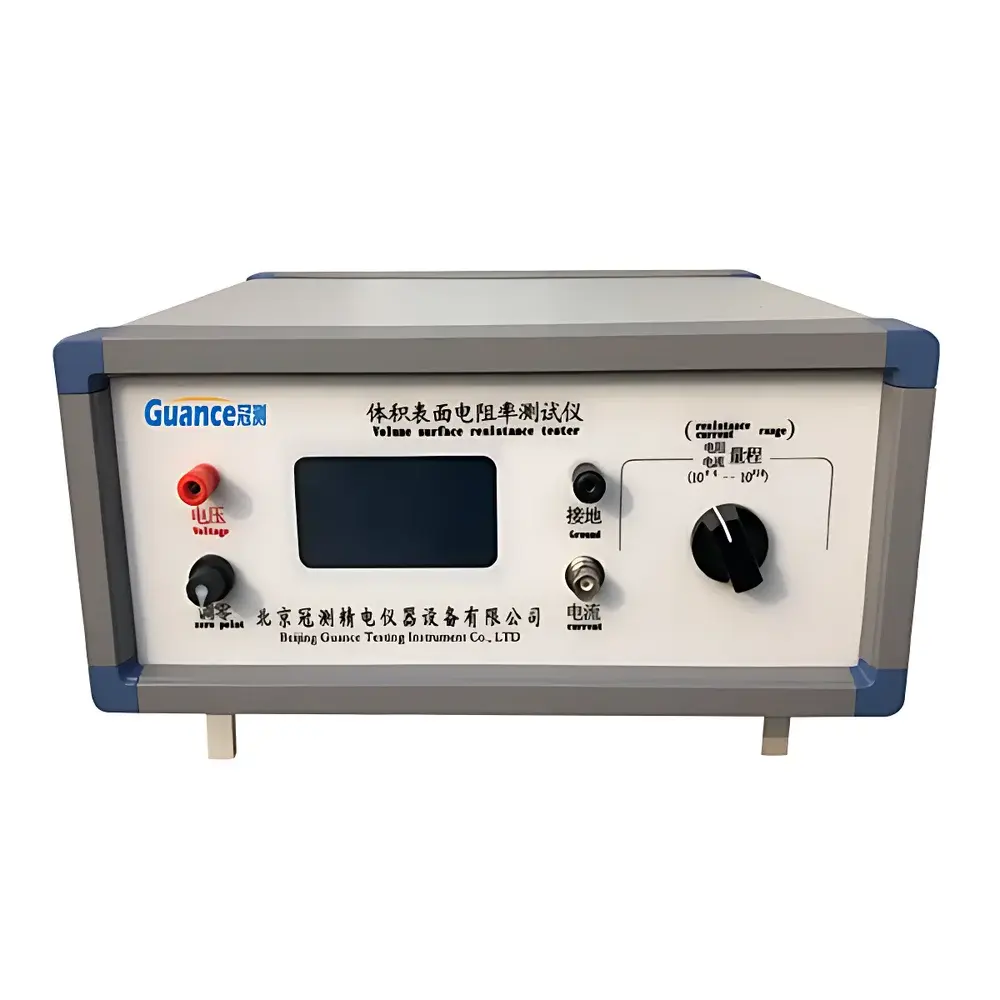
GuanCe Instruments GEST-121c High-Resistance Meter for Volume & Surface Resistivity Testing
| Brand | GuanCe Instruments |
|---|---|
| Model | GEST-121c |
| Measurement Range | 10⁴ Ω to 10¹⁸ Ω |
| Current Range | 2×10⁻⁴ A to 1×10⁻¹⁶ A |
| Test Voltages | 10 V, 50 V, 100 V, 250 V, 500 V, 1000 V |
| Accuracy | ±1% (≤10¹⁰ Ω), ±5–10% (>10¹⁰ Ω) |
| Display | Digital LCD |
| Power Supply | 220 V / 50 Hz |
| Power Consumption | 100 W |
| Dimensions (L×W×H) | 300 mm × 300 mm × 150 mm |
| Weight | ~5 kg |
| Standard Electrode | Three-terminal solid-state electrode set for disc/film samples ≥80 mm diameter |
| Compliance | Designed per IEC 62631-3-1, ASTM D257, GB/T 1410, ISO 3915 |
Overview
The GuanCe Instruments GEST-121c is a precision high-resistance meter engineered for the quantitative determination of volume resistivity (ρᵥ), surface resistivity (ρₛ), and insulation resistance (Rᵢₙₛ) in dielectric materials. Based on the constant-voltage, guarded-electrode measurement principle defined in IEC 62631-3-1 and ASTM D257, the instrument employs a stable, low-noise electrometer architecture with six selectable DC test voltages (10 V to 1000 V) to ensure compliance with standardized test conditions across material classes. Its extended resistance range—spanning 10⁴ Ω to 10¹⁸ Ω—and ultra-low current detection capability (down to 1×10⁻¹⁶ A) enable reliable characterization of highly insulating polymers, ceramics, elastomers, and thin-film coatings where charge leakage and polarization effects must be rigorously controlled. The GEST-121c is not a generic multimeter; it is a purpose-built physical property testing system calibrated for reproducible, traceable resistivity evaluation under controlled environmental and electrostatic conditions.
Key Features
- Wide dynamic resistance range: 0.01×10⁴ Ω to 1×10¹⁸ Ω, supporting evaluation of both moderately conductive antistatic materials and ultra-high-purity insulators.
- Programmable DC test voltages: Six discrete levels (10 V, 50 V, 100 V, 250 V, 500 V, 1000 V) aligned with ASTM D257 and IEC 60093 test protocols for voltage-dependent resistivity assessment.
- Guarded three-terminal electrode configuration as standard: Minimizes surface leakage paths and ensures accurate volume resistivity measurement for solid discs and films ≥80 mm in diameter.
- High-sensitivity electrometer circuitry: Capable of resolving currents from 2×10⁻⁴ A down to 1×10⁻¹⁶ A with <1% uncertainty below 10¹⁰ Ω and ≤10% uncertainty up to 10¹⁸ Ω.
- Digital LCD interface with real-time resistance/current readout: Supports manual test execution with immediate parameter verification and pass/fail threshold indication.
- Robust mechanical design: Compact footprint (300 mm × 300 mm × 150 mm), lightweight (~5 kg), and optimized thermal stability for benchtop operation in metrology labs and QC environments.
Sample Compatibility & Compliance
The GEST-121c accommodates diverse sample geometries—including powders (using compressed pellet fixtures), liquids (via guarded liquid cells), viscous pastes, thin films (<100 µm), rigid sheets, and bulk molded parts—through modular electrode options beyond the standard three-terminal solid electrode set. It meets the electrical safety and measurement traceability requirements of national and international standards including GB/T 1410 (China), ISO 3915 (surface resistance of conductive plastics), IEC 62631-3-1 (dielectric materials), and ASTM D257 (standard test methods for DC resistance of insulating materials). For regulated environments—such as ISO/IEC 17025-accredited testing laboratories or GMP-compliant R&D facilities—the instrument supports documented calibration intervals, operator-defined test sequences, and raw data logging compatible with internal audit trails.
Software & Data Management
While the GEST-121c operates as a standalone instrument with embedded firmware, its analog/digital output interface enables integration into laboratory data acquisition systems (e.g., LabVIEW, MATLAB, or custom SCADA platforms) via RS-232 or optional USB-to-serial adapters. All measurements are timestamped and stored in non-volatile memory with user-assigned sample IDs. Exported CSV files contain test voltage, measured current, calculated resistance, derived resistivity (with geometric correction factors applied), and environmental metadata (if external hygrothermometer inputs are configured). The system architecture supports 21 CFR Part 11-compliant workflows when deployed with validated third-party LIMS or ELN software—ensuring electronic signature capability, audit trail generation, and role-based access control for QA/QC documentation.
Applications
- Volume and surface resistivity mapping of polymer composites used in aerospace radomes and printed circuit board substrates.
- Quality control screening of ESD-safe packaging films and cleanroom garments per ANSI/ESD S20.20.
- Resistivity validation of insulating coatings on lithium-ion battery separators and solid-state electrolyte membranes.
- Research-grade characterization of novel dielectrics in optoelectronic devices, including OLED encapsulation layers and photovoltaic backsheet materials.
- Calibration reference testing for accredited metrology institutes verifying secondary standards in high-resistance calibration chains.
- Evaluation of grounding performance in raised access flooring systems (per EN 1081) and conductive footwear (per EN 61340-4-3).
FAQ
What standards does the GEST-121c comply with for resistivity measurement?
It conforms to ASTM D257, IEC 62631-3-1, ISO 3915, and GB/T 1410 for methodology, electrode geometry, voltage application, and calculation procedures.
Can the instrument measure resistivity of liquid electrolytes or conductive inks?
Yes—when equipped with an optional guarded liquid cell electrode, it supports volume resistivity measurement of low-conductivity solvents and diluted ionic solutions within the 10⁴–10¹² Ω·cm range.
Is temperature or humidity compensation built-in?
No—ambient temperature and relative humidity must be monitored externally and recorded manually; however, the instrument’s low thermal drift (<0.05%/°C) ensures stable readings over typical lab temperature ranges (15–30 °C).
How is calibration maintained for long-term accuracy?
Annual recalibration against NIST-traceable high-resistance standards (e.g., 10¹² Ω and 10¹⁴ Ω reference resistors) is recommended; full calibration reports and uncertainty budgets are provided by authorized service centers.
Does the GEST-121c support automated test sequencing or pass/fail logic?
Not natively—but its serial communication interface allows integration with external PLCs or PC-based test controllers to implement multi-step voltage ramping, dwell timing, and conditional pass/fail decision logic.
Related Products



