
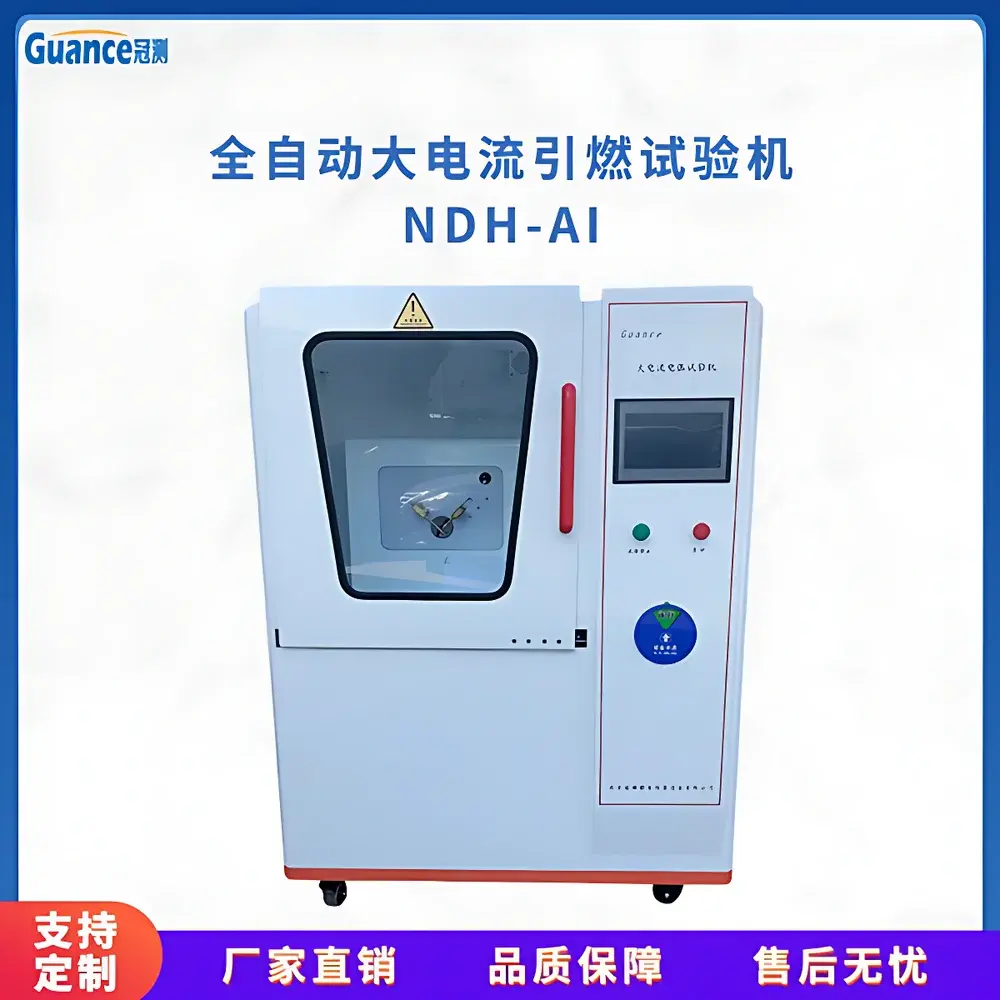
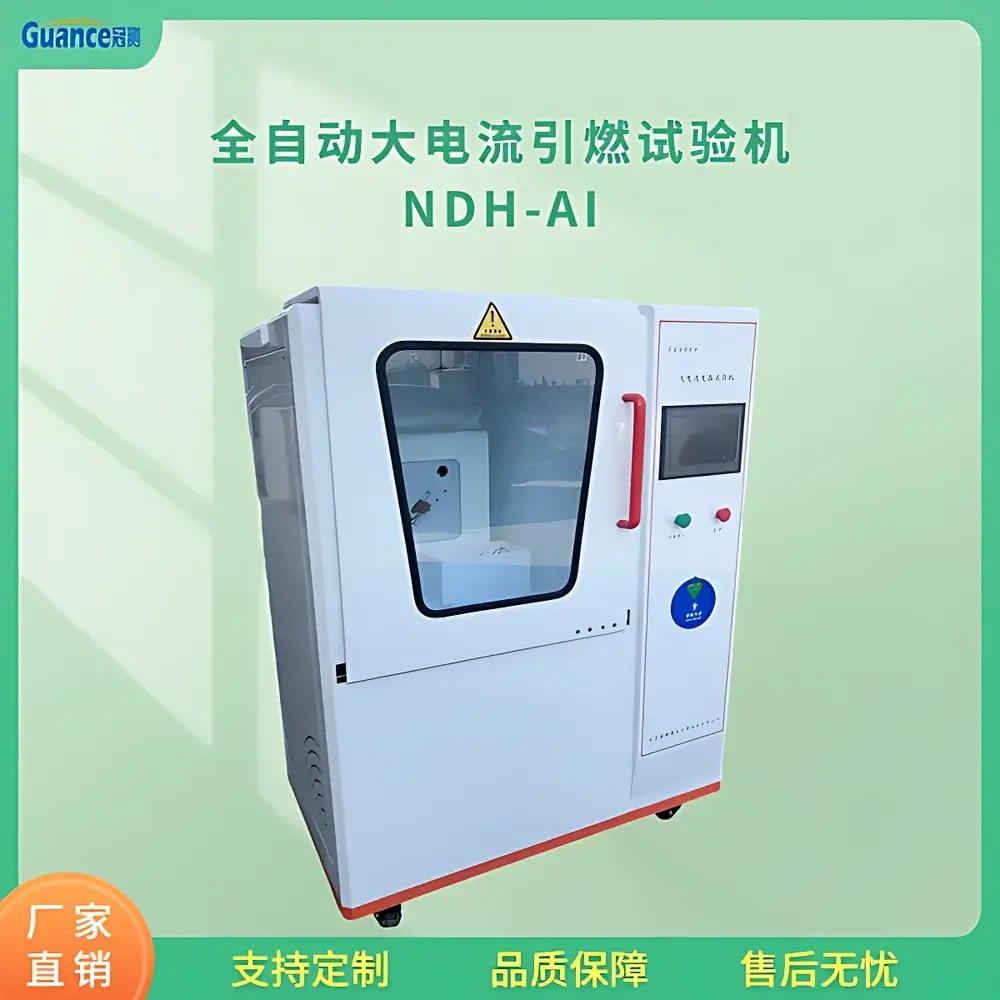
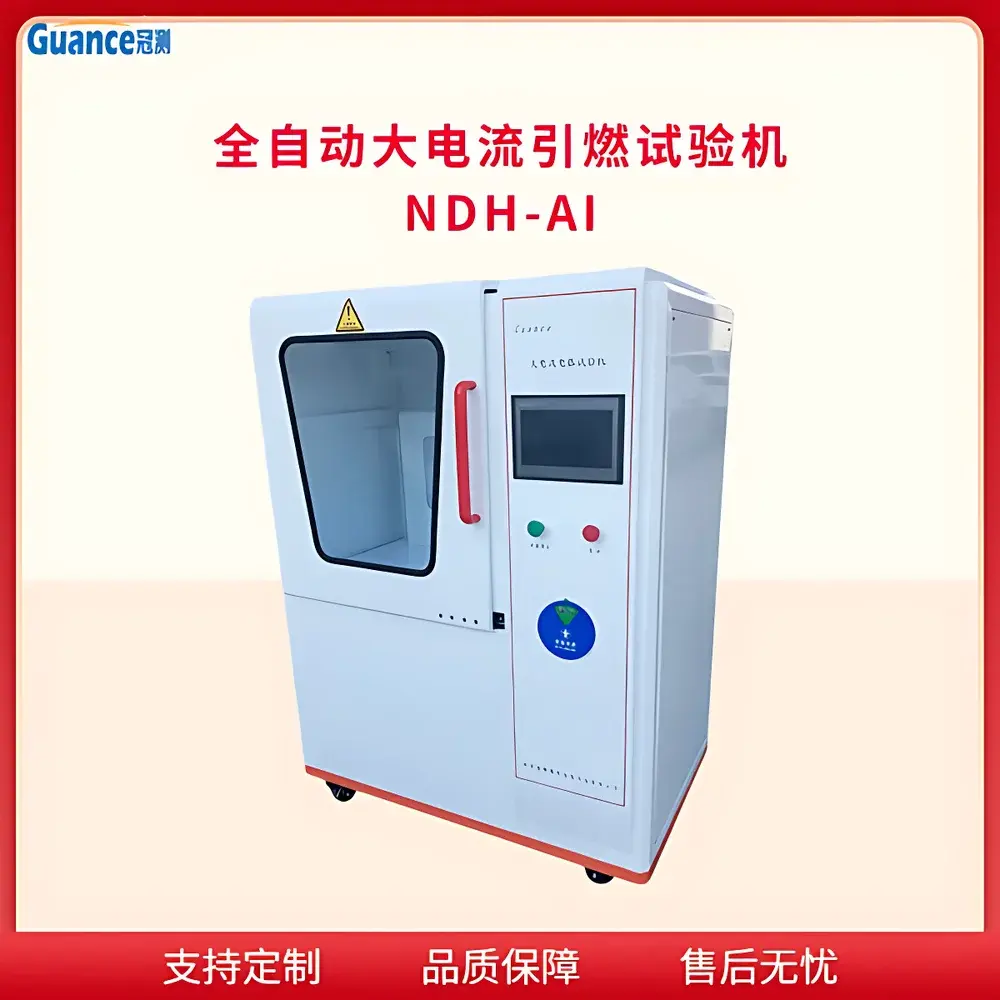
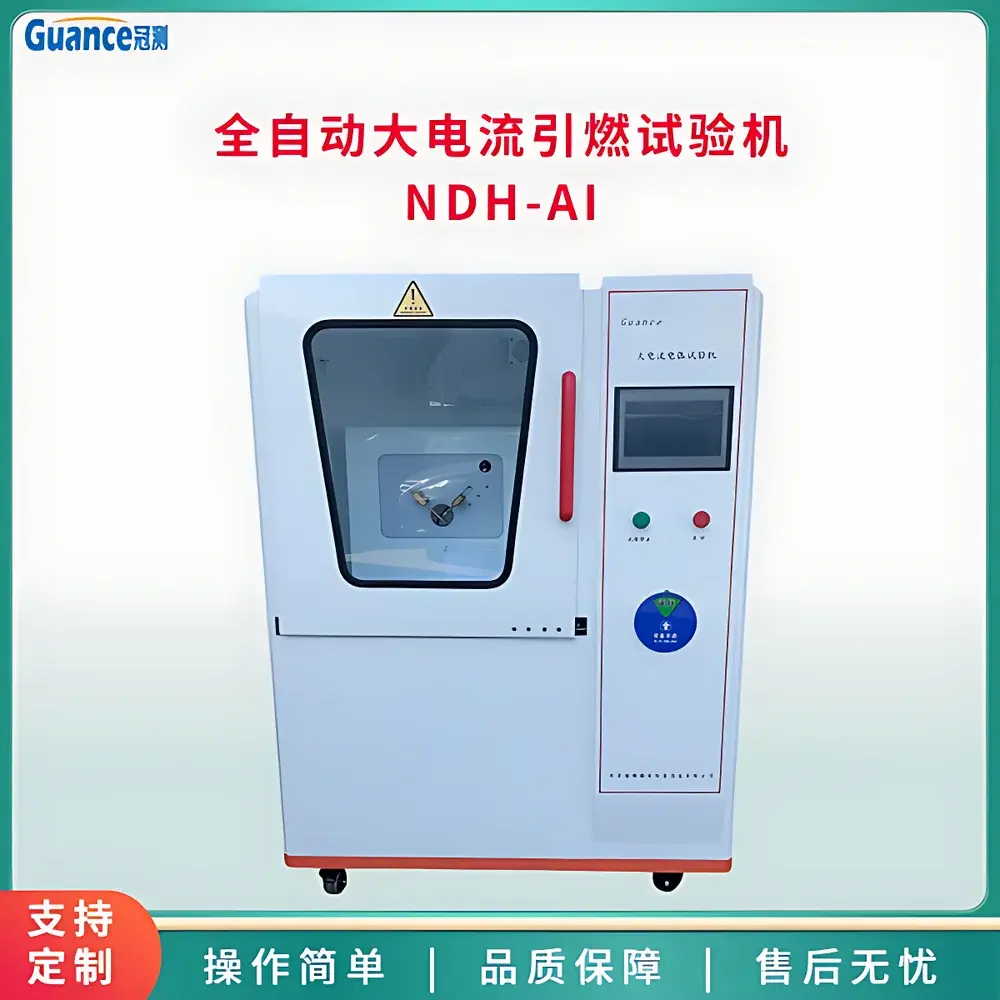
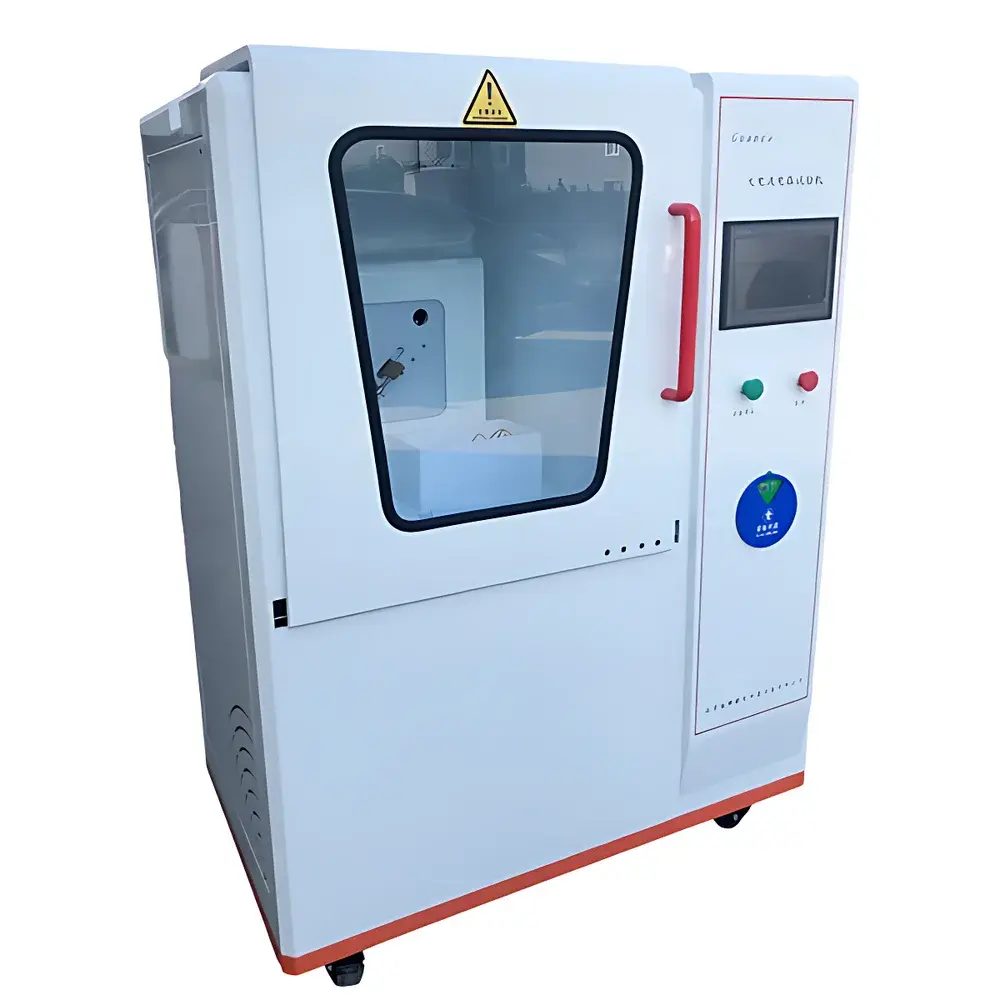
GuanCe Instruments NDH-AI4 Fully Automated High-Current Arc Ignition Tester
| Brand | GuanCe Instruments |
|---|---|
| Origin | Beijing, China |
| Manufacturer Type | Authorized Distributor |
| Country of Origin | China |
| Model | NDH-AI4 |
| Instrument Type | Electronic Universal Testing Machine |
| Rated Power | 10 kVA |
| Test Voltage | 220 V / 50 Hz |
| Arc Current | 33 ± 5 A (adjustable) |
| Power Factor | cosφ = 0.5 ± 0.05 (adjustable) |
| Arc Frequency | 40 cycles/min (adjustable) |
| Arc Speed | 254 ± 25 mm/s |
| Electrode Geometry | Static electrode — φ3.2–3.5 mm, 30° chisel tip |
| Electrode Angle | 45° to horizontal plane |
| Specimen Dimensions | 130 mm × 13 mm × (2–12) mm |
| Arc Cycles | Up to 200 (programmable) |
| Enclosure Dimensions | 1250 mm (W) × 800 mm (D) × 1750 mm (H) |
| Human-Machine Interface | 10-inch capacitive touchscreen |
| Control System | Siemens S7-1200 PLC |
| Safety Features | Interlocked sliding door, mechanical limit switches, overload protection, audible alarm, tower status lamp (green/red/yellow), integrated exhaust fan with LED illumination |
Overview
The GuanCe Instruments NDH-AI4 Fully Automated High-Current Arc Ignition Tester is an engineered solution for evaluating the arc resistance and ignition performance of solid insulating materials and structural components used in low-voltage electrical and electronic equipment. It operates on the principle of controlled high-current arcing between two precisely aligned electrodes under standardized power factor and current conditions, simulating real-world fault scenarios where sustained electric arcs may initiate thermal degradation or combustion in nearby dielectric surfaces. Designed in strict alignment with international safety standards—including IEC 60950-1:2001, IEC 60947-1:1999, IEC 730-1:1993, UL 746A, and GB 4943-2001—the NDH-AI4 delivers repeatable, traceable, and auditable test outcomes essential for product certification, R&D validation, and quality assurance workflows in regulated manufacturing environments.
Key Features
- Fully Integrated Automation: Siemens S7-1200 PLC serves as the deterministic core controller, managing all sequence-critical functions—electrode positioning, current ramping, arc timing, cycle counting, and end-of-test reset—with microsecond-level synchronization and deterministic I/O response.
- Dual-Mode Operation: Supports both static (fixed-position) and dynamic (reciprocating motion) arc testing configurations, enabling evaluation under stationary stress or mechanically coupled arc exposure per application-specific requirements.
- Intelligent HMI Interface: 10-inch industrial-grade capacitive touchscreen provides intuitive parameter configuration, real-time status visualization, password-protected access control (dynamic login), and graphical representation of arc cycle progression and system health indicators.
- Comprehensive Safety Architecture: Includes interlocked sliding door with mechanical limit sensing, hardware-based overcurrent cutoff, thermal monitoring of power stage components, audible alarm activation upon test completion, and three-color tower lamp (green = standby, yellow = active test, red = fault or door open).
- Controlled Environmental Management: Integrated axial exhaust fan with variable-speed drive ensures rapid removal of combustion byproducts during testing; built-in LED task lighting facilitates post-test visual assessment of carbon tracking, charring depth, and surface erosion patterns.
- Electrode Precision Engineering: Static electrode features a hardened copper chisel tip (φ3.2–3.5 mm, 30° included angle); dynamic electrode employs stainless steel with a 60° conical geometry (φ3.0 mm), ensuring consistent arc initiation and stable plasma column formation across repeated cycles.
Sample Compatibility & Compliance
The NDH-AI4 accommodates flat specimens measuring 130 mm × 13 mm × (2–12) mm—compatible with standard sheet stock, molded housings, terminal blocks, busbar insulators, PCB substrates, and polymer-based enclosures. Its test methodology directly supports compliance verification for electrical clearance and creepage distance assessments per IEC 60664-1, material classification under UL 746A (Relative Thermal Index and Comparative Tracking Index), and flame propagation resistance in accordance with GB/T 14048.1-2000 and IEC 60947-1 Annex G. All operational parameters—including adjustable arc current (33 ± 5 A), programmable power factor (0.5 ± 0.05), and configurable frequency (up to 40 arcs/min)—are calibrated and documented to support GLP/GMP-aligned laboratory practices and ISO/IEC 17025 accreditation requirements.
Software & Data Management
The embedded control firmware logs timestamped event records—including start/stop times, actual current and voltage waveforms (sampled at ≥10 kHz), arc count, door status, and fault codes—to non-volatile memory. While no external PC software is bundled, raw binary log files are exportable via USB interface for post-processing in MATLAB, Python (Pandas), or LabVIEW environments. The system architecture supports audit trail generation per FDA 21 CFR Part 11 when integrated into validated enterprise LIMS platforms using optional RS-485 or Ethernet/IP communication modules (available upon request). All user actions—including parameter changes, login/logout events, and emergency stop triggers—are time-stamped and immutable within the local event buffer.
Applications
This tester is routinely deployed in laboratories supporting the design and certification of lighting ballasts, industrial control panels, household appliance internal wiring assemblies, motor starters, circuit breakers, EV charging connectors, medical device enclosures, and railway signaling components. It is equally applicable in material science labs evaluating halogen-free flame-retardant thermoplastics (e.g., PBT, PA66, LCP), silicone elastomers, phenolic laminates, and ceramic-filled composites. End users include QC departments of Tier-1 automotive suppliers, third-party certification bodies (e.g., SGS, TÜV Rheinland, CCC-certified labs), and national metrology institutes conducting inter-laboratory comparison studies for arc resistance proficiency testing.
FAQ
What standards does the NDH-AI4 explicitly support?
The NDH-AI4 implements test protocols compliant with IEC 60950-1:2001, IEC 60947-1:1999, IEC 730-1:1993, UL 746A, GB 4943-2001, GB/T 14048.1-2000, and GB 14536.1-1998.
Can the arc current and power factor be independently adjusted?
Yes—both parameters are independently tunable within specified tolerances (33 ± 5 A and cosφ = 0.5 ± 0.05) using closed-loop feedback from shunt-based current sensing and digital phase-angle control of the AC supply.
Is calibration documentation provided with shipment?
Each unit ships with a factory calibration certificate referencing traceable standards (NIM or CNAS-accredited reference labs), including verification data for electrode geometry, current accuracy, timing resolution, and power factor stability.
Does the system support remote monitoring or network integration?
Standard configuration includes RS-232 and USB ports; optional RS-485 Modbus RTU or Ethernet/IP interfaces enable integration into SCADA or MES systems for centralized test fleet management.
What maintenance intervals are recommended for electrode replacement?
Electrodes should be inspected after every 50 test cycles and replaced after 200 total arcs or upon visible pitting, oxidation, or dimensional deviation exceeding ±0.1 mm—whichever occurs first.



