
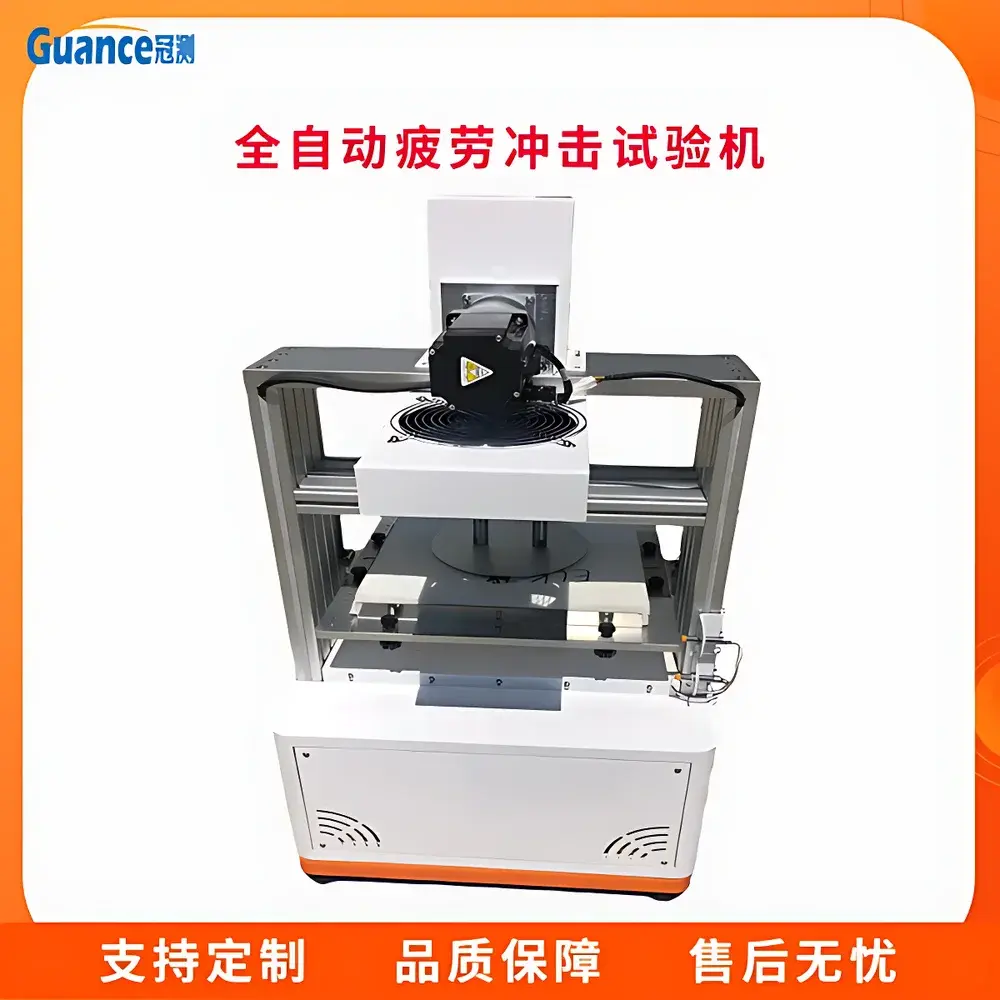
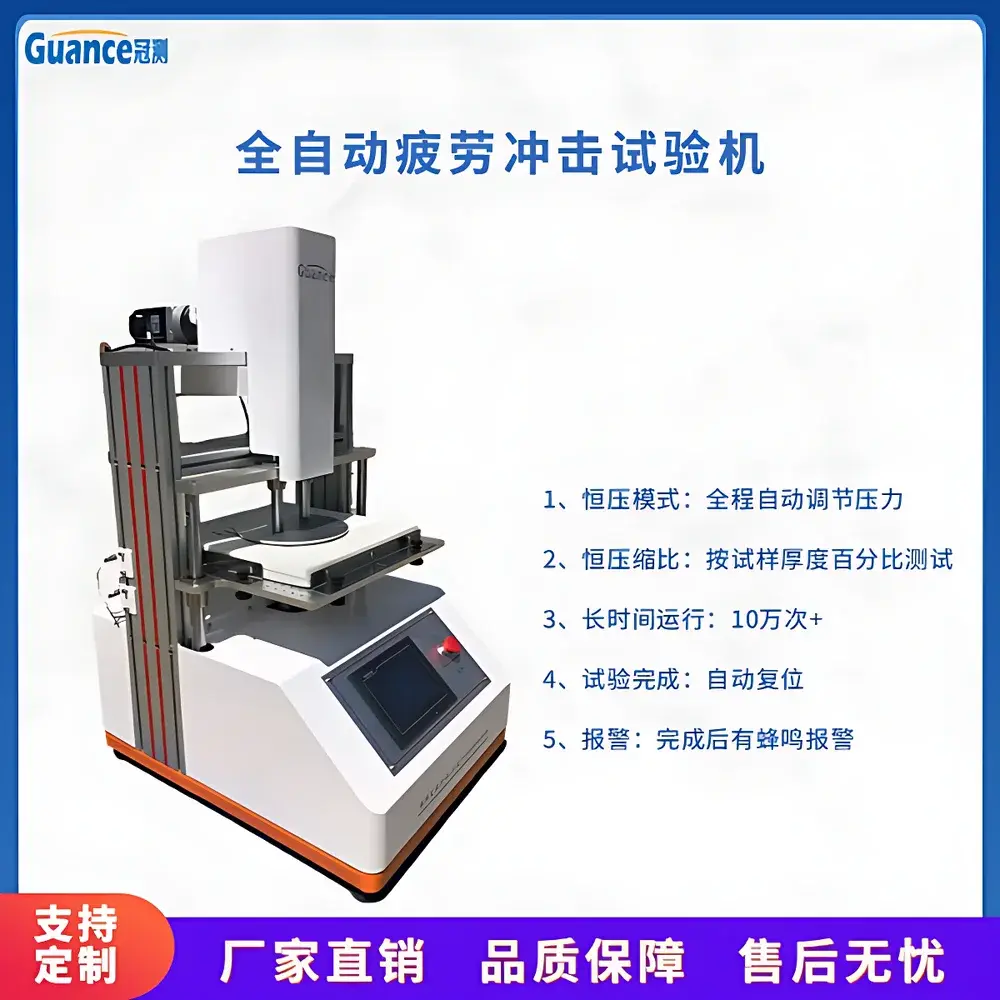
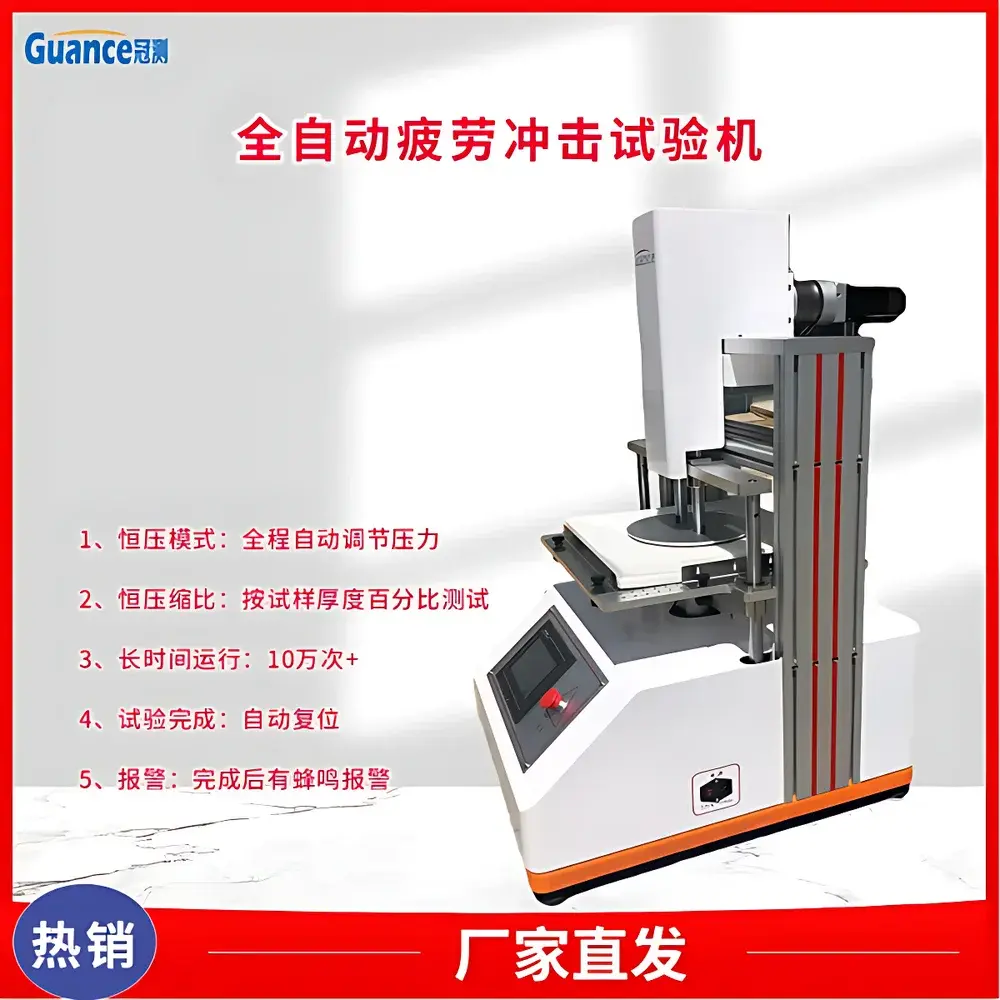
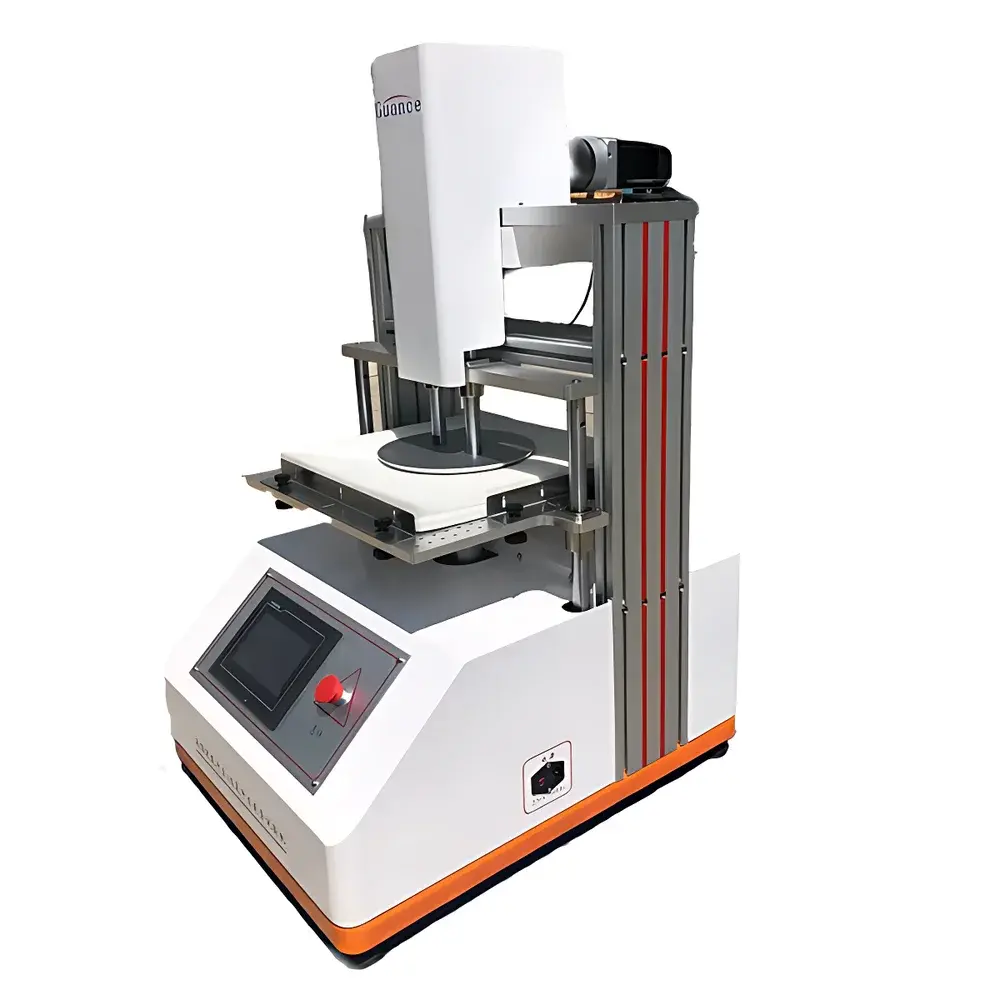
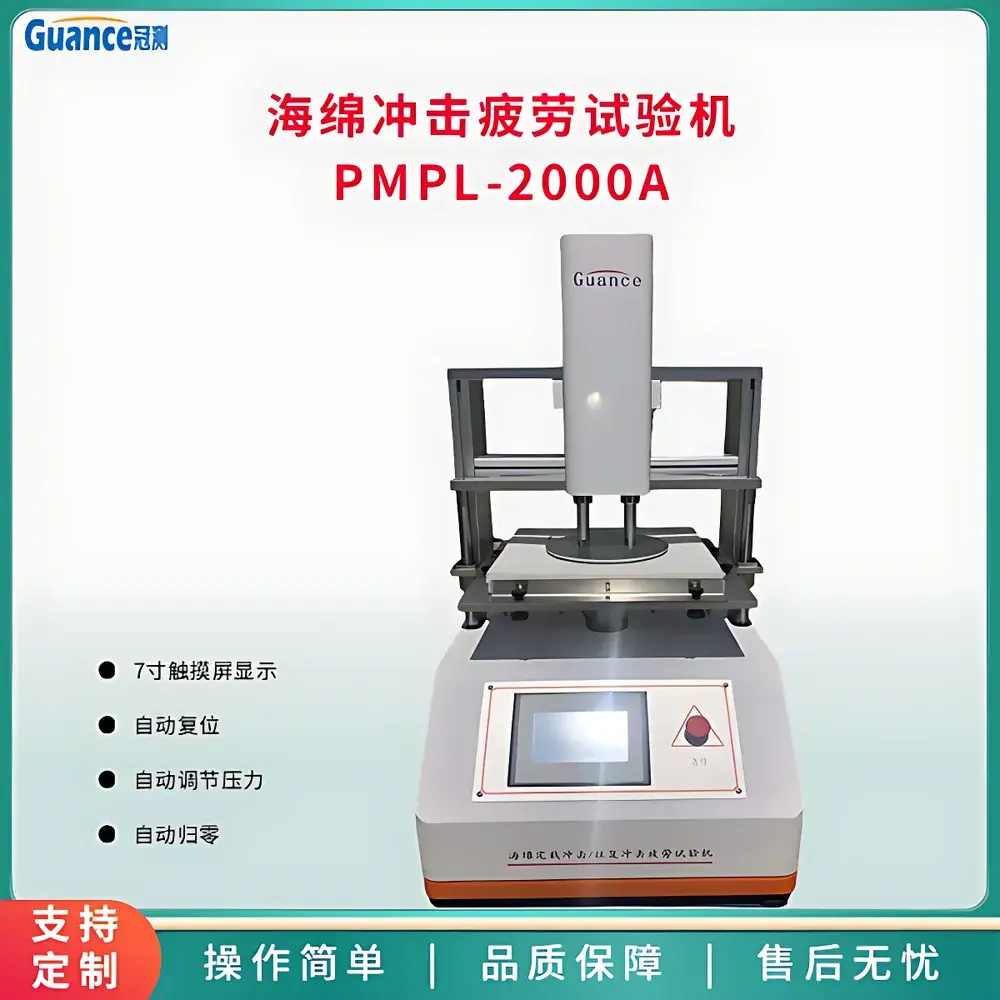
GuanCe Instruments PMPL-2000A1 Foam Reciprocating Fatigue Testing Machine
| Brand | GuanCe Instruments |
|---|---|
| Origin | Beijing, China |
| Manufacturer Type | Authorized Distributor |
| Country of Origin | China |
| Model | PMPL-2000A1 |
| Instrument Type | Electromechanical Universal Testing Machine |
| Maximum Load Capacity | 1000 N |
| Reciprocating Compression Frequency | 10–100 cycles/min (Standard Compliance: 70 ± 5 cycles/min per ISO 3385) |
| Max. Cycles | >100,000 |
| Platen Diameter | φ250 mm ± 1 mm, Bottom Edge Radius: R25 mm ± 1 mm |
| Specimen Support Table | 500 mm × 500 mm square, 10 mm thick, with 6.35 mm diameter holes on 20 mm centers |
| Specimen Dimensions | 500 mm × 500 mm × (50 ± 2) mm |
| Force Display | Real-time peak load readout |
| Control Interface | 7-inch color touchscreen HMI |
| Actuation | Servo motor-driven |
| Test Modes | Constant-force loading or constant-thickness compression (expressed as % deformation) |
| End-of-Test Action | Audible alarm + automatic platen return to zero position |
| Specimen Positioning | Adjustable mechanical alignment fixtures ensuring positional stability over extended cycling |
| Power Supply | 220 V AC / 50 Hz |
| Footprint | 800 mm (L) × 500 mm (W) × 1200 mm (H) |
| Net Weight | 100 kg |
Overview
The GuanCe Instruments PMPL-2000A1 Foam Reciprocating Fatigue Testing Machine is an electromechanical universal testing system engineered for standardized dynamic fatigue evaluation of flexible polymeric foams—particularly those used in automotive seating, furniture cushioning, and bedding applications. It operates on the principle of controlled, repetitive uniaxial compression under defined load or displacement boundary conditions, simulating real-world service stresses that induce progressive structural degradation. The instrument implements the fundamental mechanics of cyclic viscoelastic deformation, where successive compressive strokes induce time-dependent energy dissipation, permanent set accumulation, and measurable reductions in thickness and indentation hardness. Its design adheres strictly to internationally recognized test protocols including ISO 3385 (Foam plastics — Determination of fatigue by the constant-load method), GB/T 18941 (Chinese national adoption of ISO 3385), QB/T 2819–2006 (Long-term fatigue performance of soft foam materials), QC/T 56–93 (Testing methods for automotive seat cushion materials), and JASO B408–84 (Japanese Automotive Standards Organization specification for seat foam durability). Unlike static compression testers, the PMPL-2000A1 quantifies fatigue life through cumulative cycle counting, residual deformation tracking, and hardness decay profiling—enabling correlation between laboratory data and field performance metrics such as seat sag resistance and comfort retention.
Key Features
- Servo-motor-driven actuation ensures precise, repeatable stroke control with minimal thermal drift and high positional fidelity across >100,000 cycles.
- Self-compensating height adjustment mechanism maintains constant impact load throughout testing—even as specimen thickness decreases—by dynamically repositioning the support platform in real time.
- Siemens PLC-based control architecture guarantees deterministic timing, robust I/O handling, and immunity to electromagnetic interference in industrial lab environments.
- 7-inch color touchscreen HMI provides intuitive parameter configuration (target load, cycle count, frequency, compression mode) and real-time visualization of peak force values during each stroke.
- Dual-test-mode capability supports both constant-force fatigue (per ISO 3385) and constant-thickness compression (e.g., 40% strain hold), enabling comparative analysis of material resilience under different stress states.
- Mechanically indexed specimen positioning system prevents lateral migration or rotation during prolonged cycling, preserving test validity and reducing operator dependency.
- Integrated audible alarm and automatic platen return-to-zero function upon test completion streamline workflow and support unattended operation.
Sample Compatibility & Compliance
The PMPL-2000A1 accommodates standard foam specimens measuring 500 mm × 500 mm × (50 ± 2) mm, mounted on a perforated stainless steel support table (500 mm × 500 mm × 10 mm, 6.35 mm holes on 20 mm centers) that facilitates air displacement and minimizes hydrodynamic resistance during rapid compression. The φ250 mm ± 1 mm circular impact platen—with R25 mm ± 1 mm edge radius—meets dimensional tolerances specified in ISO 3385 Annex A and QC/T 56–93 Clause 4.2. All mechanical and control functions are traceable to documented calibration procedures aligned with ISO/IEC 17025 requirements for testing laboratories. While not certified to GLP or FDA 21 CFR Part 11 out-of-the-box, the system’s deterministic PLC logic, non-volatile cycle logging, and timestamped parameter records provide foundational auditability for regulated environments when integrated into validated SOPs.
Software & Data Management
The embedded Siemens S7-1200 PLC stores all test parameters—including start time, target load, selected mode, total cycles executed, and final peak force—in non-volatile memory. Cycle-by-cycle force maxima are displayed live but not archived internally; however, external data acquisition via RS485 Modbus RTU or optional analog output (0–10 V) enables integration with third-party SCADA or LIMS platforms. Users may export test logs manually via USB stick connected to the HMI terminal. No proprietary software installation is required for basic operation, minimizing IT overhead and cybersecurity exposure. For laboratories requiring electronic records compliance, the system supports manual annotation and printout of test reports—including specimen ID, operator initials, environmental conditions (if externally logged), and pass/fail status against predefined deformation thresholds.
Applications
- Automotive interior component qualification: Seat cushion foam fatigue life assessment per JASO B408–84 and QC/T 56–93.
- Furniture industry R&D: Comparative evaluation of polyurethane vs. bio-based foams under long-term cyclic loading.
- Quality assurance in foam manufacturing: Batch release testing for residual deformation ≤ 10% after 80,000 cycles at 70 cpm and 50% compression.
- Regulatory submission support: Generation of ISO 3385-compliant datasets for CE marking dossiers or OEM technical specifications.
- Academic research on viscoelastic aging mechanisms: Correlation of hysteresis loop evolution with chemical crosslink density changes measured via FTIR or DSC.
FAQ
What standards does the PMPL-2000A1 directly support?
ISO 3385, GB/T 18941, QB/T 2819–2006, QC/T 56–93, and JASO B408–84.
Can the machine perform tests at frequencies outside the 70 ± 5 cpm range?
Yes—operational range is 10–100 cycles per minute; however, deviation from 70 ± 5 cpm requires explicit justification in test reports per ISO 3385 Clause 6.2.
Is force calibration traceable to national metrology institutes?
The system accepts external verification using Class M1 or better deadweight standards; full calibration certificates require engagement of an ISO/IEC 17025-accredited service provider.
Does the instrument include data export functionality?
Yes—via USB-stick export of parameter logs and real-time analog/Modbus outputs for external DAQ systems.
What maintenance intervals are recommended?
Lubrication of linear guide rails every 500 hours of operation; annual verification of platen parallelism and load cell linearity.



