
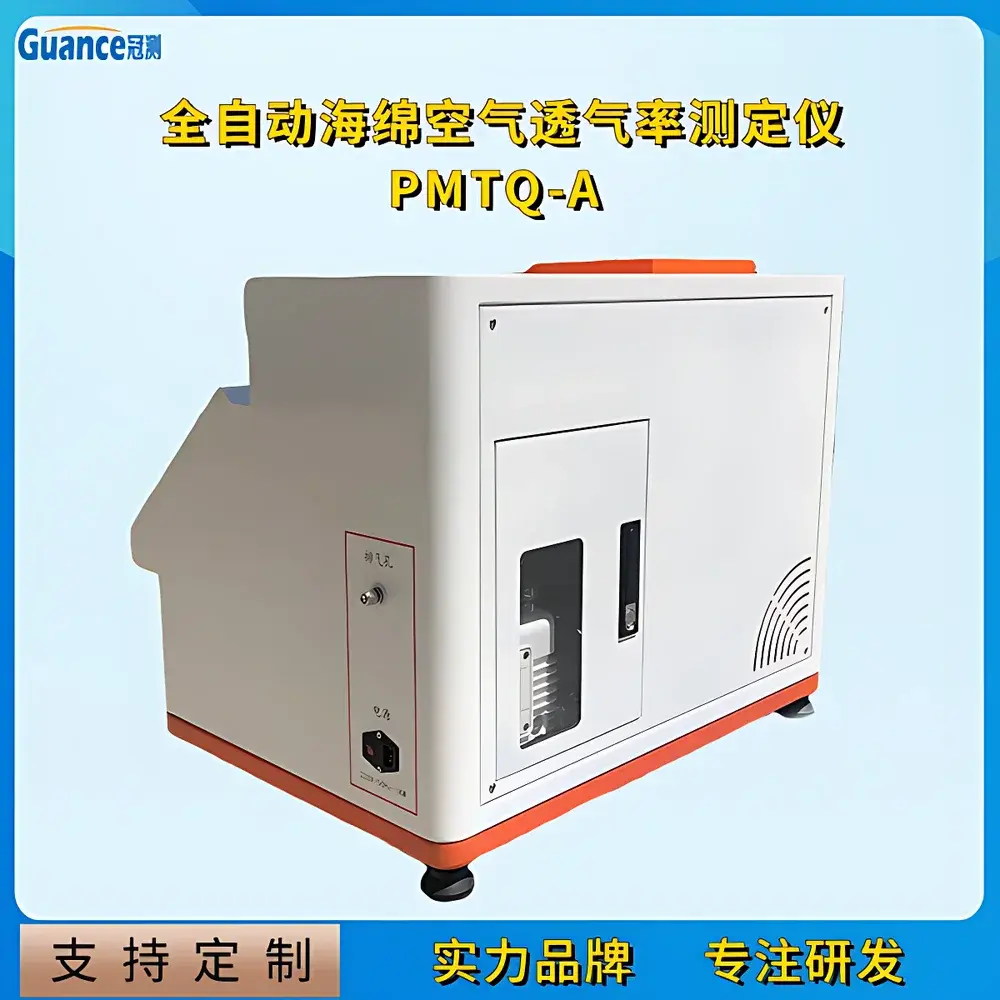
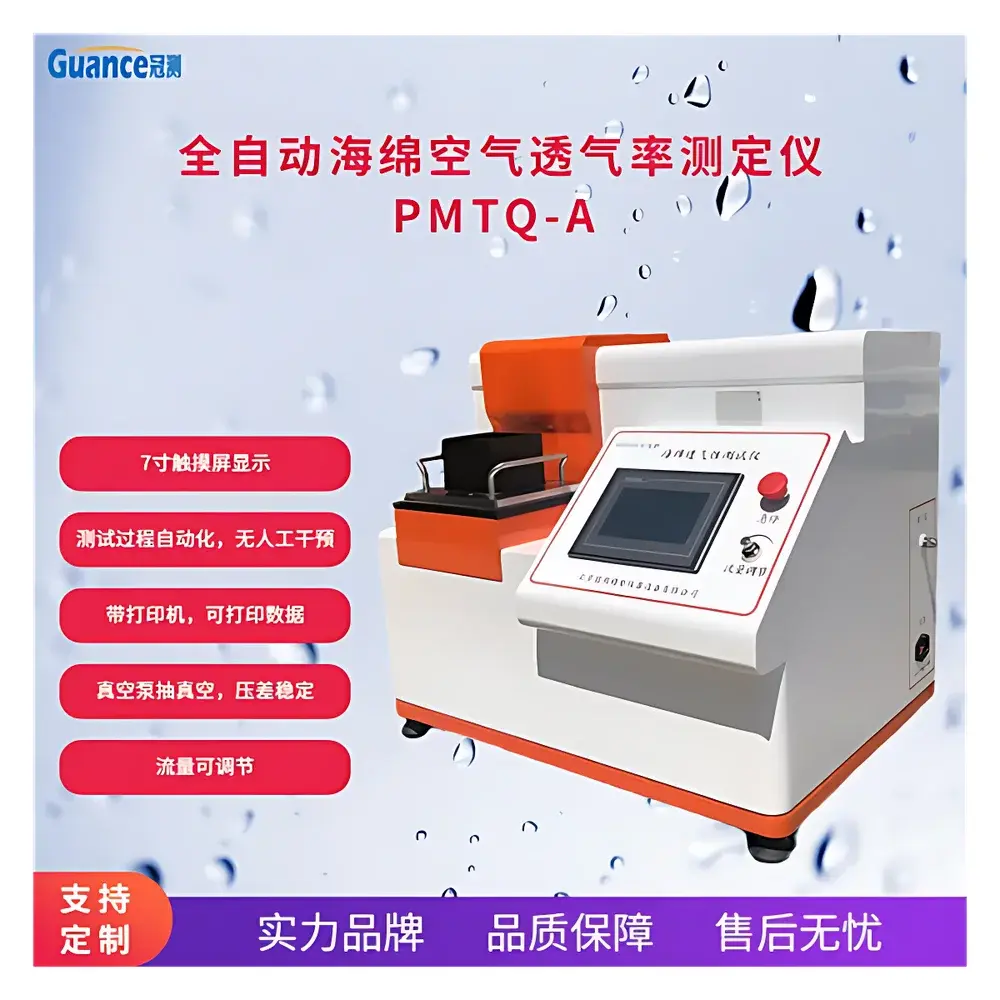
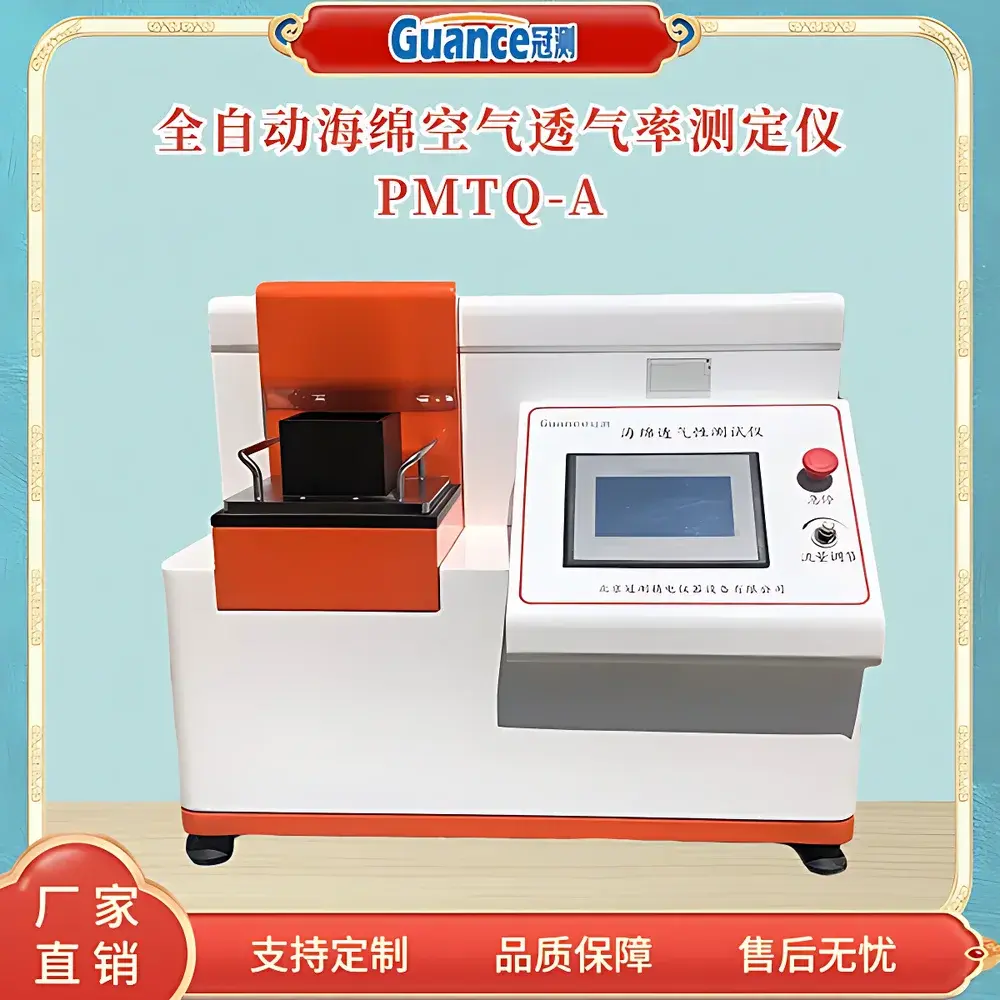
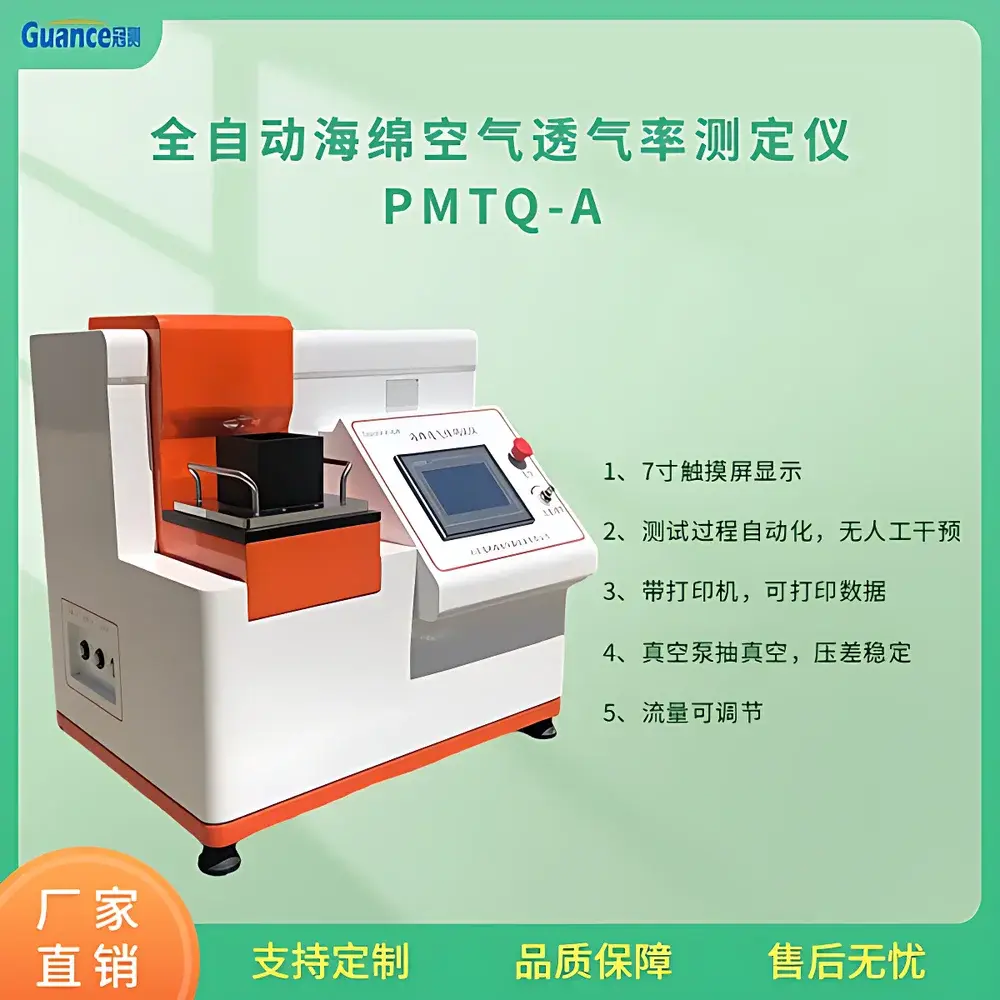
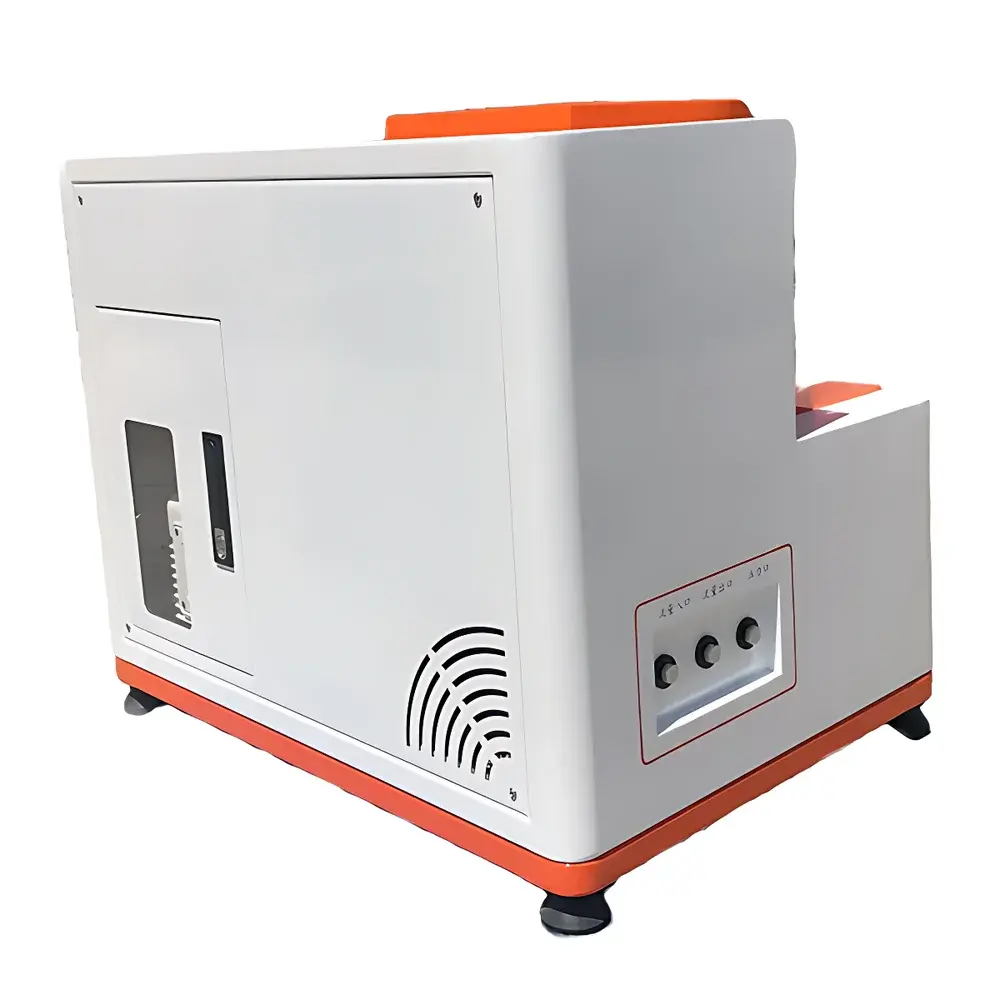
Guance Instruments PMTQ-A.2 Foam Air Permeability Analyzer for Flexible Polymeric Foams
| Brand | Guance Instruments |
|---|---|
| Origin | Beijing, China |
| Manufacturer Type | Authorized Distributor |
| Country of Origin | China |
| Model | PMTQ-A.2 |
| Price | USD 2,800 (FOB Beijing) |
| Compliance | ISO 4638:1984, GB/T 10655, ASTM D3574-2005, AQ 1088-2011 |
| Vacuum Pump | 1.3 m³/h (4.8 L/s), Ultimate Vacuum: 5 × 10² Pa |
| Flow Sensor Range | 0–50 L/min |
| Differential Pressure Sensors | Dual-range — 0–400 Pa & 0–100 Pa |
| Test Chamber Dimensions | 100 mm × 100 mm × 104 mm (L×W×D) |
| Specimen Size | 102 mm × 102 mm × (0–100) mm |
| Air Permeability Range | 0–999.9 × 10⁻¹⁰ m² |
| Temperature Sensor | −40 °C to +80 °C |
| Chamber Material | 4 mm 304 brushed stainless steel |
| Safety Protections | Over-temperature, over-pressure, over-flow, and motor overload protection |
| Unit Dimensions | 800 mm × 630 mm × 700 mm (L×W×H) |
| Weight | 85 kg |
| Power Supply | 1 kW, 220 V AC, 50 Hz |
Overview
The Guance Instruments PMTQ-A.2 Foam Air Permeability Analyzer is a precision-engineered instrument designed for the quantitative determination of air permeability in flexible polymeric foams—including polyurethane, latex, sponge rubber, and other open-cell elastomeric materials. It operates on the principle of steady-state laminar airflow through a standardized test specimen under controlled differential pressure, in strict accordance with the fundamental physical model described in ISO 4638:1984 and GB/T 10655. The system applies Darcy’s law for porous media flow, where air permeability (k) is calculated as k = (Q·μ·d)/(A·ΔP), with Q representing volumetric flow rate, μ dynamic viscosity (temperature-compensated), d specimen thickness, A cross-sectional area, and ΔP applied pressure drop. Unlike legacy manual systems such as the RXQ-1, the PMTQ-A.2 integrates dual-range differential pressure sensing, real-time temperature compensation, and closed-loop vacuum control—enabling reproducible, operator-independent measurements within ≤10 seconds per test cycle.
Key Features
- Integrated dual-range differential pressure transducers (0–100 Pa and 0–400 Pa) automatically switch based on measured ΔP to optimize signal-to-noise ratio and measurement resolution.
- 7-inch industrial-grade capacitive touchscreen HMI with intuitive, icon-driven workflow—no training required for routine operation.
- Real-time temperature compensation: embedded Pt100 sensor continuously monitors ambient and chamber temperature, dynamically adjusting air viscosity (μ) using Sutherland’s formula per ISO 8503-2 Annex B.
- High-stability vacuum system featuring a 1.3 m³/h oil-free diaphragm pump with ultimate vacuum ≤500 Pa, ensuring consistent flow initiation and repeatability across humidity gradients.
- Comprehensive parameter output per test: differential pressure (Pa), volumetric flow rate (L/min), air permeability (×10⁻¹⁰ m²), linear flow velocity (mm/s), specific flow resistance (Pa·s/m), and flow resistivity (Pa·s/m²).
- Multi-level safety architecture: hardware-based thermal cutoff, pressure relief valve, flow limiter, and motor current monitoring—all compliant with IEC 61000-6-2/6-4 EMC requirements.
Sample Compatibility & Compliance
The PMTQ-A.2 accommodates specimens up to 102 mm × 102 mm × 100 mm—fully covering standard test coupons defined in ASTM D3574 Method D (air permeability), ISO 4638 Clause 5, and GB/T 10655 Section 4. Its stainless-steel test chamber (304 grade, 4 mm wall thickness) resists corrosion from residual solvents or aging byproducts common in PU foam degradation studies. The instrument meets functional equivalence requirements for GLP-compliant laboratories: all critical parameters (ΔP, Q, T) are timestamped and logged with 0.1 s resolution; raw data export supports CSV and XML formats for traceability. While not certified to FDA 21 CFR Part 11 out-of-the-box, its audit trail architecture (user login, test ID, calibration stamp, and digital signature fields) enables validation per internal SOPs aligned with ISO/IEC 17025:2017 Clause 7.7.
Software & Data Management
Firmware v3.2 embeds a deterministic real-time OS (RTOS) with deterministic sampling intervals (100 Hz for pressure, 50 Hz for temperature and flow). All measurements are stored locally on a 4 GB industrial-grade eMMC module with cyclic overwrite protection. USB 2.0 host port enables direct export of test reports—including statistical summaries (n ≥ 3), coefficient of variation (CV%), and pass/fail status against user-defined limits. Optional Ethernet interface (RJ45, TCP/IP stack) supports integration into LIMS via Modbus TCP or HTTP REST API (JSON payload), enabling automated result ingestion without manual transcription. Calibration certificates (traceable to NIM, China) include uncertainty budgets per GUM (JCGM 100:2008).
Applications
- Quality control of automotive seat foams (e.g., breathability verification per VW 50180)
- R&D of flame-retardant spray-applied sealants for mine ventilation ducts (per AQ 1088-2011)
- Comparative analysis of bio-based polyol formulations versus petrochemical counterparts
- Accelerated aging studies: tracking permeability drift after UV exposure or thermal cycling (−20 °C to +70 °C)
- Regulatory submission support for medical cushioning devices (ISO 10993-5 cytotoxicity screening prerequisite)
FAQ
What standards does the PMTQ-A.2 directly support?
ISO 4638:1984, GB/T 10655, ASTM D3574-2005 (Method D), and AQ 1088-2011 — all implemented via fixed test protocols embedded in firmware.
Is temperature compensation mandatory or optional?
Mandatory: air viscosity varies ±2.4% per 10 °C change near 23 °C; the system applies real-time correction using measured chamber temperature.
Can the instrument be calibrated in-house?
Yes — users may perform span calibration using NIST-traceable pressure and flow references; full calibration requires factory service or authorized metrology lab.
Does the unit support continuous unattended operation?
Yes — with external power conditioning and stable ambient temperature (23 ± 2 °C), it supports batch testing of up to 99 samples with auto-sequencing.
What maintenance is required beyond annual calibration?
Monthly inspection of vacuum line seals, quarterly cleaning of stainless-steel chamber interior with IPA, and biannual replacement of pump diaphragm (part #GP-DIA-02).
Related Products



