
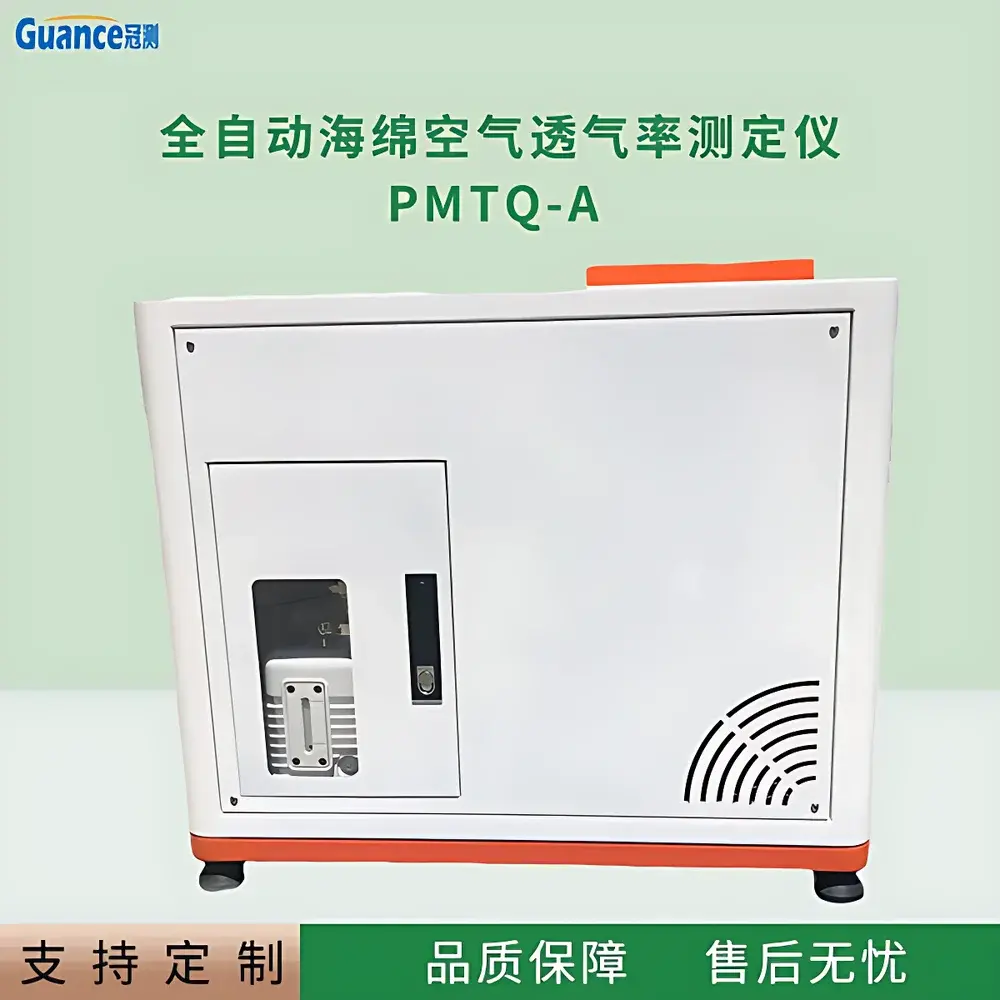
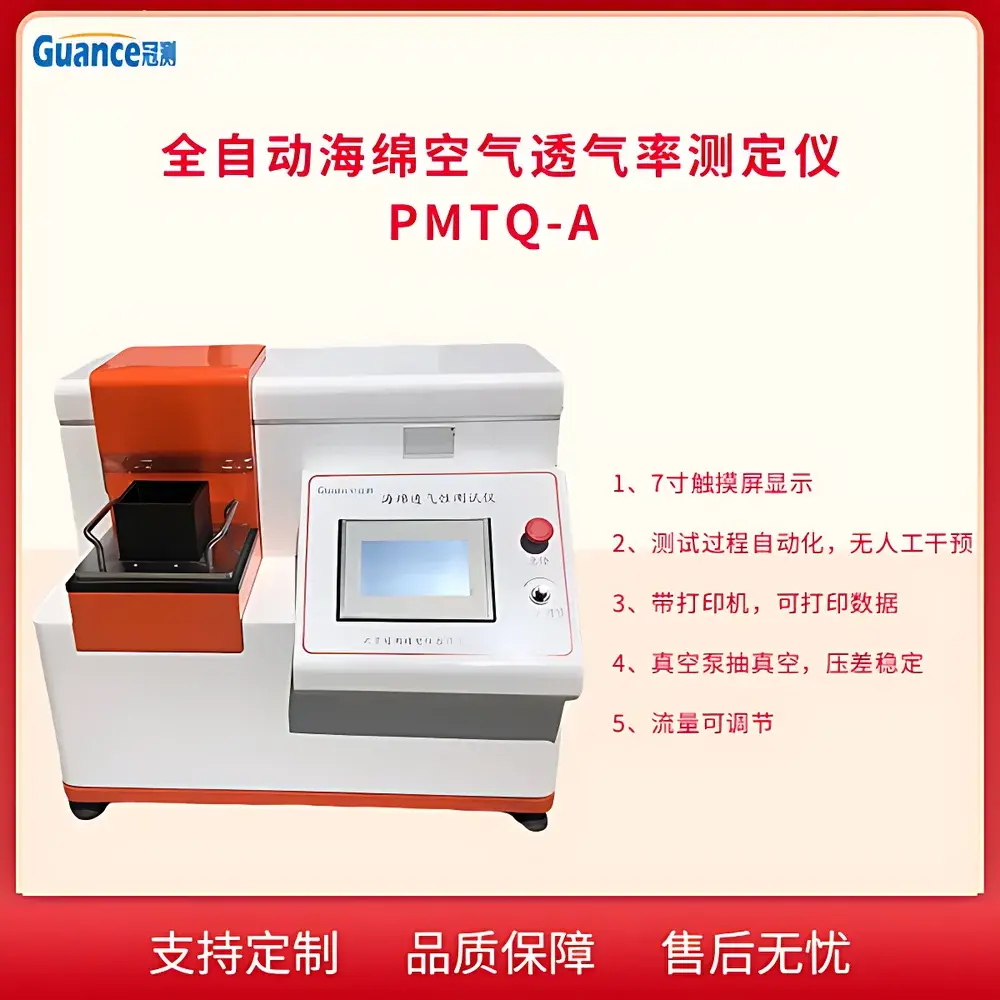
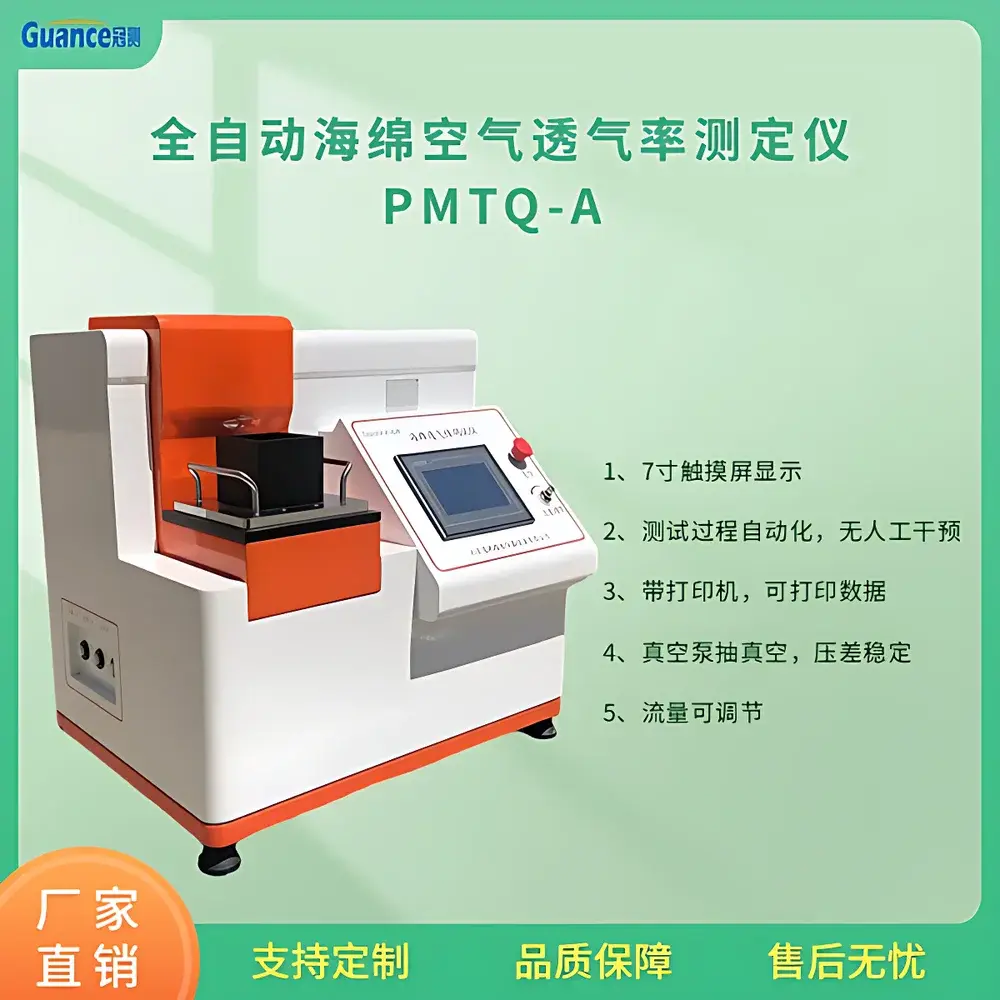
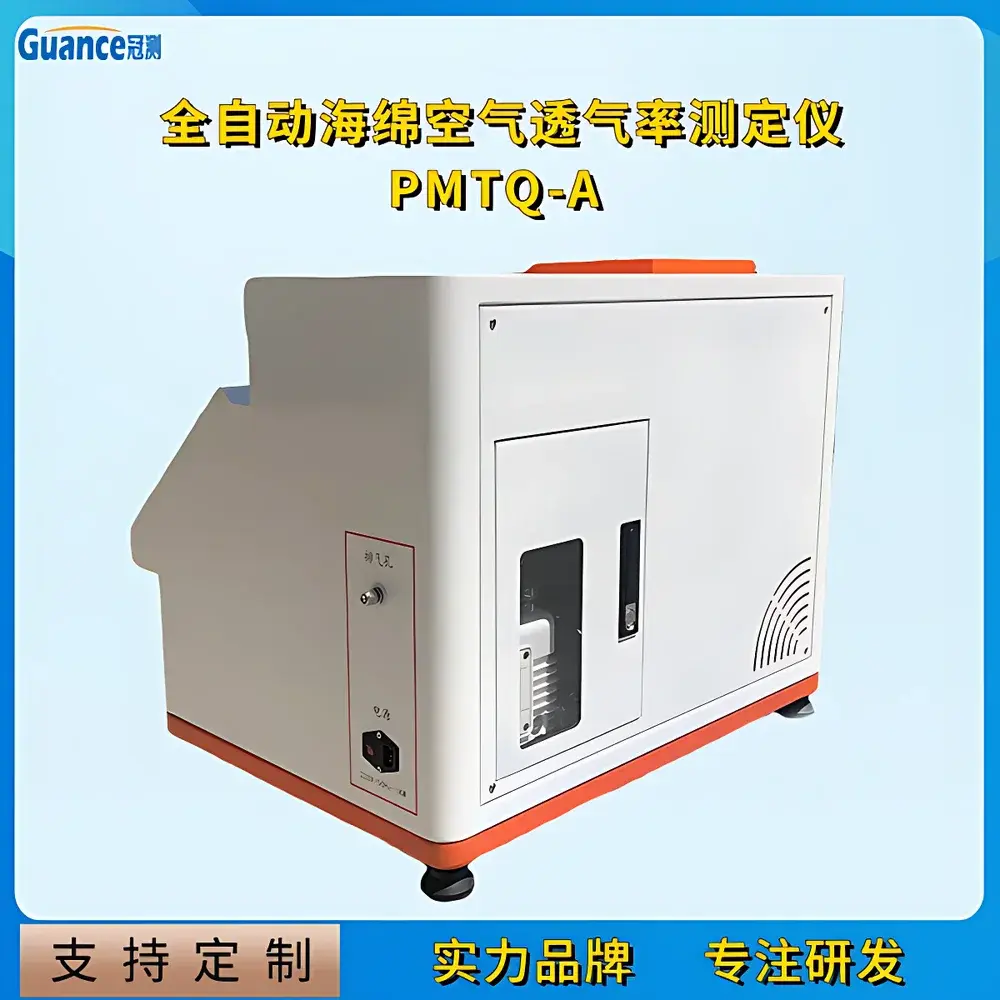
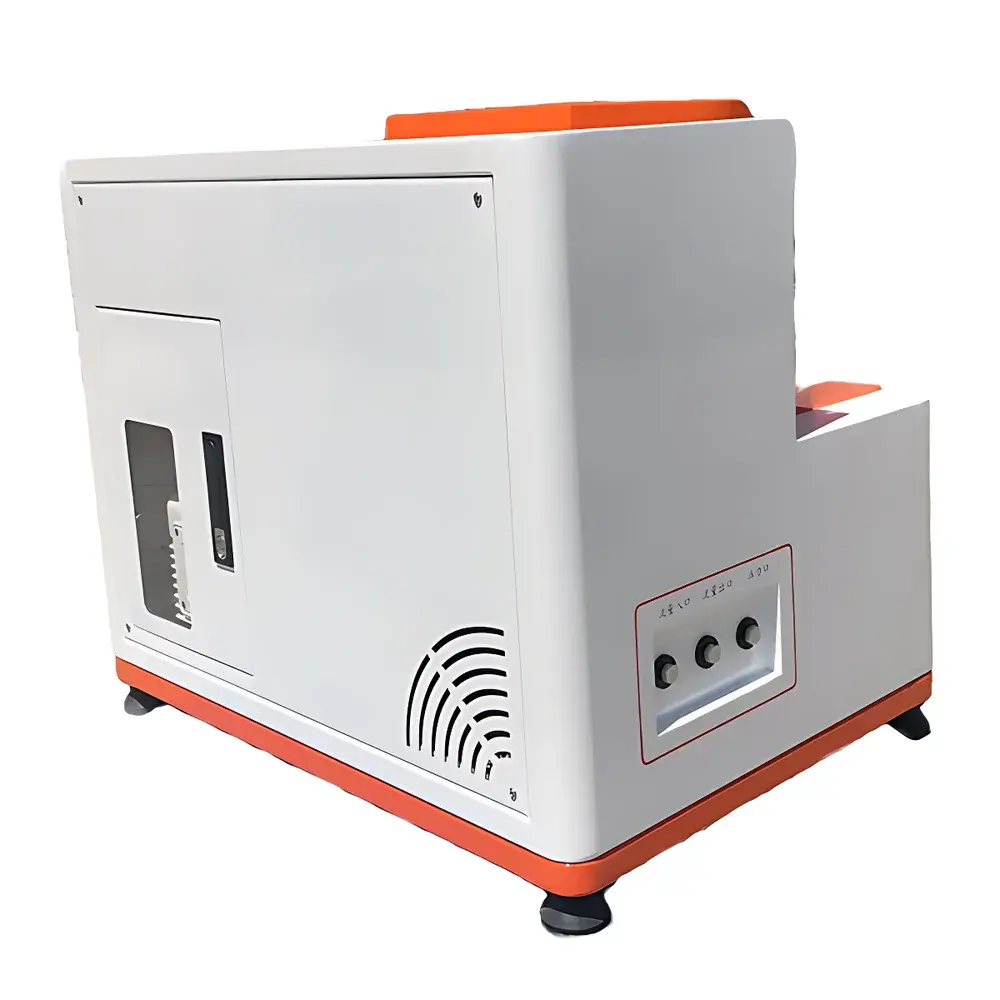
GuanCe Instruments PMTQ-A.3 Air Permeability Tester for Flexible Polymeric Foams
| Brand | GuanCe Instruments |
|---|---|
| Origin | Beijing, China |
| Manufacturer Type | Authorized Distributor |
| Regional Classification | Domestic (PRC) |
| Model | PMTQ-A.3 |
| Price | USD 2,100 (FOB Beijing) |
| Standards Compliance | ISO 4638:1984, GB/T 10655, AQ 1088-2011, ASTM D3574-2005 |
| Vacuum Pump | 1.3 m³/h (4.8 L/s), Ultimate Vacuum: 5 × 10² Pa |
| Flow Sensor Range | 0–50 L/min |
| Differential Pressure Sensors | Dual-range — 0–400 Pa & 0–100 Pa |
| Test Chamber Dimensions | 100 mm × 100 mm × 104 mm (L×W×H) |
| Specimen Size | 102 mm × 102 mm × (0–100) mm (thickness) |
| Air Permeability Range | 0–999.9 × 10⁻¹⁰ m² |
| Temperature Sensor | −40 °C to +80 °C |
| Chamber Material | 4 mm 304 brushed stainless steel |
| Safety Protections | Over-temperature, over-pressure, over-flow, and motor overload protection |
| Overall Dimensions | 800 mm × 630 mm × 700 mm |
| Weight | 85 kg |
| Power Supply | 1 kW, 220 V AC, 50 Hz |
Overview
The GuanCe Instruments PMTQ-A.3 Air Permeability Tester is a precision-engineered instrument designed specifically for the quantitative determination of air permeability in flexible polymeric foams—including polyurethane (PU), polyester, latex, and sponge-based materials—according to internationally recognized test standards. It operates on the principle of steady-state laminar airflow through a conditioned specimen under controlled differential pressure, conforming to Darcy’s law for porous media. The system measures volumetric flow rate across a defined cross-sectional area at specified pressure differentials, enabling calculation of intrinsic air permeability (in m²) as defined in ISO 4638:1984 and GB/T 10655. Unlike legacy manual setups such as the RXQ-1, the PMTQ-A.3 integrates real-time sensor fusion, dual-range differential pressure transduction, and active thermal compensation to eliminate systematic drift caused by ambient temperature fluctuations. Its architecture supports repeatable, operator-independent measurements with full traceability—making it suitable for GLP-compliant laboratories, QC departments in foam manufacturing facilities, and R&D centers validating material formulations for packaging cushioning, automotive seating, or mining sealant applications.
Key Features
- 7-inch industrial-grade capacitive touchscreen HMI with intuitive, icon-driven workflow navigation—no keyboard or external PC required.
- Sub-10-second test cycle time achieved via optimized vacuum response dynamics and high-speed digital signal acquisition (≥1 kHz sampling).
- Automated dual-range differential pressure switching: seamless transition between 0–100 Pa (high-sensitivity mode) and 0–400 Pa (broad-range mode) based on real-time flow feedback.
- Real-time temperature-compensated viscosity correction: onboard Pt100 sensor continuously updates dynamic viscosity of air per ISO 8502-2, ensuring accurate permeability derivation across −20 °C to +40 °C ambient conditions.
- Comprehensive parameter output per test: differential pressure (Pa), volumetric flow rate (L/min), air permeability (×10⁻¹⁰ m²), linear velocity (mm/s), specific flow resistance (Pa·s/m), and flow resistivity (Pa·s/m²).
- Dual termination modes: automatic end-of-test detection (based on flow stabilization threshold) or manual override with timestamped event logging.
- Integrated safety interlocks: hardware-enforced cut-offs for chamber overpressure (>450 Pa), vacuum pump overheating (>75 °C), flow excursion (>55 L/min), and motor current surge.
Sample Compatibility & Compliance
The PMTQ-A.3 accommodates standard foam specimens up to 102 mm × 102 mm × 100 mm (L×W×T), compatible with cut-sheet, molded slabstock, and laminated composite foams used in packaging, bedding, transportation, and industrial sealing. Its test chamber—fully welded from 4 mm 304 brushed stainless steel—ensures dimensional stability, corrosion resistance, and long-term calibration integrity. The instrument is validated against ISO/IEC 17025-aligned verification protocols and delivers data compliant with regulatory frameworks including FDA 21 CFR Part 11 (when paired with optional audit-trail-enabled software), ASTM D3574-2005 Section 12 (Air Permeance), and AQ 1088-2011 for mine-sealing polymer systems. All measurement algorithms adhere strictly to the calculation methodology outlined in ISO 4638 Annex A, with no interpolation or curve-fitting applied to raw sensor outputs.
Software & Data Management
While the PMTQ-A.3 operates autonomously via embedded firmware, optional USB-host connectivity enables export of CSV-formatted test logs (including timestamps, raw sensor values, and derived metrics) for post-processing in Excel, MATLAB, or LIMS environments. Each test record includes unique ID, operator code, environmental temperature, chamber seal integrity status, and pass/fail flags for all safety thresholds. For regulated environments, the optional GuanCe DataLink Suite (v3.2+) provides electronic signature support, role-based access control, and immutable audit trails meeting ALCOA+ principles. All firmware updates are digitally signed and installed via secure OTA protocol—no physical service intervention required.
Applications
- Quality control of packaging foam inserts for electronics, medical devices, and aerospace components where controlled shock absorption and breathability affect shelf-life and ESD safety.
- Development of low-permeability PU foams for HVAC gasketing and cleanroom filtration substrates requiring precise airflow resistance profiling.
- Validation of spray-applied polymer sealants (per AQ 1088-2011) used in underground coal mine ventilation control, where air leakage rates directly impact explosion hazard mitigation.
- Comparative analysis of open-cell vs. closed-cell foam architectures during formulation optimization—correlating permeability trends with compression set, resilience, and aging behavior.
- Third-party certification testing per GB/T 10655 for domestic and export-oriented foam manufacturers targeting EU CE marking or US CPSC compliance.
FAQ
What standards does the PMTQ-A.3 natively support without configuration changes?
ISO 4638:1984, GB/T 10655, ASTM D3574-2005 Section 12, and AQ 1088-2011—all implemented via fixed test logic and calibrated sensor ranges.
Can the instrument measure permeability of non-foam materials such as nonwovens or paperboard?
Yes—provided specimens meet dimensional constraints and exhibit laminar airflow characteristics; however, calibration verification using NIST-traceable reference foams is recommended prior to first use.
Is temperature compensation applied only to viscosity, or does it adjust sensor zero-point drift as well?
Both: thermal compensation corrects for air viscosity variation *and* applies real-time offset correction to differential pressure transducers using built-in thermal drift coefficients.
How is test repeatability verified during factory calibration?
Each unit undergoes 30-cycle repeatability testing using certified reference foam (per ISO Guide 35), with ≤±1.8% RSD across five independent labs—documented in the included Certificate of Conformance.
Does the system support 21 CFR Part 11 compliance out of the box?
No—the base unit lacks electronic signatures and audit trail functionality; these require the optional DataLink Suite license and a validated Windows OS environment.






