
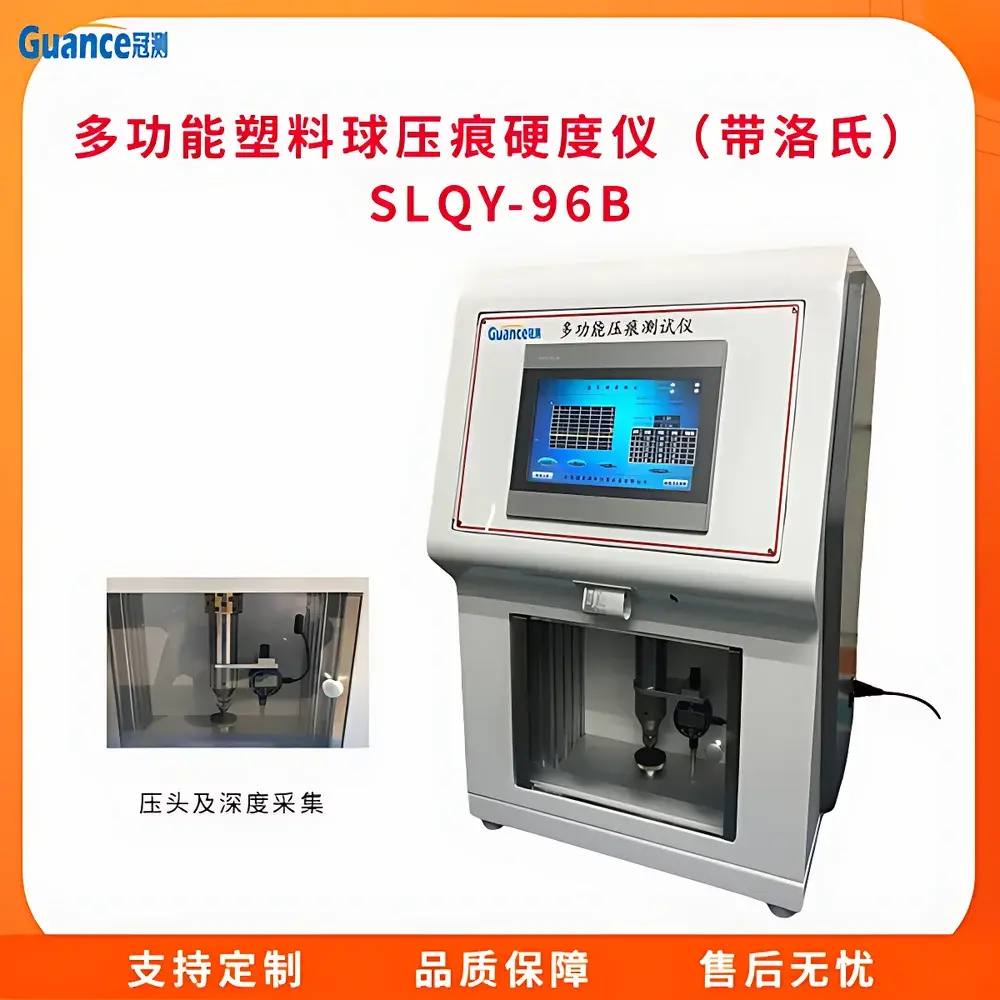
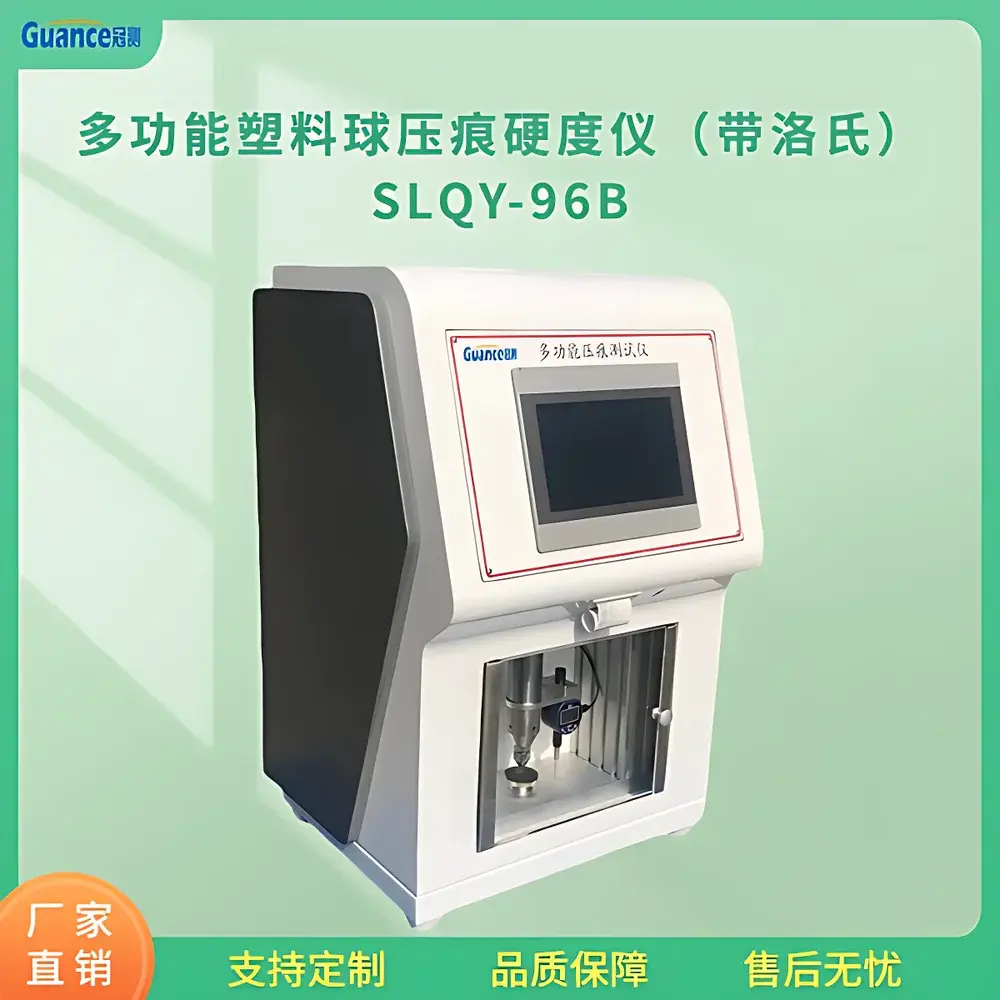
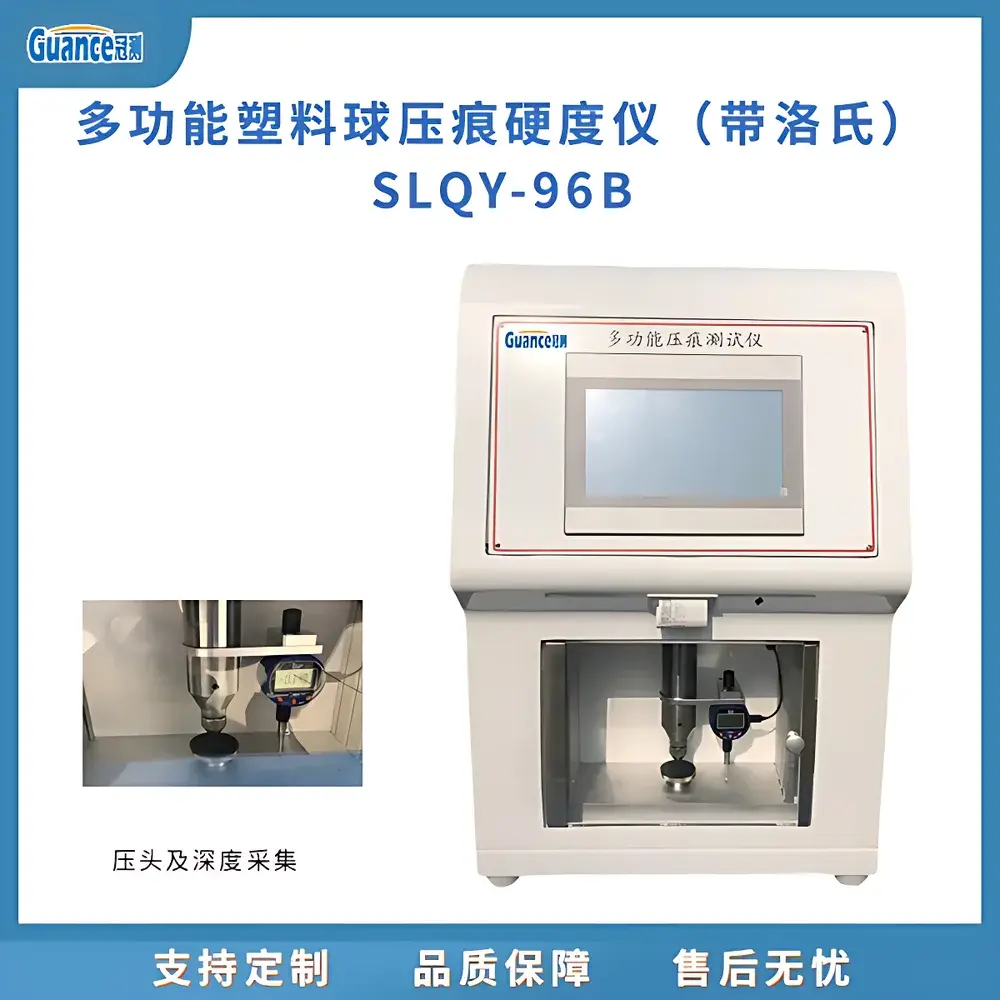
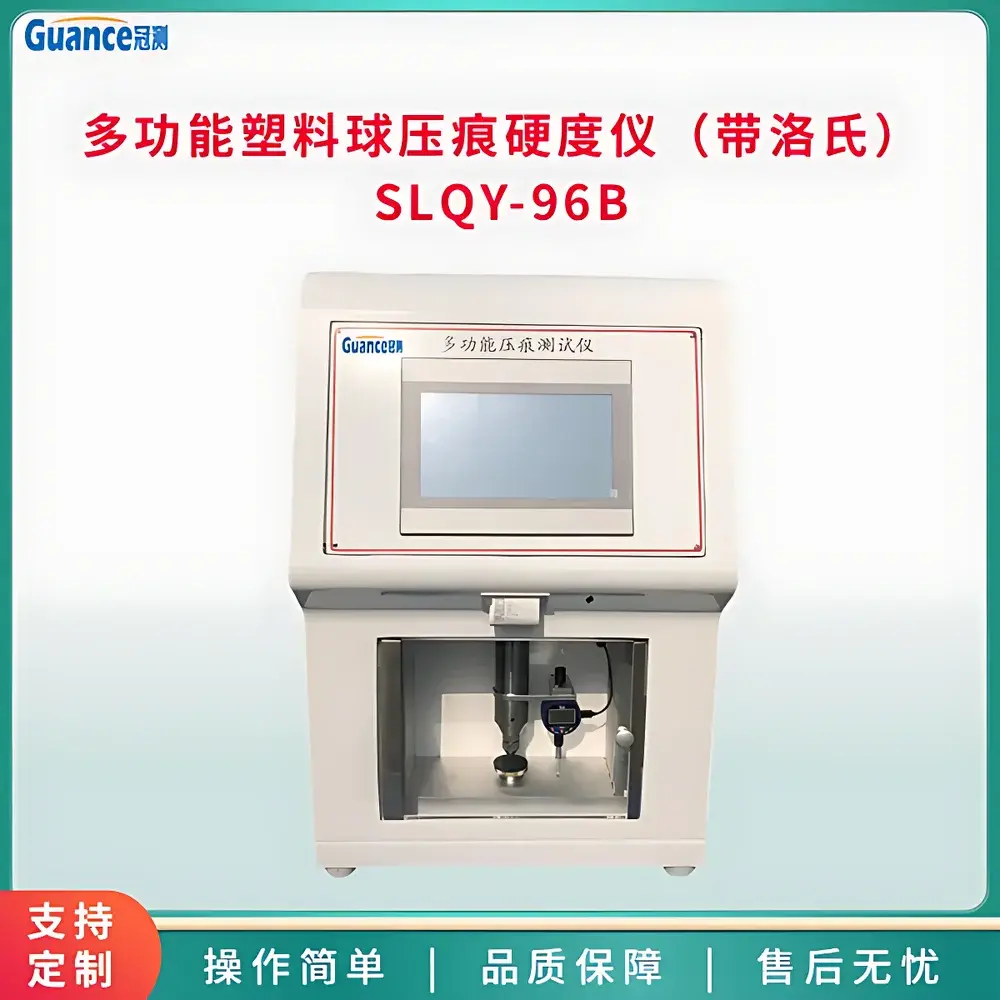
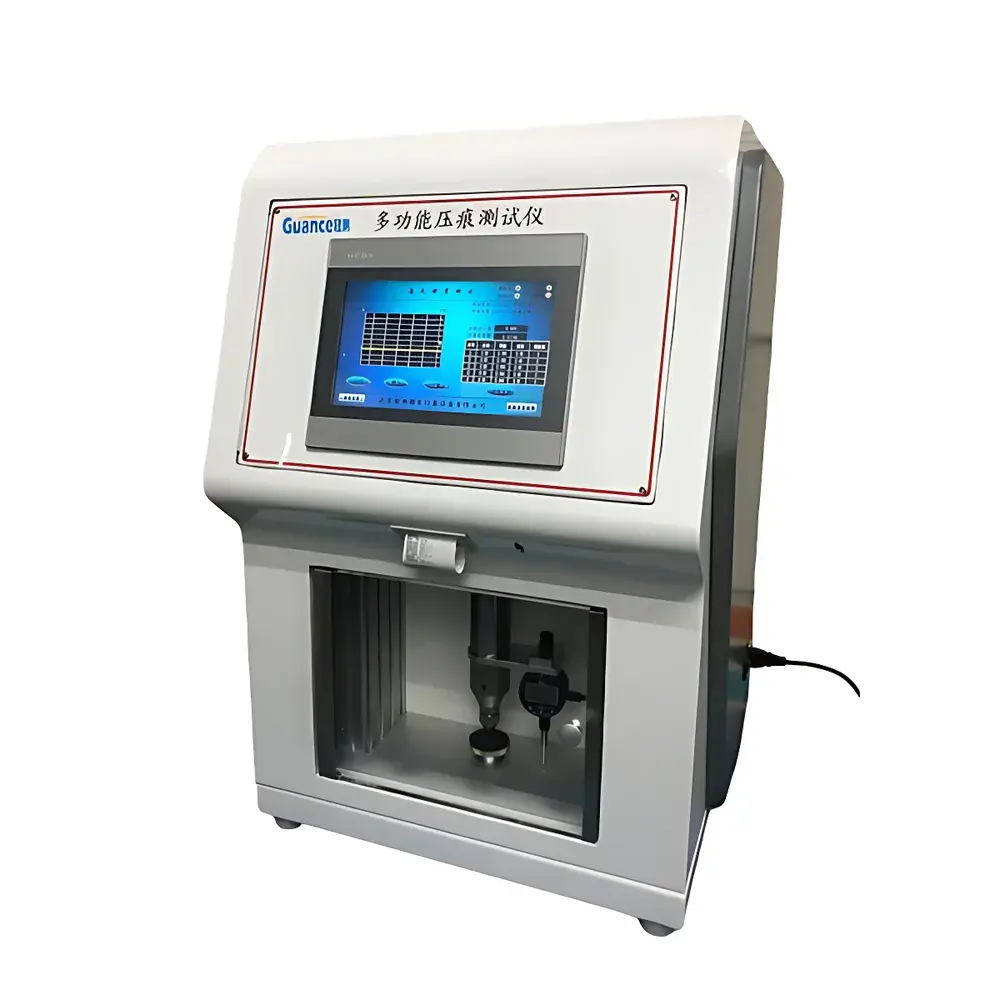
GuanCe Instruments SLQY-96B4 Ball Indentation Hardness Tester for Plastics
| Brand | GuanCe Instruments |
|---|---|
| Origin | Beijing, China |
| Manufacturer Type | Authorized Distributor |
| Country of Origin | China |
| Model | SLQY-96B4 |
| Instrument Type | Ball Indentation Hardness Tester (compliant with ISO 2039-1 and ASTM D785 for comparative Rockwell-scale measurements) |
| Test Force Range | 9.8 N (ball indentation preload), 49 N / 132 N / 358 N / 612 N / 961 N (main indentation forces) |
| Indentation Depth Resolution | 0.001 mm |
| Display Interface | 10-inch capacitive touchscreen HMI |
| Data Output | Integrated thermal micro-printer |
| Test Modes | Ball Indentation (ISO 2039-1), Rockwell-type hardness (ASTM D785 reference scale), Compression Resistance Test |
Overview
The GuanCe Instruments SLQY-96B4 Ball Indentation Hardness Tester is a precision-engineered instrument designed specifically for the quantitative mechanical evaluation of thermoplastic and thermosetting polymer materials. It operates on the principle of controlled quasi-static indentation using a hardened steel ball under defined load conditions, in strict accordance with ISO 2039-1:2023 “Plastics — Determination of indentation hardness by means of a spherical indenter” and referenced methodologies aligned with ASTM D785 (Rockwell hardness of plastics). Unlike conventional Rockwell hardness testers intended for metals, the SLQY-96B4 implements a dual-force protocol: a light pre-load (9.8 N) establishes initial contact and zero-reference, followed by application of one of five standardized main test forces (49 N to 961 N) for a specified dwell time. The resulting permanent indentation depth—measured with ±0.001 mm resolution via a calibrated linear variable differential transformer (LVDT)-based displacement sensor—is converted into a dimensionless ball indentation hardness number (H, expressed in MPa), enabling direct comparison across material grades and processing conditions.
Key Features
- 10-inch industrial-grade capacitive touchscreen HMI with intuitive parameter configuration, real-time force/depth curve visualization, and multi-language UI support (English default)
- High-stability electromechanical loading system delivering precise, repeatable force application with <±0.5% full-scale accuracy across all five test force levels
- Micro-displacement sensing architecture utilizing a traceable LVDT transducer with 1 µm resolution and thermal drift compensation (≤0.002 mm/°C over 15–30°C ambient range)
- Automated test sequence: auto-zeroing → pre-load application → main load application → dwell → unloading → depth measurement → hardness calculation → actuator return to home position
- Onboard thermal micro-printer providing immediate hardcopy output of test ID, force level, dwell time, measured depth, calculated hardness value (H), and timestamp
- Triple-test-mode capability: dedicated ball indentation mode (ISO 2039-1), Rockwell-type plastic hardness mode (using equivalent scale conversion per ASTM D785 Annex A1), and compression resistance assessment (non-standardized but configurable dwell-and-hold protocol)
Sample Compatibility & Compliance
The SLQY-96B4 accommodates flat, rigid specimens with minimum dimensions of 50 mm × 50 mm × 4 mm (L × W × T), including injection-molded plaques, extruded sheets, and compression-molded discs. Specimen surfaces must be smooth, parallel, and free of burrs or contaminants. The instrument complies with the mechanical and metrological requirements of ISO/IEC 17025:2017 for hardness testing laboratories when operated within validated environmental conditions (23 ± 2°C, 50 ± 5% RH). Its test methodology supports quality control documentation under ISO 9001, IATF 16949, and regulatory submission frameworks requiring mechanical property traceability (e.g., FDA 21 CFR Part 11-compliant data handling optional via external PC interface).
Software & Data Management
While the SLQY-96B4 operates autonomously via its embedded controller, it features a USB 2.0 host port and RS-232 serial interface for bidirectional communication with external PCs. Optional GuanCe LabLink™ PC software (v3.2+) enables raw depth-vs.-time export (CSV), batch report generation (PDF/Excel), statistical process control (SPC) charting (X̄-R, Cp/Cpk), and audit-trail-enabled user access logging—fully compatible with GLP/GMP environments requiring electronic record integrity per ALCOA+ principles. All internal test records are timestamped and stored with unique identifiers; memory capacity supports ≥5,000 test entries with automatic overwrite protection.
Applications
- Quality assurance of polypropylene (PP), polyethylene (PE), ABS, PC, and PVC formulations during incoming raw material inspection
- Process validation of injection molding parameters (melt temperature, holding pressure, cooling time) via hardness correlation studies
- Comparative evaluation of plasticizer content, filler dispersion, or thermal aging effects on surface mechanical integrity
- Supporting technical data sheet (TDS) generation for polymer suppliers in compliance with ISO 1043 and ASTM D4000 classification systems
- Teaching laboratory use in polymer engineering curricula for hands-on demonstration of viscoelastic indentation response
FAQ
Does the SLQY-96B4 meet ISO 2039-1 certification requirements for accredited testing labs?
Yes—the instrument’s force application accuracy, depth resolution, indenter geometry (10 mm diameter hardened steel ball), and dwell timing stability satisfy Clause 5 (Apparatus) and Clause 6 (Procedure) of ISO 2039-1:2023. Full compliance requires annual calibration by an ISO/IEC 17025-accredited provider.
Can test data be exported to LIMS or ERP systems?
Yes—via RS-232 or USB-to-serial emulation, the device supports ASCII-based data streaming compatible with common LIMS middleware (e.g., Thermo Fisher SampleManager, LabVantage) using configurable delimiters and header protocols.
Is the Rockwell-type hardness mode traceable to NIST standards?
No—the Rockwell-scale output is a derived comparative index based on ASTM D785 methodology; it is not a certified Rockwell hardness value per ASTM E18. It serves only as an internal benchmark for relative ranking among plastic samples.
What maintenance is required for long-term measurement stability?
Quarterly verification of indenter sphericity (optical profilometry), annual load cell recalibration, and biannual LVDT linearity check using certified gauge blocks are recommended. No consumables beyond standard lab-grade isopropyl alcohol for indenter cleaning.



