
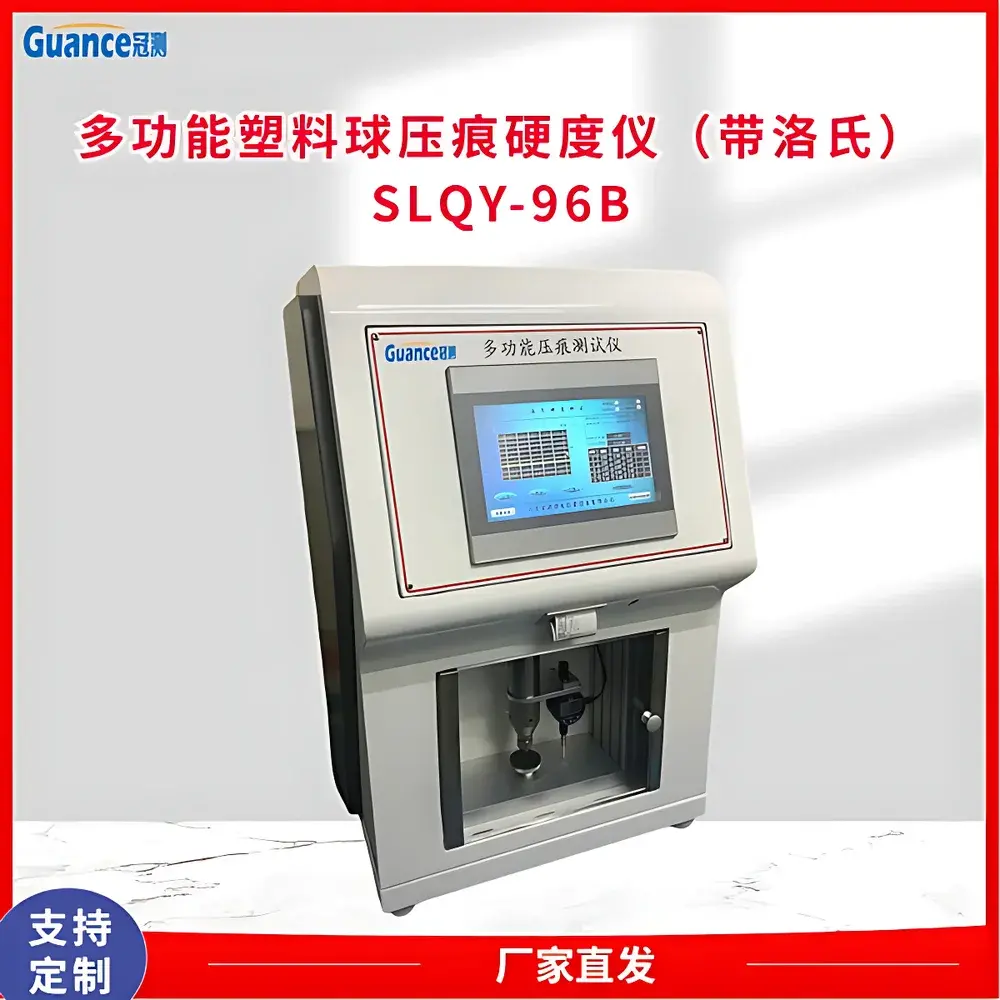
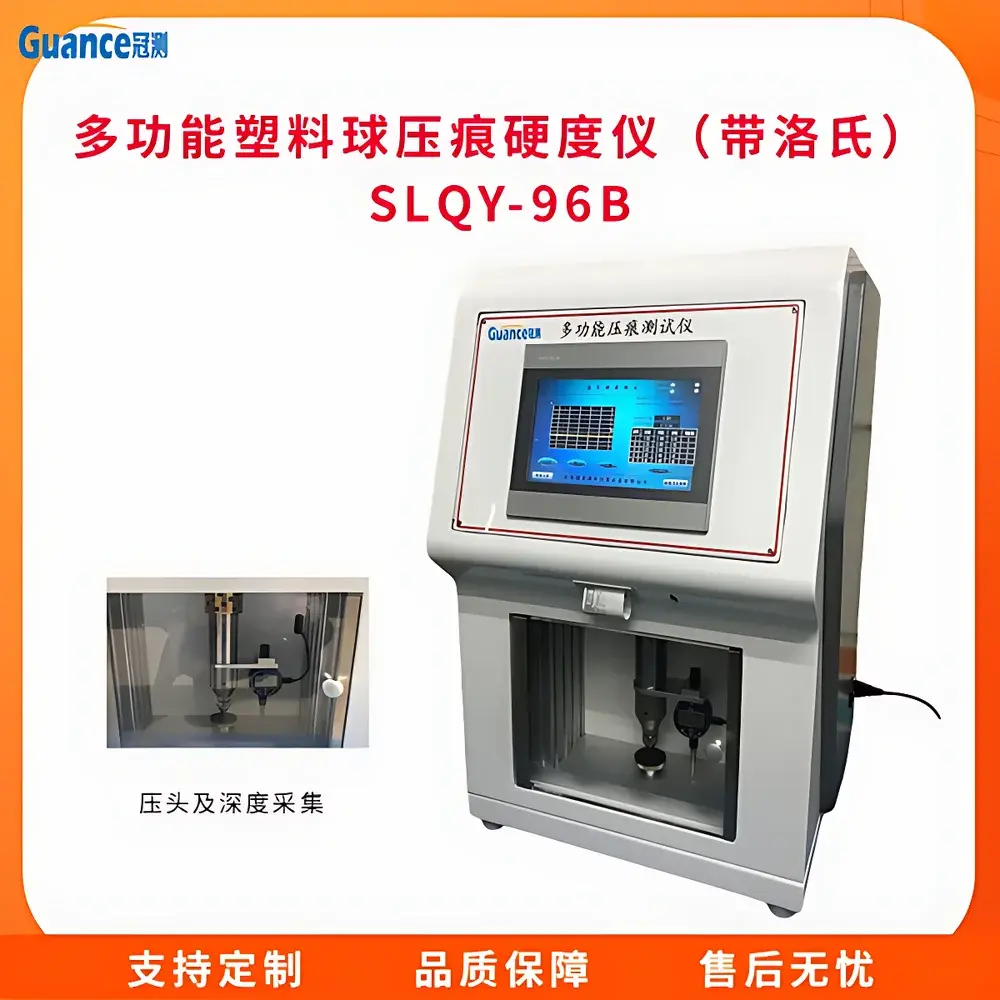
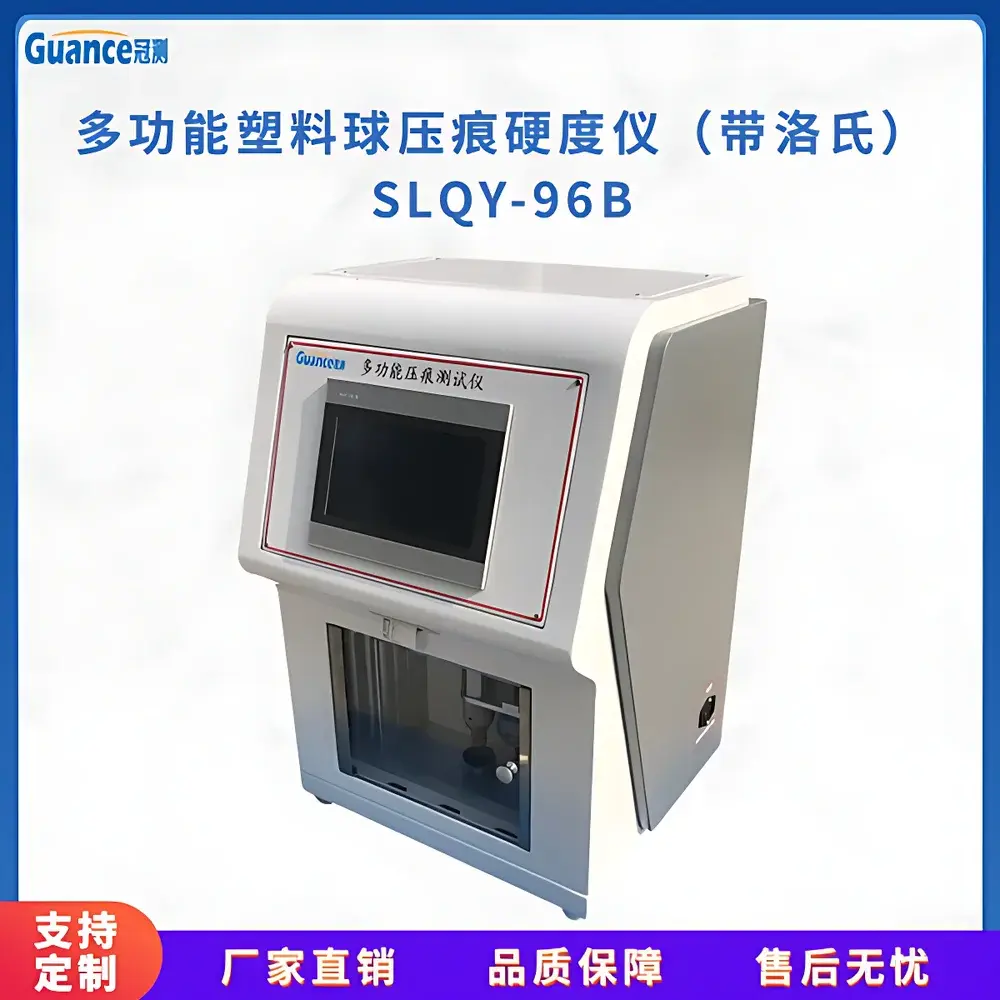
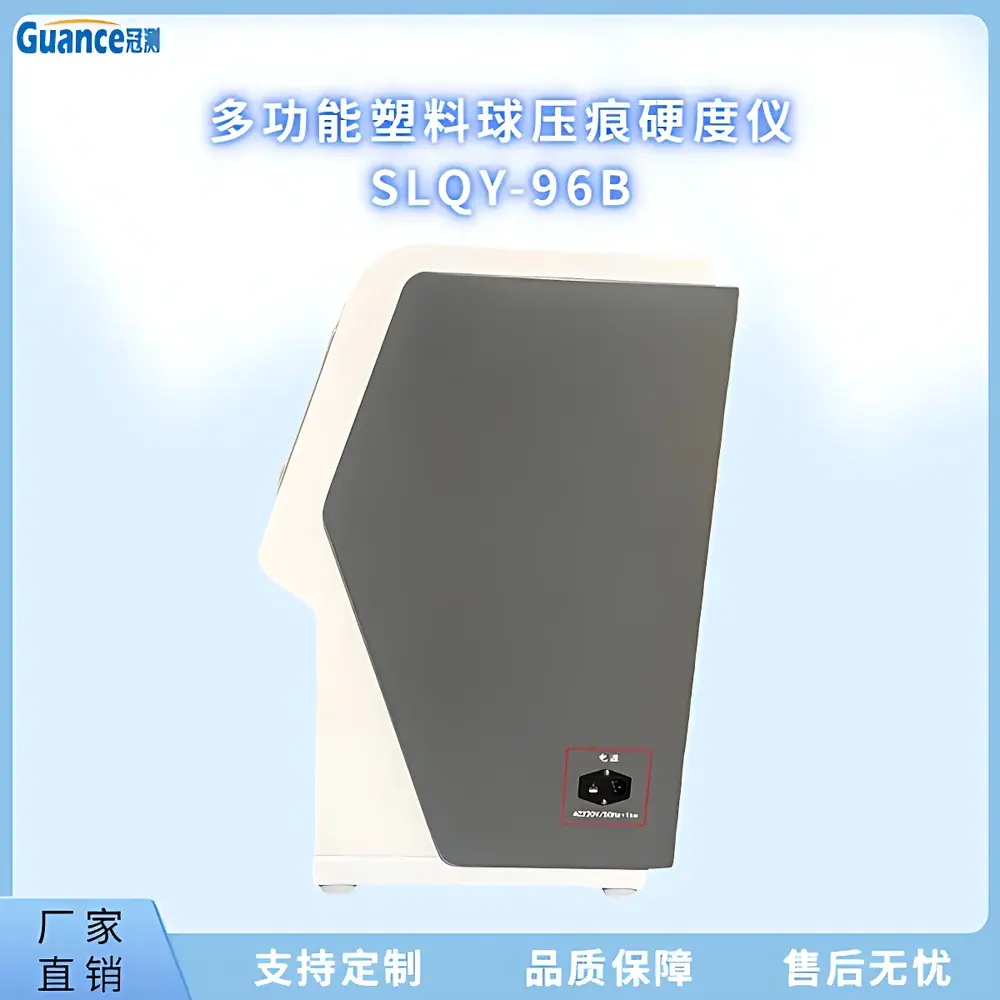
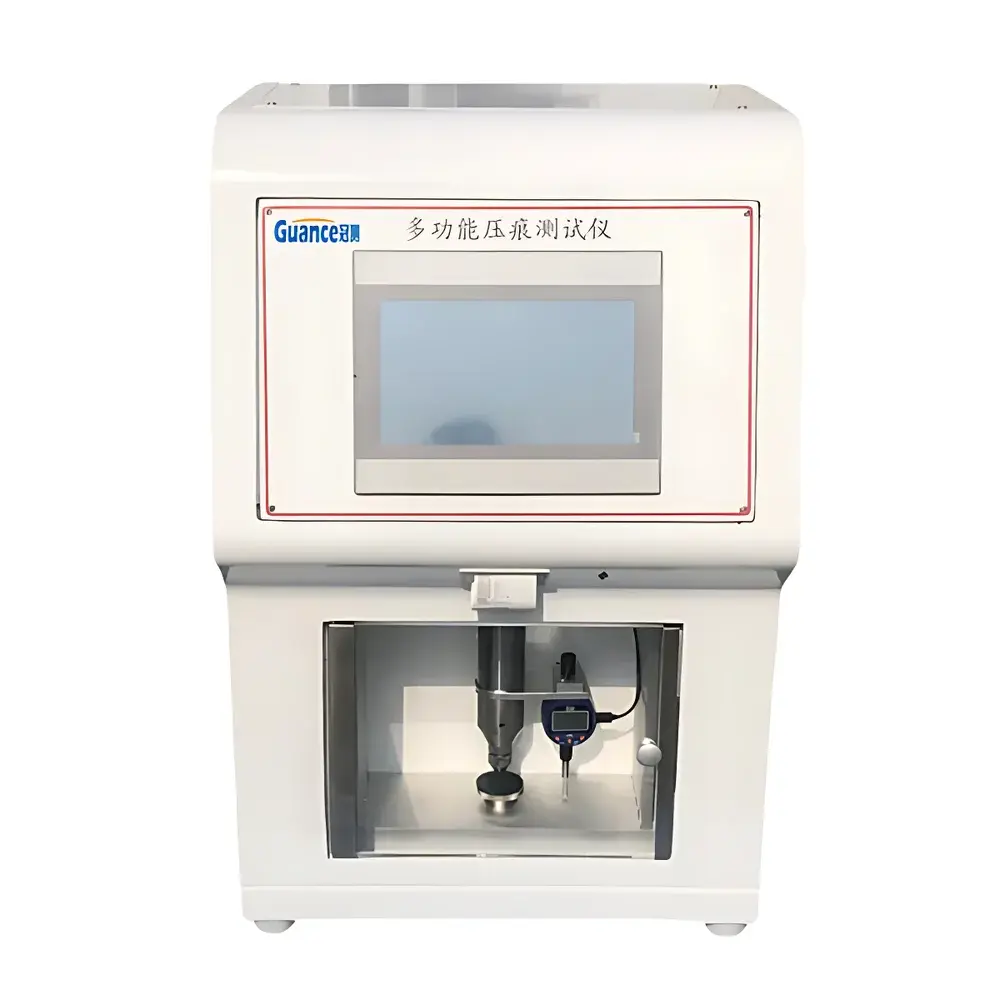
GuanCe Instruments SLQY-96B5 Multi-Function Ball Indentation Hardness Tester
| Brand | GuanCe Instruments |
|---|---|
| Origin | Beijing, China |
| Manufacturer Type | Authorized Distributor |
| Country of Origin | China |
| Model | SLQY-96B5 |
| Instrument Type | Rockwell Hardness Tester |
| Ball Indentation Load | 9.8 N |
| Total Test Forces | 49 N, 132 N, 358 N, 612 N, 961 N |
| Indentation Depth Resolution | 0.001 mm |
| Display Interface | 10-inch capacitive touchscreen |
| Data Output | Integrated thermal micro-printer |
| Test Modes | Ball indentation, Rockwell hardness, compression resistance testing |
Overview
The GuanCe Instruments SLQY-96B5 Multi-Function Ball Indentation Hardness Tester is an electromechanically controlled instrument engineered for standardized mechanical property evaluation of thermoplastics, elastomers, composites, and other polymeric materials under ISO 2039-1, ASTM D785, and GB/T 3398.1–2018. Unlike conventional Rockwell hardness testers designed primarily for metals, the SLQY-96B5 integrates three distinct test methodologies—ball indentation, Rockwell-scale hardness, and compression resistance—within a single platform, enabling comparative assessment across material classes without hardware reconfiguration. Its core measurement principle for ball indentation relies on controlled quasi-static loading of a hardened steel sphere (typically 5 mm diameter) into the specimen surface under defined force-duration profiles, followed by high-resolution depth displacement measurement to determine the permanent indentation depth. This depth value is then converted into a standardized hardness index per ISO 2039-1 methodology, where lower indentation depth correlates with higher material stiffness and resistance to plastic deformation.
Key Features
- 10-inch industrial-grade capacitive touchscreen interface with intuitive GUI for parameter setup, real-time load/depth monitoring, and mode selection—no external PC required for basic operation.
- High-precision linear displacement transducer with ±0.001 mm resolution and <0.5% linearity error over full stroke, calibrated traceable to national metrological standards.
- Automated test sequence execution: motorized loading ramp, dwell time control (10–60 s configurable), unloading, automatic depth readout, result calculation, and indenter retraction—all synchronized via embedded PLC logic.
- Five selectable total test forces (49 N, 132 N, 358 N, 612 N, 961 N) compliant with ISO 2039-1 force tiers, plus dedicated 9.8 N pre-load for ball indentation calibration and soft polymer screening.
- Integrated thermal micro-printer supporting immediate hard-copy output of test ID, force, dwell time, measured depth, calculated hardness value, date/time stamp, and operator ID.
- Robust cast-iron base and guided vertical column ensure minimal frame deflection (<0.2 µm under max load), critical for reproducibility in low-force indentation tests.
Sample Compatibility & Compliance
The SLQY-96B5 accommodates flat, parallel-surface specimens up to 150 mm × 150 mm × 50 mm (L×W×H), with minimum thickness ≥3 mm to prevent substrate interference. It supports rigid thermoplastics (e.g., ABS, PC, PP), semi-crystalline polymers (e.g., PA6, POM), thermoset composites (e.g., epoxy-glass laminates), and vulcanized rubber compounds. All test modes adhere to internationally recognized standards: ball indentation per ISO 2039-1 (Plastics — Determination of indentation hardness by means of a spherical indenter); Rockwell hardness per ASTM D785 (Standard Test Method for Rockwell Hardness of Plastics); and compression resistance per ISO 604 (Plastics — Determination of compressive properties). The instrument’s force application accuracy meets ±1.0% of reading per ISO 14644-1 Class 5 cleanroom-compatible assembly protocols, and its firmware architecture supports audit-ready test logging for GLP/GMP environments.
Software & Data Management
While standalone operation is fully functional via touchscreen, optional USB-host connectivity enables export of CSV-formatted test logs (including raw depth vs. time traces, calculated hardness values, metadata, and pass/fail flags) to external storage or laboratory information management systems (LIMS). Firmware supports user-defined test templates with password-protected access levels (operator, supervisor, administrator), timestamped event logs, and automatic data backup upon power cycle. All digital records include ISO/IEC 17025-aligned traceability: instrument ID, calibration certificate expiry, operator credentials, environmental temperature/humidity tags (when paired with optional external sensor), and revision-controlled firmware versioning. No proprietary software installation is required; exported files are natively readable in Excel, MATLAB, or statistical process control (SPC) platforms.
Applications
- Quality control of injection-molded plastic components for automotive interior trim, medical device housings, and consumer electronics enclosures.
- Comparative ranking of polymer batch consistency during incoming raw material inspection or in-process manufacturing verification.
- R&D evaluation of filler-reinforced composites (e.g., CaCO₃-, glass-fiber-, or carbon-black-loaded systems) where indentation modulus correlates with reinforcement efficiency.
- Accelerated aging studies assessing hardness degradation of elastomeric seals exposed to UV, ozone, or thermal cycling.
- Regulatory submission support for ISO 10993 biocompatibility assessments requiring mechanical property documentation of polymer-based implants.
FAQ
What standards does the SLQY-96B5 comply with for ball indentation testing?
It conforms to ISO 2039-1:2019 and GB/T 3398.1–2018 for indentation hardness determination using a spherical indenter.
Can the instrument perform Rockwell hardness tests on metallic samples?
No—it is optimized for polymeric and non-ferrous materials per ASTM D785; metallic Rockwell testing requires dedicated metallurgical hardness testers with diamond cone indenters and higher force ranges.
Is calibration certification included with shipment?
Yes—a factory calibration report traceable to CNAS-accredited reference standards is provided, covering force application accuracy and displacement transducer linearity.
What is the maximum specimen height clearance under the indenter?
The vertical test space allows specimens up to 50 mm in height, with a minimum base plate distance of 120 mm from the indenter tip at zero position.
Does the system support 21 CFR Part 11 compliance?
The embedded firmware provides electronic signature capability, audit trail generation, and role-based access control—fully configurable to meet FDA 21 CFR Part 11 requirements when deployed within validated IT infrastructure.



