
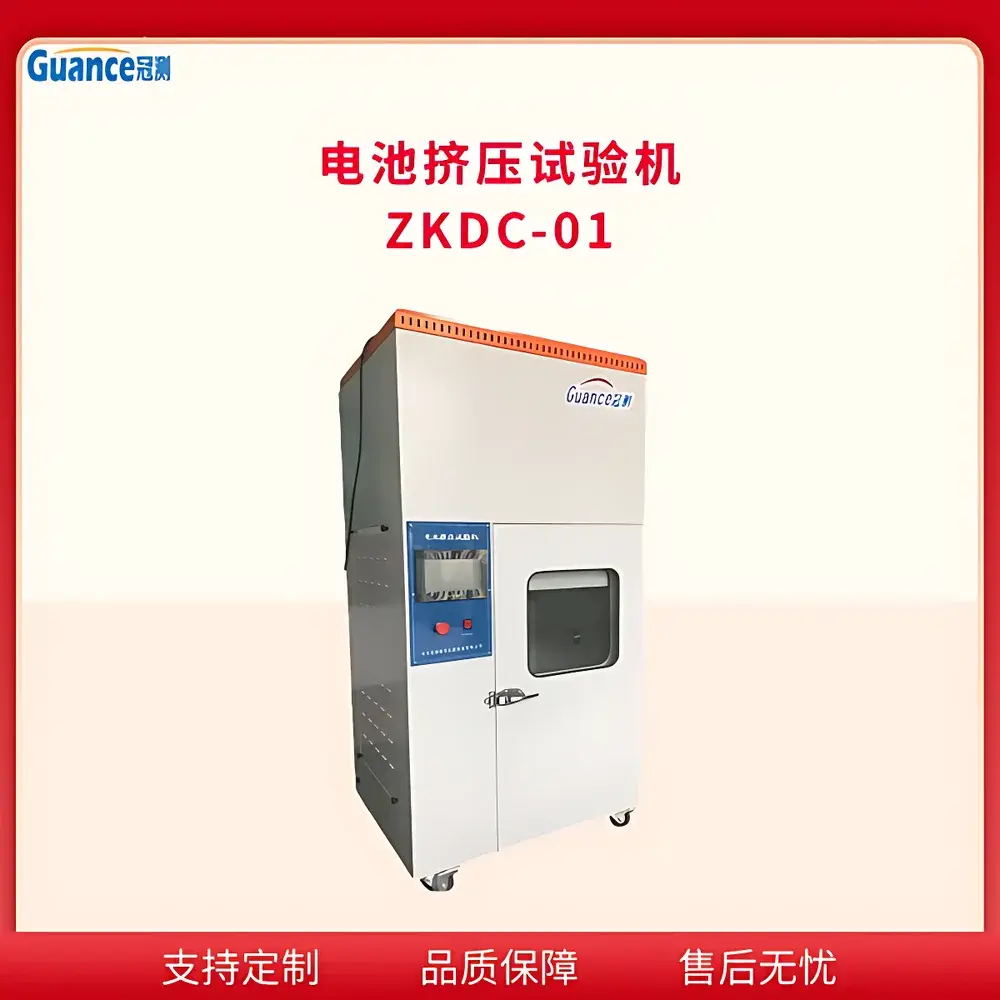
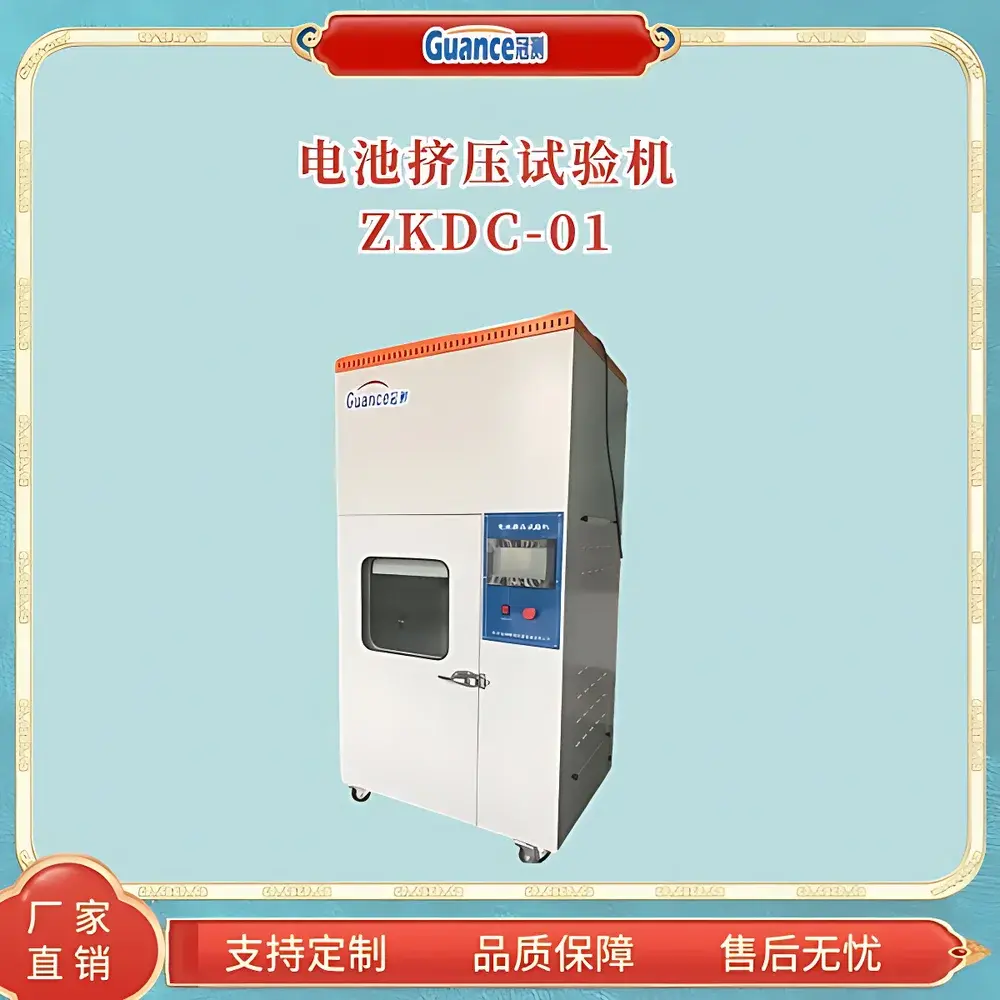
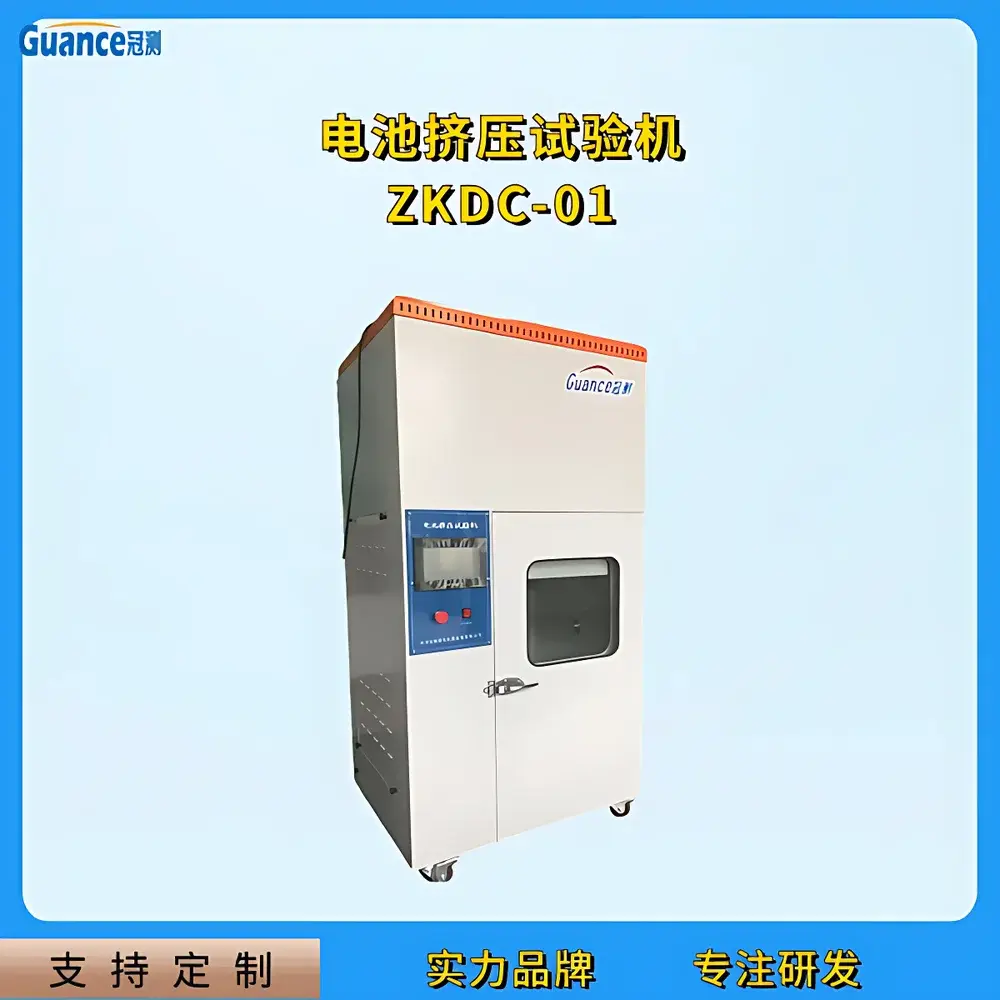
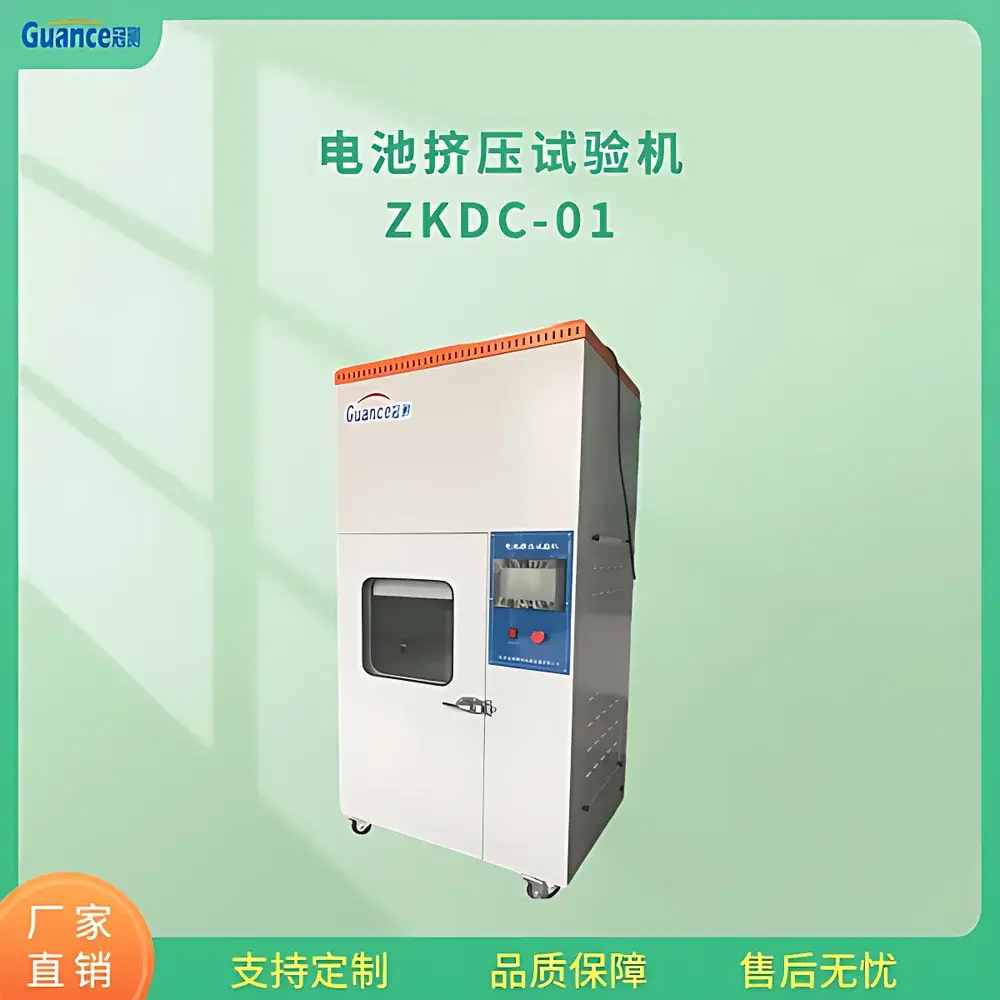
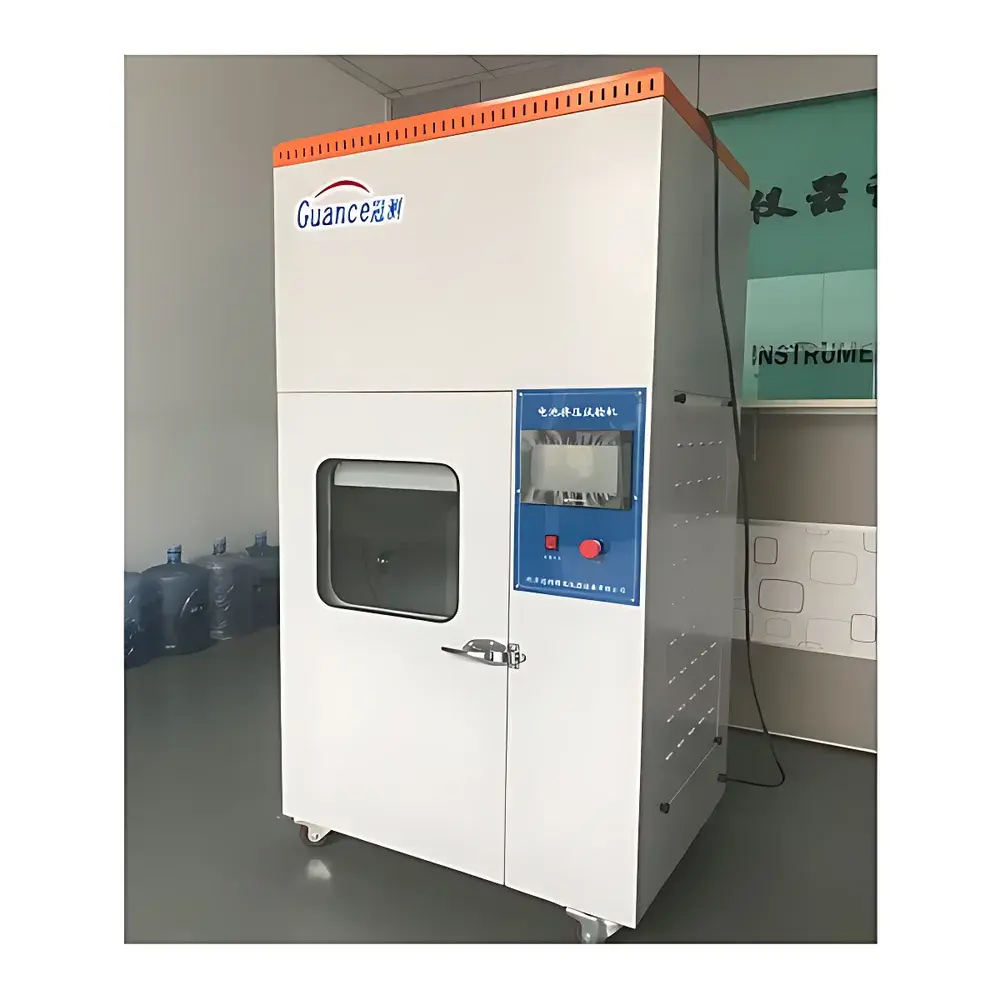
Guance Instruments ZKDC-01.2 Battery Crush & Physical Property Tester
| Brand | Guance Instruments |
|---|---|
| Origin | Beijing, China |
| Manufacturer Type | Authorized Distributor |
| Origin Category | Domestic (China) |
| Model | ZKDC-01.2 |
| Price | USD 1,850 (approx.) |
Overview
The Guance Instruments ZKDC-01.2 Battery Crush and Physical Property Tester is a purpose-built mechanical safety evaluation system engineered for standardized uniaxial compression testing of primary and rechargeable electrochemical cells. It operates on the principle of controlled quasi-static force application via a hydraulically actuated platen, enabling precise replication of mechanical abuse conditions defined in international battery safety standards. The instrument applies compressive load perpendicular to the cell’s largest surface area—aligned per geometry-specific orientation protocols—to assess thermal runaway susceptibility, structural integrity, and failure mode behavior under mechanical stress. Designed for laboratory-based quality control, R&D validation, and regulatory pre-compliance screening, the ZKDC-01.2 delivers repeatable, traceable force application without dynamic impact or inertial artifacts, ensuring data consistency required for internal audit trails and third-party certification submissions.
Key Features
- Hydraulic actuation system with 32 mm diameter piston for uniform pressure distribution across test surfaces
- Programmable peak pressure limit up to 17.2 MPa (equivalent to ~13 kN nominal force at piston area), adjustable in 0.1 MPa increments
- Real-time analog pressure transducer feedback with digital display for operator verification prior to test initiation
- Fixed parallel platens with hardened steel contact surfaces (HV ≥ 600) to minimize deformation during high-load compression
- Manual pressure release mechanism following peak threshold attainment—no automatic hold or dwell function, consistent with UL/GB static crush methodology
- Modular mounting interface compatible with optional alignment fixtures for cylindrical, prismatic, and coin-cell configurations
- CE-marked electrical enclosure with emergency stop button and mechanical interlock on access guard
Sample Compatibility & Compliance
The ZKDC-01.2 supports standardized mechanical testing of lithium-ion, lithium-metal, Ni-MH, and alkaline cells across all common form factors: cylindrical (e.g., 18650, 21700), prismatic (including pouch variants when mounted in rigid support frames), and coin/button cells (e.g., CR2032, BR1225). Orientation protocols strictly follow clause-defined requirements: cylindrical and prismatic cells are tested with their longitudinal axis parallel to the platen plane; prismatic units undergo sequential testing at orthogonal orientations (0° and 90° rotation about the long axis) to evaluate weakest-plane response. Coin cells are compressed normal to their electrode stack plane. The system complies with the mechanical test provisions of MT/T 1051–2007, UL 1642–2005 (Section 10), UL 2054–2005 (Sections 14, 27, and 32), SJ/T 11169–1998, SJ/T 11170–1998, YD 1268–2003, and GB/T 8897.4–2002. While not certified to ISO/IEC 17025, its force application methodology aligns with ISO 12100 risk assessment principles for mechanical hazard mitigation in battery safety labs.
Software & Data Management
The ZKDC-01.2 operates as a standalone hardware platform without embedded microcontroller-based data logging. All operational parameters—including setpoint pressure, actual peak reading, and test timestamp—are manually recorded by the operator into laboratory notebooks or LIMS-compatible spreadsheets. This design intentionally avoids software-driven automation to maintain full transparency in test execution and eliminate potential validation burdens associated with electronic records under FDA 21 CFR Part 11 or EU Annex 11. For laboratories requiring digital documentation, the instrument integrates seamlessly with external pressure data loggers (e.g., National Instruments USB-9234 + LabVIEW custom VI) configured for analog voltage input scaling (0–10 V = 0–20 MPa). Audit-ready test reports must include operator ID, sample lot number, cell orientation diagram, observed failure mode (e.g., venting, leakage, ignition), and pass/fail determination per standard-specified criteria (no fire, no explosion, no disassembly).
Applications
- Pre-shipment safety verification for battery manufacturers supplying OEMs in consumer electronics, power tools, and e-mobility sectors
- Material-level qualification of novel separator membranes, jelly-roll designs, and can venting mechanisms under compressive stress
- Root cause analysis of field failures linked to mechanical abuse (e.g., dropped devices, seat-mounted EV battery packs)
- Supporting UN 38.3 Section 5.1.1 compression test preparation through protocol-adherent bench-scale simulation
- Teaching laboratories demonstrating fundamental battery safety physics, including internal short-circuit initiation via electrode stack deformation
FAQ
Does the ZKDC-01.2 meet UL 2054 Clause 27 requirements for battery housing crush testing?
Yes—the instrument replicates the specified 13 kN force application via calibrated hydraulic loading, with platen geometry and rate-of-load compliance verified against UL 2054 Annex D test setup guidelines.
Can it be used for pouch cell testing?
Pouch cells require rigid external framing (e.g., aluminum edge clamps) to prevent lateral extrusion; such fixtures are user-supplied and must ensure uniform load transfer to the active area without corner stress concentration.
Is calibration traceable to national standards?
Force transducer calibration certificates are provided with each unit, traceable to CNAS-accredited metrology labs in China (certificate included); annual recalibration is recommended per ISO/IEC 17025 Clause 6.5.
What maintenance is required?
Monthly visual inspection of hydraulic seals and piston rod surface finish; biannual replacement of hydraulic fluid (ISO VG 32 mineral oil) and filter element; no firmware updates or software patches apply.
Does it support automated test sequencing or multi-sample batch operation?
No—it is a single-cycle, manual-release device designed for discrete sample evaluation per standard-specified “one test per cell” requirement; automation would violate UL/GB clause wording and introduce uncontrolled dwell variables.



