
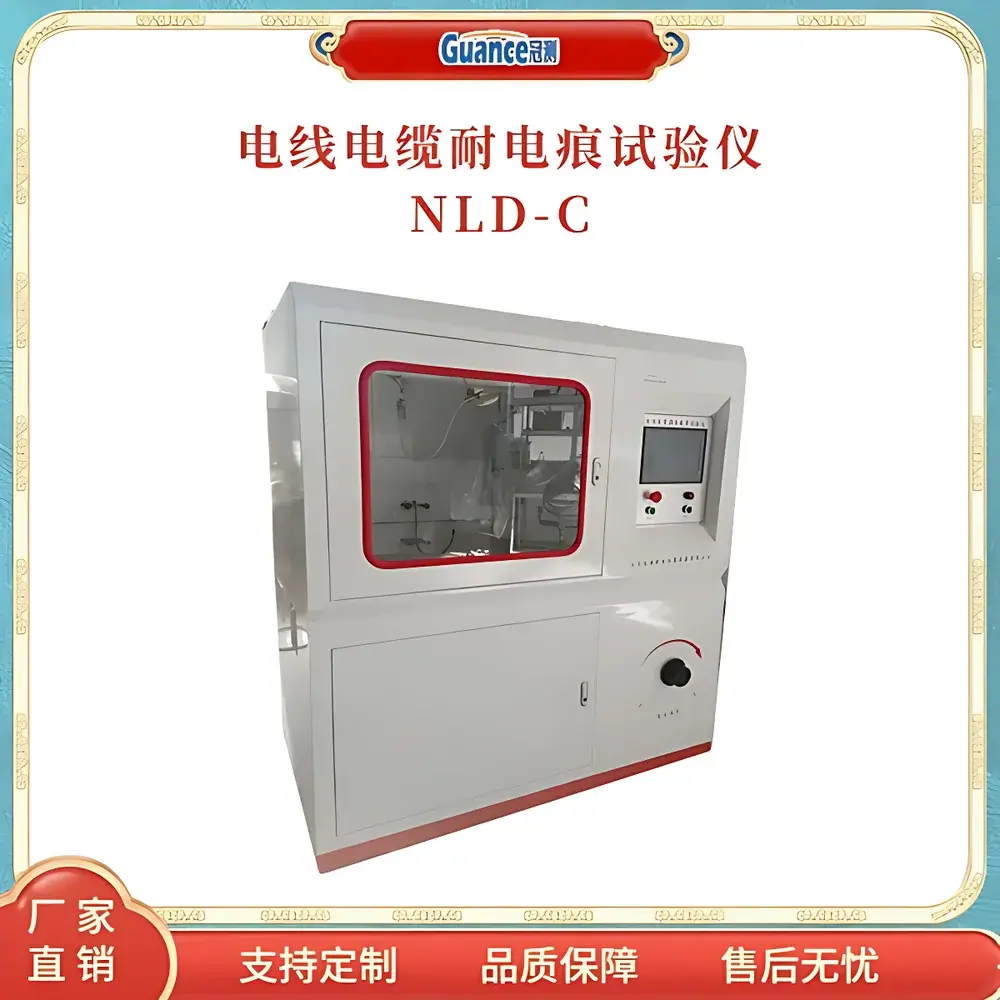
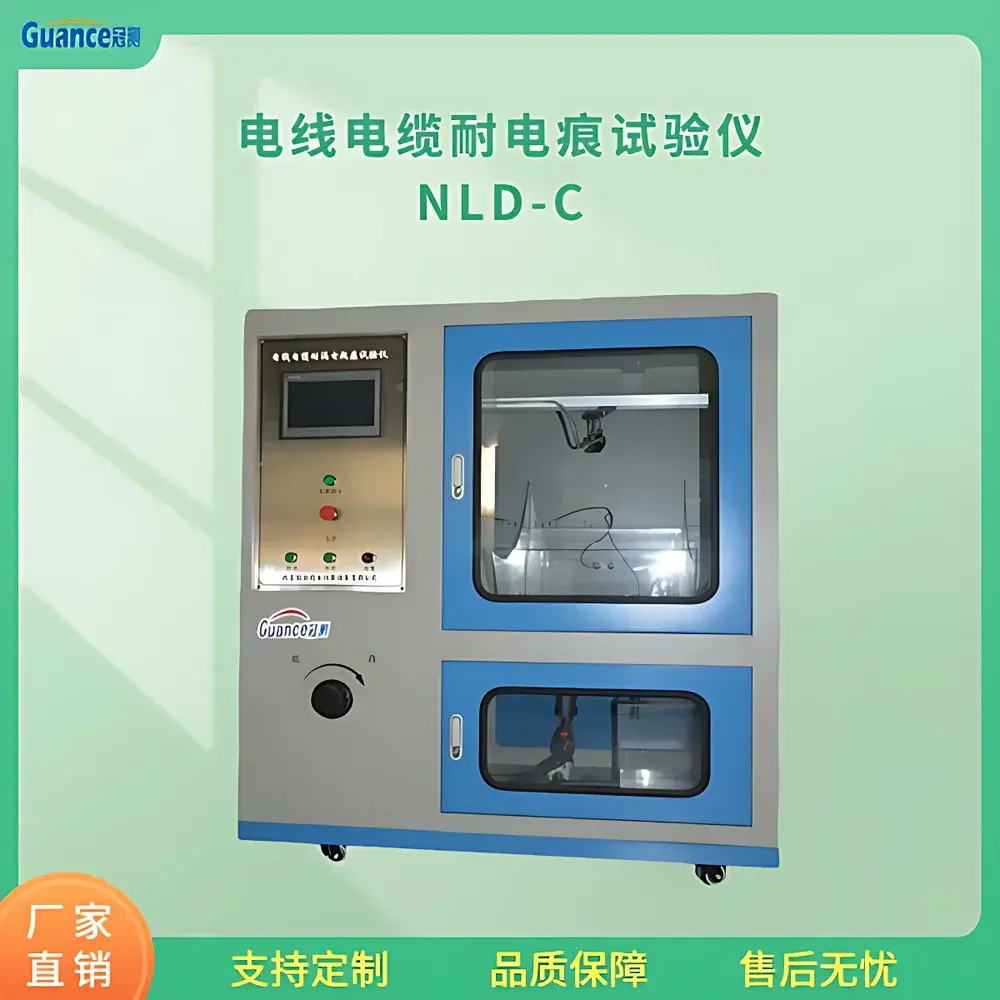
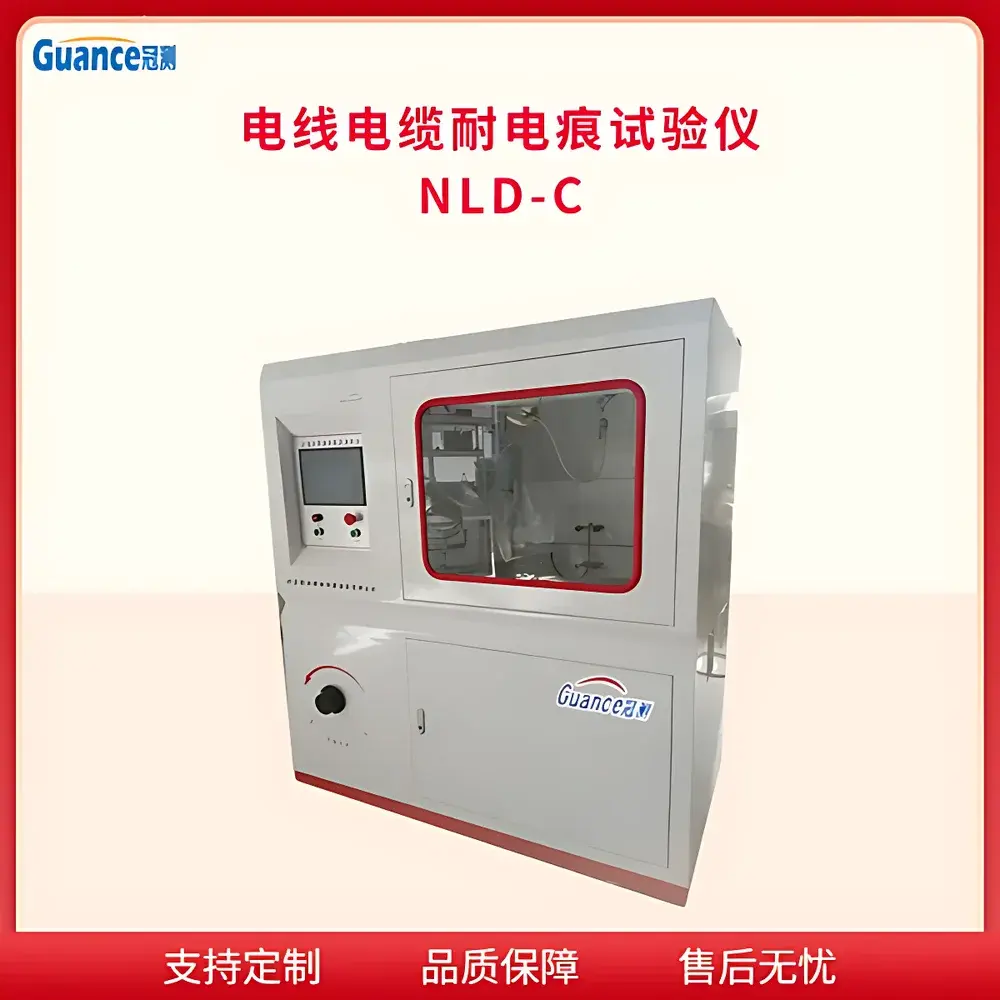
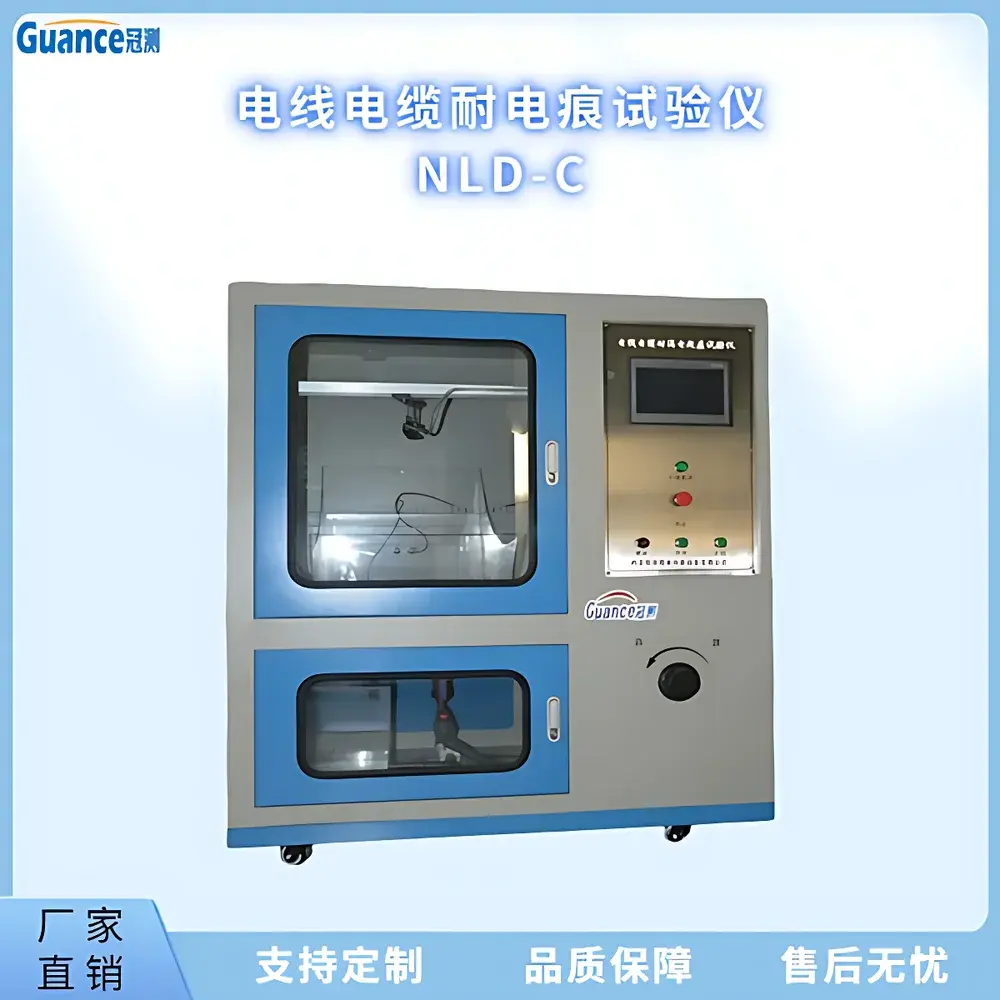
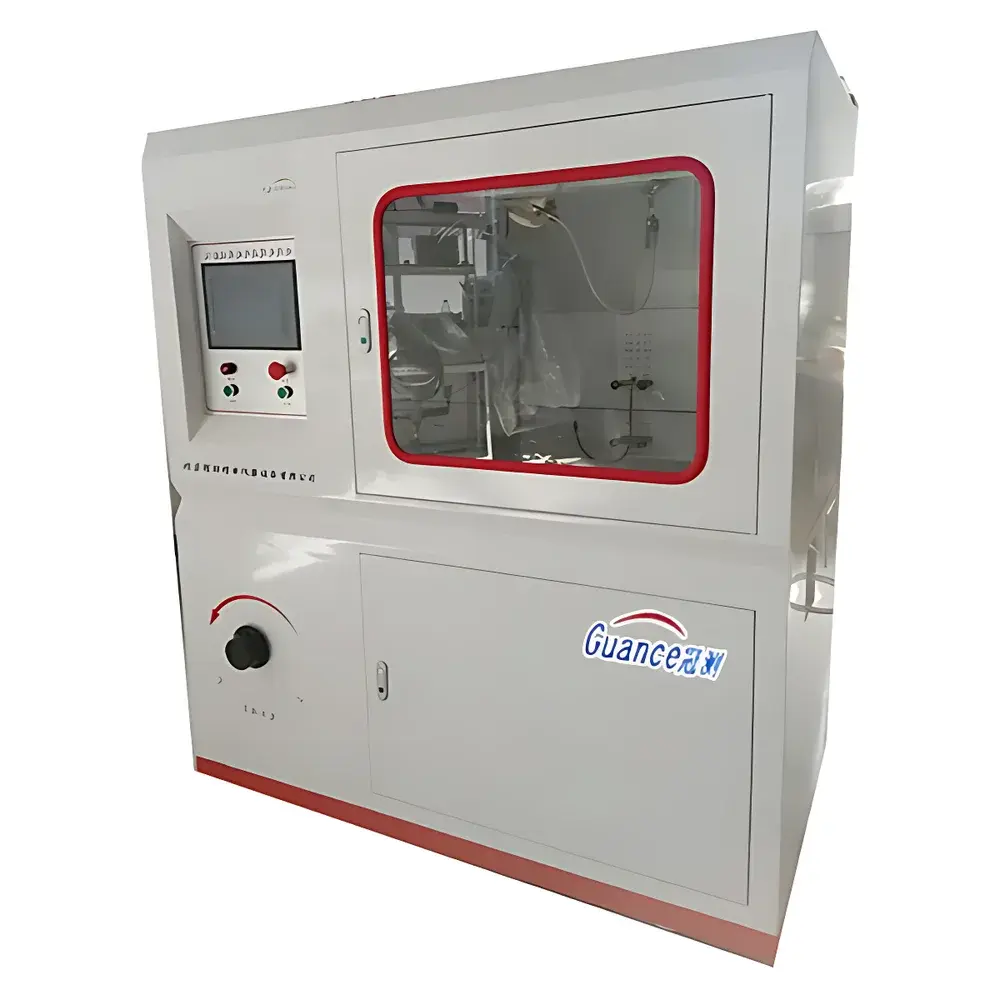
GuanCe NLD-C2 Universal Cable Tracking Resistance Tester
| Brand | GuanCe Instruments |
|---|---|
| Origin | Beijing, China |
| Manufacturer Type | Authorized Distributor |
| Country of Origin | China |
| Model | NLD-C2 |
| Instrument Type | Electromechanical Universal Testing Machine |
| Input Voltage | AC 220 V |
| Output Voltage Range | AC 0–5 kV |
| Power Rating | 5 kVA |
| Voltage Accuracy | < 2% |
| High-Side Output Current | > 1 A |
| Current Measurement Accuracy | < 1% |
| Spray Velocity at Specimen | 3 m/s |
| Spray Rate | 0.5 mm/min |
| Standard Spray Cycle | 10 s spray / 20 s pause |
| Nozzle-to-Specimen Distance | ≥ 500 mm |
| Nozzle Angle Relative to Specimen Axis | 45° |
| Spray Range | > 1 m |
| Specimen Length | ≥ 150 mm |
| Compliance | GB/T 3048.7–2007 |
Overview
The GuanCe NLD-C2 Universal Cable Tracking Resistance Tester is a purpose-built electromechanical testing system engineered for evaluating the electrical tracking resistance of solid insulating materials used in wire and cable applications. It operates on the principle of controlled electrochemical degradation under high-voltage stress combined with periodic electrolyte (corrosive solution) exposure — a standardized method defined in GB/T 3048.7–2007, which aligns with international practices for assessing comparative tracking index (CTI) and proof tracking index (PTI) behavior. During operation, a calibrated AC high voltage (0–5 kV) is applied across a conditioned specimen while a defined corrosive solution (e.g., ammonium chloride) is intermittently sprayed onto its surface at precisely regulated velocity (3 m/s), flow rate (0.5 mm/min), and angular orientation (45° relative to specimen axis). The system monitors leakage current in real time; failure is determined when current exceeds 1 A, or when surface arcing, ignition, or dielectric breakdown occurs within the specified number of spray cycles. This test directly reflects the material’s ability to resist formation of conductive carbonized paths — a critical failure mode in outdoor, humid, or polluted environments.
Key Features
- 10-inch industrial-grade capacitive touch screen HMI for intuitive parameter setting, real-time monitoring, and test execution.
- Siemens S7-1200 PLC-based control architecture ensures electromagnetic compatibility (EMC), long-term stability, deterministic response timing, and immunity to electrical noise in laboratory or production floor environments.
- Optically isolated voltage and current acquisition channels provide galvanic separation between high-voltage circuitry and low-voltage data processing — eliminating ground-loop interference and ensuring measurement integrity per IEC 61000-4 series EMC requirements.
- Manual voltage ramping with fine-resolution potentiometric control enables precise, repeatable application of test voltage without overshoot or transient instability.
- Adjustable spray cycle programming supports custom protocols beyond the standard 10 s spray / 20 s pause sequence, accommodating research-grade investigations or alternative standards.
- Calibrated rotameter-based flow control allows visual verification and consistent regulation of corrosive solution delivery rate throughout test duration.
- Dedicated corrosion fluid recirculation path with quick-release drain port facilitates safe, tool-free fluid exchange without disassembly or spill risk.
- Integrated exhaust fan with duct interface enables continuous removal of volatile decomposition byproducts or odorous fumes generated during tracking events — supporting occupational safety compliance (e.g., OSHA 1910.1200).
- LED-dedicated specimen illumination improves visual inspection of surface degradation, carbon tracking progression, and arc initiation points during and post-test.
- Configurable audible alarm triggers upon either current threshold exceedance (>1 A) or elapsed test time, with user-defined alarm duration (1–60 s) to support audit-ready documentation.
- Integrated 45° angled guide channel and fixed-nozzle alignment ensure consistent spray geometry and reproducible liquid impact distribution across specimen surface — minimizing inter-test variability.
- Leak-proof containment trough with sloped drainage directs all residual electrolyte into sealed collection reservoir, preventing contamination of test chamber base or surrounding infrastructure.
Sample Compatibility & Compliance
The NLD-C2 accommodates cylindrical wire and cable specimens ≥150 mm in length, with standardized preparation per GB/T 3048.7–2007: one end stripped to expose conductor (20 mm), a 1–2 mm bare copper binding wire wound at 100 mm from the cut edge, and opposite-end insulation extended or otherwise shielded to prevent flashover. The system meets national metrological verification requirements for high-voltage instrumentation and conforms to the electrical safety provisions of GB/T 5226.1–2019 (equivalent to IEC 60204-1). While primarily validated against GB/T 3048.7–2007, its programmable spray timing, voltage control, and current monitoring architecture permit adaptation to ASTM D3638 (Standard Test Method for Comparative Tracking Index of Solid Electrical Insulating Materials), IEC 60112 (Method for Determination of the Proof and Comparative Tracking Indices), and UL 746A Annex G protocols — subject to user-defined calibration and procedural validation.
Software & Data Management
The embedded HMI firmware logs timestamped voltage, current, spray status, and alarm events to internal non-volatile memory (≥10,000 test records). Data export is supported via USB 2.0 to CSV format for external analysis in MATLAB, Excel, or LIMS platforms. Audit trail functionality includes operator ID tagging (via optional RFID badge integration), parameter change history, and event-triggered snapshots — supporting GLP-compliant documentation workflows. Although no remote PC software is bundled, the system exposes Modbus RTU over RS-485 for integration into factory SCADA or centralized QC databases. All stored data retains traceability to calibration certificates for voltage/current sensors (valid per ISO/IEC 17025-accredited calibration intervals).
Applications
- Quality assurance of polymeric cable jacketing (PVC, XLPE, EPR, TPE) in power transmission and building wiring systems.
- R&D evaluation of flame-retardant additives and nanofiller-modified insulation compounds for improved CTI performance.
- Comparative screening of recycled polymer blends intended for secondary cable insulation use.
- Conformance testing for certification bodies validating compliance with CCC, CQC, or SRRC marking requirements for Chinese domestic markets.
- Failure analysis of field-failed cables exhibiting surface tracking damage under coastal or industrial pollution conditions.
FAQ
What standards does the NLD-C2 explicitly support out-of-the-box?
GB/T 3048.7–2007 is fully implemented in default test mode, including automatic spray timing, voltage ramp profile, and pass/fail logic based on 1 A leakage current threshold.
Can the system be used for CTI determination per IEC 60112?
Yes — by manually configuring variable voltage steps and cycle counts, and applying the stepwise reduction protocol defined in Clause 9 of IEC 60112; full automation requires optional firmware upgrade.
Is the high-voltage transformer rated for continuous duty?
The 5 kVA transformer is designed for intermittent operation (duty cycle ≤ 20% per IEC 61558-2-4), consistent with standard tracking test durations of ≤ 6 hours per specimen.
How is electrical safety ensured during operator interaction?
Interlocked access doors cut HV output upon opening; emergency stop button disconnects primary supply; all HV terminals are recessed and guarded per IP2X requirements.
Does the system include calibration documentation?
Each unit ships with factory calibration certificate for voltage divider and shunt resistor, traceable to CNAS-accredited reference standards; annual recalibration is recommended.



