
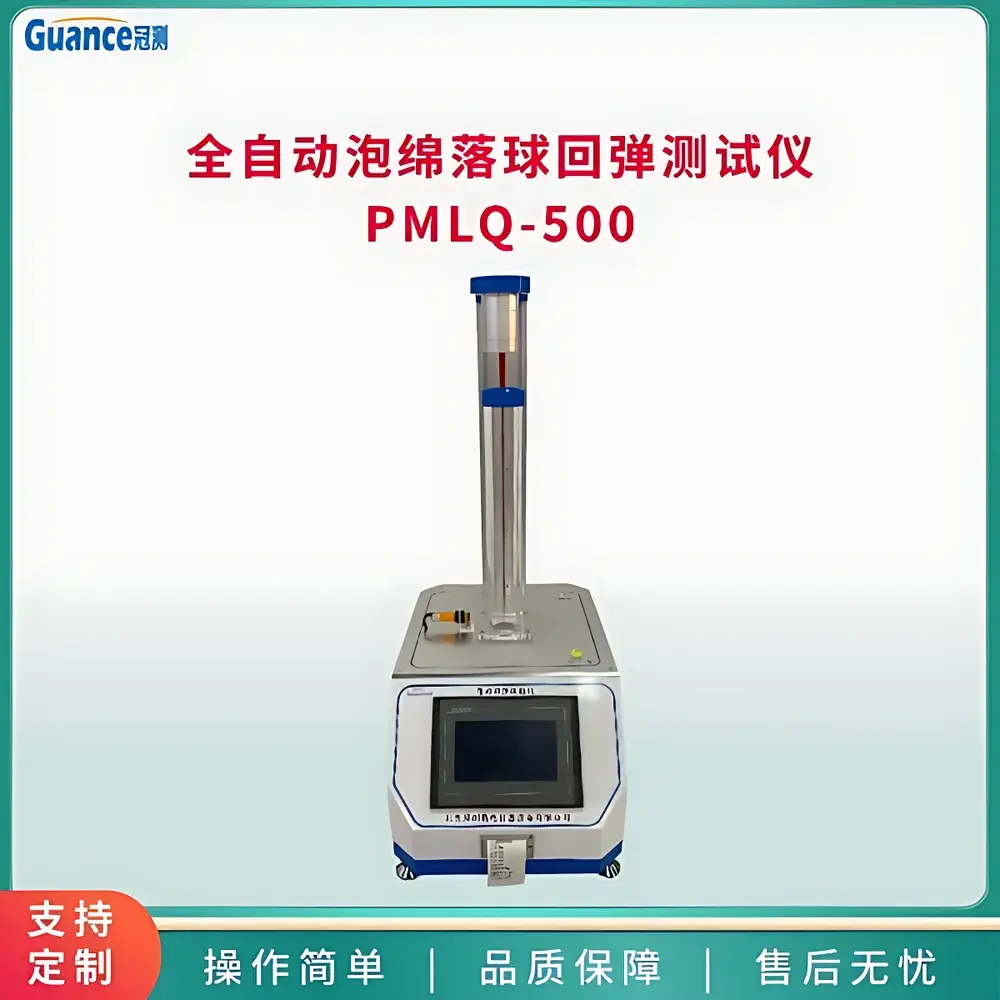
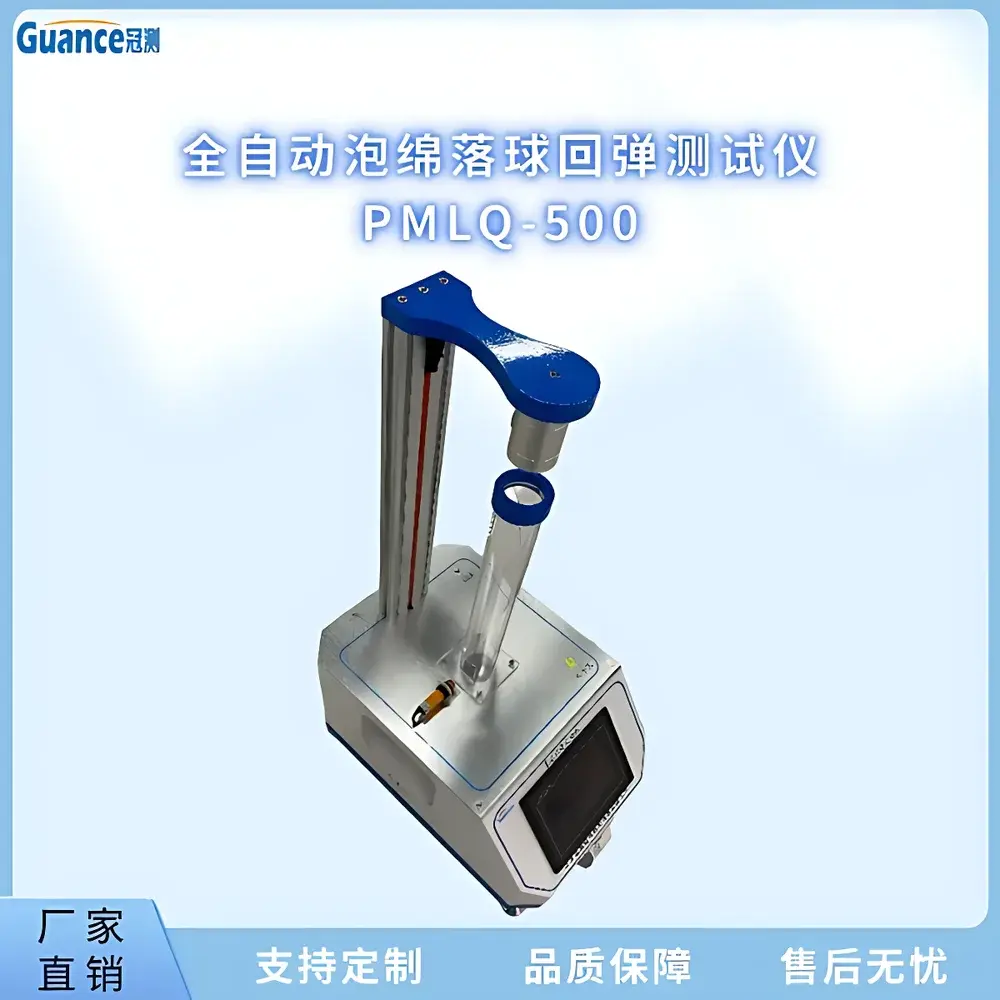
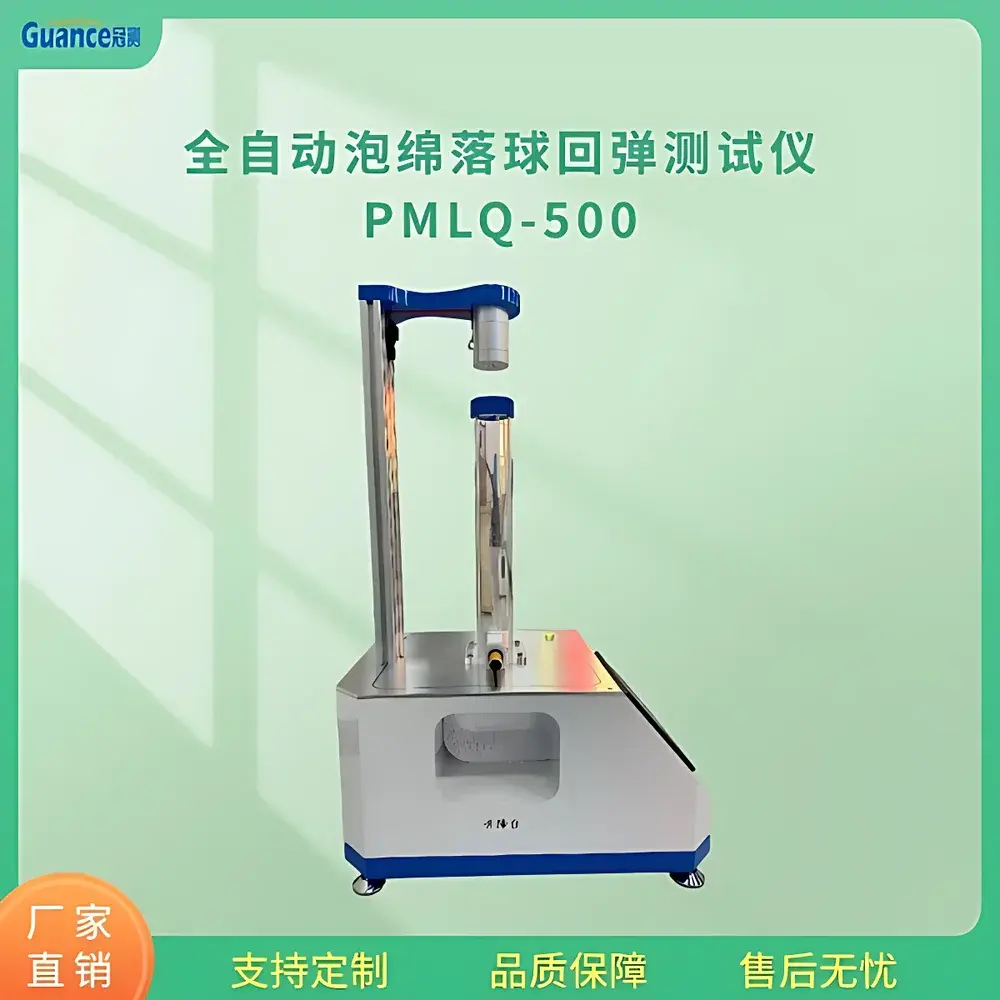
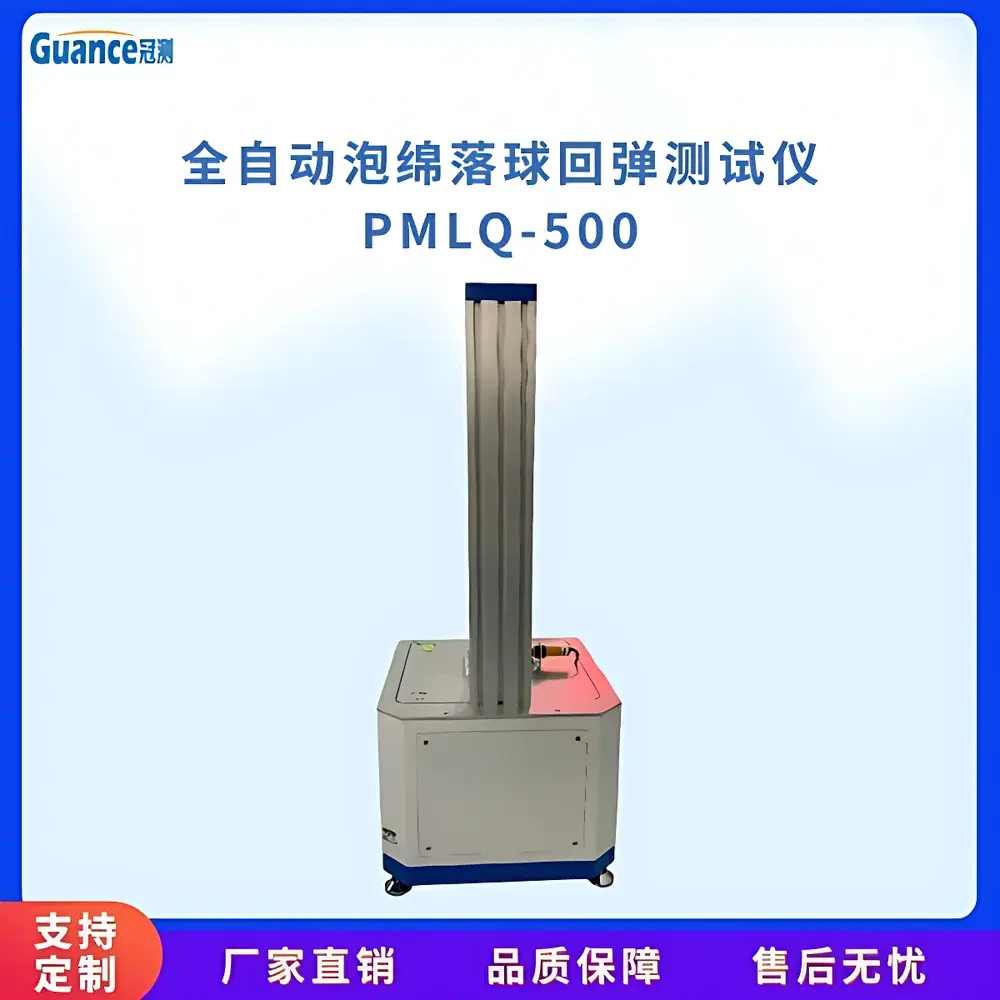
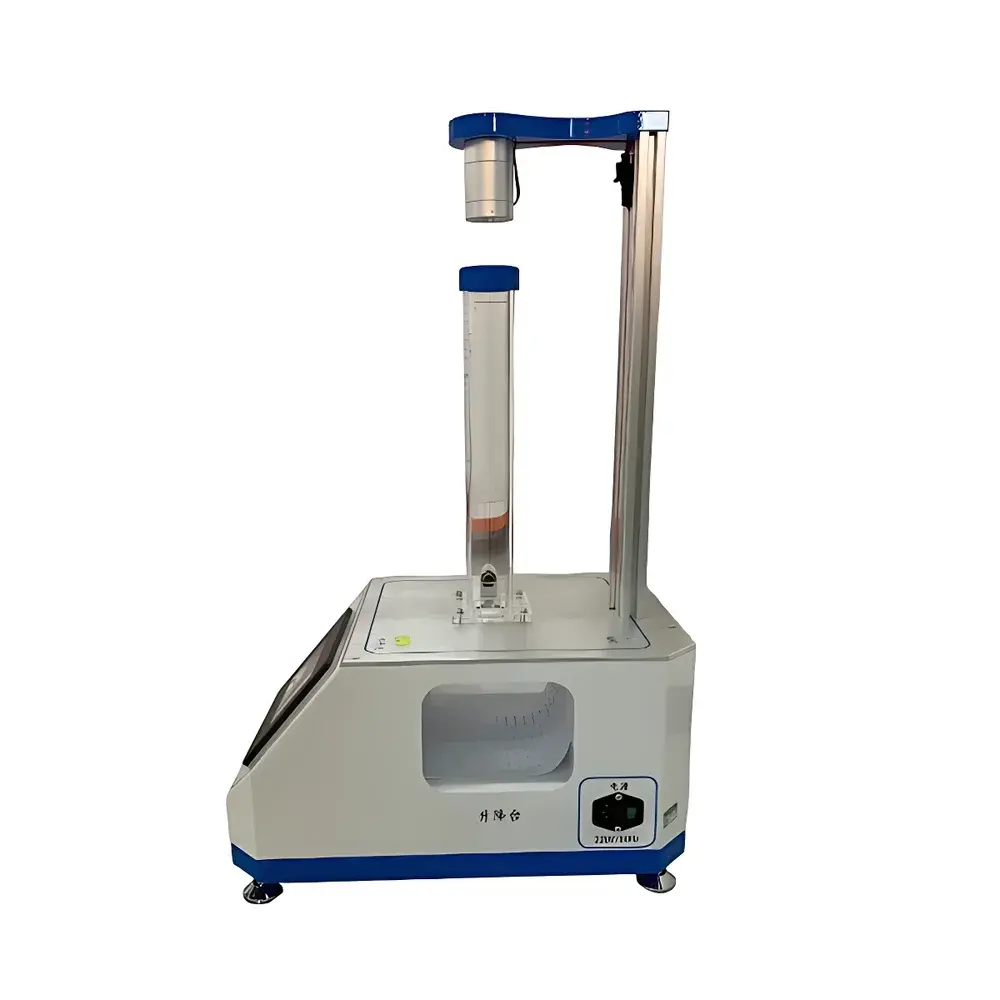
Guance PMLQ-500 Ball Rebound Tester for Flexible Polyurethane Foam
| Brand | Guance Instruments |
|---|---|
| Origin | Beijing, China |
| Model | PMLQ-500 |
| Drop Height | 460 mm (GB/T 6670–2008) / 500 mm (ASTM D3574 & ISO 8307) |
| Specimen Max Weight | 25 kg |
| Specimen Max Dimensions | 100 mm × 100 mm × 100 mm (or 50 mm thickness) |
| Drop Surface Detection | Auto-height recognition and data logging |
| Steel Ball Diameter | Ø16 mm |
| Guide Tube | Transparent acrylic, inner diameter Ø50 mm |
| Rebound Accuracy | <1% |
| Specimen Sets per Test | 3 samples × 3 drops each |
| Control System | Siemens PLC |
| Display | 7-inch HMI touchscreen interface |
| Power Supply | 220 V AC / 50 Hz |
| Footprint | 560 × 360 × 860 mm (L×W×H) |
| Unit Weight | 25 kg |
Overview
The Guance PMLQ-500 Ball Rebound Tester is an engineered precision instrument designed for the quantitative evaluation of resilience in flexible polymeric foam materials—primarily soft polyurethane (PU) foams used in automotive seating, furniture, bedding, and packaging applications. It operates on the standardized principle of free-fall impact mechanics: a calibrated steel ball (Ø16 mm) is released from a defined vertical height (460 mm per GB/T 6670–2008 or 500 mm per ASTM D3574 and ISO 8307) through a vertically aligned, low-friction acrylic guide tube (Ø50 mm internal diameter), striking the center of a horizontally mounted foam specimen. The rebound height is measured either optically (via integrated auto-detection sensors) or manually (using engraved scale markings), and the rebound ratio—expressed as a percentage—is calculated as (rebound height ÷ drop height) × 100. This metric directly correlates with the material’s viscoelastic energy recovery behavior under transient compressive loading.
Key Features
- Compliance-ready dual-height configuration: factory preset to 460 mm for Chinese national standard GB/T 6670–2008 and 500 mm for ASTM D3574 and ISO 8307—no mechanical recalibration required between standards.
- Electromagnetic release mechanism ensures zero rotational torque and perfect axial alignment during drop, eliminating lateral deviation and wall contact—critical for measurement reproducibility and regulatory acceptance.
- Siemens S7-1200 PLC-based control architecture provides deterministic real-time sequencing, fault-tolerant operation, and immunity to ambient electromagnetic interference.
- 7-inch industrial-grade resistive touchscreen HMI supports multilingual UI (English default), intuitive test setup, parameter validation, and on-device result review—including pass/fail flagging per ASTM-defined repeatability thresholds.
- Dual-mode height measurement: high-resolution optical sensor captures rebound trajectory automatically; engraved vertical scale enables manual verification—ensuring traceability and error cross-checking per GLP audit requirements.
- Automated statistical processing: calculates individual rebound ratios, filters outliers using ASTM D3574’s ±5% deviation rule, and computes mean rebound % across three specimens (each tested thrice), all compliant with GBT 10652–2001 reporting conventions.
- Benchtop modular design (560 × 360 × 860 mm) integrates compactly into QC laboratories without dedicated floor space; load-rated base accommodates specimens up to 25 kg and dimensions up to 100 mm cube (or 100 × 100 × 50 mm slab).
Sample Compatibility & Compliance
The PMLQ-500 is validated for use with flexible open-cell polyurethane foams, including molded, slabstock, and laminated variants within density ranges of 15–80 kg/m³. Specimens must be conditioned at 23 ± 2 °C and 50 ± 5% RH for ≥16 h prior to testing, per ISO 293 and ASTM D3574 conditioning protocols. The instrument fully satisfies the mechanical and procedural requirements of GB/T 6670–2008, GB/T 10652–2001, ASTM D3574–2022 (Sections 4.1–4.4), and ISO 8307:2017. Its electromagnetic release system meets Clause 6.2.1 of ASTM D3574 (“ball shall fall freely without rotation”), while its auto-height recognition and digital averaging functionality support FDA 21 CFR Part 11-compliant electronic records when paired with validated laboratory information management systems (LIMS).
Software & Data Management
Test sequences are configured via the embedded HMI interface: users define specimen ID, batch number, standard reference (e.g., “ASTM_D3574_500mm”), and operator credentials. All raw drop/rebound height values, timestamps, outlier flags, and final mean rebound % are stored in non-volatile memory with ISO/IEC 17025-aligned metadata (test date, environmental conditions, calibration status). Data export is supported via USB 2.0 to CSV format for integration with Excel, Minitab, or enterprise LIMS platforms. Firmware updates are delivered free-of-charge over USB and include version-locked audit trails compliant with GLP/GMP documentation requirements.
Applications
- Quality control of PU foam batches in Tier-1 automotive seating suppliers verifying compliance with OEM specifications (e.g., Ford WSS-M99P30-A2, GM GMW15634).
- R&D screening of novel elastomeric formulations for improved resilience retention after aging (70 °C/96 h per ASTM D3574 Method B).
- Third-party certification labs performing accredited testing per CNAS-CL01:2018 (equivalent to ISO/IEC 17025).
- Packaging material qualification where dynamic cushioning performance impacts product damage rates (ISTA 3A correlation studies).
- Academic research on polymer network architecture effects on energy dissipation—when coupled with synchronized high-speed imaging (optional external trigger port available).
FAQ
What standards does the PMLQ-500 natively support?
It is preconfigured for GB/T 6670–2008 (460 mm), ASTM D3574–2022 (500 mm), ISO 8307:2017, and GB/T 10652–2001—all without hardware modification.
How is measurement traceability ensured?
Each test log includes timestamp, operator ID, environmental readings (if external hygrothermograph is connected), and digital signatures for calibration certificate linkage.
Can the system integrate with our existing LIMS?
Yes—CSV exports contain structured fields compatible with most LIMS ingestion pipelines; optional RS-232/Modbus RTU interface available for real-time SCADA integration.
Is manual height reading still necessary if auto-detection is enabled?
No, but it remains available as a secondary verification method to satisfy internal QA checklists and regulatory audit requirements for measurement redundancy.
What maintenance is required for long-term accuracy?
Annual verification of guide tube verticality (±0.2° tolerance) and steel ball sphericity (ISO 3290 Grade 10) is recommended; calibration certificates are issued by accredited metrology labs upon request.



