
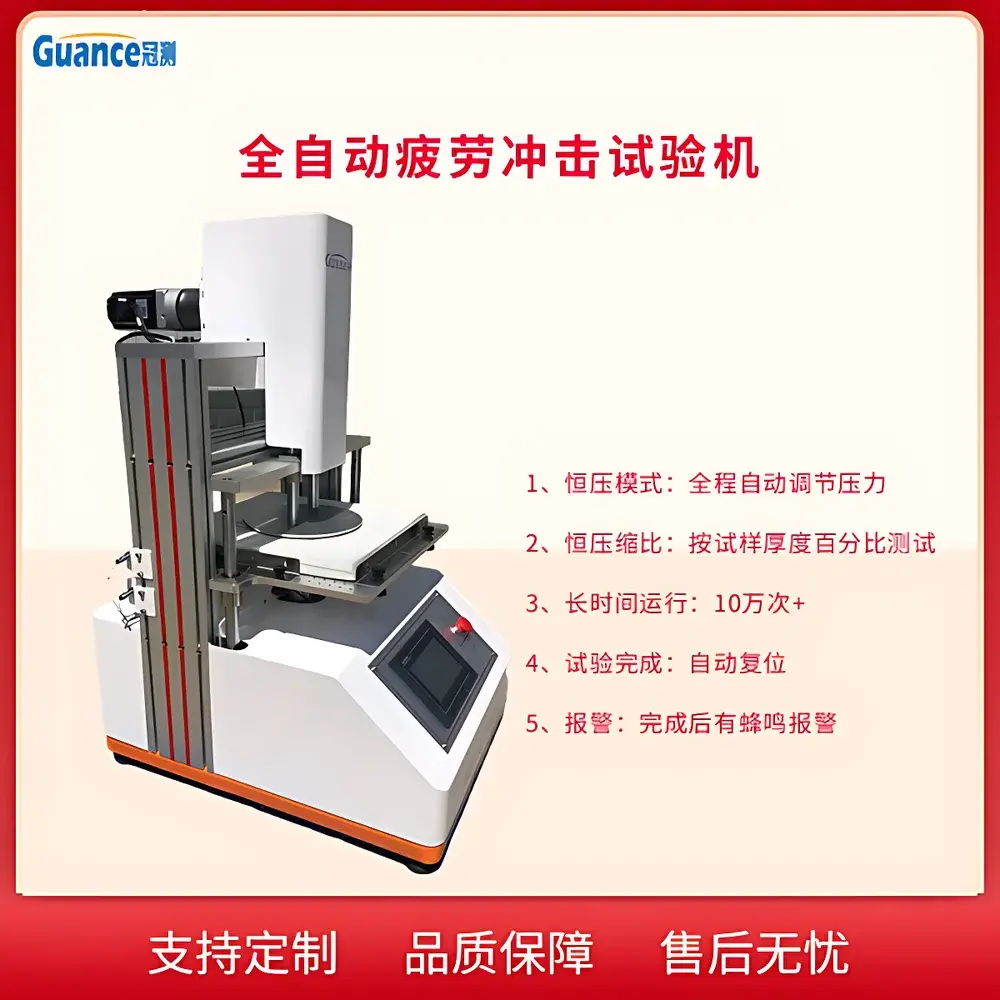
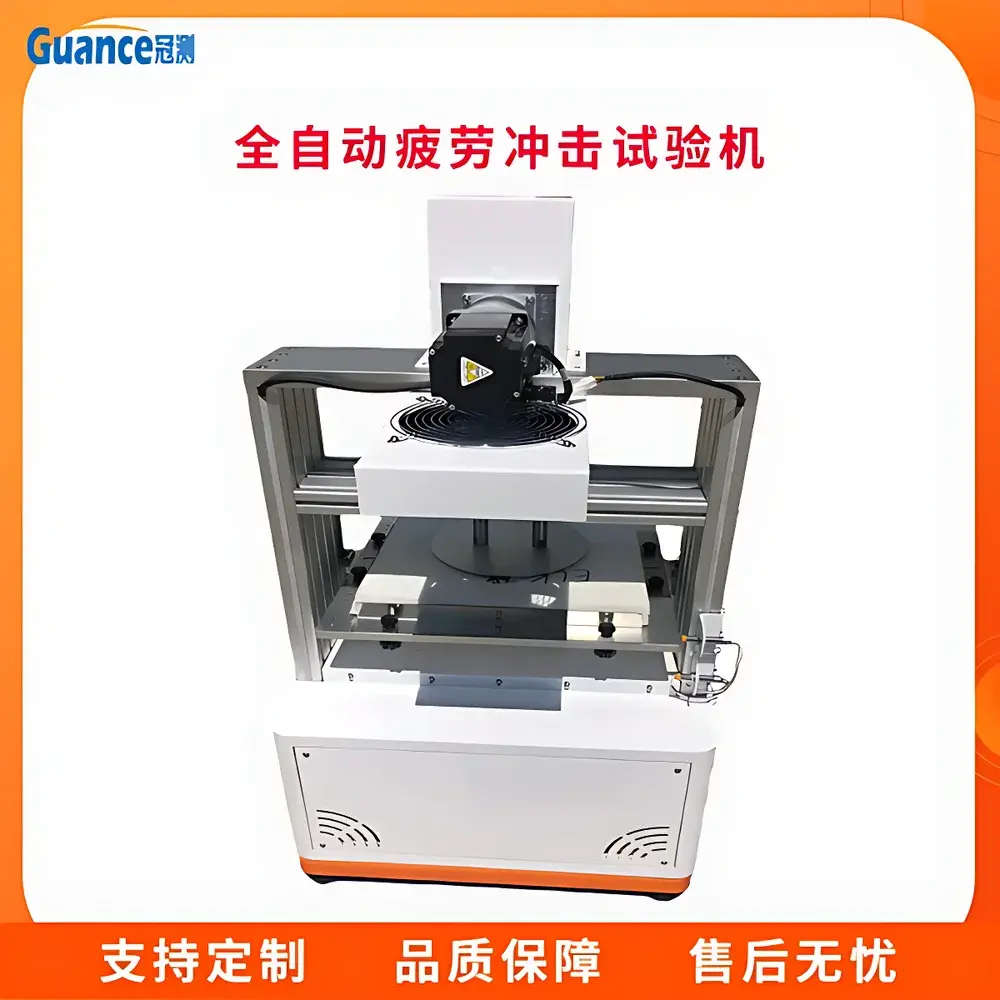
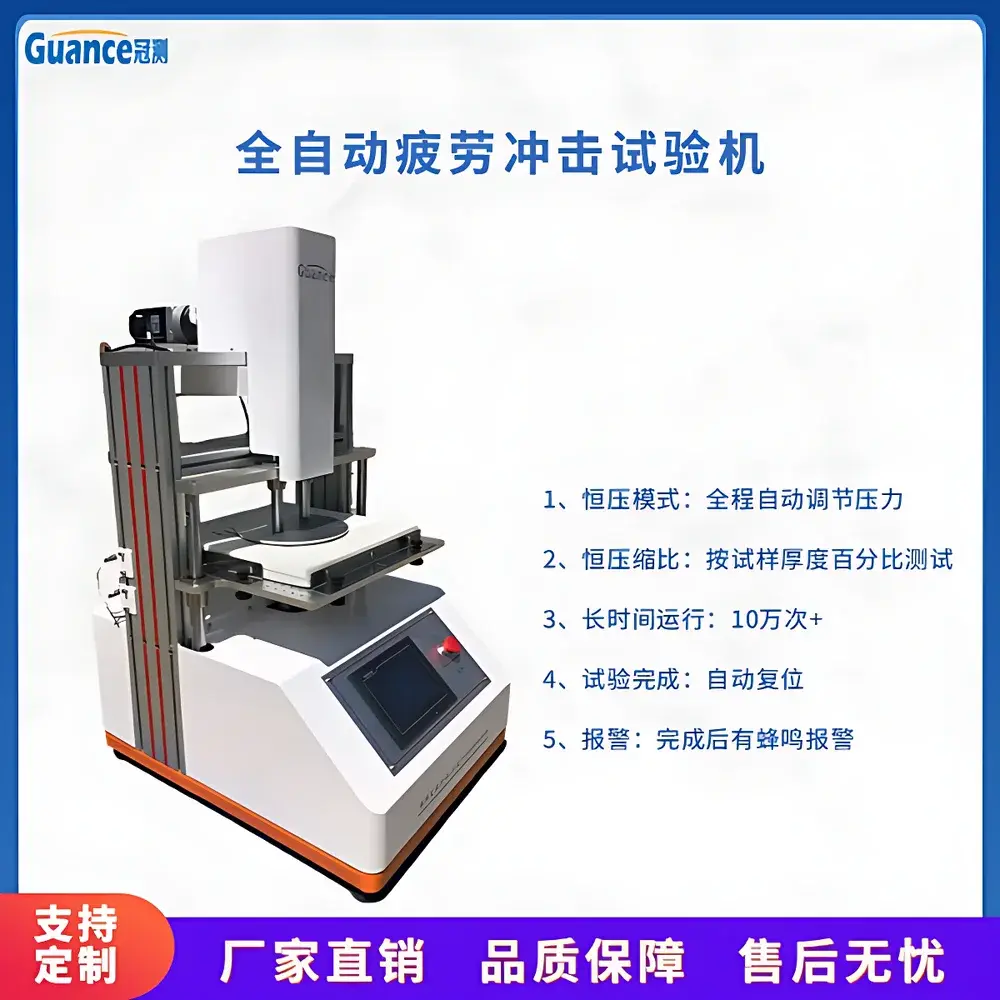
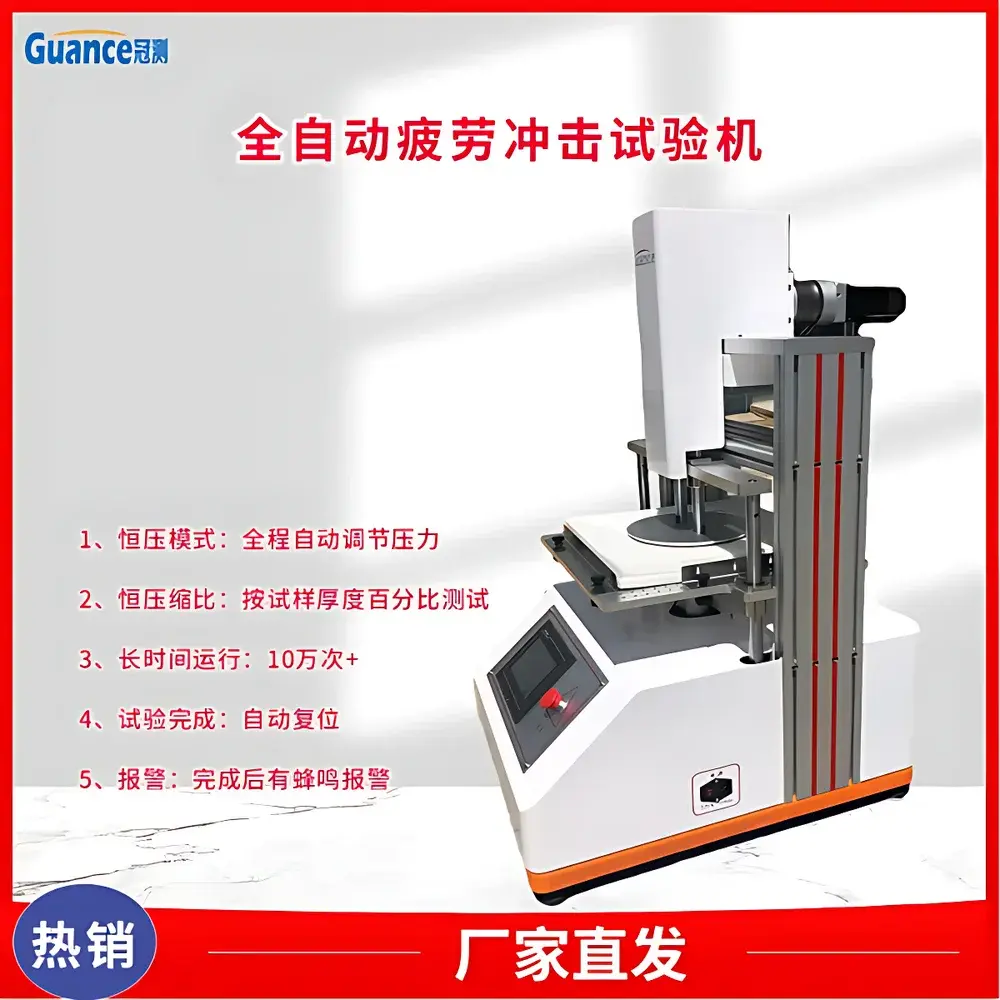
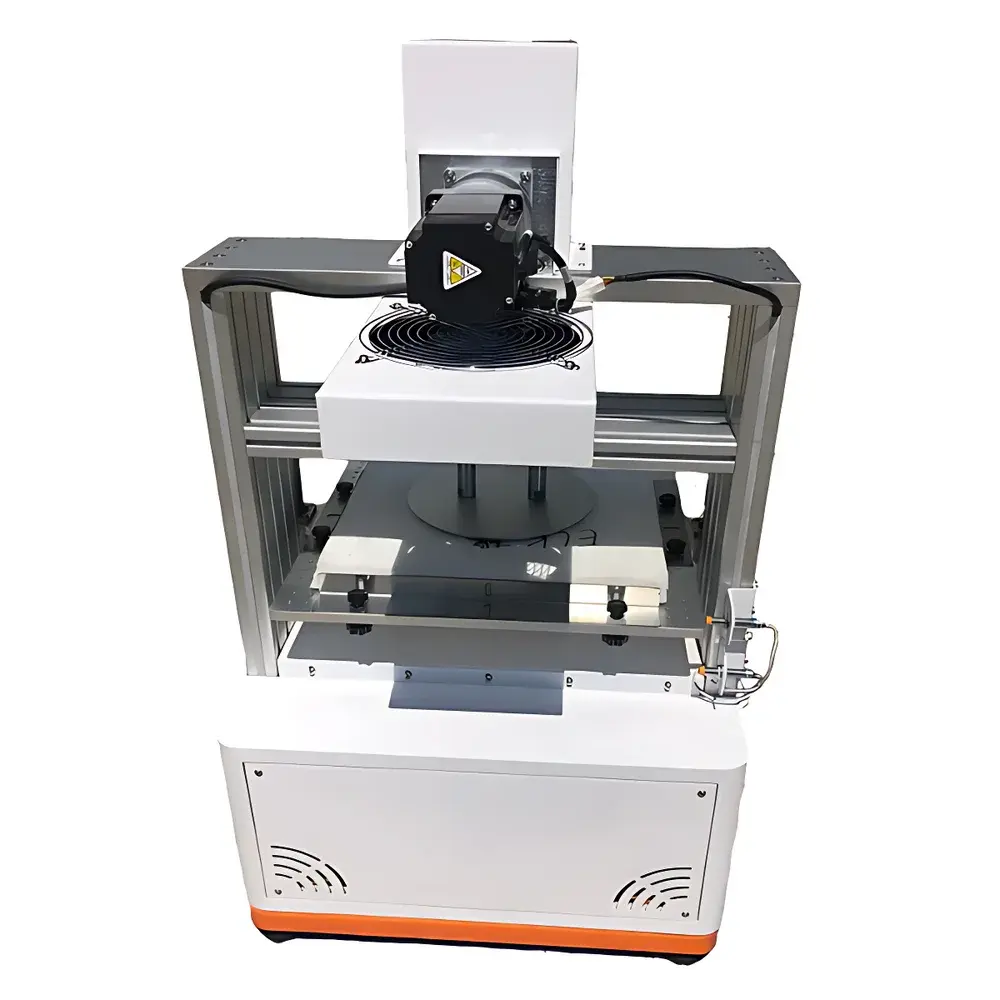
GuanCe PMPL-2000A4 Fully Automated Sponge Reciprocating Constant-Load Impact Fatigue Testing Machine
| Brand | GuanCe |
|---|---|
| Origin | Beijing, China |
| Manufacturer Type | Authorized Distributor |
| Country of Origin | China |
| Model | PMPL-2000A4 |
| Max Test Force | 0–1000 N |
| Frequency Range | 10–100 cycles/min (Standard Compliance: 70 ± 5 cycles/min) |
| Machine Weight | 100 kg |
| Platen Diameter | Ø250 ± 1 mm (Edge Radius: R25 ± 1 mm) |
| Specimen Support Table | 500 × 500 × 10 mm (Perforated, 6.35 mm holes on 20 mm centers) |
| Specimen Dimensions | 500 × 500 × (50 ± 2) mm |
| Drive System | Servo Motor |
| Control Interface | 7-inch Color Touchscreen HMI |
| Control Unit | Siemens PLC |
| Test Modes | Constant-Load Mode / Thickness-Reduction Percentage Mode |
| Max Cycles | >100,000 |
| End-of-Test Alert | Audible Alarm + Auto-Return to Home Position |
| Power Supply | 220 VAC / 50 Hz |
| Footprint | 800 × 500 × 1200 mm (L × W × H) |
Overview
The GuanCe PMPL-2000A4 Fully Automated Sponge Reciprocating Constant-Load Impact Fatigue Testing Machine is an engineered solution for standardized dynamic fatigue evaluation of flexible polymeric foams—primarily soft and semi-rigid polyurethane (PU), ethylene-vinyl acetate (EVA), and thermoplastic elastomer (TPE) foams used in automotive seating, bedding, packaging, and medical cushioning applications. It operates on the principle of controlled reciprocating compression under constant mechanical load, simulating real-world cyclic loading conditions such as repeated sitting or impact events. The system complies with internationally recognized test standards including ISO 3385:2014 (“Flexible cellular polymeric materials — Determination of fatigue by constant-load impact”), GB/T 18941–2003 (Chinese national adoption of ISO 3385), QB/T 2819–2006 (“Determination of long-term fatigue performance of flexible foam materials”), QC/T 56–1993 (“Test methods for cushioning materials of automobile seat assemblies”), and JASO B408–1984 (“Automotive interior material testing standard for foam resilience and durability”). Its core functional objective is to quantify two critical fatigue indicators: residual thickness loss (as % of initial thickness) and permanent hardness reduction (measured via indentation force deflection, IFD), both of which correlate directly with service life prediction and material degradation kinetics.
Key Features
- Real-time closed-loop load regulation: Integrated servo-driven vertical actuation combined with Siemens S7-1200 PLC ensures continuous adjustment of specimen support height during testing—maintaining applied load within ±2% of setpoint even as foam compressibility increases with cycle count.
- Dual-mode test configuration: Users select either constant-force mode (e.g., 100 N, 250 N, 500 N) or thickness-reduction percentage mode (e.g., 25%, 40%, 50% compression depth), enabling compliance with diverse regulatory and internal specification requirements.
- High-fidelity mechanical architecture: Precision-ground linear guides, hardened steel impact platen (Ø250 mm, R25 edge radius), and rigid cast-iron base ensure repeatability and minimize parasitic vibrations that could distort fatigue response data.
- Intuitive human-machine interface: A 7-inch industrial-grade touchscreen HMI provides guided workflow navigation, parameter validation, live force waveform preview, and immediate post-test summary—including total cycles completed, max/min/mean load deviation, and final thickness measurement.
- Automated end-of-test protocol: Upon reaching user-defined cycle count or failure threshold (e.g., >15% thickness loss), the system triggers audible alarm, halts motion, retracts platen to home position, and locks data for export.
- Specimen stability assurance: Modular locating pins and adjustable clamping rails prevent lateral displacement over extended tests (>100,000 cycles), eliminating positional drift-induced measurement artifacts.
Sample Compatibility & Compliance
The PMPL-2000A4 accommodates standard foam specimens measuring 500 mm × 500 mm × (50 ± 2) mm, mounted on a perforated stainless-steel support table (500 × 500 × 10 mm, 6.35 mm diameter holes on 20 mm centers) to allow air displacement and thermal dissipation during high-frequency cycling. It supports both free-foam and laminated composite configurations, provided surface flatness meets ISO 3385’s ≤0.5 mm deviation requirement. All operational parameters—including frequency (70 ± 5 cycles/min per ISO 3385), load tolerance, and dimensional tolerances—are traceable to NIST-traceable calibration protocols. The system is designed for GLP-compliant environments: audit trails are logged automatically (timestamp, operator ID, test parameters, raw force/time data), supporting FDA 21 CFR Part 11 readiness when integrated with validated LIMS or ELN platforms.
Software & Data Management
Data acquisition is performed at 1 kHz sampling rate via embedded analog-to-digital conversion, capturing full force-time waveforms for each impact event. Raw datasets (CSV format) include cycle index, instantaneous load (N), platen displacement (mm), elapsed time (s), and temperature (optional external sensor input). The onboard firmware enables batch report generation compliant with ISO/IEC 17025 documentation structure—featuring test header metadata, statistical summaries (mean, SD, CV%), trend plots (thickness loss vs. log cycles), and pass/fail flagging against user-defined acceptance criteria. Exported files retain digital signatures and are compatible with third-party analysis tools (MATLAB, Python pandas, JMP). No cloud dependency: all processing occurs locally; optional Ethernet port enables secure LAN-based remote monitoring without internet exposure.
Applications
- Automotive Tier-1 suppliers validating seat cushion longevity per JASO B408 and QC/T 56 specifications.
- Foam manufacturers qualifying new formulations for hotel mattress cores under GB/T 18941 accelerated fatigue protocols.
- Medical device OEMs assessing pressure-relief performance of wheelchair seat overlays per ISO 10993-10 biocompatibility-linked mechanical endurance requirements.
- Quality control laboratories performing incoming inspection of EVA midsoles for athletic footwear, tracking IFD decay across 50,000+ cycles.
- Academic research into viscoelastic recovery kinetics of bio-based foams, where synchronized load/displacement hysteresis loops inform constitutive modeling.
FAQ
What standards does the PMPL-2000A4 explicitly support?
ISO 3385:2014, GB/T 18941–2003, QB/T 2819–2006, QC/T 56–1993, and JASO B408–1984.
Can the machine maintain constant load while foam permanently deforms?
Yes—via servo-controlled vertical translation of the specimen platform, dynamically compensating for cumulative creep to sustain setpoint load within ±2% throughout the test.
Is calibration documentation included with shipment?
Yes—a factory calibration certificate (traceable to CNAS-accredited reference standards) and SOP-aligned verification checklist are supplied.
What maintenance intervals are recommended for long-term reliability?
Lubrication of linear guides every 500 hours; annual verification of load cell linearity and platen parallelism; biannual firmware update review.
Does the system support automated data upload to enterprise QA systems?
Yes—via configurable TCP/IP socket interface or Modbus TCP protocol; integration with LabVantage, TrackWise, and SAP QM has been validated by multiple customers.



