
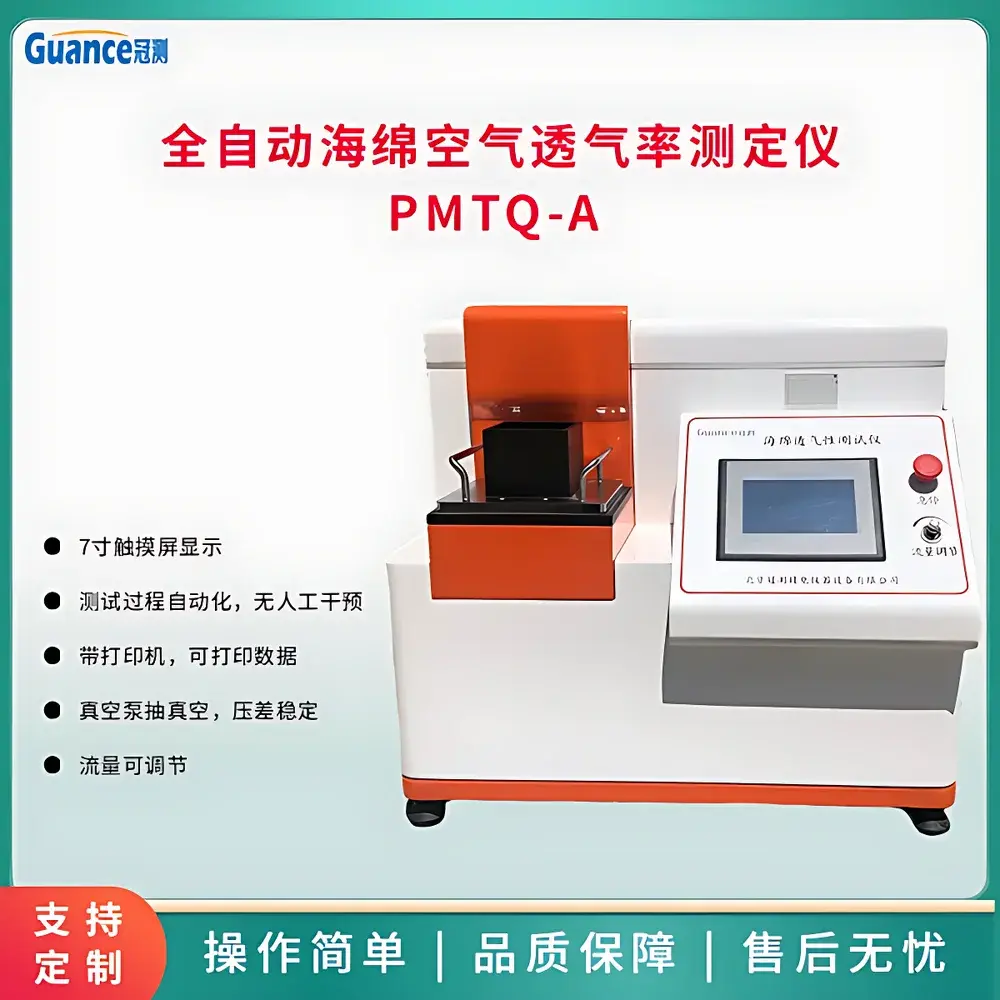
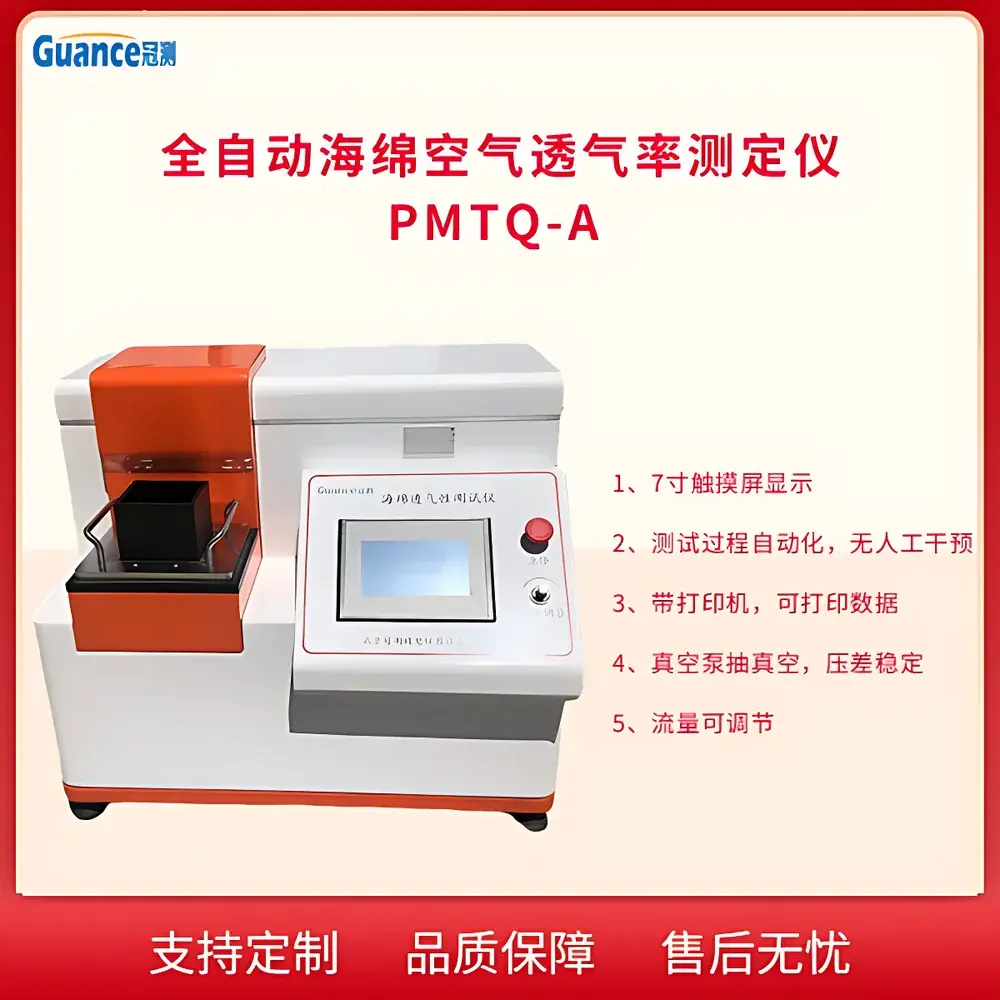
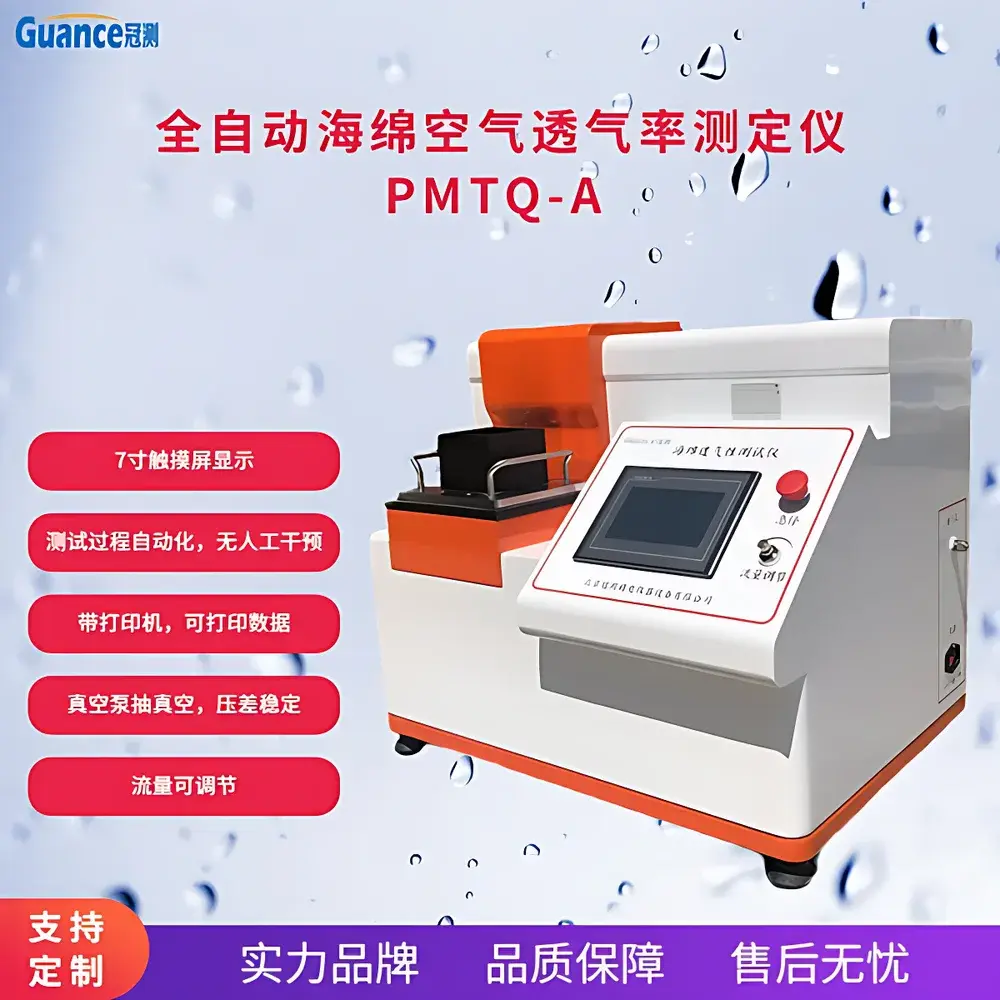
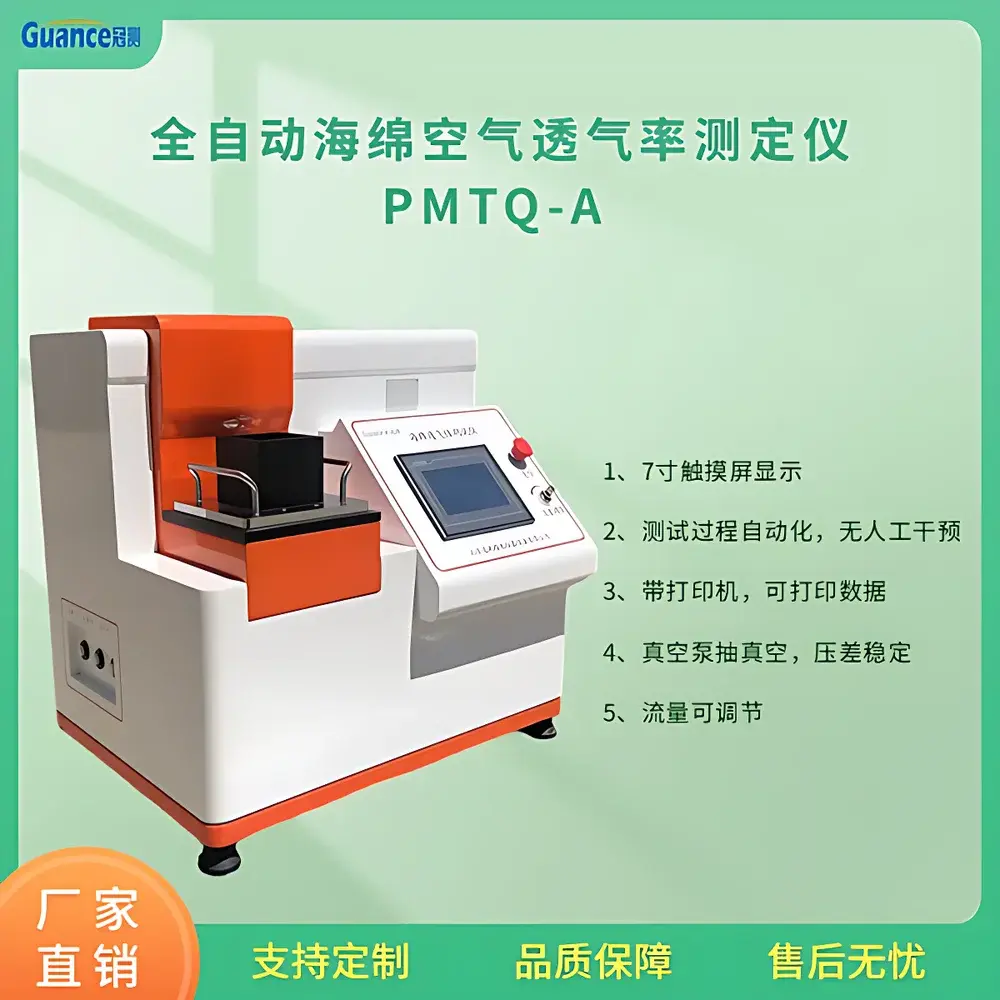
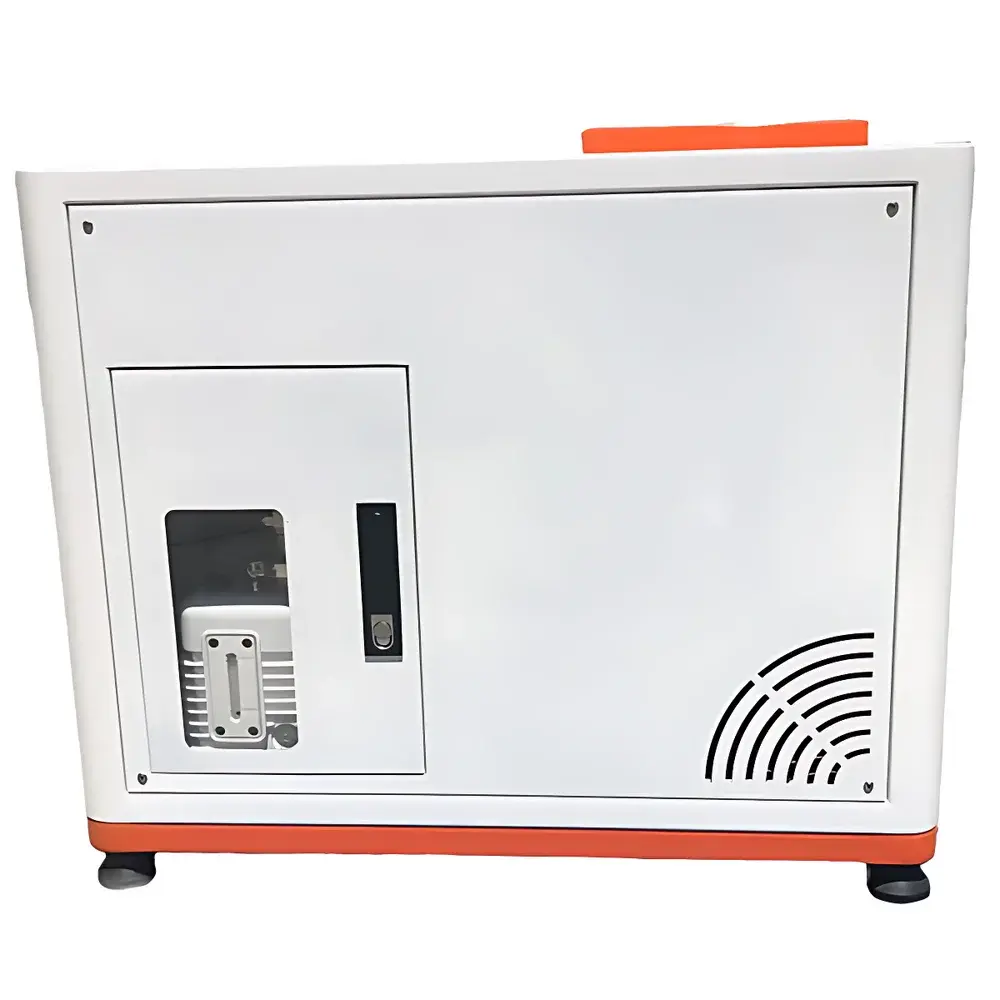
GuanCe PMTQ-A Automatic Air Permeability Tester for Flexible Polymeric Foams
| Brand | GuanCe Instruments |
|---|---|
| Origin | Beijing, China |
| Manufacturer Type | Authorized Distributor |
| Country of Origin | China |
| Model | PMTQ-A |
| Instrument Type | Electronic Universal Testing Machine |
| Vacuum Pump Speed | 1.3 m³/h (4.8 L/s) |
| Ultimate Vacuum | 5 × 10² Pa |
| Flow Sensor Range | 0–50 L/min |
| Differential Pressure Sensors | 0–400 Pa & 0–100 Pa |
| Test Chamber Dimensions | 100 mm × 100 mm × 104 mm |
| Specimen Size | 102 mm × 102 mm × 0–100 mm |
| Air Permeability Range | 0–999.9 × 10⁻¹⁰/m² |
| Temperature Sensor Range | −40 °C to +80 °C |
| Chamber Material | 4 mm 304 brushed stainless steel |
| Safety Protections | Over-temperature, over-pressure, over-flow, and overload protection |
| Dimensions (L×W×H) | 800 mm × 630 mm × 700 mm |
| Weight | 85 kg |
| Power Rating | 1 kW |
Overview
The GuanCe PMTQ-A Automatic Air Permeability Tester is a dedicated physical property testing instrument engineered for precise, repeatable measurement of air permeability in flexible polymeric foams—including polyurethane, latex, and viscoelastic sponge materials. It operates on the principle of controlled airflow through a standardized test specimen under defined differential pressure conditions, in strict compliance with ISO 4638:1984, GB/T 10655, ASTM D3574-2005 (Section 12: Air Permeability), and AQ 1088-2011. Unlike general-purpose universal testing machines, the PMTQ-A integrates a purpose-built vacuum-driven flow circuit, dual-range differential pressure sensing, and real-time thermodynamic compensation—enabling direct determination of volumetric flow rate, dynamic viscosity-corrected permeability coefficient (k), and derived parameters including specific airflow resistance and linear velocity. Its architecture eliminates manual calibration drift and operator-dependent timing errors inherent in legacy analog systems such as the RXQ-1 it replaces.
Key Features
- 7-inch industrial-grade capacitive touchscreen interface with intuitive, icon-driven workflow navigation—no keyboard or external PC required
- Full test automation: initiation, pressure stabilization, flow acquisition, thermal compensation, and result calculation completed within ≤10 seconds per specimen
- Dual differential pressure sensor system (0–100 Pa and 0–400 Pa) with automatic range switching ensures optimal signal-to-noise ratio across low- and high-permeability foam grades
- Integrated temperature-compensated air viscosity algorithm compliant with ISO 8502-2:2017, using real-time ambient sensor feedback (−40 °C to +80 °C)
- Comprehensive parameter output: differential pressure (Pa), volumetric flow rate (L/min), air permeability (×10⁻¹⁰/m²), linear velocity (m/s), specific airflow resistance (Pa·s/m), and flow resistivity (Pa·s/m²)
- Redundant hardware safety layer: independent thermal cutoff, pressure relief valve, flow limiter, and motor overload detection—fully documented in the CE-compliant technical file
- Test chamber constructed from 4 mm thick 304 brushed stainless steel with TIG-welded seams, ensuring dimensional stability, corrosion resistance, and long-term sealing integrity
Sample Compatibility & Compliance
The PMTQ-A accommodates standard foam specimens measuring 102 mm × 102 mm × up to 100 mm thickness—compatible with all ISO/GB/ASTM-specified sample preparation protocols. Its fixed 100 mm × 100 mm test area aperture enables direct comparison with historical RXQ-1 data without geometric correction. The instrument satisfies metrological traceability requirements for accredited laboratories under ISO/IEC 17025:2017, with factory calibration certificates referencing NIM (National Institute of Metrology, China) standards. All software-generated reports include embedded audit trails, timestamped operator ID, environmental metadata (temperature, barometric pressure), and instrument serial-number binding—supporting GLP and GMP documentation workflows per FDA 21 CFR Part 11 Annex 11 principles.
Software & Data Management
Firmware v3.2 includes embedded data logging with non-volatile memory storage (≥10,000 test records), USB export (CSV/Excel-compatible), and optional Ethernet connectivity for LAN-based lab network integration. Each test record contains raw sensor time-series data (100 Hz sampling), calculated metrics, pass/fail flags against user-defined limits, and configurable statistical summaries (mean, SD, CV%). Audit logs capture all configuration changes, calibration events, and user logins with immutable timestamps. Exported files conform to ASTM E2500-18 data formatting guidelines and support automated ingestion into LIMS platforms via structured XML schema.
Applications
- Quality control of automotive seat foams per OEM specifications (e.g., Ford WSS-M99P30-A2, GMW14350)
- R&D evaluation of flame-retardant or bio-based polyurethane formulations for HVAC filtration media
- Regulatory testing of mine-sealing polymer composites under AQ 1088-2011 ventilation leakage criteria
- Validation of medical cushioning materials for pressure ulcer prevention (ISO 10993-10 biocompatibility screening support)
- Batch release testing in ISO 9001-certified foam manufacturing facilities
FAQ
What standards does the PMTQ-A directly support?
ISO 4638:1984, GB/T 10655, ASTM D3574-2005 Section 12, and AQ 1088-2011—with full alignment to specimen geometry, pressure gradient, and calculation methodology.
Can the instrument be integrated into an existing laboratory information management system (LIMS)?
Yes—via USB mass-storage mode or optional TCP/IP interface; exported CSV files include all mandatory fields for ASTM E2500-18 and ISO/IEC 17025 traceability.
Is temperature compensation applied during calculation, and how is it validated?
Yes—real-time temperature input adjusts kinematic viscosity per ISO 8502-2:2017; validation performed using NIST-traceable dry-block calibrators at three points across the operating range.
Does the system provide raw sensor data for secondary analysis?
Yes—each test saves full-resolution pressure and flow time-series data (100 Hz, 32-bit) alongside final results in the internal database.
What maintenance intervals are recommended for the vacuum pump and sensors?
Vacuum pump oil replacement every 1,000 operating hours; differential pressure sensors require annual recalibration by an ISO/IEC 17025-accredited provider; no user-serviceable parts inside the sealed test chamber.



