
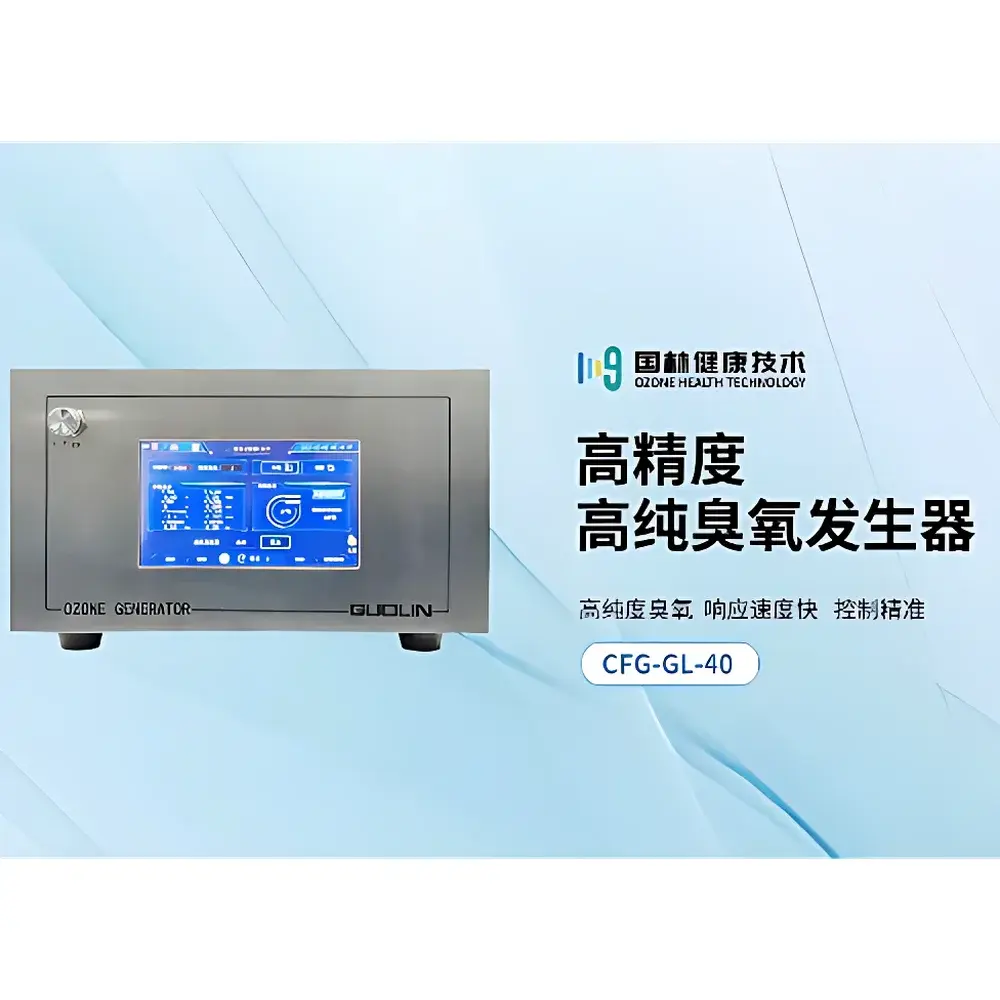
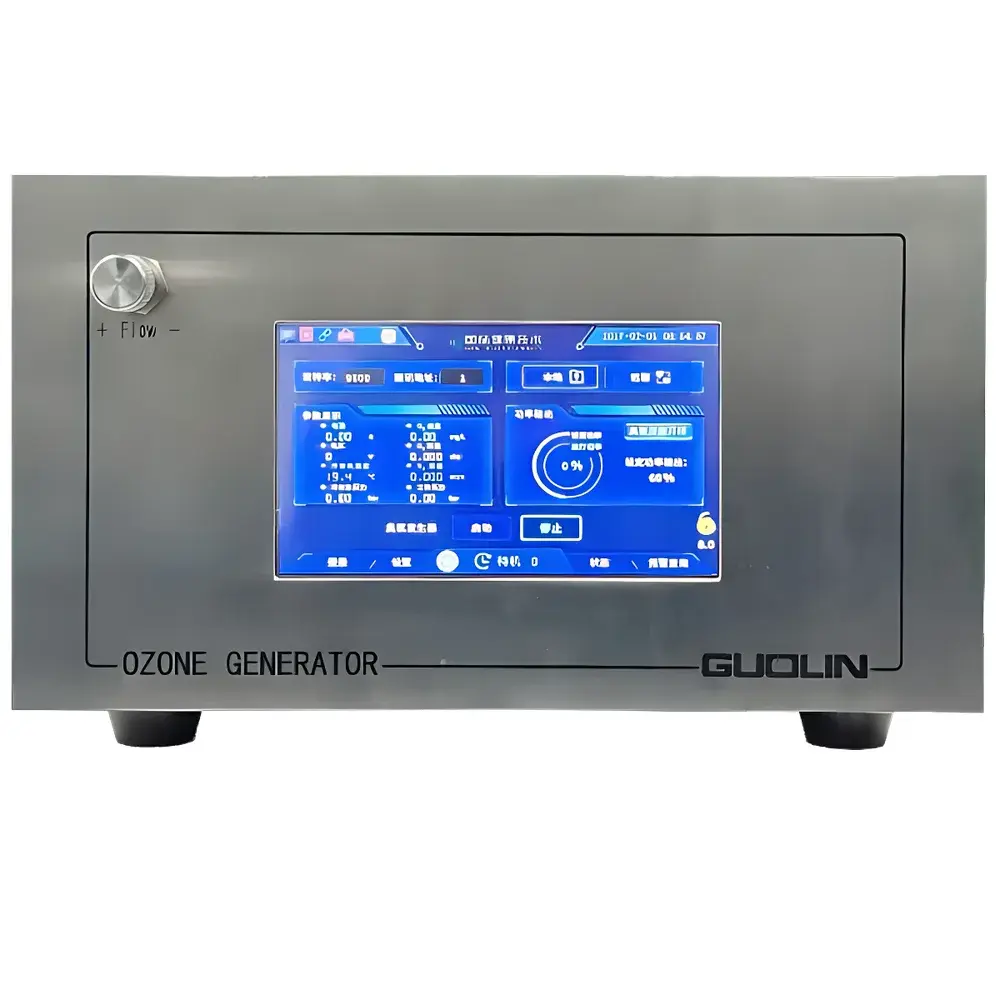
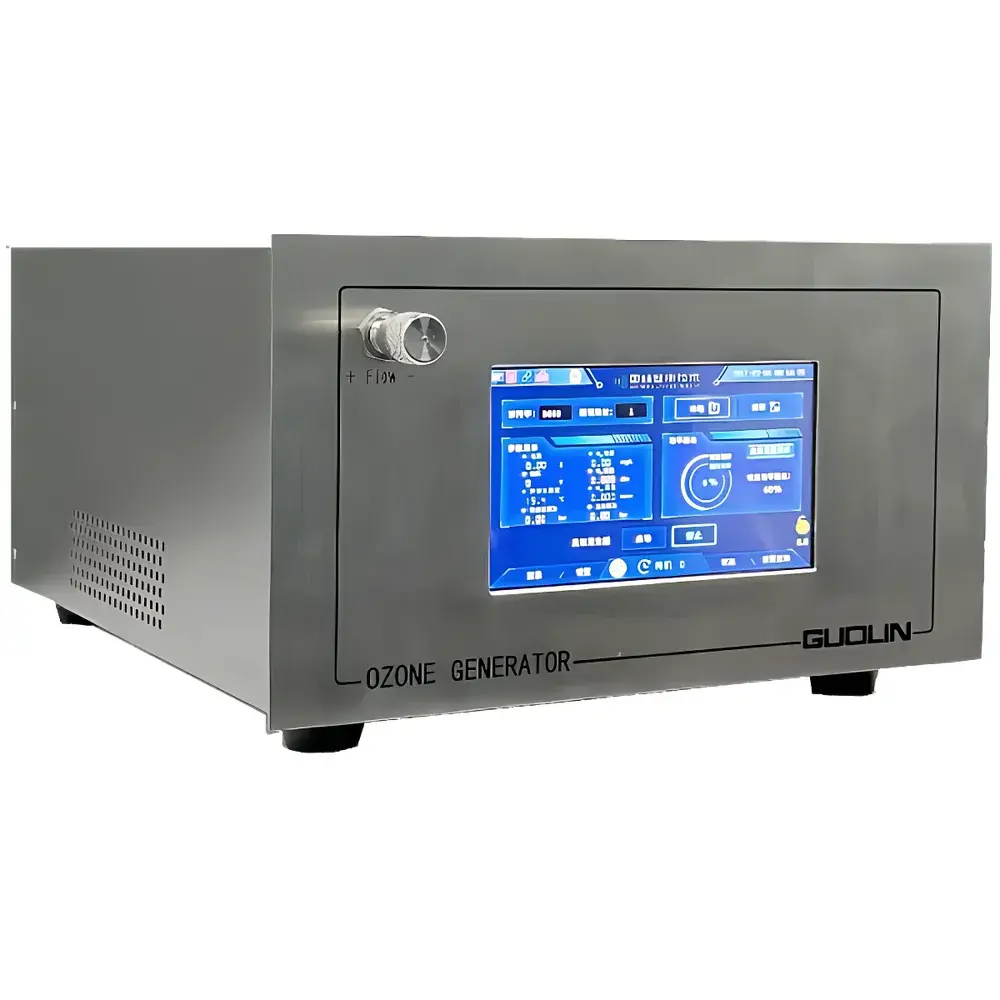
Guolin Health CFG-GL-40 Advanced Ozone Generator for Semiconductor Process Gas & Analytical Instrument Calibration
| Brand | Guolin Health Technology |
|---|---|
| Origin | Shandong, China |
| Model | CFG-GL-40 Advanced Edition |
| Ozone Output | 0–40 g/h |
| Adjustable Ozone Concentration | 20–170 mg/L |
| Feed Gas | High-Purity Oxygen (≥99.999%) |
| Generation Principle | Dielectric Barrier Discharge (DBD) |
| Construction Materials | Semiconductor-Grade PTFE & Electropolished 316L Stainless Steel |
| Dimensions (W×D×H) | 340 × 190 × 410 mm |
| Control Accuracy | ±1.0% of setpoint (S.P.), ±0.35% of full scale (F.S.) |
| Pressure Regulation Range | 0.4–1.0 bar |
| Interface | OLED Touchscreen + Modbus RTU/TCP/IP |
| Power Supply | 220 V AC, 500 W |
| Compliance | Designed for ISO/IEC 17025-compliant labs |
Overview
The Guolin Health CFG-GL-40 Advanced Ozone Generator is an engineered solution for laboratories requiring traceable, ultra-high-purity ozone gas in controlled concentrations—specifically tailored for semiconductor process validation, analytical instrument calibration (e.g., UV photometric ozone analyzers per ISO 13964), and cleanroom ambient monitoring. It employs a precision dielectric barrier discharge (DBD) cell operating exclusively on high-purity oxygen feed gas, eliminating nitrogen oxide byproducts and ensuring ozone purity >99.99% with negligible metallic ion leaching. Unlike corona discharge systems using ambient air, this generator delivers stable, repeatable output across its full 0–40 g/h range, with concentration resolution down to 0.1 mg/L and real-time feedback control enabled by integrated thermal mass flow and electrochemical ozone sensing. Its compact footprint and modular architecture support integration into gas standard generation systems, purge-and-trap setups, and inline calibration manifolds used in EPA Method 40 CFR Part 53–compliant ozone reference analyzers.
Key Features
- Ultra-high-purity ozone generation via DBD technology with oxygen-only feed gas—no NOx, hydrocarbons, or particulate carryover
- Electropolished 316L stainless steel wetted parts and semiconductor-grade PTFE gas pathways to prevent metal ion contamination (critical for wafer surface passivation studies)
- OLED touchscreen interface with programmable ramp profiles, setpoint logging, and dual-unit display (g/h and mg/L)
- Integrated pressure-regulated flow control (0.4–1.0 bar) with ±0.5% F.S. accuracy, enabling consistent delivery to mass flow controllers or diffusion scrubbers
- Modbus RTU and TCP/IP protocols for seamless integration into SCADA, LIMS, or centralized lab automation platforms
- Dual-layer safety architecture: real-time ozone leakage detection (ppb-level electrochemical sensor), over-pressure cut-off, and thermal runaway protection
- Low-power consumption design (500 W nominal) with energy-efficient DBD cell cooling—validated for continuous 24/7 operation under Class 100 cleanroom conditions
Sample Compatibility & Compliance
The CFG-GL-40 is validated for use with ozone-sensitive instrumentation including UV absorption analyzers (254 nm), chemiluminescence detectors, and electrochemical sensors employed in ASTM D5128, ISO 13964, and EN 14625 standard methods. Its gas pathway materials comply with SEMI F57 (semiconductor equipment material compatibility) and USP <661.1> for extractables testing. The generator meets CE marking requirements for electromagnetic compatibility (EN 61326-1) and low-voltage directive (2014/35/EU). While not certified as medical device (FDA 21 CFR Part 820), its design adheres to GLP principles—audit-ready event logs, user-accessible calibration history, and password-protected parameter modification align with FDA 21 CFR Part 11 data integrity expectations for regulated QC environments.
Software & Data Management
No proprietary cloud platform or mobile app is required. Configuration, monitoring, and data export are performed via native Modbus registers or optional web-based HMI (HTTP server embedded). All operational parameters—including ozone output, inlet pressure, cell temperature, and alarm status—are timestamped and stored locally (16 MB non-volatile memory, ≥30 days at 1 Hz sampling). CSV export via USB-C enables direct import into MATLAB, Python Pandas, or LabVIEW for metrological uncertainty analysis. Firmware updates are performed offline via signed binary files to maintain system integrity in air-gapped lab networks.
Applications
- Calibration and verification of ozone monitors used in semiconductor fab ambient air quality control (per ISO 14644-8)
- Generation of certified ozone reference standards for EPA-equivalent photometric analyzers in environmental testing labs
- In-situ oxidation kinetics studies for high-k dielectric film formation (e.g., Al2O3, HfO2) requiring sub-ppm ozone dosing precision
- Validation of ozone destruct efficiency in abatement systems per SEMI S2/S8 safety guidelines
- Controlled oxidative stress modeling in cell culture and biomaterials research where trace metal contamination must be excluded
FAQ
What feed gas is required—and why can’t ambient air be used?
High-purity oxygen (≥99.999%) is mandatory. Ambient air introduces nitrogen, moisture, and VOCs that generate NOx and organic ozonides in the DBD cell—compromising ozone purity and accelerating electrode corrosion. This violates semiconductor-grade gas specifications (SEMI F21).
Is the ozone concentration output traceably calibrated?
Yes. Each unit ships with a NIST-traceable calibration certificate for ozone mass flow (g/h) and concentration (mg/L) at three points across its operating range, verified against a primary UV photometer per ISO 13964 Annex B.
Can this generator be integrated into a fully automated gas standard delivery system?
Absolutely. Modbus TCP/IP enables bidirectional communication with PLCs or gas mixing manifolds. Analog 4–20 mA outputs (optional) support legacy DCS integration without protocol conversion.
What maintenance intervals are recommended for sustained purity performance?
Quarterly inspection of DBD electrode alignment and O-ring integrity; annual replacement of oxygen filter (part #GL-OX-FIL-01); no scheduled replacement of PTFE components under normal operating conditions (validated >10,000 hours MTBF).



