
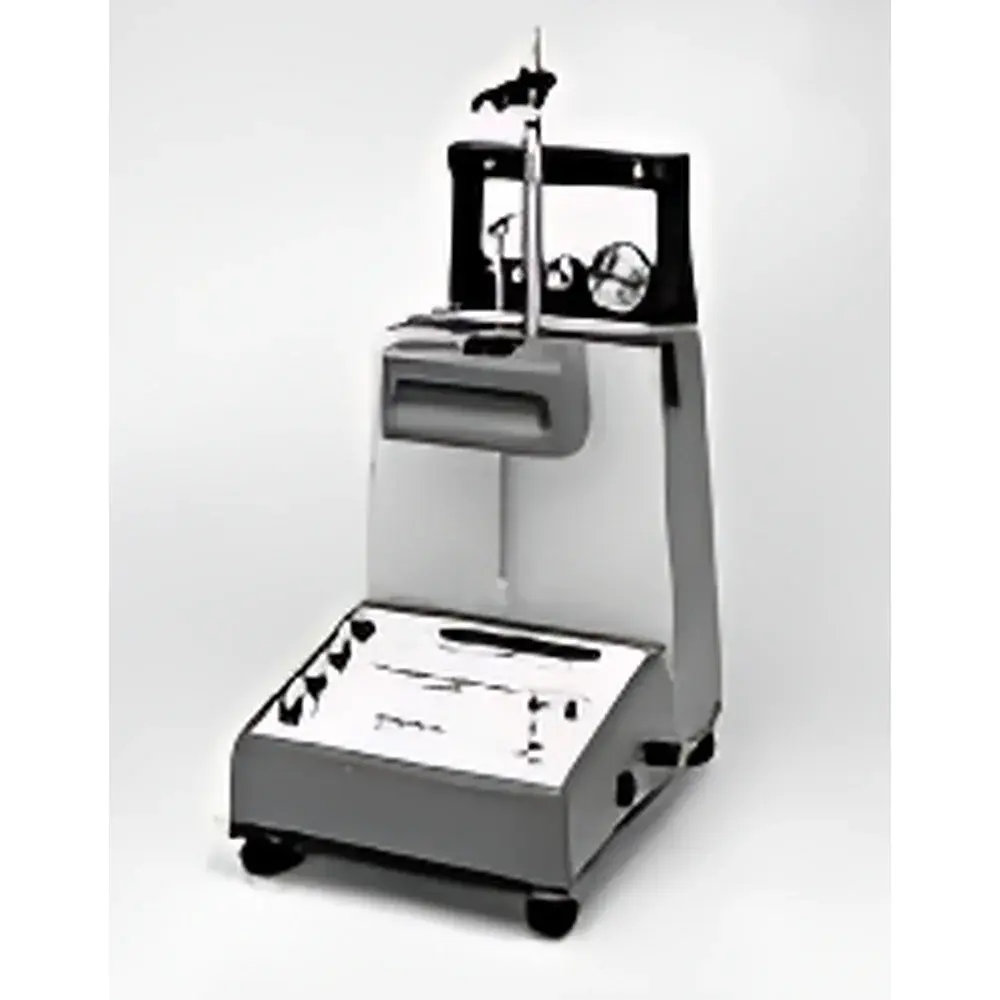
Gurley Model 4171 Digital Tensile-Stiffness Tester
| Brand | Gurley |
|---|---|
| Origin | USA |
| Model | 4171 |
| Power Supply | 110/220 V, 50/60 Hz |
| Display | Digital (LCD) |
| Output Units | mg, sin θ (1.0–7.0), or mN·m (via conversion formula) |
| Sample Capacity | Flat specimens — L 25.4–114.3 mm, W 1.27–50.8 mm, T ≤ 6.35 mm |
| Angular Adjustment | 0°–180° in 15° increments |
| Interface | RS-232 (4171-ET variant) |
| Compliance | ASTM D747, ISO 2493, TAPPI T823, GB/T 22895 |
Overview
The Gurley Model 4171 Digital Tensile-Stiffness Tester is a precision mechanical instrument engineered for the quantitative determination of bending resistance—commonly referred to as stiffness—in flexible and semi-rigid materials. Operating on the principle of controlled angular deflection under standardized gravitational loading, the instrument measures the restoring torque required to bend a specimen through a defined arc (0° to 180°), with force quantified via calibrated weights and a pivoting pendulum system. This gravimetric torsional method delivers high reproducibility for comparative and specification-grade testing across packaging, paper, polymer, rubber, and wire manufacturing environments. Designed and manufactured in the United States, the Model 4171 complies with internationally recognized test standards including ASTM D747 (Standard Test Method for Stiffness of Paperboard), ISO 2493 (Paper and board — Determination of bending resistance), TAPPI T823 (Stiffness of Paper and Paperboard), and GB/T 22895 (Chinese national standard for paperboard stiffness). Its dual-purpose sample handling architecture—featuring interchangeable flat and tubular clamping fixtures—enables consistent measurement across heterogeneous geometries without recalibration.
Key Features
- Modular clamping system: Dedicated parallel-jaw fixture for flat sheet materials (thickness up to 6.35 mm) and proprietary tubular grip assembly enabling secure axial alignment of soft tubes, wires, and hollow profiles from 0° to 180° in precise 15° increments.
- Digital readout interface: Real-time display of results in three interoperable units—milligrams (mg), sine of deflection angle (sin θ, range 1.0–7.0), or converted torque values in millinewton-meters (mN·m) using the manufacturer-provided empirical formula.
- Configurable test matrix: Sixty distinct test configurations achievable by varying specimen length (25.4–114.3 mm), weight mass, and weight placement along the pendulum arm—supporting wide dynamic range without hardware modification.
- RS-232 serial port (4171-ET variant): Enables direct data export to laboratory information management systems (LIMS), statistical process control (SPC) software, or custom QA databases for audit-ready traceability.
- Robust mechanical architecture: All-metal construction, hardened steel pivot bearings, and zero-backlash linkage ensure long-term dimensional stability and minimal hysteresis across repeated cycles.
Sample Compatibility & Compliance
The Model 4171 accommodates diverse physical forms critical to packaging and converting industries: corrugated board, solid bleached sulfate (SBS) board, metallized films, extruded thermoplastic sheets, vulcanized rubber strips, copper or aluminum wire bundles, and laminated flexible tubing. Its tubular clamping mechanism—patented for coaxial alignment—eliminates torsional misalignment errors common in generic bending testers. Regulatory alignment includes full support for GLP-compliant documentation workflows when paired with validated data acquisition software. Instrument validation protocols align with ISO/IEC 17025 requirements for testing laboratories, and measurement uncertainty budgets are documented per EURACHEM/CITAC guidelines. Routine verification uses NIST-traceable stainless steel reference specimens with certified stiffness values.
Software & Data Management
While the base Model 4171-DT operates as a stand-alone analog-digital hybrid instrument, the 4171-ET variant integrates seamlessly into regulated digital environments. The RS-232 interface supports ASCII-based command-response protocol compatible with Windows-based QA applications and Python-driven automation scripts. Exported datasets include timestamp, operator ID, specimen ID, configuration parameters (length, weight mass, position), raw sin θ value, derived mg and mN·m outputs, and pass/fail flags against user-defined specification limits. Audit trails comply with FDA 21 CFR Part 11 requirements when used with validated third-party software implementing electronic signatures, role-based access control, and immutable record retention.
Applications
- Quality control of folding cartons and retail packaging boards to verify compliance with retailer-specific stiffness thresholds (e.g., Walmart S-1000, Amazon FBA packaging guidelines).
- R&D evaluation of coated paper substrates during formulation development—quantifying effects of fiber refining, filler addition, or surface sizing on bending modulus.
- Validation of extrusion die settings for thermoplastic tubing by correlating measured stiffness with wall thickness uniformity and melt flow index.
- Comparative assessment of biodegradable film alternatives (PLA, PHA, cellulose acetate) against petrochemical benchmarks under identical environmental conditioning (23°C/50% RH per ISO 187).
- Failure analysis of delaminated composite laminates where interfacial shear loss manifests as anomalous stiffness reduction at specific bend radii.
FAQ
What standards does the Gurley Model 4171 directly support?
ASTM D747, ISO 2493, TAPPI T823, and GB/T 22895. Full test method documentation and calibration procedures are provided with each unit.
Can the instrument measure both flat and tubular specimens without recalibration?
Yes—the mechanical design maintains geometric equivalence between flat and tubular test modes; only fixture exchange is required. Calibration is retained across both configurations.
Is the mg-to-mN·m conversion formula instrument-specific or universally applicable?
It is empirically derived for the Model 4171’s lever geometry and pivot radius; use of the Gurley-provided formula ensures metrological traceability to NIST-certified reference masses.
Does the RS-232 interface support real-time streaming or only batch export?
The interface operates in polled mode—data is transmitted upon completion of each test cycle, enabling integration into continuous monitoring dashboards via polling intervals configured in host software.
What maintenance is required to sustain measurement accuracy over time?
Annual verification using Gurley-supplied reference specimens and visual inspection of pivot wear; no lubrication or adjustment is needed under normal operating conditions per the manufacturer’s maintenance schedule.




