
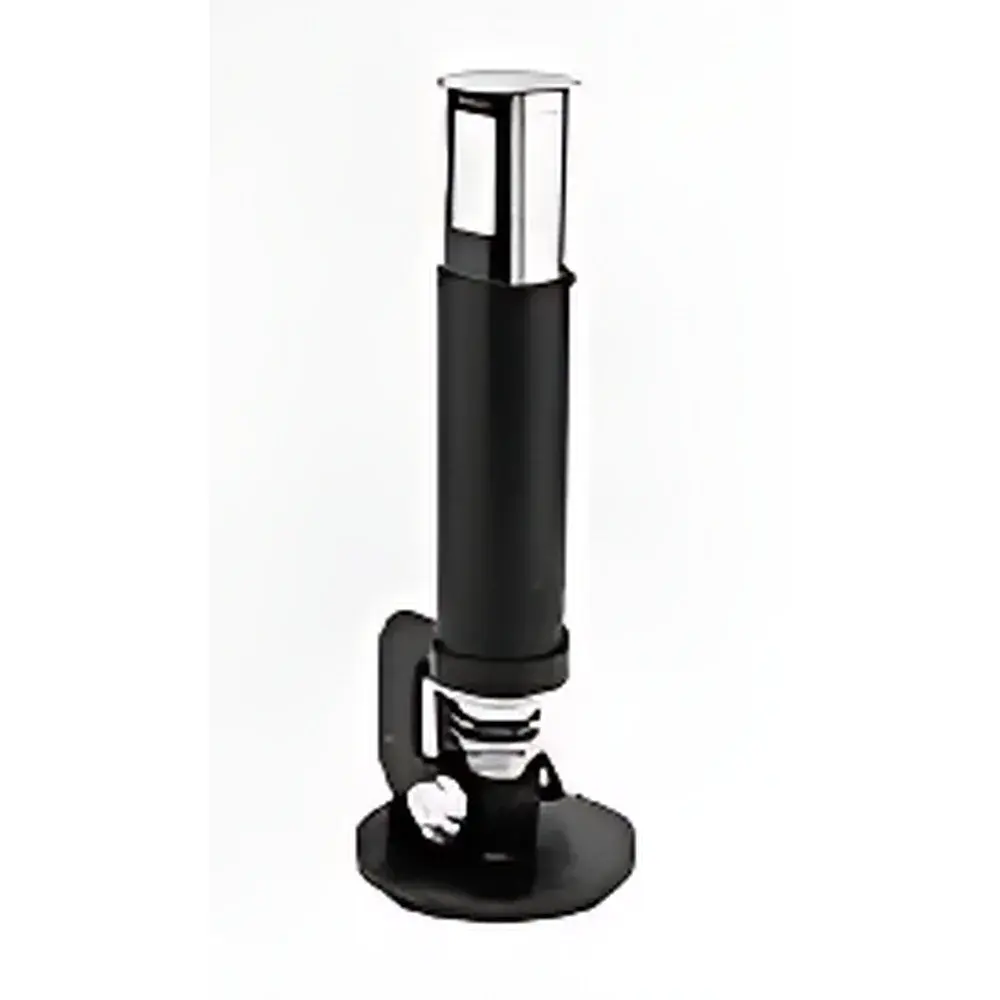
Gurley Model 4320 Standardized Air Permeability Tester
| Brand | Gurley |
|---|---|
| Origin | USA |
| Model | 4320 |
| Cylinder Weight | 20 oz |
| Test Area Options | 1.0, 0.25, or 0.1 in² |
| Applied Pressure | 4.88 in H₂O (1.2 kPa) |
| Air Volume Measured | 100 cm³ |
| Flow Time Range | 2.0–2000 s |
| Equivalent Gurley Seconds | 0.00156–25 s⁻¹ (calculated per ASTM D737) |
| Net Weight | 12–17 lbs |
| Compliance | ASTM D737, ISO 9237, TAPPI T460, GB/T 5453 |
Overview
The Gurley Model 4320 Standardized Air Permeability Tester is a precision mechanical instrument engineered for the gravimetric determination of air resistance—commonly reported as Gurley seconds—across porous sheet materials. It operates on the fundamental principle of constant-pressure, fixed-volume airflow measurement: under a precisely defined hydrostatic pressure differential (4.88 inches water column, equivalent to 1.2 kPa), a fixed volume of ambient air (100 cm³) is drawn through a standardized test area of the specimen. The elapsed time required for this volumetric flow is measured mechanically with high reproducibility. Unlike electronic pressure-controlled systems, the Gurley method relies on a calibrated free-falling weighted piston (20 oz cylinder) sliding within an oil-sealed outer cylinder—ensuring passive, drift-free pressure generation without external regulators or feedback loops. This architecture delivers long-term stability and metrological traceability essential for QC laboratories operating under GLP or ISO/IEC 17025 frameworks.
Key Features
- True constant-pressure operation via gravity-driven piston system—no compressed air supply, solenoids, or pressure regulators required.
- Interchangeable test area inserts (1.0 in², 0.25 in², and 0.1 in²) enabling accurate measurement across low-, medium-, and high-resistance materials—from tissue paper to coated barrier films.
- Calibrated 20 oz stainless-steel inner cylinder with precision-machined surface finish and consistent oil seal geometry for repeatable pressure application.
- Mechanical stop-and-release timing mechanism with dual-scale analog dial: direct Gurley second readout (0–2000 s) and secondary scale for extended range verification.
- Modular clamping assembly with hardened steel platens and precision-ground gasket surfaces ensuring uniform sample compression and leak-free sealing.
- Compliance-ready design: fully compatible with ASTM D737 Annex A1 (standard test method for air permeability of textile fabrics), ISO 9237 (determination of air permeability of fabrics), TAPPI T460 (air resistance of paper and paperboard), and GB/T 5453 (Chinese national standard for textile air permeability).
Sample Compatibility & Compliance
The Model 4320 accommodates flat, non-extensible sheet specimens up to 0.5 mm thickness, including uncoated and coated papers, cardboard, nonwovens, technical textiles, filtration media, and thin polymer laminates. Sample conditioning per ASTM D6413 or ISO 139 is recommended prior to testing to ensure equilibrium at 23 ± 1 °C and 50 ± 2 % RH. All test fixtures—including orifice plates, gaskets, and piston components—are manufactured to dimensional tolerances specified in ASTM D737 Section 6. The instrument meets the mechanical accuracy requirements outlined in ISO/IEC 17025 Clause 6.4 for equipment used in accredited testing laboratories. Routine verification using NIST-traceable reference standards (e.g., certified Gurley reference foils) supports audit readiness for FDA-regulated packaging validation (21 CFR Part 11 data integrity not applicable due to analog operation, but full manual log traceability is maintained per GLP Annex 11 principles).
Software & Data Management
As a purely mechanical analog instrument, the Gurley Model 4320 does not incorporate embedded electronics, firmware, or digital output interfaces. All measurements are recorded manually into laboratory notebooks or LIMS-compatible spreadsheets. For laboratories requiring automated data capture, optional accessories include a certified mechanical stopwatch with ±0.1 s resolution and a dedicated Gurley Timing Base Station (sold separately), which integrates with USB-timed data loggers compliant with ASTM E2917. Raw time values are converted to Gurley seconds using the standardized equation defined in ASTM D737 Section 11: Gurley seconds = t / V × K, where t = measured time (s), V = volume (100 cm³), and K is the instrument-specific calibration factor (0.00156 s·cm⁻³ for 1.0 in² aperture). Calibration certificates are supplied with each unit and renewed annually per ISO/IEC 17025 internal verification protocols.
Applications
- Quality control of release liners, label facestocks, and breathable medical packaging substrates.
- R&D evaluation of pore structure homogeneity in filtration papers and battery separator membranes.
- Process validation of calendering, coating, and embossing parameters in tissue manufacturing.
- Comparative assessment of breathability in personal protective equipment (PPE) nonwovens per EN 14325.
- Regulatory submission support for pharmaceutical blister packaging per USP and Ph. Eur. 2.9.17.
- Teaching laboratories demonstrating fundamental gas transport phenomena in porous media (Darcy’s law approximation, Knudsen flow regime identification).
FAQ
What is the difference between Gurley seconds and air permeability in SI units (m³/Pa·s·m²)?
Gurley seconds measure time—not permeability directly. Conversion requires material thickness and pressure gradient; ASTM D737 provides empirical correlation tables, while ISO 9237 expresses results as air permeance (mm/s) at 100 Pa differential pressure.
Can the Model 4320 be used for testing elastomeric or highly compressible materials?
No. The test method assumes negligible specimen deformation under 1.2 kPa load. Compressible foams or gels require alternative methods such as ASTM F2100 (bacterial filtration efficiency) or ISO 15223-1 (porometry).
Is operator training required for ASTM D737 compliance?
Yes. ASTM D737 Section 8 mandates documented operator competency, including proper sample mounting technique, piston release timing, and environmental monitoring records.
How often should the oil seal be inspected and replaced?
Gurley recommends visual inspection before each shift; replacement every 6 months or after 500 tests—whichever occurs first—to maintain pressure consistency per ASTM D737 Section 7.2.
Does Gurley provide calibration services traceable to NIST?
Yes. Factory calibration includes NIST-traceable pressure and dimensional verification, with certificate of conformance issued per ISO/IEC 17025. On-site recalibration is available through authorized service partners.






