
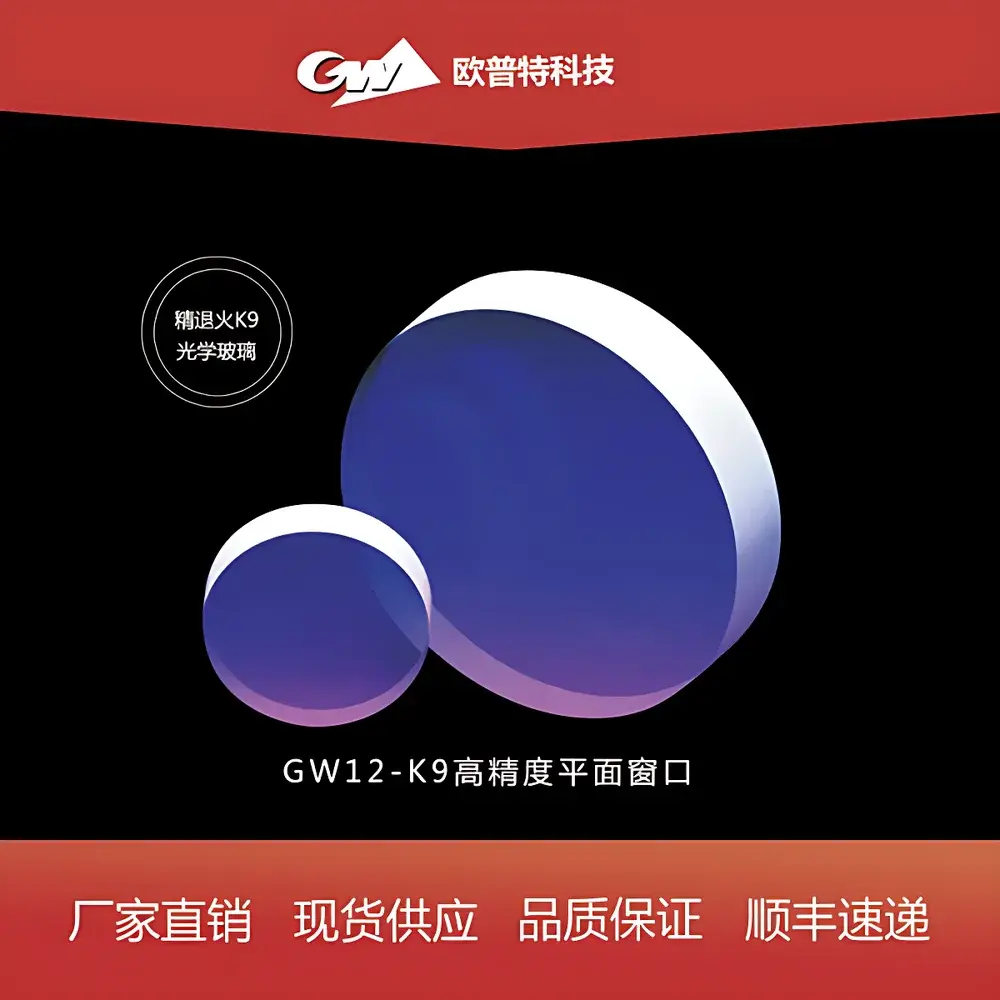
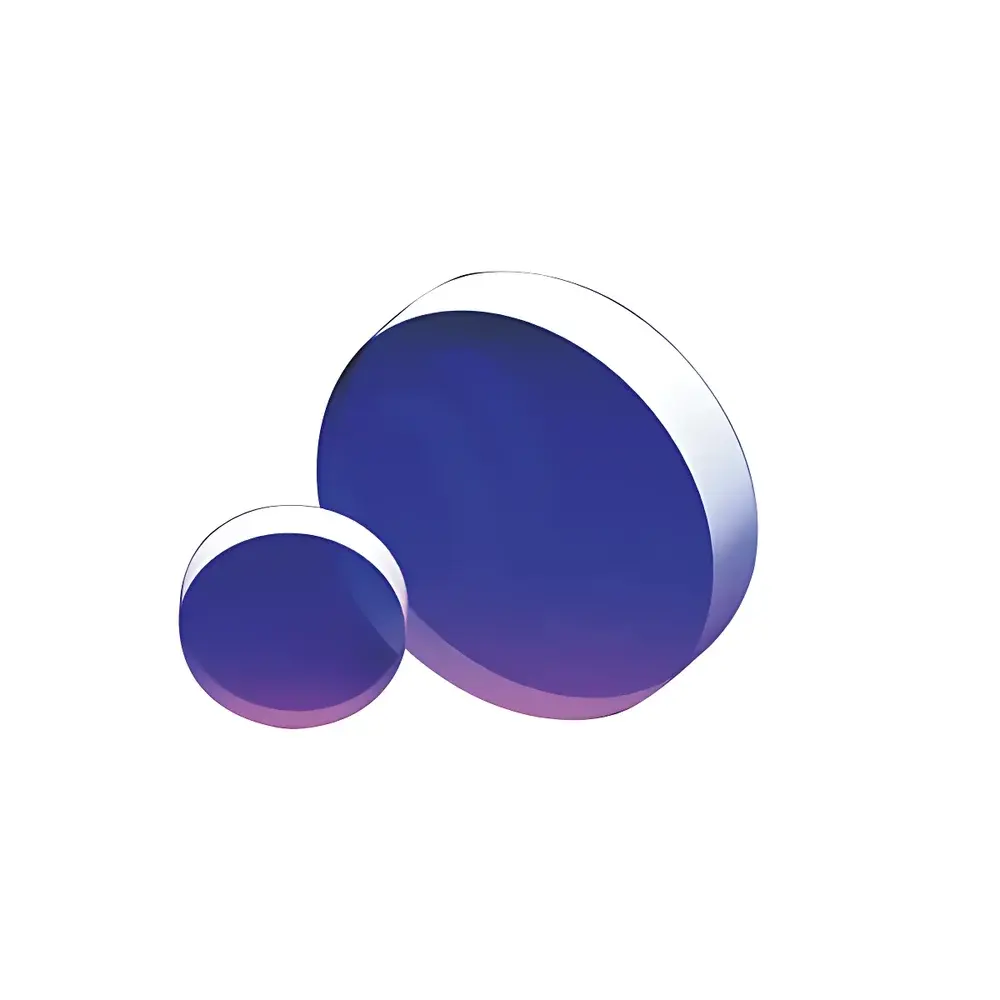
GW12-K9 Precision Plane Optical Window
| Origin | Beijing, China |
|---|---|
| Manufacturer Type | Authorized Distributor |
| Product Category | Domestic Optical Component |
| Model | GW12 |
| Unit Price Range | USD 0.15–75.00 (varies by size, thickness, and coating) |
| Component Type | Optical Window |
| Substrate Material | K9 Borosilicate Crown Glass |
| Transmission Range | 350–2100 nm (coating-dependent) |
| Coating Options | Uncoated, VIS AR (350–700 nm), NIR AR (600–1100 nm), SWIR AR (900–1700 nm) |
| Available Diameters | Φ5.0 to Φ50.8 mm |
| Thicknesses | 2.0 to 10.0 mm |
| Surface Quality | 20–10 scratch-dig (per MIL-PRF-13830B) |
| Parallelism | ≤3 arcsec |
| Wavefront Distortion | λ/4 @ 633 nm |
Overview
The GW12-K9 Precision Plane Optical Window is a high-stability, low-birefringence optical component engineered for demanding applications in spectroscopy, laser systems, imaging optics, and short-wave infrared (SWIR) instrumentation. Fabricated from certified K9 borosilicate crown glass—a material conforming to ISO 10110-1 and SCHOTT BK7 specifications—the window delivers excellent homogeneity, low fluorescence, and minimal internal stress. Its uncoated baseline transmission spans 350–2100 nm, with optional anti-reflection (AR) coatings optimized for three critical spectral bands: visible (VIS: 350–700 nm), near-infrared (NIR: 600–1100 nm), and short-wave infrared (SWIR: 900–1700 nm). Designed for integration into vacuum chambers, environmental enclosures, and optical benches, the GW12 series maintains dimensional stability across thermal gradients (CTE: 7.1 × 10⁻⁶ /°C) and exhibits high resistance to mechanical shock and humidity-induced degradation.
Key Features
- Precision-ground and polished plane surfaces with surface quality rated at 20–10 scratch-dig per MIL-PRF-13830B
- Wavefront distortion controlled to λ/4 at 633 nm (measured interferometrically)
- Parallelism tolerance ≤3 arcseconds—critical for collimated beam preservation in interferometric and metrology setups
- Multiple standardized diameters (Φ5.0 to Φ50.8 mm) and thicknesses (2.0 to 10.0 mm) supporting OEM integration and modular optical design
- AR coatings deposited via ion-assisted e-beam evaporation, achieving 99.5% peak transmission
- Batch-certified material traceability, including refractive index (nd = 1.5163 @ 587.6 nm), Abbe number (νd = 64.2), and density (2.51 g/cm³)
Sample Compatibility & Compliance
The GW12-K9 window is compatible with standard optical mounts (e.g., SM-threaded lens tubes, kinematic mirror mounts, and vacuum flange adapters). Its K9 substrate meets RoHS Directive 2011/65/EU and REACH Annex XVII requirements. All coated variants undergo accelerated environmental testing per ISO 9211-4:2013 (adhesion, humidity, abrasion) and are qualified for use in Class 1000 cleanroom assembly. The product line supports GLP-compliant documentation packages—including certificate of conformance, spectral transmission reports, and interferometric wavefront maps—upon request. While not inherently FDA-regulated, GW12 windows are routinely deployed in ISO 13485-certified medical laser delivery systems and ASTM E1317-22 compliant spectrophotometer calibration modules.
Software & Data Management
No embedded firmware or proprietary software is associated with the GW12-K9 window, as it is a passive optical component. However, comprehensive spectral transmission data (350–2100 nm, 1 nm resolution) is provided in ASCII and CSV formats for integration into optical design platforms such as Zemax OpticStudio, CODE V, and FRED. Each shipment includes a unique serial-numbered test report referencing measurement conditions (temperature: 22 ± 0.5°C; relative humidity: 45 ± 5%; collimated source: tungsten-halogen + monochromator). Raw interferograms and surface profile scans (via Zygo Verifire™) are archived for traceability and may be accessed under NDA for audit purposes.
Applications
- Laser cavity end windows and beam entry/exit ports for CW and pulsed lasers operating at 532 nm, 780 nm, 1064 nm, and 1550 nm
- Protective windows in SWIR hyperspectral imagers (e.g., InGaAs focal plane array systems)
- Reference standards in UV-Vis-NIR spectrophotometer calibration workflows (per ASTM E275 and ISO/IEC 17025)
- Optical isolation barriers in Raman spectroscopy sample compartments
- Environmental sealing interfaces in industrial machine vision lenses exposed to particulate or corrosive atmospheres
- Substrate base for custom thin-film filter deposition or micro-patterning processes
FAQ
What is the maximum permissible power density for continuous-wave laser exposure on an uncoated GW12-K9 window?
For uncoated K9 at 1064 nm, the damage threshold is ≥500 kW/cm² (10 ns pulse, 10 Hz, Ø0.5 mm spot); for CW operation, thermal lensing becomes limiting above 10 W/cm²—consult application-specific LIDT reports.
Can GW12 windows be mounted in ultra-high vacuum (UHV) environments?
Yes—when cleaned per ISO 10110-7 (Class 5 solvent cleaning) and baked at ≤120°C, outgassing rates meet ASTM E595 requirements (<1.0% TML, <0.1% CVCM).
Is custom diameter or thickness available beyond the standard catalog offerings?
Yes—custom dimensions (up to Φ100 mm, thickness up to 25 mm) and non-standard coatings (e.g., dual-band VIS-SWIR AR) are available under minimum order quantities and extended lead times.
Do AR-coated variants maintain performance after repeated cleaning with IPA and lint-free wipes?
All ion-assisted AR coatings pass 50+ cycles of ASTM F1353-22 cleaning protocol without measurable reflectance increase or adhesion loss.
How is wavefront distortion verified for each production lot?
Every batch undergoes full-aperture interferometry using a Zygo GPI XP/D with λ/20 reference flat; results are logged in the QC database with date/time stamp, operator ID, and environmental monitoring data.




