
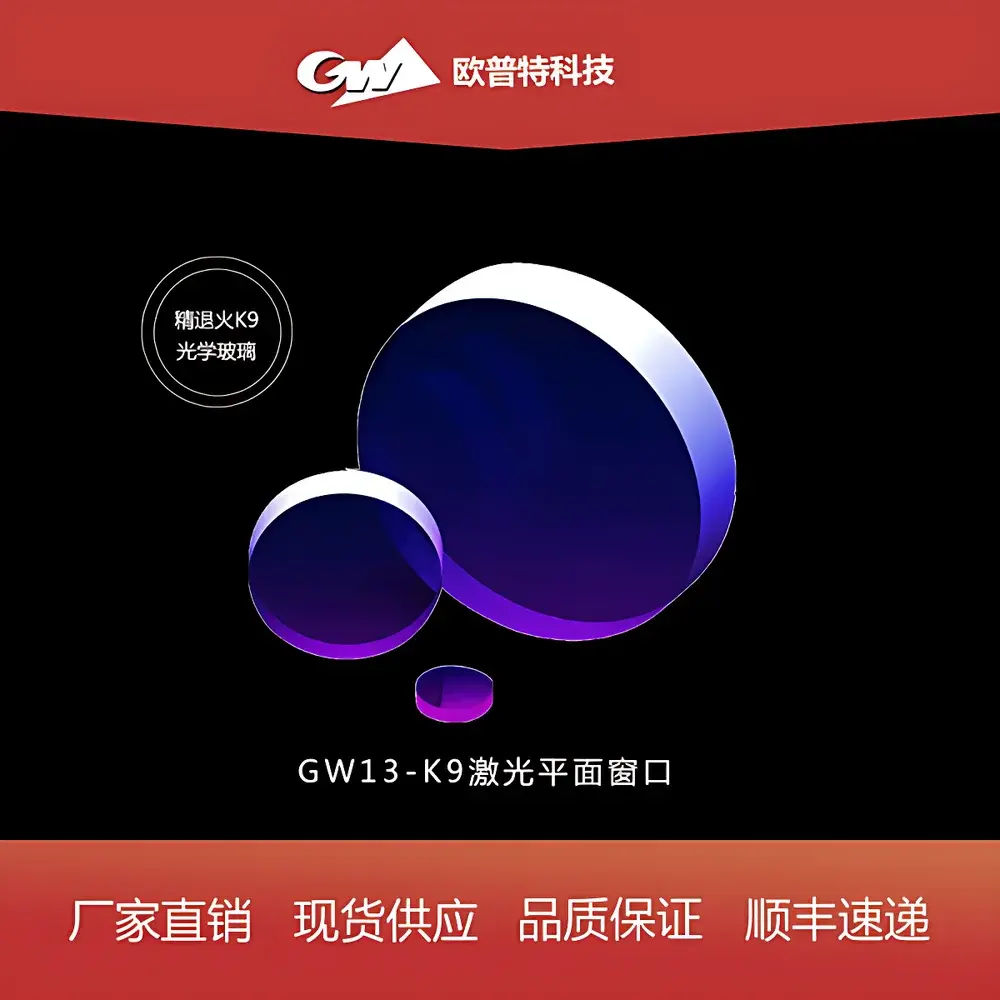

GW13-K9 Laser-Grade Plane Optical Window
| Origin | Beijing, China |
|---|---|
| Manufacturer Type | Authorized Distributor |
| Model | GW13 |
| Component Category | Precision Optical Element |
| Coating Specification | V-Coated Broadband Anti-Reflective (AR) with Rₐᵥg < 0.25% at 532 nm, 632.8 nm, 785 nm, and 1064 nm |
| Available Diameters | Φ5.0–Φ50.8 mm |
| Thickness | 2.0–10.0 mm |
| Substrate Material | Fused Silica (Suprasil-grade or equivalent) |
| Surface Quality | 10–5 scratch-dig |
| Surface Flatness | λ/10 @ 633 nm |
| Parallelism | < 10 arcsec |
| Clear Aperture | ≥ 90% of diameter |
Overview
The GW13-K9 Laser-Grade Plane Optical Window is a high-precision fused silica substrate engineered for demanding laser and interferometric applications requiring minimal wavefront distortion, exceptional transmission stability, and ultra-low residual reflectance across multiple NIR–VIS laser lines. Designed and manufactured to meet stringent optical metrology standards, the GW13-K9 window utilizes a proprietary V-type broadband anti-reflective (AR) coating optimized for four fundamental laser wavelengths: 532 nm (frequency-doubled Nd:YAG), 632.8 nm (HeNe), 785 nm (Raman spectroscopy diode), and 1064 nm (Nd:YAG fundamental). Each unit is fabricated from synthetic fused silica with low OH⁻ content, ensuring high UV-VIS-NIR transmission (>99.5% per surface at design wavelengths), negligible birefringence, and outstanding thermal and chemical stability. Its λ/10 surface flatness and <10 arcsec parallelism support applications where beam collimation integrity, polarization fidelity, and long-term alignment retention are critical—such as cavity optics in ultrafast oscillators, vacuum feedthroughs in UHV laser systems, and reference surfaces in heterodyne interferometers.
Key Features
- Precision-ground and polished fused silica substrate with certified surface flatness ≤ λ/10 @ 633 nm and surface quality compliant with MIL-PRF-13830B 10–5 scratch-dig specification
- V-coated broadband AR multilayer stack achieving average reflectance Ravg < 0.25% at 532 nm, 632.8 nm, 785 nm, and 1064 nm—verified via spectrophotometric measurement traceable to NIST-calibrated instrumentation
- High laser-induced damage threshold (LIDT): >10 J/cm² @ 1064 nm, 10 ns, 10 Hz (tested per ISO 21254-1); suitable for CW and pulsed laser systems up to Class 4 operation
- Thermal expansion coefficient α ≈ 0.55 × 10⁻⁶ /°C (20–300 °C), enabling stable performance under thermal cycling in environmental chambers and cryogenic mounts
- Customizable mounting interface options—including kinematic grooves, anodized aluminum retaining rings, and vacuum-compatible indium gasket seats—available upon request for OEM integration
Sample Compatibility & Compliance
The GW13-K9 window is compatible with standard optomechanical components (e.g., Thorlabs SM-series lens tubes, Newport kinematic mounts) and integrates seamlessly into ISO-standard optical tables and vacuum flanges (CF-35, CF-63). All substrates undergo full spectral verification across the 400–1100 nm range and are supplied with individual test reports documenting measured reflectance curves, transmitted wavefront error (WFE), and coating uniformity. Manufacturing adheres to ISO 9001:2015 quality management protocols; coating deposition is performed in class-100 cleanrooms using ion-assisted e-beam evaporation. The product satisfies key regulatory prerequisites for research-grade instrumentation, including compliance with RoHS Directive 2011/65/EU and REACH Annex XVII restrictions on heavy metals and halogenated compounds.
Software & Data Management
While the GW13-K9 is a passive optical component, its specifications are fully integrated into industry-standard optical design platforms. Zemax OpticStudio and CODE V users may import native .ZRD and .DAT files containing measured refractive index dispersion (Sellmeier coefficients), absorption coefficient data, and coating spectral response. Each shipment includes a digital certificate of conformance (CoC) with embedded metadata (batch ID, coating lot number, spectral scan timestamps) in XML format—compatible with laboratory information management systems (LIMS) supporting ASTM E2092–22 data exchange schemas. Audit trails for coating process parameters (deposition rate, chamber pressure, substrate temperature) are retained for 10 years per GLP-compliant archiving policy.
Applications
- Laser cavity end windows and output couplers for DPSS, fiber, and Ti:sapphire lasers
- Vacuum viewport windows in ultra-high-vacuum (UHV) atomic physics experiments (e.g., MOT, optical lattice clocks)
- Reference flats in phase-shifting interferometry (PSI) and digital holographic microscopy (DHM)
- Beam delivery optics in confocal Raman spectrometers and OCT systems operating at 785 nm or 1064 nm
- Calibration standards for photonic packaging alignment fixtures and free-space optical interconnect testbenches
FAQ
Is the GW13-K9 window suitable for ultraviolet (UV) applications below 250 nm?
No—the fused silica grade used is optimized for VIS–NIR transmission; for deep-UV use (<250 nm), specify the GW13-UVC variant with high-purity synthetic quartz and MgF₂ overcoat.
Can custom diameters or thicknesses be manufactured?
Yes—standard production supports diameters from Φ5.0 mm to Φ50.8 mm and thicknesses from 2.0 mm to 10.0 mm; non-standard dimensions require minimum order quantity (MOQ) of 10 units and 8-week lead time.
Are coating performance data provided per unit or batch-averaged?
Each window is individually spectrophotometrically scanned; full spectral reflectance/transmission curves are included in the CoC for traceability.
Does the AR coating withstand cleaning with IPA or acetone?
Yes—the V-coating is mechanically robust and solvent-resistant; recommended cleaning protocol follows ISO 10110-7:2019 using lint-free wipes and reagent-grade isopropanol.
Is the product certified for use in FDA-regulated medical laser devices?
The GW13-K9 meets material biocompatibility requirements per ISO 10993-5 (cytotoxicity) and ISO 10993-10 (irritation/sensitization); final device-level certification remains the responsibility of the OEM integrator.




