
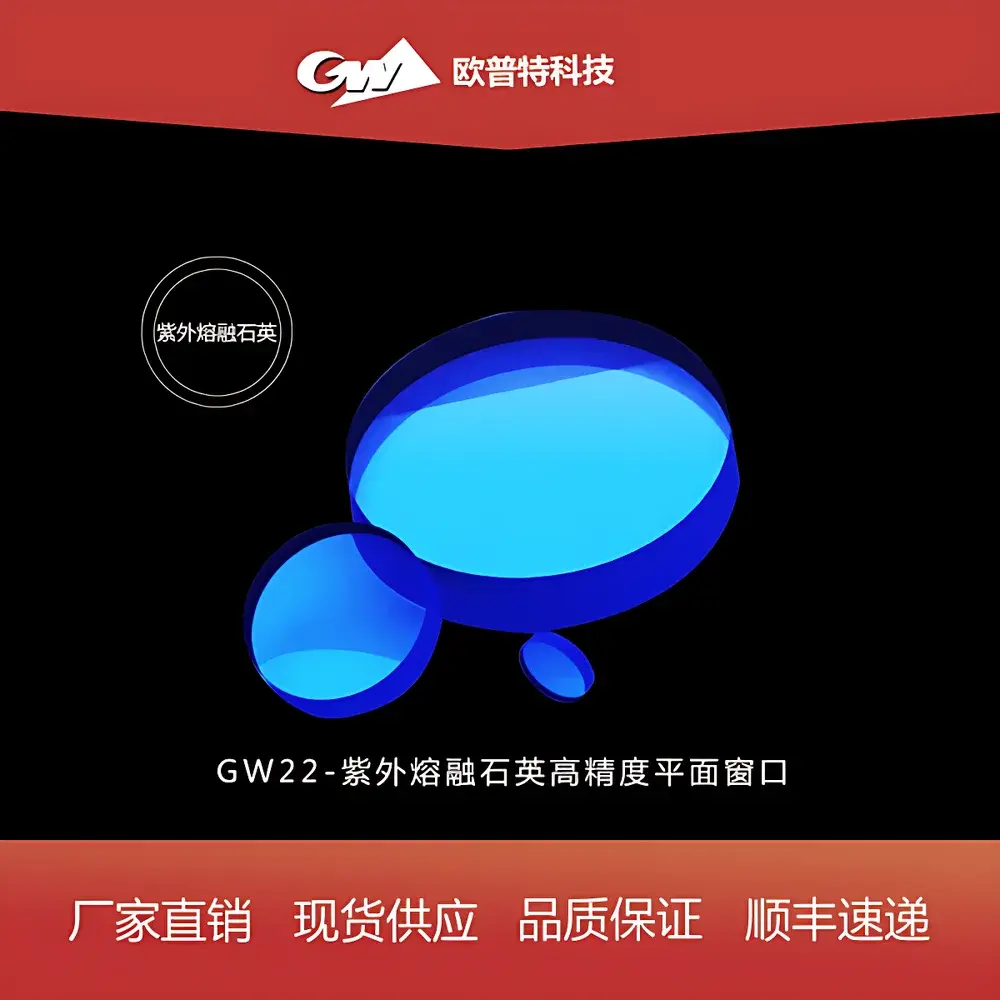

GW22 Ultra-Precision Fused Silica Flat Optical Window
| Origin | Beijing, China |
|---|---|
| Manufacturer Type | Distributor |
| Product Category | Domestic |
| Model | GW22 |
| Price Range | USD 0.15–75.00 (per unit) |
| Component Type | Optical Element |
| Available Coating Options | AR @250–425 nm (UV), AR @350–700 nm (VIS), AR @600–1100 nm (NIR), AR @900–1700 nm (SWIR) |
| Standard Dimensions | Ø5.0–Ø50.8 mm, Thickness: 2.0–10.0 mm |
| Substrate Material | High-Hydroxyl Fused Silica (Grade UV-Grade) |
| Surface Quality | 10–5 scratch-dig |
| Surface Flatness | λ/10 @ 633 nm |
| Parallelism | <5 arcsec |
| Wavefront Distortion | <λ/8 RMS |
| Transmission | >99.5% per surface (AR-coated, specified band) |
| Laser Damage Threshold | >5 J/cm² @ 1064 nm, 10 ns, 10 Hz |
Overview
The GW22 Ultra-Precision Fused Silica Flat Optical Window is a high-stability, low-birefringence optical component engineered for demanding applications in ultraviolet (UV), visible (VIS), near-infrared (NIR), and short-wave infrared (SWIR) spectral regions—specifically optimized for the 900–1700 nm SWIR band. Constructed from synthetic fused silica with ultra-low OH⁻ content (<1 ppm), the substrate exhibits exceptional transmission from 190 nm to 2.2 µm, minimal thermal expansion (α ≈ 0.55 × 10⁻⁶ /°C), and outstanding resistance to thermal shock and radiation-induced darkening. Unlike standard BK7 or K9 glass windows, the GW22 series maintains sub-nanometer-level surface fidelity and wavefront integrity under vacuum, high-power laser irradiation, and cryogenic conditions—making it suitable for interferometric systems, spectroscopic beam delivery, vacuum chamber viewports, and space-qualified optical assemblies.
Key Features
- UV-grade fused silica substrate with certified homogeneity (Δn < 1 × 10⁻⁶) and refractive index uniformity across diameter
- Precision-polished surfaces meeting λ/10 surface flatness (measured at 633 nm HeNe wavelength) and ≤5 arcsec parallelism tolerance
- Surface quality rated to 10–5 scratch-dig per MIL-PRF-13830B, verified via automated dark-field inspection
- Multiple anti-reflection (AR) coating variants deposited via ion-assisted e-beam evaporation, each validated for >99.5% average transmission within its designated band
- Low wavefront distortion (<λ/8 RMS) and negligible stress birefringence (<2 nm/cm), critical for polarization-sensitive setups
- Compatible with Class 100 cleanroom handling and ISO 10110–7 compliant packaging
Sample Compatibility & Compliance
The GW22 window is designed for integration into optomechanical mounts, vacuum feedthroughs, laser cavities, and environmental test chambers. Its thermal and mechanical stability ensures long-term performance under sustained exposure to UV photons (down to 250 nm), high-intensity CW lasers (e.g., Ti:Sapphire, fiber lasers at 1064/1550 nm), and pulsed systems (nanosecond to femtosecond regimes). All coated variants comply with ISO 9211–3 for AR coating durability (rub test, adhesion, humidity cycling) and meet RoHS 2015/863/EU material restrictions. Uncoated versions are supplied with protective SiO₂ overcoat for handling; AR-coated units undergo full spectral verification (250–1700 nm) using calibrated PerkinElmer Lambda 1050+ spectrophotometry and traceable NIST-standard reference standards.
Software & Data Management
Each GW22 unit is assigned a unique serial number linked to its metrology dossier—including interferometric surface map (Zygo Verifire™ data), spectral transmission curve (CSV export), coating thickness profile (ellipsometry report), and batch-level certification of raw material purity (ICP-MS assay). Dossiers are archived in accordance with ISO/IEC 17025:2017 documentation requirements and support GLP-compliant audit trails. While no proprietary software is required for operation, spectral data files conform to ASTM E275–22 format and integrate natively with common optical design platforms (Zemax OpticStudio, CODE V, FRED) via importable .DAT or .SDF files.
Applications
- High-resolution UV-VIS-NIR spectroscopy beam windows in FTIR, Raman, and UV-Vis-NIR spectrophotometers
- Input/output couplers for SWIR imaging systems (InGaAs detectors, quantum cascade lasers)
- Vacuum-compatible viewports in UHV analytical instruments (XPS, AES, molecular beam epitaxy chambers)
- Reference optics in metrology-grade interferometers (e.g., Twyman–Green, Mach–Zehnder configurations)
- Protective windows for space-based optical sensors requiring radiation hardness and outgassing compliance (ECSS-Q-ST-70-02C)
- Substrates for custom thin-film filter deposition or micro-patterned diffractive elements
FAQ
What is the maximum operating temperature for GW22 windows?
The fused silica substrate is rated for continuous operation up to 1000 °C in inert atmosphere; for precision optical alignment, recommended upper limit is 300 °C to preserve coating integrity and minimize thermal drift.
Can GW22 windows be used in ultra-high vacuum (UHV) environments?
Yes—each unit meets ASTM E595 total mass loss (TML) < 0.5% and collected volatile condensable materials (CVCM) < 0.05%, with outgassing verified per ESA ECSS-Q-ST-70-02C.
Is there a difference between GW22-025A and GW22-025?
GW22-025 denotes Ø25.0 mm × 6.0 mm; GW22-025A specifies Ø25.4 mm × 6.0 mm—the latter conforms to imperial-inch mounting standards commonly used in OEM optomechanics.
Do AR coatings affect laser damage threshold?
Coated variants maintain LDT >5 J/cm² @ 1064 nm (10 ns, 10 Hz) when applied to UV-grade fused silica; uncoated versions exhibit marginally higher thresholds but suffer from Fresnel losses and ghost reflections.
Are custom diameters or thicknesses available?
Yes—custom geometries (including wedged variants, chamfered edges, and non-circular apertures) are available under OEM agreements with minimum order quantities and extended lead times.





