
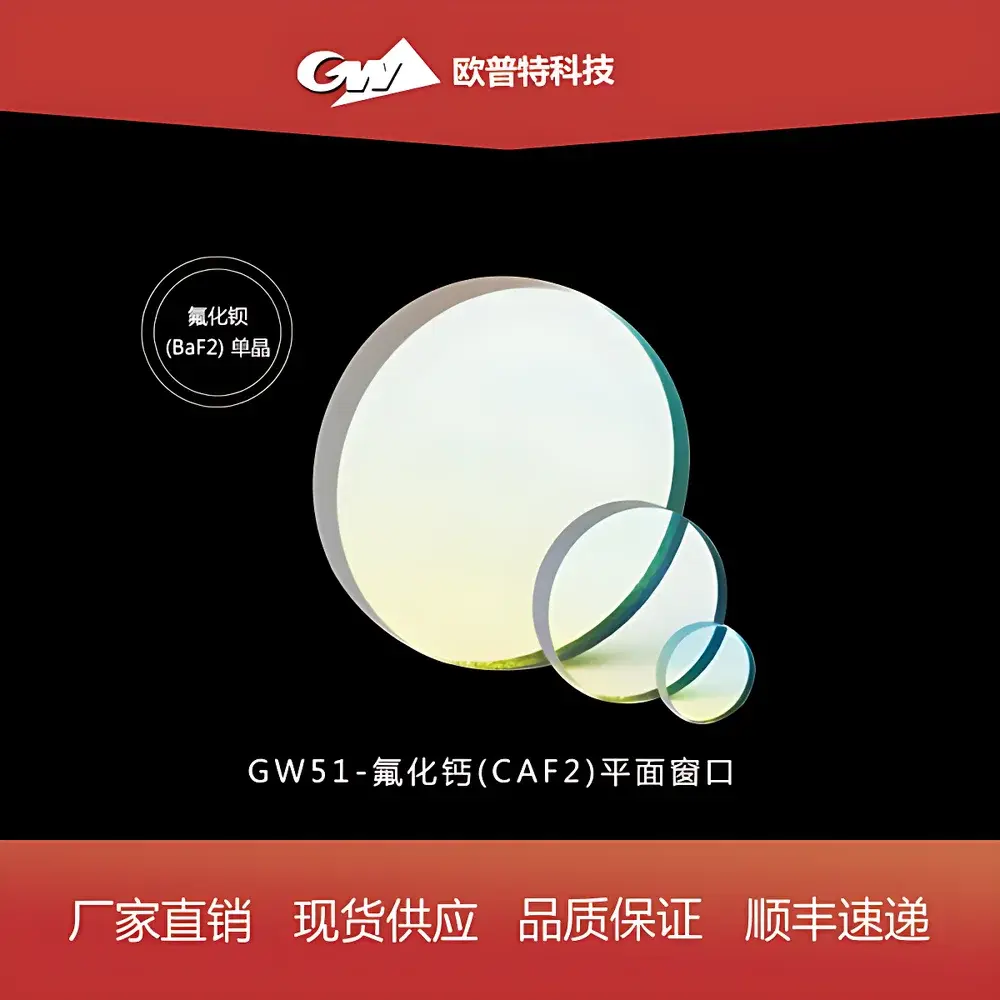
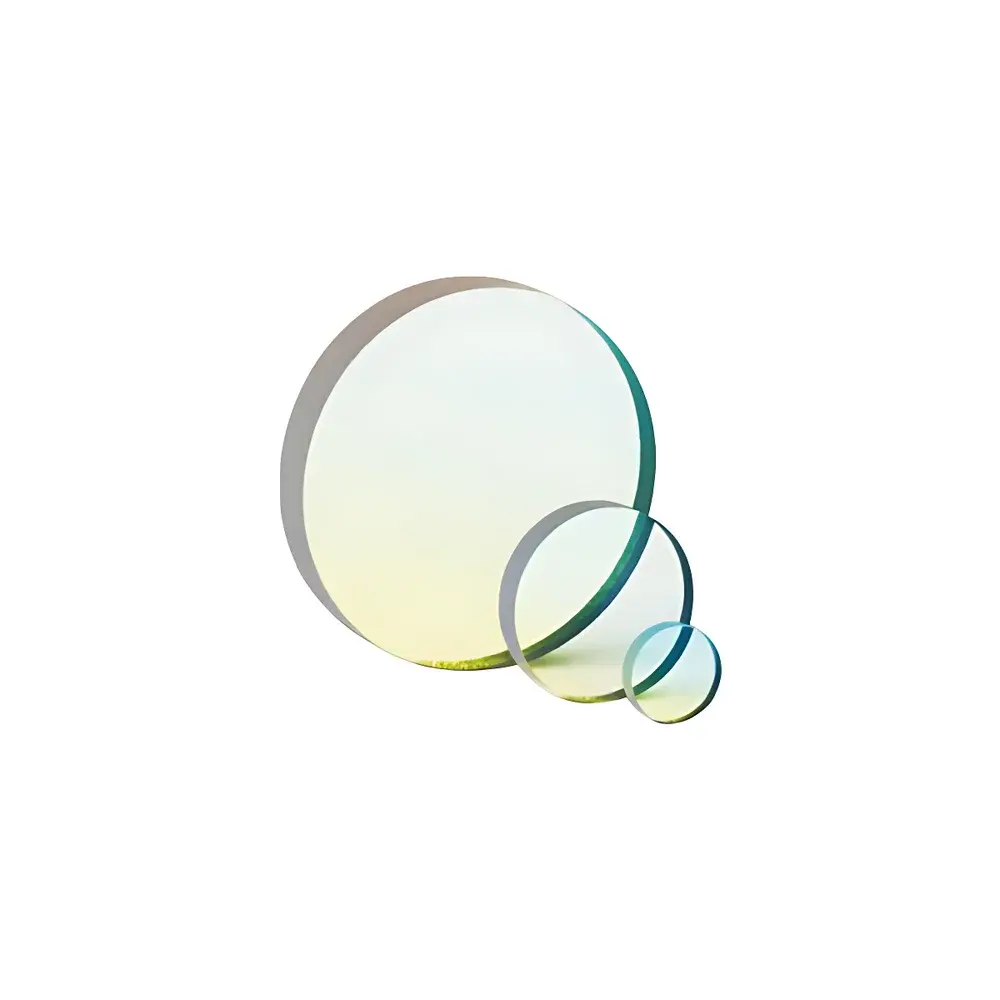
GW51 CaF₂ Optical Window Plate
| Origin | Beijing, China |
|---|---|
| Manufacturer Type | Authorized Distributor |
| Product Category | Domestic |
| Model | GW51 |
| Price Range | USD 0.80–399.00 (per piece) |
| Component Type | Optical Element |
| Material | Calcium Fluoride (CaF₂) |
| Surface Flatness | λ/4 @ 633 nm (standard) |
| Parallelism | < 1 arcmin |
| Surface Quality | 20–10 scratch-dig |
| Coating Options | AR (UV, VIS, NIR, SWIR) |
| Available Diameters | 3 mm, 12.5 mm, 12.7 mm, 25.0 mm, 25.4 mm, 40.0 mm, 50.0 mm |
| Thicknesses | 3.0 mm, 5.0 mm, 8.0 mm |
| Transmission Range | 0.13–9.0 µm (uncoated) |
| Refractive Index | ~1.43 @ 550 nm |
| Density | 3.18 g/cm³ |
| Thermal Expansion Coefficient | 18.85 × 10⁻⁶ /K |
Overview
The GW51 CaF₂ Optical Window Plate is a precision-engineered optical component designed for demanding transmission applications across deep-ultraviolet (DUV), visible, near-infrared (NIR), and mid-infrared (MIR) spectral regions. Fabricated from high-purity, single-crystal calcium fluoride (CaF₂), this window exhibits exceptional broadband transparency—from 130 nm to 9.0 µm—making it uniquely suitable for synchrotron beamlines, excimer laser systems (e.g., 193 nm ArF and 248 nm KrF), FTIR spectrometers, and vacuum ultraviolet (VUV) diagnostics. Unlike fused silica or BK7, CaF₂ maintains low absorption and negligible fluorescence under intense UV irradiation, ensuring signal fidelity and long-term stability in photon-hungry experimental configurations. Its cubic crystal structure provides isotropic optical behavior, minimal birefringence (< 5 nm/cm), and excellent resistance to thermal shock—critical for pulsed laser and cryogenic optical setups.
Key Features
- High-purity synthetic CaF₂ substrate with controlled stoichiometry and low OH⁻/metallic impurity content
- Standard surface flatness of λ/4 at 633 nm (measured via interferometry per ISO 10110-5)
- Parallelism tolerance ≤ 1 arcminute, enabling minimal wavefront distortion in collimated beam paths
- Surface quality rated 20–10 scratch-dig per MIL-PRF-13830B, verified by automated dark-field inspection
- Optional anti-reflection (AR) coatings optimized for specific bands: UV (190–400 nm), VIS (400–700 nm), NIR (700–1100 nm), or SWIR (1.1–2.5 µm), each achieving < 0.5% residual reflectance per surface
- Customizable edge geometry (e.g., beveled, blackened, or metallized) to suppress stray light and facilitate mounting in kinematic mounts or vacuum flanges
- Compatible with ultra-high vacuum (UHV) environments (≤ 10⁻⁹ mbar) following proper bake-out protocols
Sample Compatibility & Compliance
The GW51 series is manufactured and tested in accordance with ISO 9013 (optical element dimensional tolerances) and ISO 10110 (specification of optical components). All CaF₂ blanks are sourced from certified crystal growers adhering to ASTM F265-22 (Standard Specification for Calcium Fluoride Optical Crystals). Each lot undergoes spectral transmittance verification using a calibrated PerkinElmer Lambda 950 UV/VIS/NIR spectrophotometer, with full spectral data provided upon request. The windows meet RoHS Directive 2011/65/EU requirements and contain no intentionally added REACH SVHC substances. For regulated laboratory environments, documentation supports GLP-compliant traceability—including batch-specific crystal growth logs, annealing profiles, and interferometric test reports.
Software & Data Management
While the GW51 is a passive optical component, its integration into automated optical systems benefits from standardized metadata handling. Each unit ships with a QR-coded label linking to a secure web portal containing: (i) individual spectral transmission curve (200–9000 nm, 1 nm resolution), (ii) interferometric surface map (Zygo GPI data format), (iii) coating design file (thin-film stack parameters in TFCalc-compatible format), and (iv) certificate of conformance aligned with ISO/IEC 17025 calibration traceability. For customers operating under FDA 21 CFR Part 11 or EU Annex 11, audit-ready digital records—including electronic signatures and immutable revision history—are available through optional subscription to our LabTrace™ documentation service.
Applications
- Excimer laser delivery optics (193 nm ArF, 248 nm KrF, 308 nm XeCl) requiring high LIDT and low photodarkening
- Vacuum ultraviolet (VUV) monochromator exit windows and detector protection in plasma diagnostics
- Cryogenic FTIR sample compartments where thermal contraction mismatch must be minimized
- Beamline front-ends at synchrotron facilities (e.g., APS, ESRF, SPring-8) for soft X-ray and EUV harmonic rejection
- Thermal imaging systems operating in 3–5 µm and 8–12 µm atmospheric windows
- UV-curable resin monitoring sensors in semiconductor photolithography tooling
FAQ
What is the damage threshold for GW51 CaF₂ windows under pulsed UV laser exposure?
For 20 ns pulses at 193 nm, the typical LIDT is ≥ 0.5 J/cm² (tested per ISO 21254-2); exact values depend on coating configuration and beam homogeneity.
Can GW51 windows be used in high-humidity environments?
CaF₂ is hygroscopic; prolonged exposure to >60% RH may cause surface clouding. We recommend sealed housings or inert-gas purging for ambient operation.
Is custom diameter or thickness available beyond standard catalog sizes?
Yes—custom dimensions up to Ø100 mm and thicknesses from 1.0 mm to 15.0 mm are available with lead times of 4–6 weeks and NRE tooling support.
Do you provide mounting hardware or kinematic cell designs compatible with GW51 windows?
Standard SM1- and SM2-threaded retaining rings, as well as vacuum-compatible CF-flange adapters, are stocked and cross-referenced in our mechanical interface guide.
How is coating durability validated for AR layers on CaF₂ substrates?
All AR coatings undergo tape adhesion (ASTM D3359), abrasion (ISO 9211-4), and humidity cycling (IEC 60068-2-30) per MIL-C-48497A, with performance data included in the Coating Qualification Report.



