
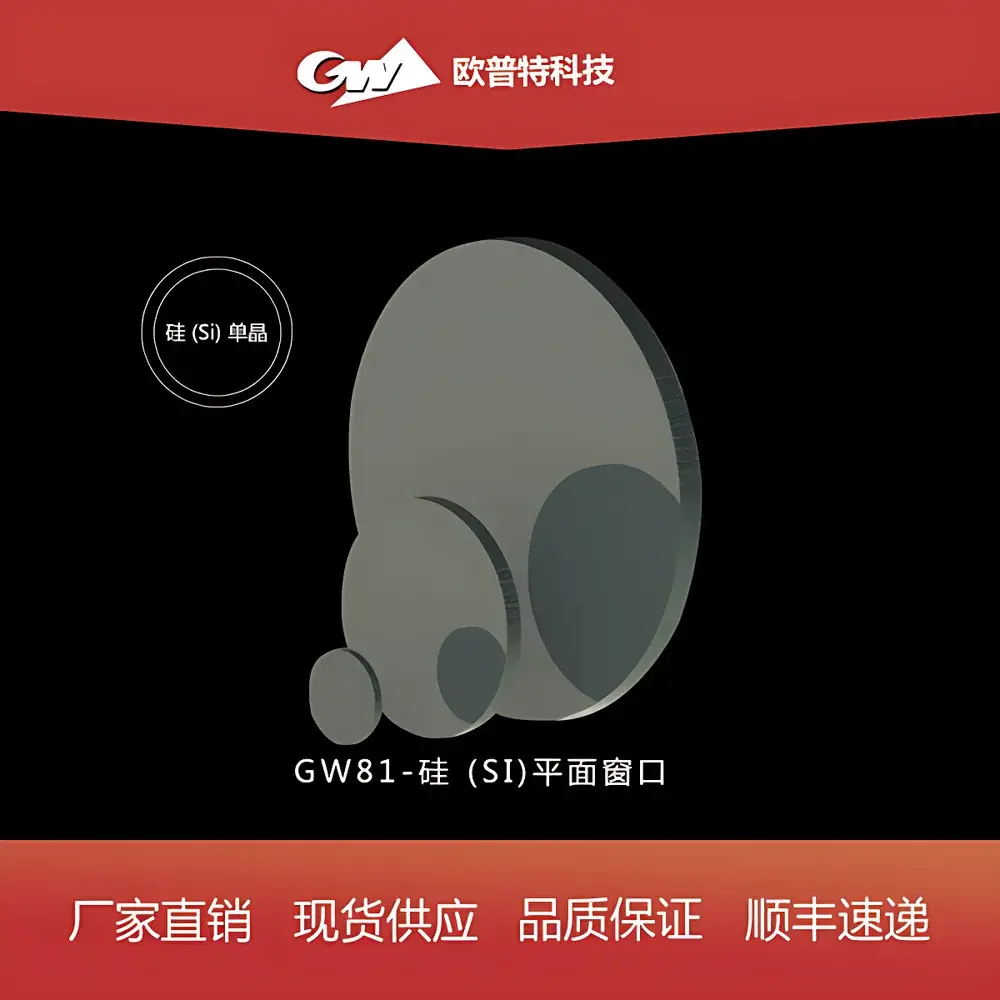
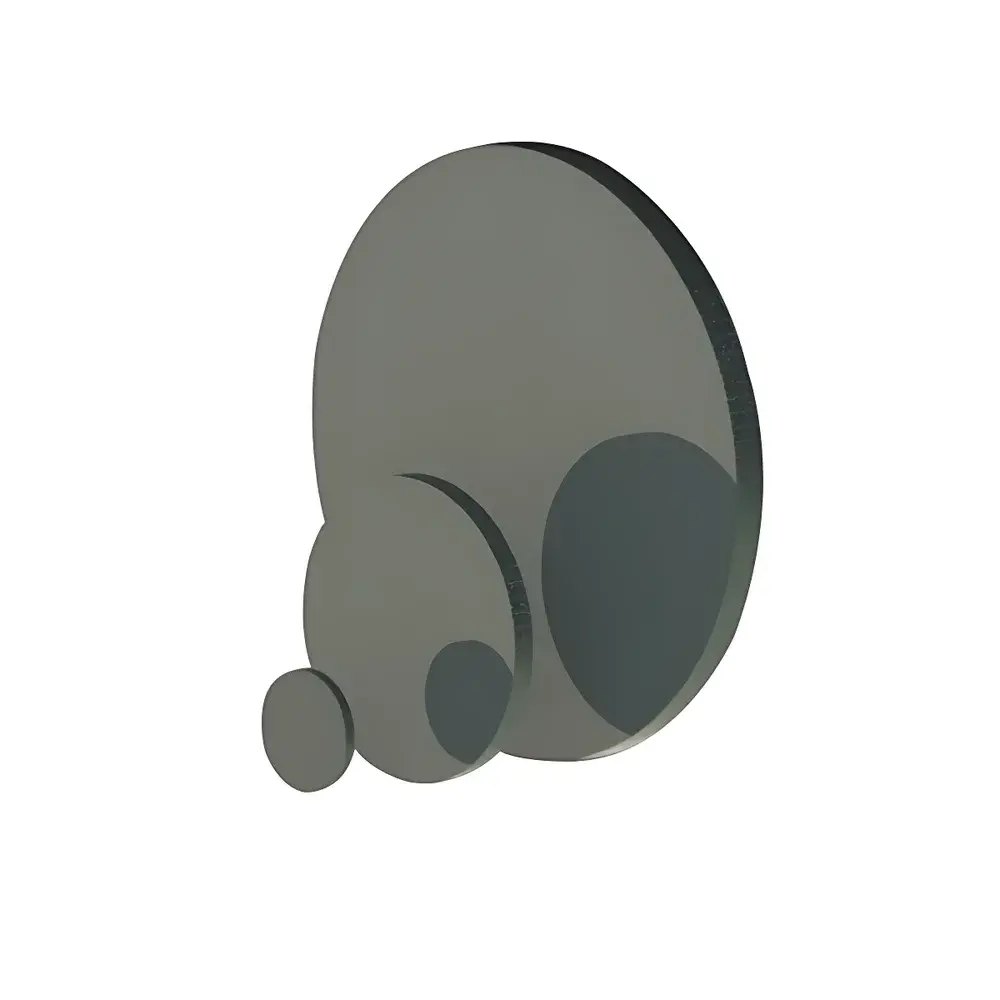
GW81 Silicon (Si) Optical Window
| Material | Single-Crystal Silicon |
|---|---|
| Surface Figure | λ/1 @ 633 nm |
| Parallelism | < 1 arcmin |
| Surface Quality | 3–4 scratch-dig |
| Diameter Tolerance | +0.0 / –0.1 mm |
| Thickness Tolerance | ±0.2 mm |
| Edge Treatment | Protective 45° chamfer, 0.2–0.5 mm |
| Coating Options | UV/VIS/NIR/SWIR AR coatings (as specified in product catalog) |
| Component Type | Optical Element |
| Origin | Beijing, China |
| Manufacturer Status | Authorized Distributor |
| Domestic Product Classification | PRC-Made |
Overview
The GW81 Silicon (Si) Optical Window is a precision-engineered optical component designed for demanding transmission applications in the near-infrared (NIR) and short-wave infrared (SWIR) spectral ranges (1.2–7.0 µm). Fabricated from high-purity, Czochralski-grown single-crystal silicon, this window exhibits excellent thermal conductivity, low thermal expansion, and high mechanical rigidity—making it suitable for vacuum chambers, laser systems, thermal imaging housings, and industrial process monitoring environments where environmental stability and long-term optical integrity are critical. Its parallel-plane geometry ensures minimal wavefront distortion, while the λ/1 surface figure (measured at 633 nm HeNe wavelength) supports high-fidelity beam propagation in alignment-critical setups. Unlike fused silica or BK7 substrates, silicon’s intrinsic transparency in the IR eliminates the need for specialized chalcogenide glasses in many mid-IR applications—offering a cost-effective, robust alternative without compromising transmission performance.
Key Features
- Optical substrate: Single-crystal silicon with controlled oxygen/carbon impurity levels per ASTM F1560, ensuring consistent refractive index homogeneity (Δn < 5 × 10⁻⁶) across the clear aperture.
- Surface quality: 3–4 scratch-dig specification per MIL-PRF-13830B, verified via automated dark-field inspection under 50× magnification.
- Tight dimensional control: Diameter tolerance of +0.0 / –0.1 mm and thickness uniformity within ±0.2 mm support repeatable mounting in kinematic or threaded lens cells.
- Edge protection: 45° protective chamfer (0.2–0.5 mm) mitigates edge chipping during handling and installation, complying with ISO 10110-7 edge finish requirements.
- Coating flexibility: Available uncoated or with broadband anti-reflection (BBAR) coatings optimized for specific bands—UV (250–400 nm), VIS (400–700 nm), NIR (700–1100 nm), or SWIR (1.2–5.5 µm)—each meeting R < 0.5% average reflectance per surface per ISO 9211-3.
Sample Compatibility & Compliance
The GW81 window is compatible with standard optical mounts (e.g., SM1-threaded cages, Ø25.4 mm lens tubes) and integrates seamlessly into ISO-standard optical tables and vacuum flanges (CF-35, KF-25). Its silicon substrate is non-hygroscopic and chemically inert to most solvents except strong alkalis and halogens—enabling use in cleanroom Class 100 and industrial ambient conditions. All units undergo full traceable metrology: interferometric surface figure verification (Zygo GPI XP), spectrophotometric transmission validation (PerkinElmer Lambda 1050+), and visual inspection per ANSI/OEOSC OP1.002. Documentation includes certificate of conformance (CoC) with lot-specific test data, supporting GLP-compliant laboratory workflows and supplier qualification under ISO 9001:2015.
Software & Data Management
While the GW81 is a passive optical element, its specifications are fully integrated into common optical design platforms—including Zemax OpticStudio (v23+), CODE V (v12.2+), and FRED—via standardized .ZMX and .COD material files containing Sellmeier coefficients for Si across 1.2–7.0 µm. Transmission curves, coating performance data, and thermal expansion profiles are provided in CSV and JSON formats upon request, enabling automated BOM validation and procurement system interoperability (e.g., SAP S/4HANA MM module). For regulated environments, batch-level documentation supports audit readiness per FDA 21 CFR Part 11 when paired with validated electronic lab notebooks (ELNs) such as LabArchives or IDBS E-WorkBook.
Applications
- Infrared spectroscopy: Entrance/exit windows for FTIR spectrometers operating in the 2–5 µm range, where silicon’s high transmission (>50% at 4 µm) and low dispersion outperform CaF₂ and BaF₂.
- Thermal imaging systems: Protective windows for uncooled microbolometer arrays (e.g., FLIR Boson, Teledyne DALSA) requiring high thermal shock resistance and minimal thermal lensing.
- Laser processing: Beam delivery windows in CO₂ (10.6 µm) and fiber-laser-based cutting/welding systems, leveraging silicon’s high damage threshold (>10 J/cm², 10 ns pulse, 1064 nm).
- Space-qualified instrumentation: Used in satellite-based Earth observation sensors (e.g., hyperspectral imagers) due to its radiation hardness and vacuum-outgassing compliance (<1 × 10⁻¹² Torr·L/s·cm² per ASTM E595).
- Research optics: Alignment reference windows in ultrafast laser labs, benefiting from silicon’s negligible group delay dispersion in the telecom C-band (1530–1565 nm).
FAQ
What is the typical transmission range of the GW81 silicon window?
Silicon transmits effectively from ~1.2 µm to 7.0 µm; peak transmission exceeds 54% (uncoated) in the 3–5 µm atmospheric window. With SWIR-optimized AR coating, average transmission rises to >95% across 1.2–5.5 µm.
Can the GW81 be used in vacuum environments?
Yes—it meets NASA outgassing requirements (CVCM < 0.1%, TML < 1.0%) and has been validated for use in UHV systems down to 1 × 10⁻⁹ Torr.
Is custom diameter or thickness available?
Standard diameters include 12.7 mm, 25.4 mm, and 50.8 mm; custom sizes (Ø5–100 mm) and thicknesses (1–10 mm) are available with NRE tooling and 6–8 week lead time.
How does silicon compare to ZnSe for CO₂ laser applications?
Silicon offers higher thermal conductivity (150 W/m·K vs. 18 W/m·K), lower coefficient of thermal expansion (2.6 × 10⁻⁶/K vs. 7.2 × 10⁻⁶/K), and superior mechanical strength—making it preferred for high-power, continuous-wave CO₂ laser windows subject to thermal loading.
Do you provide coating performance data for regulatory submissions?
Yes—spectral reflectance/transmission reports, environmental durability test summaries (per MIL-C-48497A), and RoHS/REACH compliance documentation are supplied with each shipment.



