
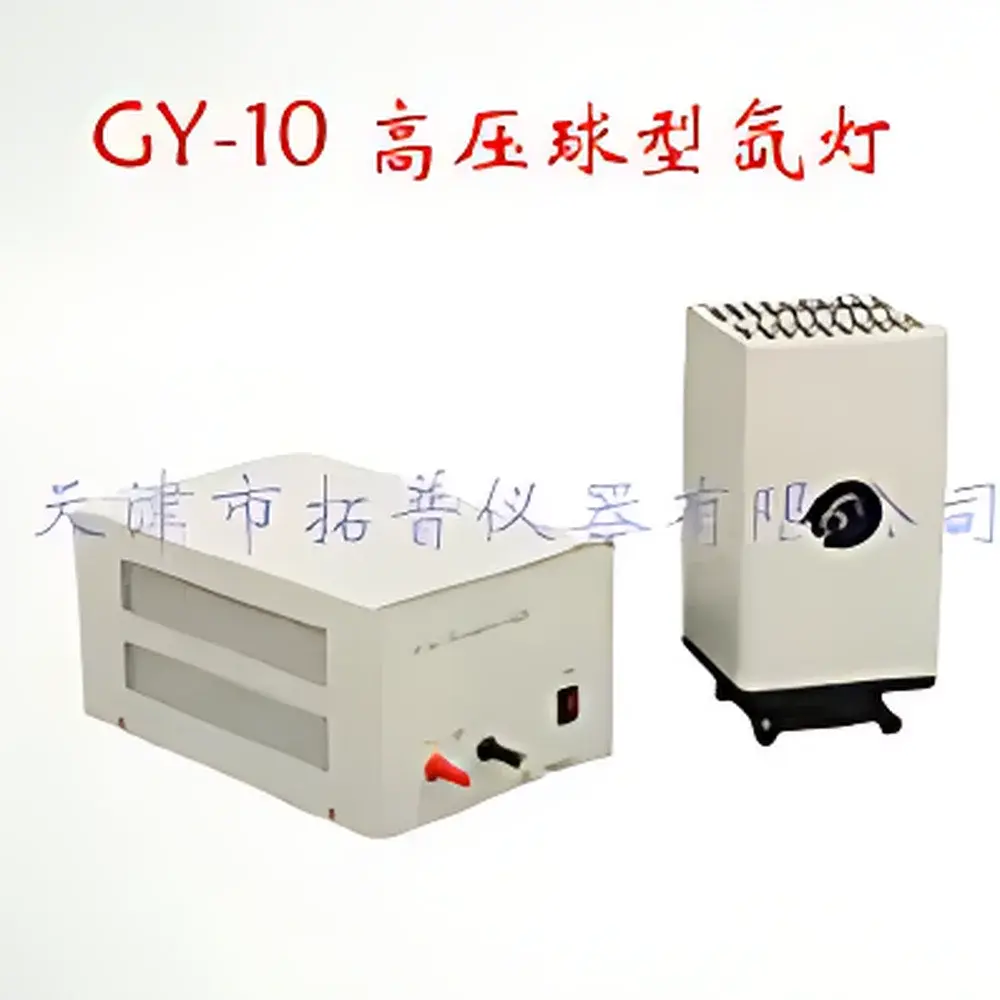
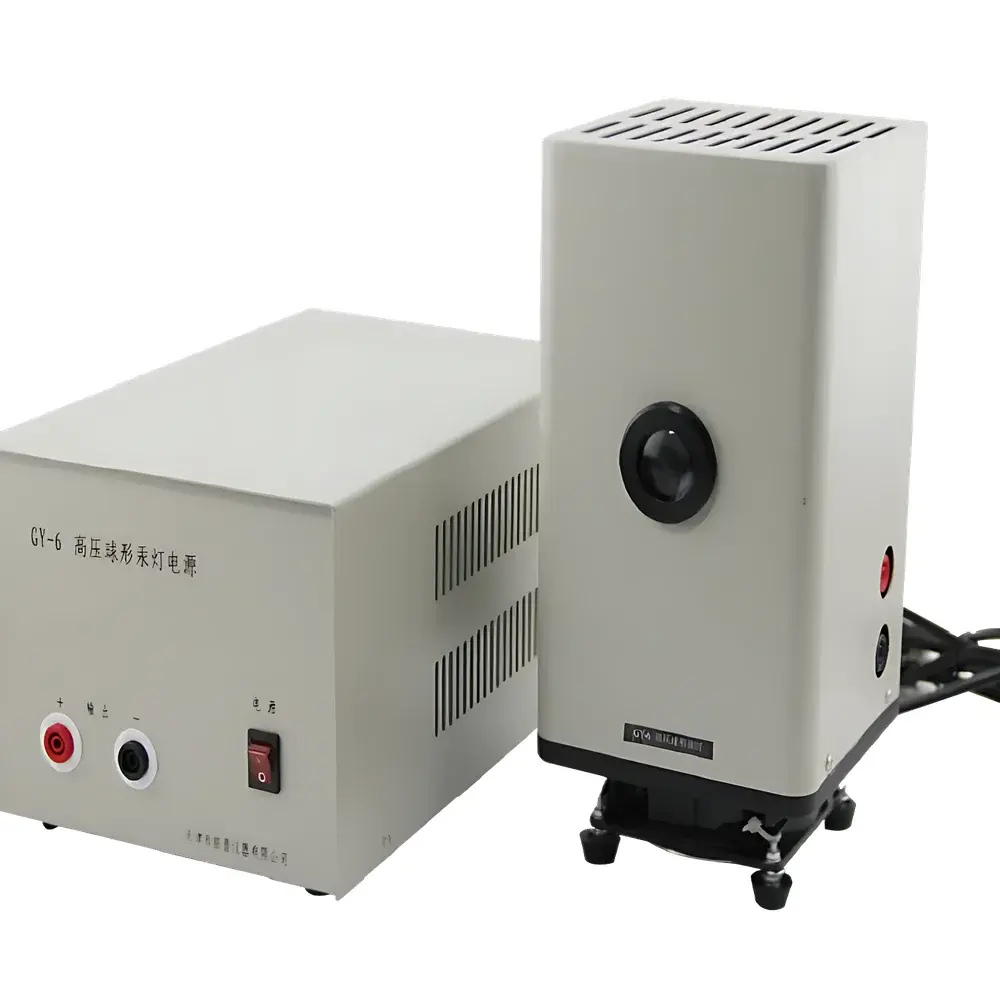
GY-10 High-Pressure Spherical Xenon Arc Lamp
| Brand | TOP / TP |
|---|---|
| Origin | Tianjin, China |
| Manufacturer Type | Direct Manufacturer |
| Origin Classification | Domestic (China) |
| Model | GY-10 |
| Pricing | Upon Request |
Overview
The GY-10 High-Pressure Spherical Xenon Arc Lamp is a precision-engineered broadband light source designed for demanding optical measurement and spectroscopic applications. Operating on the principle of high-pressure DC arc discharge in xenon gas, it generates intense, spatially stable, and temporally reproducible continuum radiation spanning the deep ultraviolet (UV) to near-infrared (NIR) spectral range — approximately 190 nm to 1100 nm. With a nominal electrical input power of 150 W, the lamp delivers high radiance from a compact spherical arc geometry (typically <1.0 mm arc gap), enabling efficient coupling into monochromators, spectrophotometers, fluorescence excitation systems, and calibration setups. Its spherical envelope and precisely aligned electrodes ensure superior point-source characteristics and minimal astigmatism, critical for collimation and fiber-optic coupling in metrology-grade instrumentation.
Key Features
- Spherical quartz envelope with ultra-pure fused silica (UV-grade), transmitting >85% down to 190 nm
- DC-stabilized operation compatible with regulated constant-current power supplies (e.g., 15–30 V, 10 A typical)
- Stable arc position and low spatial drift (<5 µm/h under thermal equilibrium), supporting long-term photometric repeatability
- Integrated safety-rated quartz housing with forced-air cooling interface for continuous-duty operation
- Electrode configuration optimized for low UV-induced ozone generation and minimal electrode sputtering over lifetime
- Compliant with IEC 62471 (Photobiological Safety of Lamps) for Risk Group 3 (high radiance UV exposure)
Sample Compatibility & Compliance
The GY-10 lamp is not a sample-measuring device but serves as a reference irradiance source in optical characterization workflows. It is routinely integrated into systems conforming to ASTM E308 (computing CIE tristimulus values), ISO/CIE 11664 (colorimetry), and JIS Z 8722 (spectral reflectance measurement). When used in fluorescence excitation platforms, it supports validation per USP (Spectrophotometric Absorbance and Fluorescence Intensity) and ISO 17025-accredited laboratory procedures. The lamp’s spectral stability (±1.5% irradiance variation over 100 h at rated power) meets GLP requirements for instrument qualification protocols, including intensity linearity verification and wavelength accuracy checks using NIST-traceable emission standards (e.g., mercury-argon or holmium oxide filters).
Software & Data Management
As a passive light source, the GY-10 requires no embedded firmware or proprietary software. However, its performance is fully characterized and validated within industry-standard optical system control environments — including Ocean Insight OceanView, Thorlabs ThorImage, and LabVIEW-based DAQ platforms. Radiometric calibration data (spectral irradiance in W·m⁻²·nm⁻¹ at 1 m distance) is supplied with each unit as NIST-traceable certificate (calibrated against a primary standard lamp at accredited lab). All calibration reports include uncertainty budgets per ISO/IEC 17025 Annex A, covering spectral responsivity, distance measurement, and thermal drift correction. Audit trails for lamp usage hours, operating current/voltage logs, and recalibration intervals are maintained externally via LIMS integration or spreadsheet-based instrument history records compliant with FDA 21 CFR Part 11 when deployed in regulated QC/QA labs.
Applications
- Excitation source for steady-state and time-resolved fluorescence spectroscopy, particularly where tunable laser alternatives are cost-prohibitive
- Primary irradiance standard in UV-Vis-NIR spectrophotometer validation and stray-light assessment (per ISO 9022-11)
- Calibration reference for hyperspectral imaging sensors and radiometric camera systems
- Accelerated aging and photostability testing in pharmaceutical packaging and polymer degradation studies (aligned with ICH Q1B)
- Broadband illumination in ellipsometry, reflectometry, and thin-film thickness metrology systems
- Secondary standard for luminous intensity transfer in national metrology institutes and calibration service providers
FAQ
What is the recommended warm-up time to achieve spectral stability?
Typically 15–20 minutes after ignition; full radiometric stabilization (±0.5% irradiance) is achieved within 30 minutes under constant-current operation.
Can the GY-10 be operated in pulsed mode?
No — it is engineered exclusively for DC continuous-wave operation; pulsed use may cause electrode fracture or envelope devitrification.
Is ozone mitigation required during operation?
Yes — due to strong VUV emission below 200 nm, operation in enclosed, ventilated enclosures with active carbon filtration is mandatory per OSHA PEL guidelines.
What is the typical operational lifetime at rated power?
Rated lifetime is 1,000 hours at 150 W with proper cooling and current regulation; output degrades gradually (~15% radiant flux loss at end-of-life).
Does the lamp include a safety interlock interface?
No — external safety circuitry (e.g., shutter control, current cutoff, or UV sensor feedback loop) must be implemented by the host system integrator per IEC 61000-6-4 EMC and laser safety Class 3B equivalent protocols.



