
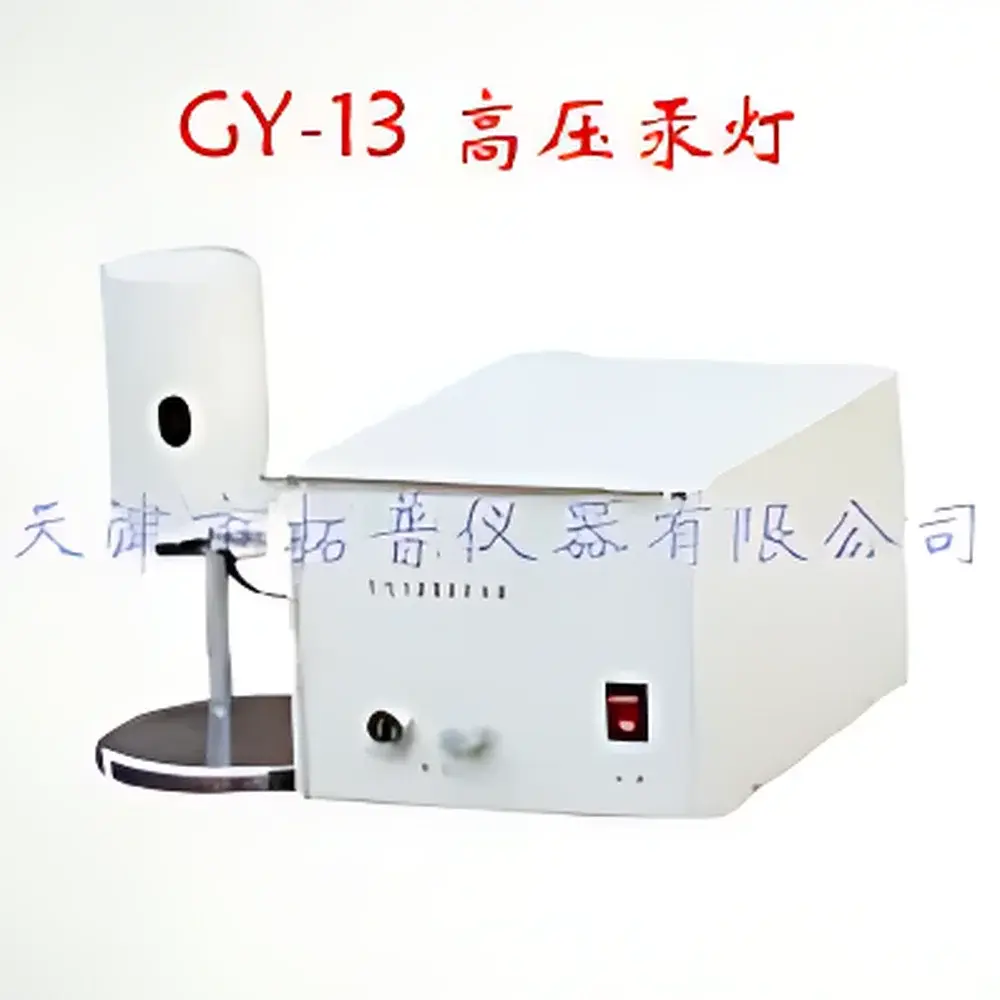
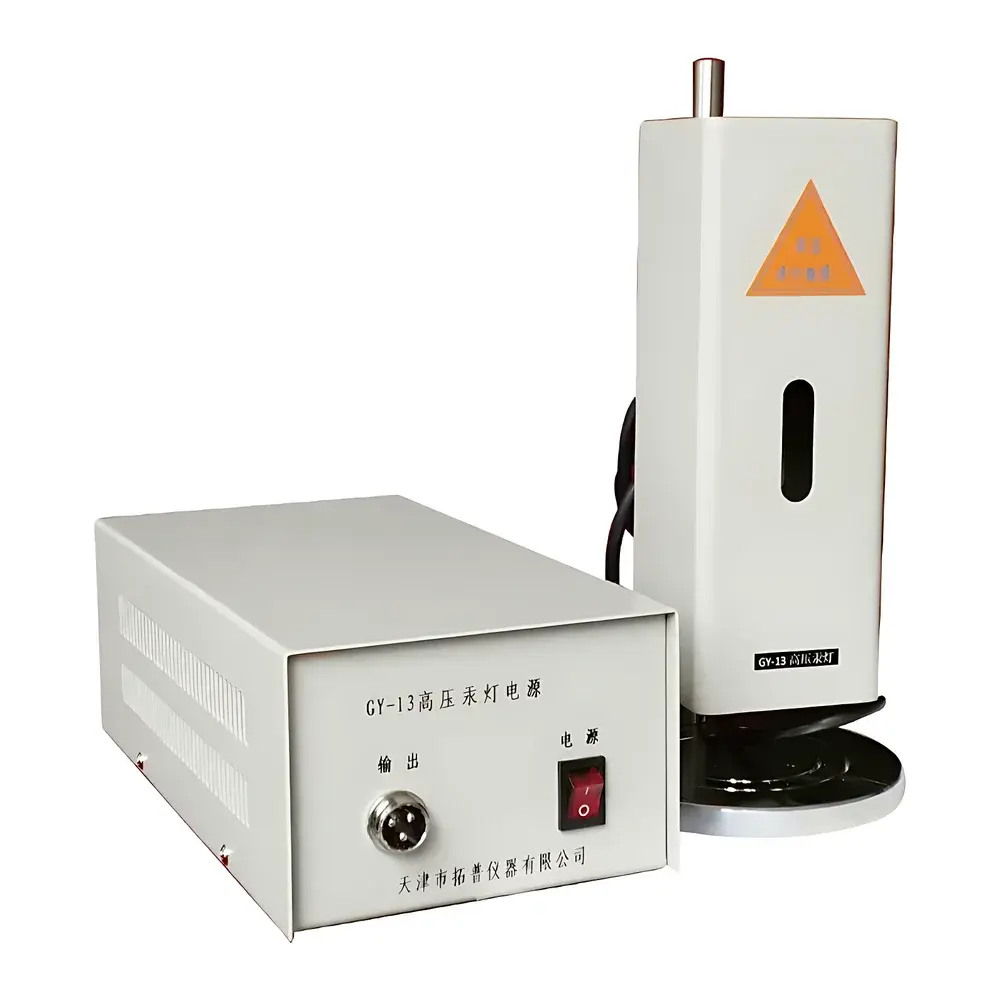
GY-13 High-Pressure Mercury Lamp
| Brand | Top (TP) |
|---|---|
| Origin | Tianjin, China |
| Manufacturer Type | Original Equipment Manufacturer (OEM) |
| Country of Origin | China |
| Model | GY-13 |
| Pricing | Available Upon Request |
Overview
The GY-13 High-Pressure Mercury Lamp is a precision-calibrated optical radiation source engineered for wavelength calibration and spectral reference applications in laboratory and metrology environments. Operating on the principle of high-pressure mercury vapor discharge, the lamp produces intense, discrete emission lines across the ultraviolet (UV), visible (VIS), and near-ultraviolet spectral regions—most notably at 253.7 nm (strongest UV line), 365.0 nm (i-line), 404.7 nm (violet), 435.8 nm (blue), 546.1 nm (green), and 577.0–579.1 nm (doublet yellow). These well-documented, NIST-traceable spectral lines serve as primary standards for calibrating spectrometers, monochromators, optical encoders, and wavelength-sensitive detectors. The lamp is integrated with a stabilized AC power supply unit designed to maintain consistent arc stability, thermal equilibrium, and temporal reproducibility—critical for minimizing drift during extended calibration sessions.
Key Features
- High-intensity, narrow-band mercury emission lines with full-width-at-half-maximum (FWHM) < 0.1 nm for selected UV/VIS peaks
- Integrated, current-regulated power supply ensuring stable discharge ignition and arc positioning
- Quartz envelope with UV-transmissive fused silica window (cutoff ~185 nm) enabling broad spectral output from 200 nm to 700 nm
- Robust mechanical housing with standardized SMA905 or FC/PC fiber-coupling interface options (optional)
- Thermally optimized base design to minimize thermal lensing and spectral centroid shift during warm-up (typical stabilization time: ≤15 min)
- Compliant with IEC 61000-4-3 for radiated electromagnetic immunity and IEC 61000-3-2 for harmonic current emissions
Sample Compatibility & Compliance
The GY-13 lamp is compatible with standard optical bench configurations, modular spectroscopy platforms (e.g., Ocean Insight, Avantes, Thorlabs systems), and OEM integration into calibration-grade instrumentation. It requires no consumables and operates without external cooling under ambient laboratory conditions (15–30 °C, <70% RH non-condensing). The device conforms to ISO/IEC 17025 requirements for reference standards used in accredited calibration laboratories. Emission line positions are traceable to NIST Standard Reference Material (SRM) 2034 (Mercury Emission Spectrum Standard) and align with ISO 6943:2021 (Optics and photonics — Calibration of spectrometers using line sources). No hazardous substance declarations (RoHS Directive 2011/65/EU) apply, though mercury content necessitates proper end-of-life disposal per local environmental regulations.
Software & Data Management
While the GY-13 is a hardware-only reference source, its spectral output is fully supported by industry-standard calibration software suites including OceanView (Ocean Insight), AvaSoft (Avantes), and SpectraSuite (Thorlabs). Line identification algorithms within these platforms automatically recognize and assign peak wavelengths based on intensity thresholds and centroid fitting routines. For GLP/GMP-compliant environments, users may log lamp usage hours, warm-up cycles, and calibration event metadata via external LIMS or ELN systems. Audit trails—including operator ID, date/time stamp, instrument ID, and spectral acquisition parameters—are retained in accordance with FDA 21 CFR Part 11 requirements when paired with validated data acquisition software.
Applications
- Wavelength calibration of UV-Vis spectrophotometers, CCD-array spectrometers, and FTIR accessories
- Verification of grating alignment and detector pixel mapping in imaging spectrometers
- Benchmarking spectral resolution and stray-light performance per ASTM E275-22
- Validation of monochromator bandpass and out-of-band rejection characteristics
- Reference source for photometric and radiometric intercomparisons in national metrology institutes
- OEM integration into automated optical test stations for semiconductor lithography tool qualification
FAQ
What is the typical warm-up time required to achieve spectral stability?
Stabilization to ±0.05 nm wavelength repeatability typically occurs within 12–15 minutes after cold start.
Is the GY-13 suitable for use in vacuum or purged optical paths?
Yes—the quartz envelope is rated for operation under nitrogen purge or dry-air environments; vacuum operation requires optional O-ring sealed mounting flange (model GY-13-VAC).
Does the lamp include NIST-traceable calibration documentation?
A certificate of conformance (CoC) listing nominal emission wavelengths and relative intensities is supplied; full NIST-traceable calibration (SRM 2034 referenced) is available as an optional service.
Can the GY-13 be operated continuously for extended periods?
Rated duty cycle is 8 hours continuous operation per session; recommended rest period of ≥30 minutes between sessions to ensure long-term arc tube integrity.
What safety precautions apply during operation?
UV radiation exposure hazard exists—operators must wear ANSI Z87.1-compliant UV-blocking eyewear and avoid direct viewing of the unfiltered arc; use of interlocked enclosures is recommended for Class 3B UV source compliance per IEC 60825-1.




