
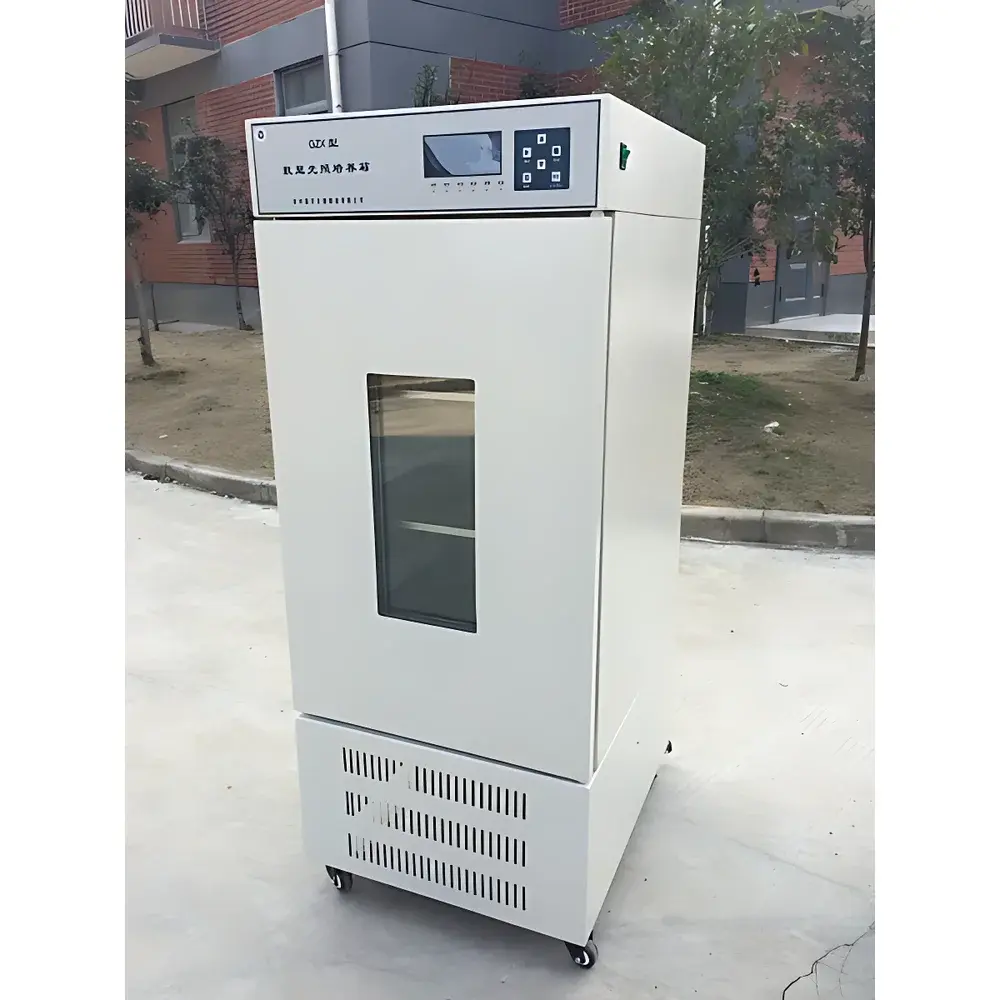
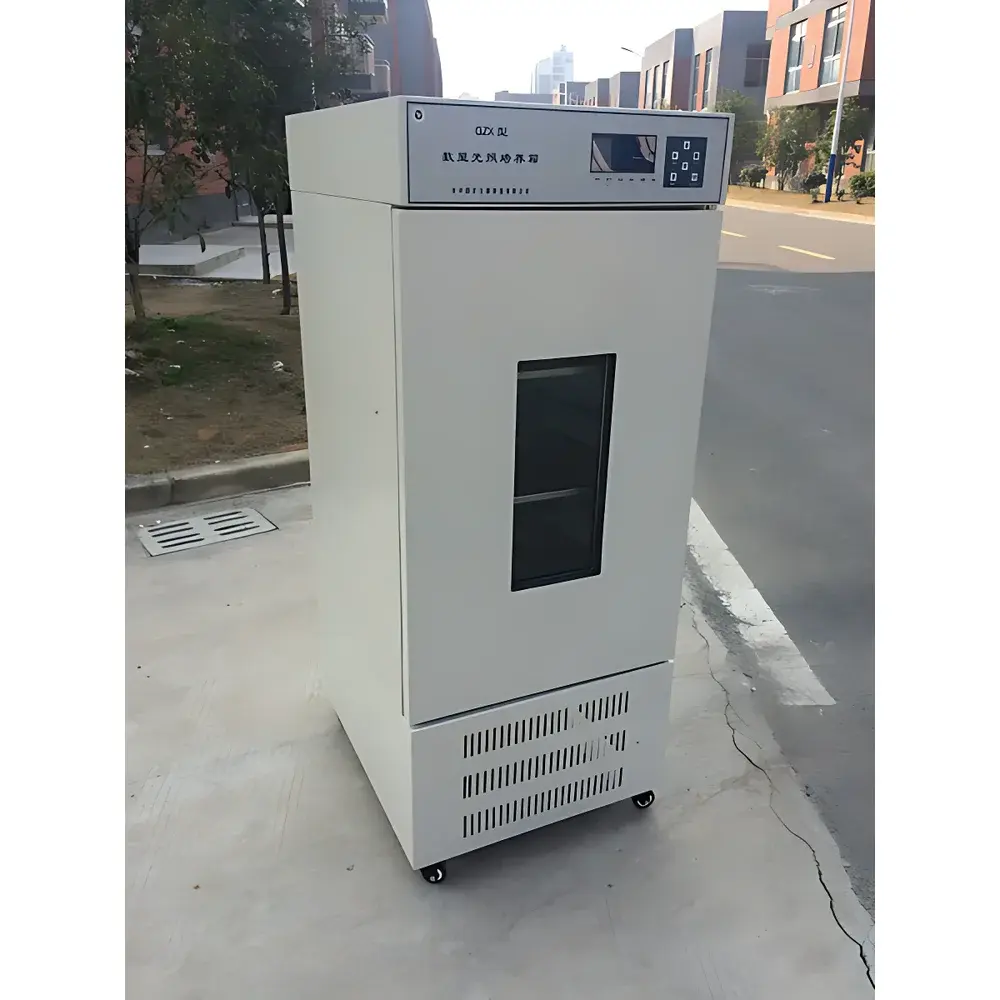
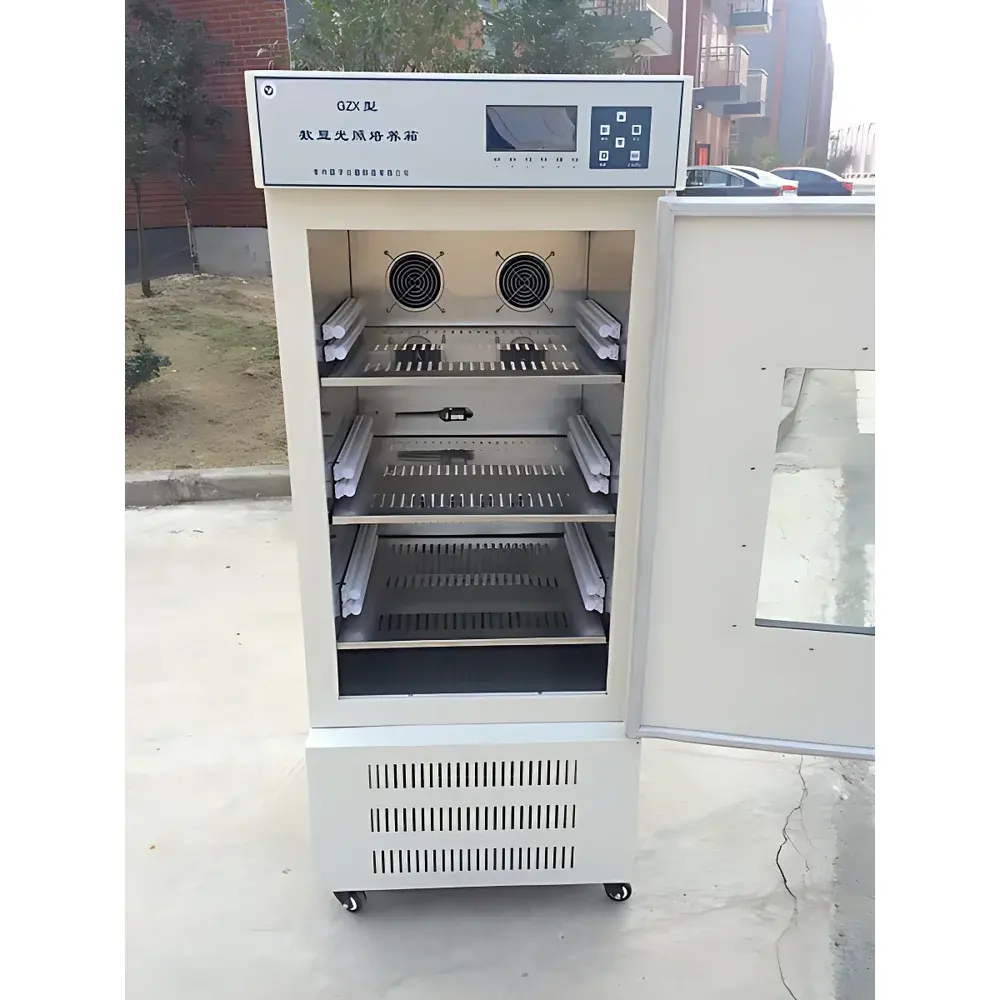
GZGY GZX-150 Plant Growth Chamber
| Brand | GZGY (CZGY) |
|---|---|
| Origin | Jiangsu, China |
| Manufacturer Type | Direct Manufacturer |
| Region Classification | Domestic (China) |
| Model | GZX-150 |
| Price | Upon Request |
| Temperature Range | 5–50 °C (dark), 10–50 °C (with illumination) |
| Temperature Resolution | 0.1 °C |
| Temperature Uniformity | ±0.5 °C |
| Temperature Stability | ±0.5 °C |
| Illuminance Range | ≥5000 lx (6-level adjustable) |
| optional high-intensity mode | 0–22,000 lx (6-level) |
| Heating Power | 300 W |
| Cooling Power | 183 W |
| Inner Chamber Dimensions (W×D×H) | 450×450×750 mm |
| Net Volume | 150 L |
| Shelving | 3 stainless-steel adjustable shelves |
| Timer Range | 1–9999 minutes or hours |
| Construction | Cold-rolled steel exterior with epoxy powder coating |
| Safety | Dual over-temperature protection (chamber + independent air duct sensor) |
| Control System | Microprocessor-based programmable controller with LCD touchscreen interface, PID temperature regulation, power-loss memory function |
| Optional Accessories | Humidification module, BOD sockets, thermal printer, data logger, custom chamber dimensions |
Overview
The GZGY GZX-150 Plant Growth Chamber is a precision-engineered environmental control system designed for reproducible, long-term cultivation of photobiological specimens under tightly regulated temperature and light conditions. Based on forced-air convection with optimized airflow distribution, the chamber maintains uniform thermal and photometric conditions across its 150 L working volume—critical for studies requiring spatial consistency in plant physiology, seed germination kinetics, microbial phototropism, and controlled-environment phenotyping. Its dual-mode thermal control architecture enables stable operation across two distinct operational envelopes: 5–50 °C in darkness (e.g., for thermosensitive dormancy assays or dark-phase metabolic studies), and 10–50 °C under active illumination—ensuring compatibility with both diurnal cycle simulation and continuous-light growth protocols. The system complies with foundational design principles outlined in ISO 17025 for environmental simulation equipment and supports GLP-compliant experimental workflows through deterministic control logic and non-volatile parameter retention.
Key Features
- Microprocessor-based programmable controller with intuitive LCD touchscreen interface and tactile membrane switches
- PID-driven temperature regulation delivering ±0.5 °C stability and 0.1 °C resolution across full operating range
- Six-step digitally adjustable illuminance output: standard configuration ≥5000 lx (cold-white LED array); optional high-output module extends range to 0–22,000 lx
- Dual-stage over-temperature protection: primary chamber sensor + independent air duct thermal cutoff (fail-safe redundancy)
- Robust mechanical construction: electrophoretically coated cold-rolled steel exterior; 304 stainless-steel seamless inner chamber; high-density rock wool insulation (≥40 mm thickness)
- Low-turbulence air circulation system ensuring ≤±0.5 °C spatial uniformity at all shelf levels
- Power-loss memory function retains setpoints, timers, and illumination schedules during unexpected outages
- Three-tier adjustable stainless-steel shelving system with load rating ≥15 kg per shelf
Sample Compatibility & Compliance
The GZX-150 accommodates standard botanical and microbiological sample formats including Petri dishes (up to 150 mm diameter), multi-well plates, growth pots (≤12 cm height), and small animal enclosures (e.g., Drosophila vials, zebrafish embryo trays). Its chamber geometry and airflow profile meet ASTM E1826-20 requirements for uniformity testing in environmental chambers. While not certified to IEC 61000-6-3 (EMC) or UL 61010-1 out-of-the-box, the unit is engineered to support integration into ISO/IEC 17025-accredited laboratories when deployed with documented calibration procedures (traceable to NIM-certified standards) and routine preventive maintenance logs. Optional humidification and BOD socket configurations enable compliance with USP environmental controls for botanical extract stability studies.
Software & Data Management
The embedded controller supports time-stamped logging of temperature, illuminance level, and operational status (heating/cooling/illumination state) to internal flash memory (12-month buffer at 1-min intervals). Data export is facilitated via USB port (CSV format), compatible with common laboratory data analysis platforms including MATLAB, Python pandas, and LabChart. Optional RS-485 Modbus RTU interface enables centralized monitoring within SCADA environments. All parameter changes are recorded with timestamp and user ID (when configured with external authentication), satisfying audit-trail requirements under FDA 21 CFR Part 11 for electronic records in regulated research settings. Firmware updates are performed via secure USB loader with cryptographic signature verification.
Applications
- Photoperiod-controlled seed germination assays (e.g., Arabidopsis thaliana, Brassica napus) under standardized ISTA protocols
- Phytochrome-mediated hypocotyl elongation studies requiring precise red/far-red light dosimetry
- Long-term culture of light-dependent cyanobacteria (e.g., Synechocystis sp. PCC 6803) and microalgae (Chlamydomonas reinhardtii)
- Stability testing of photosensitive pharmaceutical excipients under ICH Q1B photo-stability conditions
- Controlled-environment rearing of model organisms (Drosophila melanogaster, Caenorhabditis elegans) with circadian lighting cycles
- Pre-acclimation of tissue-cultured plantlets prior to greenhouse transfer
FAQ
What is the minimum recommended operating temperature under illumination?
The system maintains stable control down to 10 °C when the illumination system is active; for sub-10 °C dark-phase experiments, illumination must be disabled.
Can the chamber be calibrated externally using NIST-traceable probes?
Yes—the unit features dual PT100 sensor ports (one internal, one external access point) enabling third-party validation per ISO/IEC 17025 Clause 6.5.
Is remote monitoring supported natively?
No native Ethernet/Wi-Fi; however, the RS-485 Modbus interface allows integration with industrial gateways for cloud-based telemetry via MQTT or OPC UA.
What safety certifications does the GZX-150 hold?
It conforms to GB 4793.1–2019 (Chinese national standard equivalent to IEC 61010-1) for laboratory electrical equipment safety; CE marking requires additional EMC testing by end-user integrators.
How frequently should the air filter be replaced?
Under standard clean-room adjacent lab conditions, replace the washable aluminum pre-filter every 6 months; high-dust environments require quarterly inspection.
Related Products




