
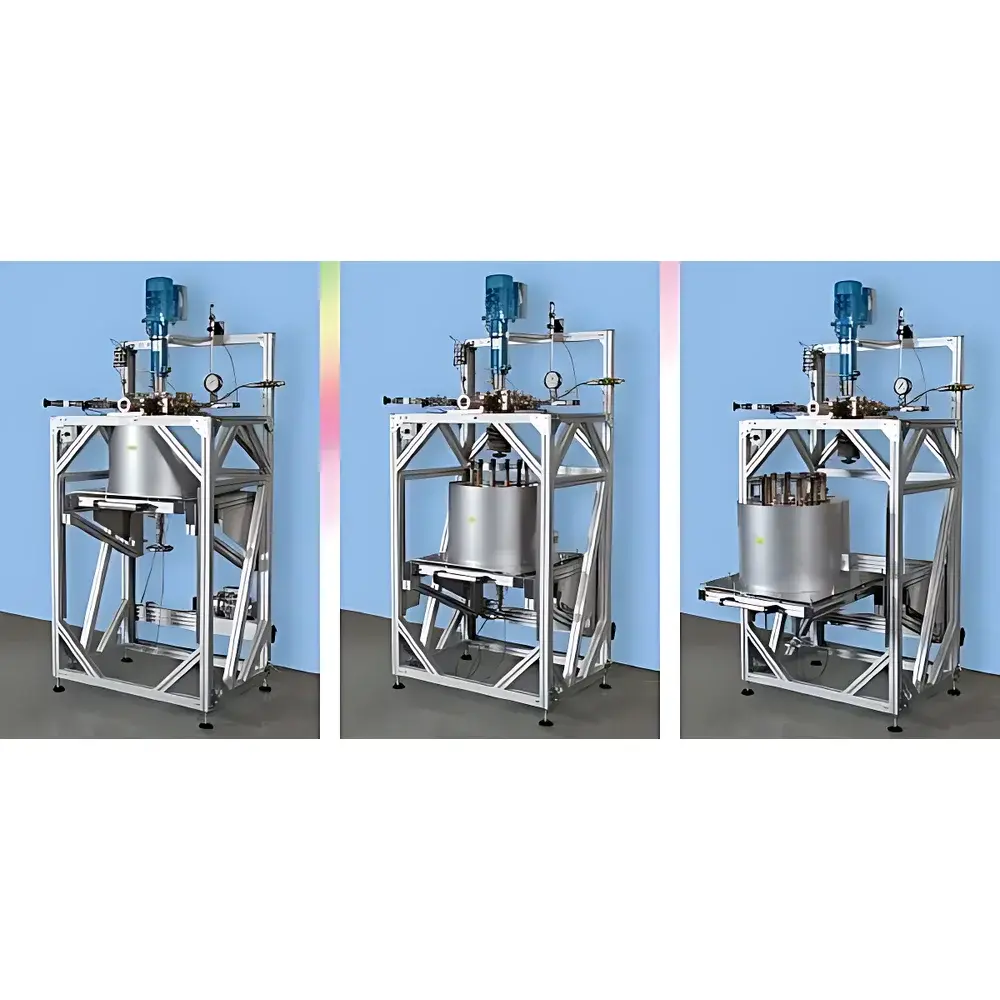
Haage High-Temperature and High-Pressure Corrosion Testing System
| Brand | Haage |
|---|---|
| Origin | Germany |
| Type | Laboratory-to-Industrial Reactor |
| Volume Range | 0.15–100 L |
| Operating Pressure | 50–3000 bar |
| Maximum Temperature | 700 °C |
| Construction | Forged High-Heat-Resistant Steel (Standard) |
| Vacuum Capability | Yes (down to <1 mbar, compatible with high-pressure operation) |
| Standard Safety Components | Certified Rupture Disc Assembly (with spare), Dual Thermocouple Monitoring (bulk & wall), Pressure Gauge, Gas Inlet/Outlet Valve, Sample Port, Magnetic Stirring Interface (optional), ATEX-Compliant Configuration Available |
| Optional Materials | Hastelloy®, Inconel®, Monel®, Nickel, Tantalum, Non-Metallic Linings (e.g., PTFE, SiC, Al₂O₃) |
| Optional Features | Digital Pressure Display, Integrated Condenser (top/bottom), Immersion Sampling Tube, Temperature-Limited Safety Interlock, Inert Gas Purge Valve, Bottom Drain Valve |
Overview
The Haage High-Temperature and High-Pressure Corrosion Testing System is an engineered solution for accelerated material degradation studies under extreme process conditions. Designed in accordance with ASME BPVC Section VIII Div. 2 and PED 2014/68/EU, this reactor platform enables controlled exposure of metallic, ceramic, and coated substrates to aggressive chemical environments—including supercritical water, H₂S/CO₂-saturated brines, acidic gases, and oxidizing molten salts—at simultaneous pressures up to 3000 bar and temperatures up to 700 °C. Its modular architecture supports both static immersion and dynamic flow-through corrosion protocols, making it suitable for evaluating localized attack mechanisms such as stress corrosion cracking (SCC), pitting, crevice corrosion, and hydrogen embrittlement in upstream oil & gas, nuclear fuel cycle, geothermal energy, and advanced metallurgy applications.
Key Features
- Forged high-heat-resistant steel construction (standard grade A—equivalent to ASTM A182 F22 or DIN 1.4980), certified per EN 10204 3.1, with optional upgrade paths to nickel-based alloys (Hastelloy C-276, Inconel 625, Monel 400) or tantalum for severe halide environments
- Pressure containment validated to 1.5× maximum allowable working pressure (MAWP) at design temperature; rupture disc assembly supplied with full traceability documentation (TÜV-certified, serial-numbered, expiry-dated)
- Dual thermocouple monitoring system: one sheathed Type K thermocouple inserted into the reaction medium via a dedicated thermowell, and a second surface-mounted sensor for real-time reactor wall temperature tracking—enabling thermal gradient analysis and heat transfer coefficient estimation
- Standard interface configuration includes two high-temperature isolation valves (up to 700 °C, metal-seated), one gas inlet/outlet valve with VCR fitting, one blind sampling port with Swagelok® compression seal, and one central drive port (for magnetic coupling or mechanical stirrer integration)
- ATEX Zone 1 certification available (II 2G IIB T4 Ga) for use in potentially explosive atmospheres; optional explosion-proof instrumentation packages comply with IEC 60079-0 and IEC 60079-11
- Modular accessory compatibility: integrated condensers (reflux or partial), bottom drain valves with cryogenic sealing, immersion sampling tubes with sapphire-lined capillaries, and electrochemical interfaces (reference electrode ports, Luggin capillaries, potentiostat feedthroughs)
Sample Compatibility & Compliance
This system accommodates solid coupons (ASTM G31/G102-compliant geometry), welded joints, clad specimens, and powder compacts. Liquid-phase testing supports aqueous electrolytes, organic solvents, ionic liquids, and supercritical fluids. All wetted surfaces are electropolished (Ra < 0.4 µm) to minimize nucleation sites and ensure reproducible surface state initialization. The reactor complies with ISO 9223 (corrosivity classification), ASTM G150 (electrochemical critical pitting temperature), and NACE TM0177 (sulfide stress cracking). Documentation packages support GLP audits and FDA 21 CFR Part 11 compliance when paired with Haage’s optional data acquisition module featuring electronic signatures and audit trail logging.
Software & Data Management
While the base system operates via analog instrumentation, Haage offers the optional CorrControl™ v4.2 digital control suite—a Windows-based application supporting synchronized acquisition of pressure (0.1% FS accuracy), temperature (±0.5 °C), stirring torque (if equipped), and optional electrochemical signals (Ecorr, ipass, EIS spectra). Data export formats include CSV, HDF5, and ASTM E1447-compliant XML. The software enforces user role-based access control, automatic calibration timestamping, and configurable alarm thresholds with email/SMS notification (via Modbus TCP or OPC UA gateway). All raw datasets are stored with SHA-256 checksums to satisfy ALCOA+ data integrity requirements.
Applications
- Development and qualification of corrosion-resistant alloys for subsea pipelines and downhole tools (API RP 14E, NACE MR0175/ISO 15156)
- Long-term aging studies of structural materials in Gen-IV nuclear reactor coolants (molten chloride/sodium, supercritical CO₂)
- Accelerated lifetime prediction of thermal barrier coatings under cyclic oxidation and hot corrosion
- In situ Raman/FTIR spectroscopy coupling via sapphire viewport options (10–5000 cm⁻¹ transmission window)
- Hydrothermal synthesis of corrosion-inhibiting nanomaterials and self-healing coatings
- Validation of thermodynamic models (e.g., OLI Stream Analyzer, Thermo-Calc) for high-pressure aqueous speciation
FAQ
What is the maximum recommended test duration for continuous operation at 3000 bar and 650 °C?
Continuous operation at these extremes is limited to 168 hours (7 days) per test cycle, based on fatigue life modeling per EN 13445-3 Annex C. Extended campaigns require intermediate non-destructive examination (phased array UT) and revalidation of safety margins.
Can the system be configured for electrochemical impedance spectroscopy (EIS) measurements?
Yes—optional feedthroughs accommodate three-electrode cells with Pt counter electrodes, Ag/AgCl reference electrodes, and working electrodes mounted on standardized coupon holders. Maximum frequency range: 10 mHz–1 MHz (requires external potentiostat with high-voltage isolation).
Is third-party calibration and validation support available?
Haage collaborates with DAkkS-accredited laboratories (e.g., BAM, PTB) for as-found/as-left calibration of pressure transducers and thermocouples, including uncertainty budgets traceable to national standards.
Does the system meet requirements for testing under NACE TM0284 (hydrogen-induced cracking)?
Yes—when equipped with H₂ gas handling modules, sour gas injection manifolds, and real-time hydrogen permeation monitoring (Devanathan-Stachurski cell interface), the system fulfills all procedural and environmental controls specified in TM0284.



