
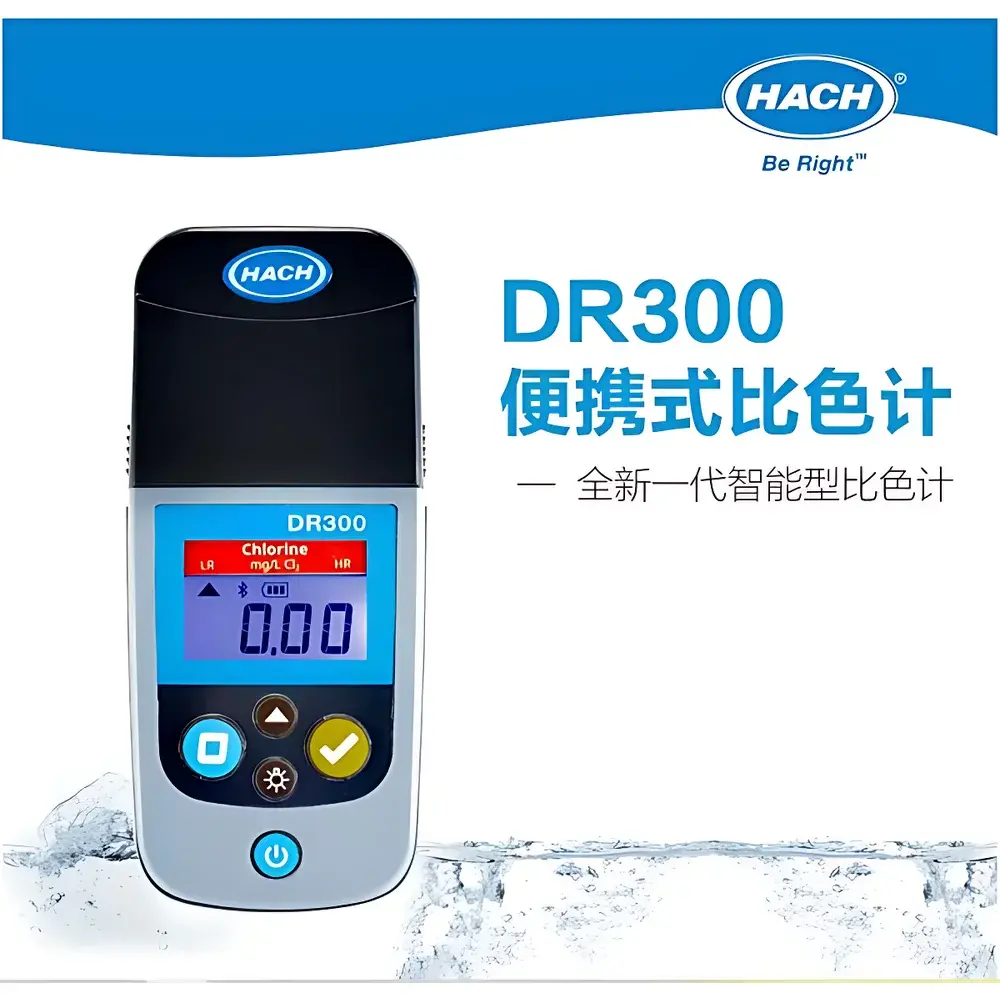
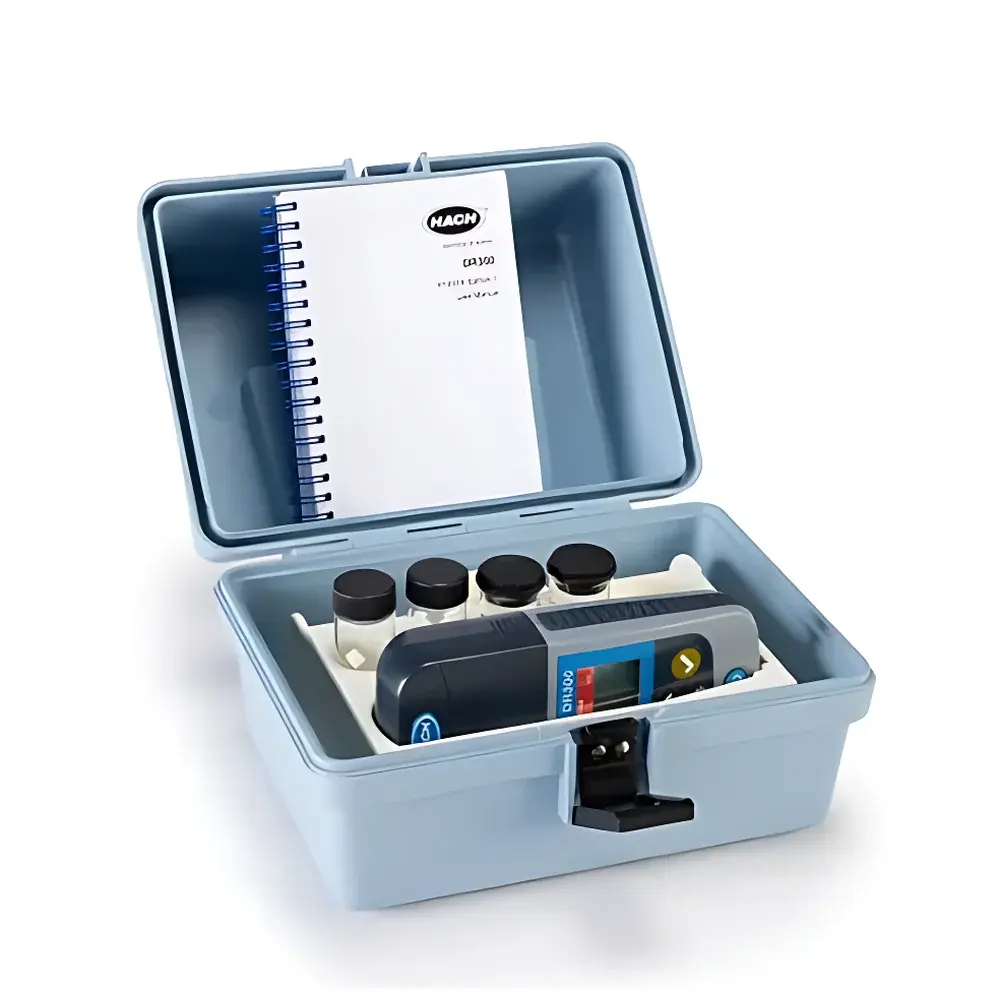
Hach DR300 Portable Colorimeter
| Brand | Hach |
|---|---|
| Origin | USA |
| Model | DR300 |
| Protection Rating | IP67 |
| Display | Backlit LCD, Enhanced Visibility |
| Connectivity | Optional Bluetooth Module (Hach Data Transfer Software Compatible) |
| Compliance | Designed for Field-Deployable Water Quality Testing per EPA, ASTM D1293, ISO 7887, and APHA Standard Methods |
Overview
The Hach DR300 Portable Colorimeter is an engineered optical measurement instrument designed for rapid, field-deployable colorimetric analysis of water and wastewater samples. Based on the established photometric principle—measuring absorbance at specific wavelengths using pre-calibrated reagent-based chemistry—the DR300 delivers traceable, reproducible results in accordance with standardized methods including EPA 365.1, ASTM D1293 (pH), ISO 7887 (color), and APHA Standard Methods 2120B (turbidity) and 4500-Cl G (chlorine). Unlike spectrophotometers, the DR300 employs fixed-wavelength LED optics optimized for common water quality parameters (e.g., chlorine, nitrate, phosphate, iron, copper, hardness), eliminating spectral calibration drift and ensuring long-term stability without routine wavelength verification. Its compact, ruggedized chassis supports continuous operation across ambient temperatures from –10 °C to 50 °C and meets IP67 ingress protection—fully submersible up to 1 m for 30 minutes and resistant to dust, rain, and mechanical shock (MIL-STD-810G drop-tested from 1.2 m onto concrete).
Key Features
- Rugged IP67-rated enclosure with reinforced polycarbonate housing and sealed membrane keypad—certified for outdoor, industrial, and emergency-response environments.
- High-contrast, backlit monochrome LCD display (128 × 64 pixels) with adjustable brightness—optimized for readability under direct sunlight or low-light conditions.
- Intuitive one-button workflow: auto-zero, reagent addition prompt, timed reaction countdown, and final absorbance-to-concentration conversion—all guided via on-screen icons and text prompts.
- Integrated Bluetooth 4.2 module (optional accessory) enables secure wireless data export to Hach’s compatible mobile applications and desktop software—supporting CSV and PDF report generation with embedded method metadata and timestamped audit trails.
- Battery-powered operation (4 × AA alkaline or rechargeable NiMH) delivering ≥2,000 measurements per charge; low-power sleep mode activates after 5 minutes of inactivity.
- Pre-programmed method library covering >50 Hach-approved chemistries—including free/total chlorine (DPD), nitrate (cadmium reduction), phosphate (ascorbic acid), and silica (molybdate)—with built-in calibration curves traceable to NIST-certified standards.
Sample Compatibility & Compliance
The DR300 accepts standard 13-mm round glass or plastic cuvettes (10-mm pathlength) and is validated for use with Hach’s full suite of liquid, powder, and tablet reagents (e.g., CN-02, HR-01, PO-04 series). It complies with Good Laboratory Practice (GLP) requirements through automatic logging of operator ID (via optional PIN entry), sample ID, date/time stamp, method version, and measured absorbance values. While the DR300 itself does not require FDA 21 CFR Part 11 compliance (as it lacks electronic signature capability), its exported data files are structured to integrate into LIMS or Claros-enabled enterprise platforms where full audit-trail functionality is implemented at the system level. All factory calibrations are performed against Hach’s internal reference standards, which are annually verified against NIST-traceable photometric references.
Software & Data Management
Data capture and reporting are supported via Hach’s free desktop software (Hach LabStation v4.2+) and mobile companion apps (Hach Mobile Lab, iOS/Android). The DR300 stores up to 500 test records internally—including raw absorbance, calculated concentration, method ID, and operator notes—with automatic overwrite protection for flagged QC samples. Bluetooth transmission supports batch export with configurable metadata fields (site ID, sampling depth, analyst initials). Exported files include ISO/IEC 17025-aligned uncertainty annotations where applicable and support seamless import into Microsoft Excel, LimnoTech WQX, or custom SQL-based environmental databases. Firmware updates are delivered via USB or over-the-air (OTA) through authenticated Hach Cloud channels.
Applications
The DR300 serves as a primary field instrument for municipal drinking water utilities performing routine disinfectant residual monitoring (free/combined chlorine, chloramine), wastewater treatment plants verifying nutrient removal efficiency (nitrate, orthophosphate), power generation facilities assessing condensate purity (iron, copper), food & beverage QA labs validating rinse water clarity (turbidity, color), and environmental consultants conducting stormwater runoff assessments (COD, manganese). Its portability and battery autonomy make it suitable for unattended deployment in remote wells, distribution system dead-ends, or disaster-recovery sites where grid power and lab infrastructure are unavailable.
FAQ
Does the DR300 require annual recalibration by an accredited service provider?
No—routine recalibration is not required. The instrument’s LED light source and optical path are factory-stabilized; users perform daily verification using Hach’s certified calibration check standards (e.g., CC-100). Full performance verification per ASTM E275 is recommended every 12 months or after physical impact.
Can the DR300 be used with non-Hach reagents?
Hach does not validate or support third-party reagents. Method accuracy, detection limits, and interference rejection are guaranteed only when using Hach-branded chemistries and cuvettes.
Is the Bluetooth module included by default?
No—the Bluetooth communication module (part number LZV912.99.00001) is an optional accessory ordered separately and requires firmware v3.1 or higher.
What is the measurement repeatability for chlorine analysis at 1.0 mg/L?
Based on internal validation per ISO 5725-2:2019, typical repeatability (within-run CV) is ≤2.3% RSD (n = 10) using Hach DPD Free Chlorine Reagent Powder Pillows and 10-mm quartz cuvettes.
How is data security handled during Bluetooth transmission?
All wireless sessions use AES-128 encryption and require explicit pairing authorization. No credentials or historical data are stored on the device beyond the active session cache, which clears automatically upon disconnect.




