
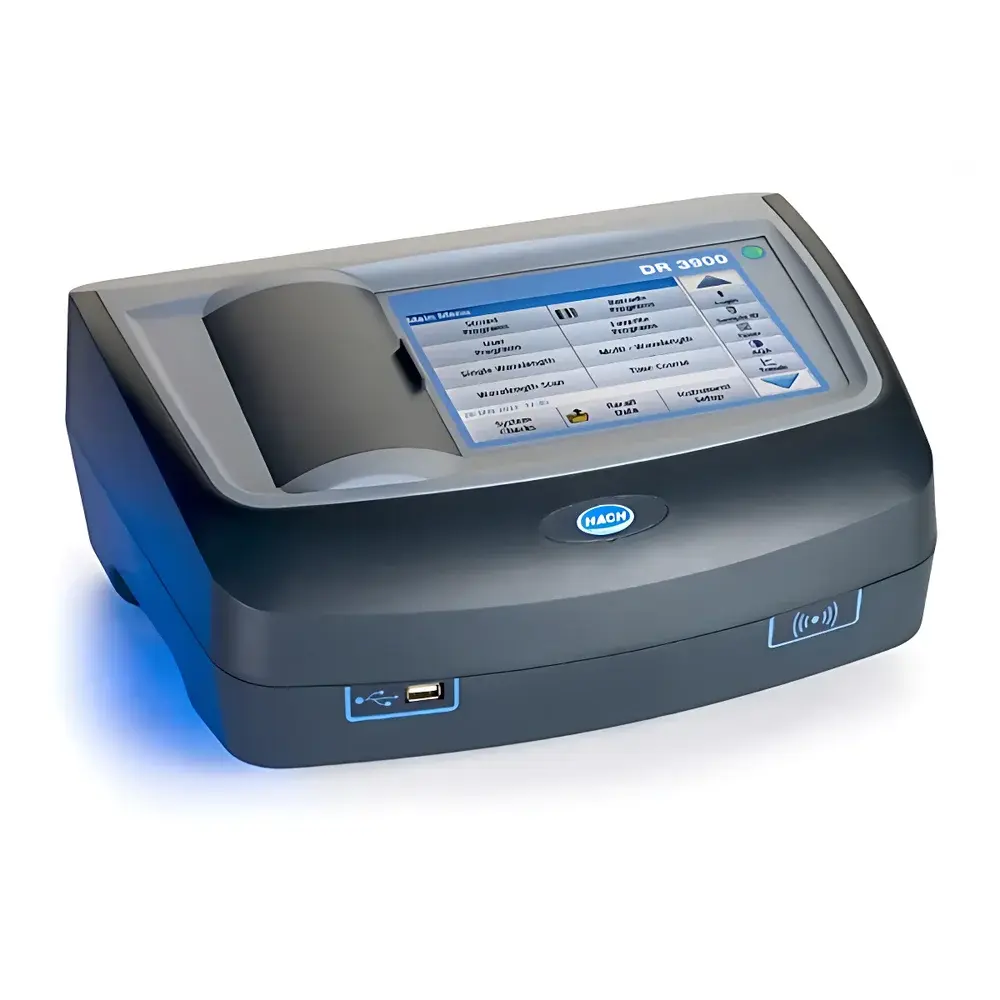
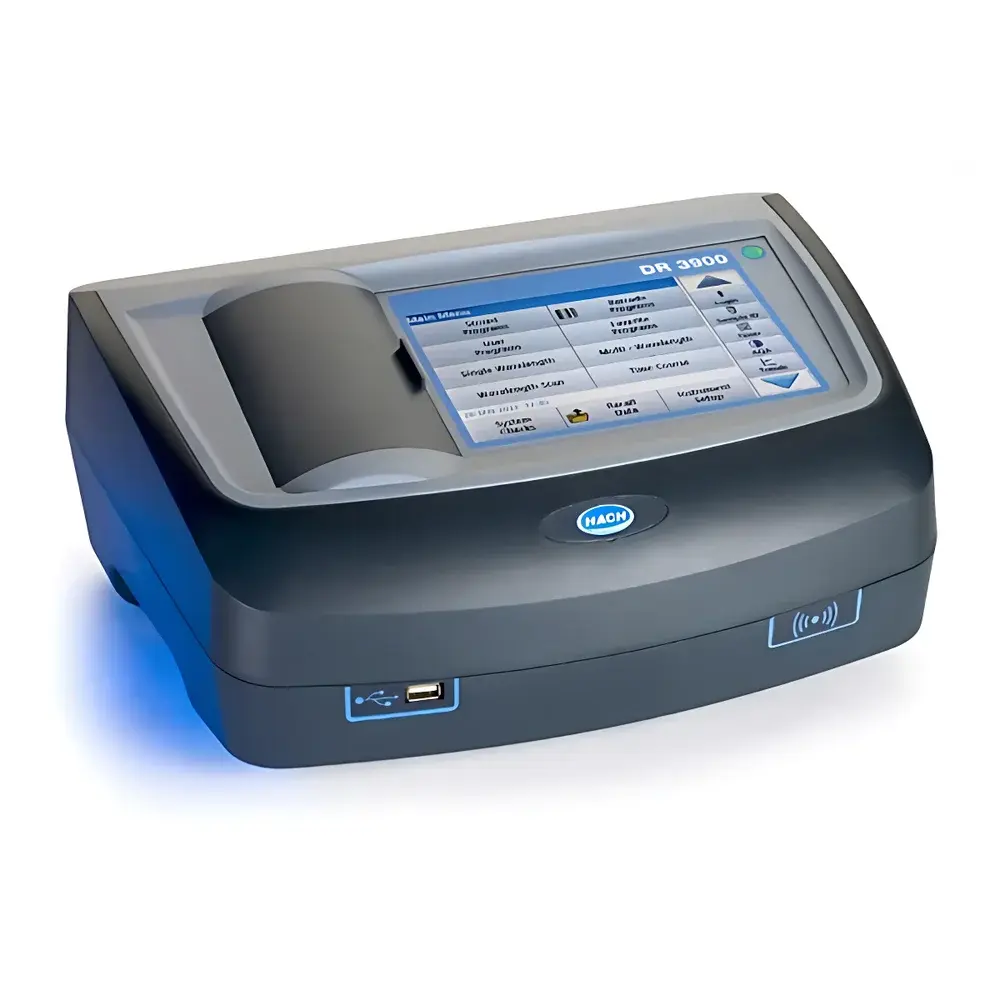
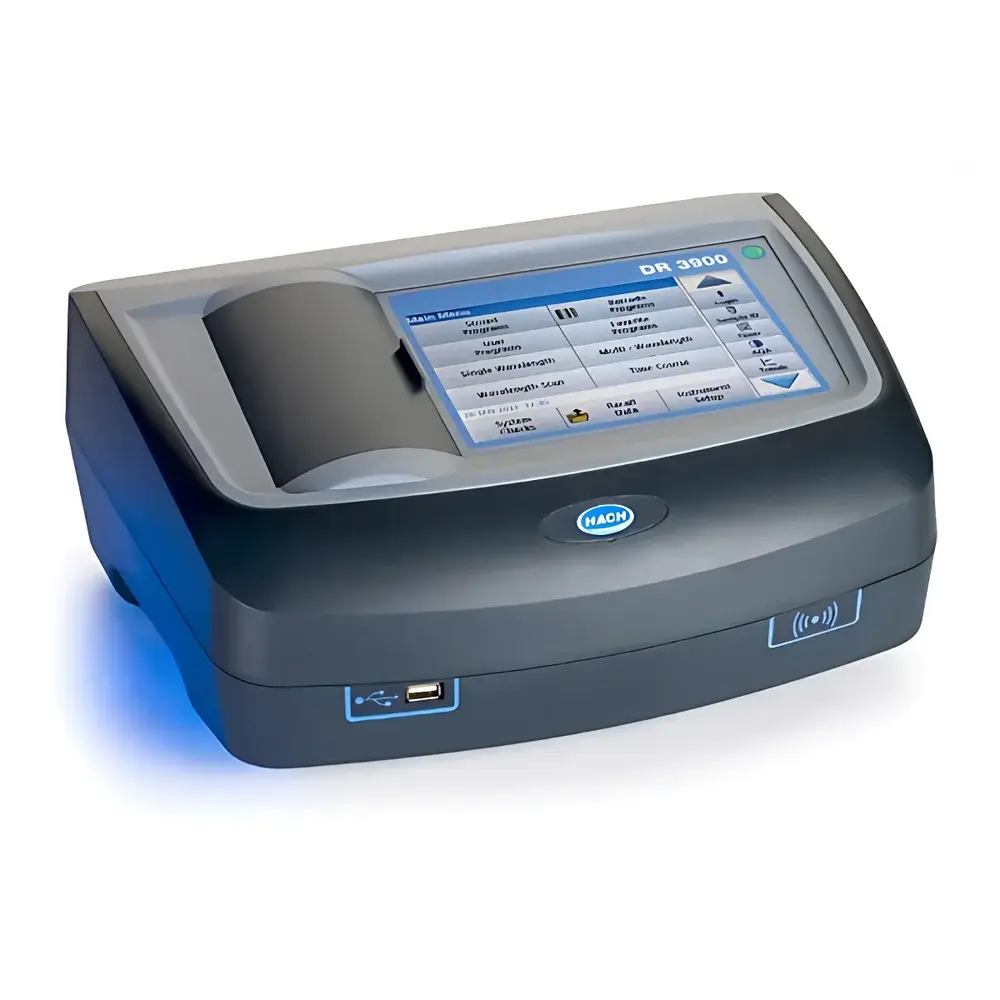
Hach DR3900 Benchtop Visible Spectrophotometer
| Brand | Hach |
|---|---|
| Origin | Shanghai, China |
| Model | DR3900 |
| Wavelength Range | 320–1100 nm |
| Wavelength Accuracy | ±1.5 nm (340–900 nm) |
| Photometric Measurement Range | 340–900 nm |
| Spectral Bandwidth | 5 nm |
| Display | 7″ TFT WVGA Color Touchscreen (800 × 480 pixels) |
| Data Storage Capacity | 2000 measurement sets |
| Preprogrammed Methods | >240 |
| User-Defined Methods | 100 |
| Operating Environment | 10–40 °C, ≤80% RH (non-condensing) |
| Dimensions | 151 × 350 × 255 mm |
| Weight | 4.2 kg |
| Power Supply | 100–240 VAC, 50–60 Hz |
Overview
The Hach DR3900 Benchtop Visible Spectrophotometer is a precision optical instrument engineered for quantitative absorbance and transmittance measurements in the visible and near-UV spectral range. Utilizing a fixed-grating monochromator and a silicon photodiode detector, the DR3900 operates on single-beam optical architecture with internal reference compensation—commonly referred to as “quasi-double-beam” design—to minimize drift and enhance photometric stability over time. Its wavelength coverage spans 320–1100 nm, with certified accuracy of ±1.5 nm across the primary analytical range of 340–900 nm, aligning with ISO 9001-compliant manufacturing and ASTM E275 and E380 standards for spectrophotometric performance validation. Designed specifically for routine water quality analysis, the DR3900 integrates seamlessly into laboratory workflows where reproducibility, traceability, and compliance with regulatory data integrity requirements—including FDA 21 CFR Part 11 readiness via optional software configurations—are essential.
Key Features
- 7-inch high-resolution color touchscreen interface (800 × 480 pixels) with intuitive, icon-driven navigation and real-time graphical feedback—including dynamic bar-chart display of absorbance ranges and automatic cuvette recognition with error alerting
- Onboard library of >240 prevalidated test methods (e.g., COD, nitrate, phosphate, ammonia, chlorine species) and support for up to 100 user-defined protocols compliant with Hach’s Method Validation Framework
- Advanced Quality Assurance (AQA) suite enabling scheduled verification runs, standard calibration checks, interference testing protocols, and full audit-trail logging for GLP/GMP-aligned laboratories
- Dual USB ports (front and rear) for firmware updates, method transfers, and direct export of measurement datasets—including date/time stamps, sample IDs, operator codes, and raw absorbance values
- Integrated Ethernet port supporting TCP/IP connectivity for networked data upload to LIMS or enterprise servers; optional Hach LINK2SC software enables synchronized comparison between lab-based DR3900 results and field-deployed SC1000 controller outputs
- Multi-level user access control with password protection, role-based permissions (administrator, standard user), and session timeout functionality to meet data governance requirements
- Automatic wavelength calibration routine executed at startup and configurable periodic intervals to maintain long-term spectral fidelity
Sample Compatibility & Compliance
The DR3900 accepts standard 10-mm square or round glass or plastic cuvettes and supports both manual and automated sample introduction. Its optical path is optimized for aqueous matrices typical in environmental, municipal, and industrial wastewater testing—ensuring minimal scattering artifacts under turbid conditions up to 1000 NTU when used with appropriate method-specific corrections. All factory-loaded methods conform to U.S. EPA, APHA Standard Methods, ISO 7027 (turbidity), and ISO 6060 (COD) guidelines. Instrument qualification documentation—including Installation Qualification (IQ), Operational Qualification (OQ), and Performance Qualification (PQ) templates—is available upon request to support regulated laboratory validation processes.
Software & Data Management
Data handling is governed by Hach’s proprietary operating system, which logs every measurement with immutable metadata: timestamp (RTC-synchronized), operator ID, method name, wavelength, absorbance/transmittance/concentration output, and pass/fail status per AQA criteria. Export formats include CSV and XML, compatible with third-party statistical packages and LIMS interfaces. When deployed with LINK2SC, the DR3900 functions as a hybrid lab-field correlation node—enabling side-by-side visualization of offline lab data and online sensor outputs from SC1000 platforms, facilitating rapid root-cause analysis of discrepancies and triggering remote recalibration commands without site visits. Audit trails are retained locally for ≥2 years and support electronic signature capture under configured 21 CFR Part 11 settings.
Applications
- Regulatory compliance monitoring for drinking water (e.g., residual chlorine, fluoride, nitrite per EPA Method 334.0)
- Wastewater treatment plant process control (e.g., total phosphorus by ascorbic acid method, COD by dichromate digestion)
- Industrial effluent characterization (e.g., heavy metal complexes, organic dye concentrations)
- Educational laboratory instruction in analytical chemistry and environmental science curricula
- Calibration verification and performance trending of online analyzers using standardized reference materials
FAQ
Does the DR3900 comply with FDA 21 CFR Part 11 requirements?
Yes—when operated with Hach’s validated LINK2SC software and configured with electronic signatures, audit trail logging, and role-based access controls, the system meets core technical and procedural elements of 21 CFR Part 11 for electronic records and signatures.
Can the DR3900 measure outside the 340–900 nm range?
While the instrument physically scans 320–1100 nm, photometric accuracy specifications (±1.5 nm) and method validation apply only to the 340–900 nm band per Hach’s published performance documentation.
Is external PC software required to manage data?
No—full data acquisition, storage, export, and AQA reporting are handled onboard. Optional LINK2SC software extends interoperability but is not mandatory for basic operation.
What is the maximum allowable sample turbidity for accurate absorbance readings?
For methods relying on Beer-Lambert law linearity, samples should be filtered to <5 NTU unless the selected method includes turbidity correction algorithms (e.g., certain Hach COD protocols).
How frequently must wavelength calibration be performed?
The DR3900 performs automatic calibration at power-on; users may schedule additional verifications weekly or per shift based on internal QA policies—no manual alignment tools or external standards are required.
Related Products





