
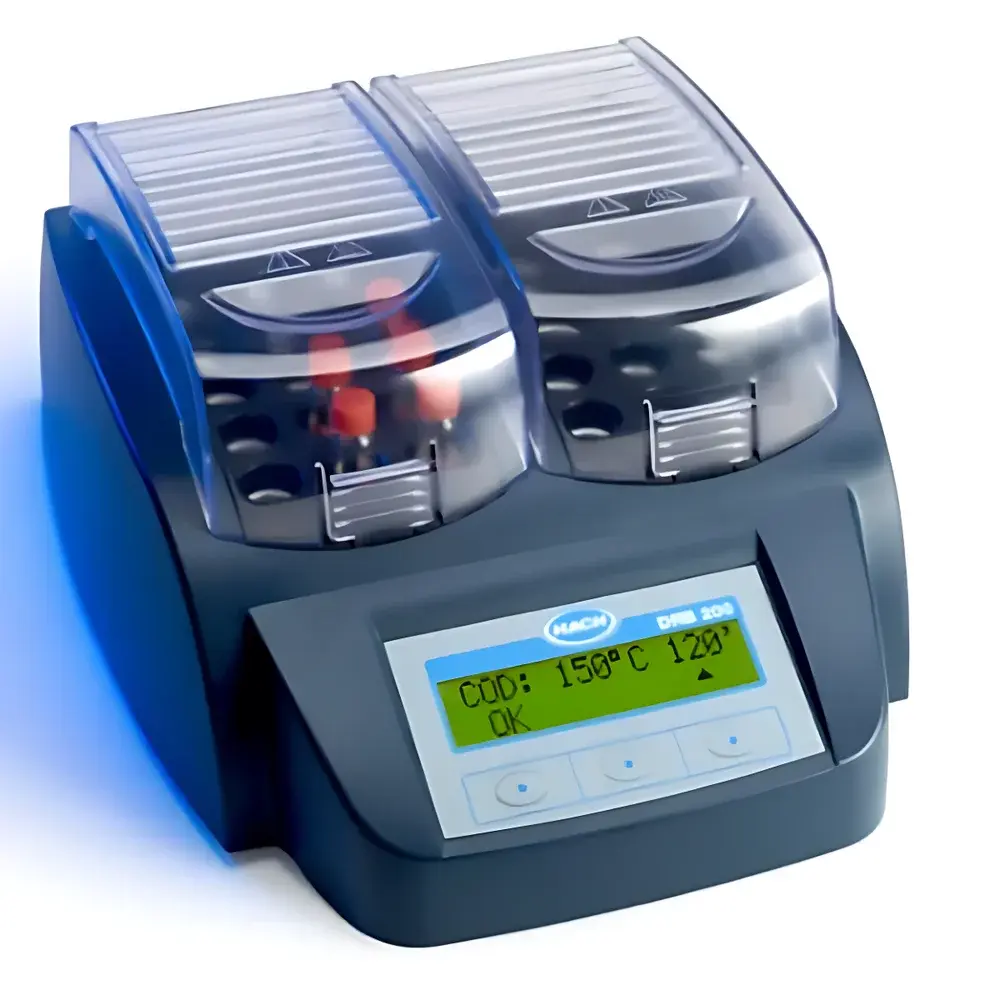
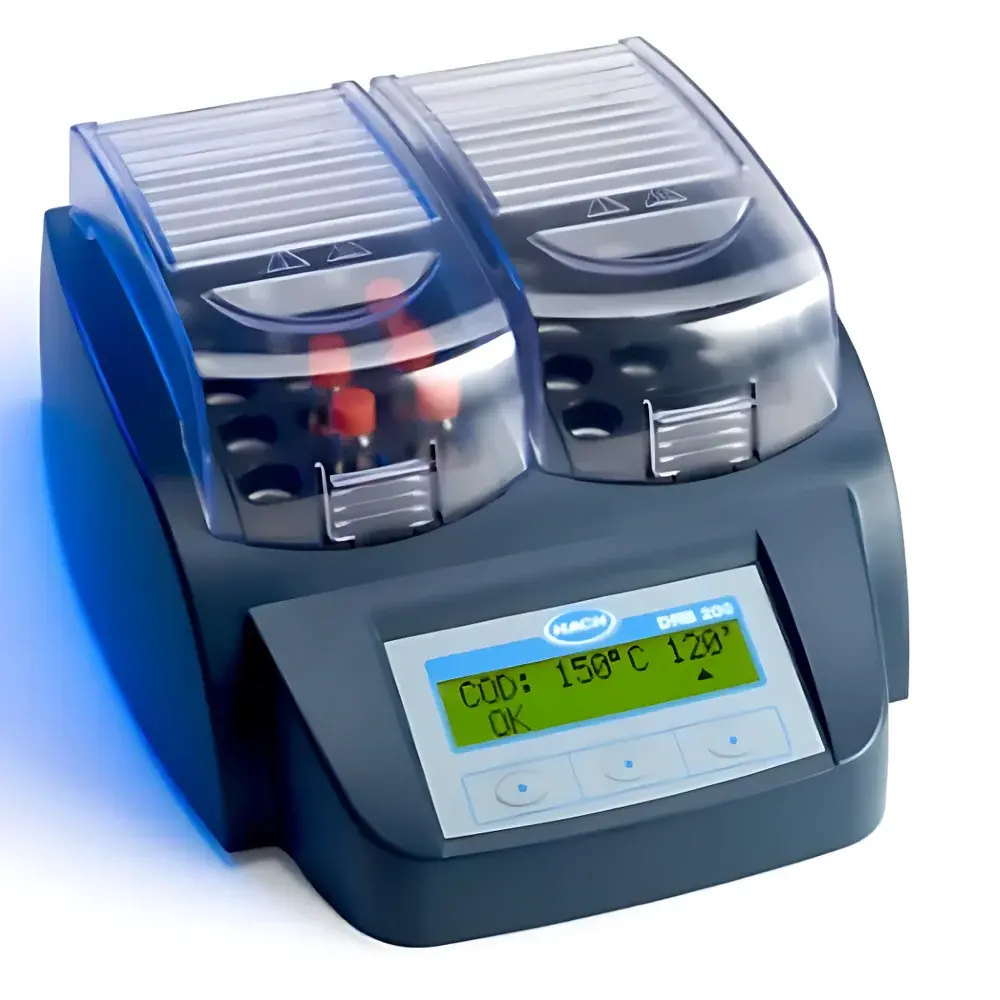
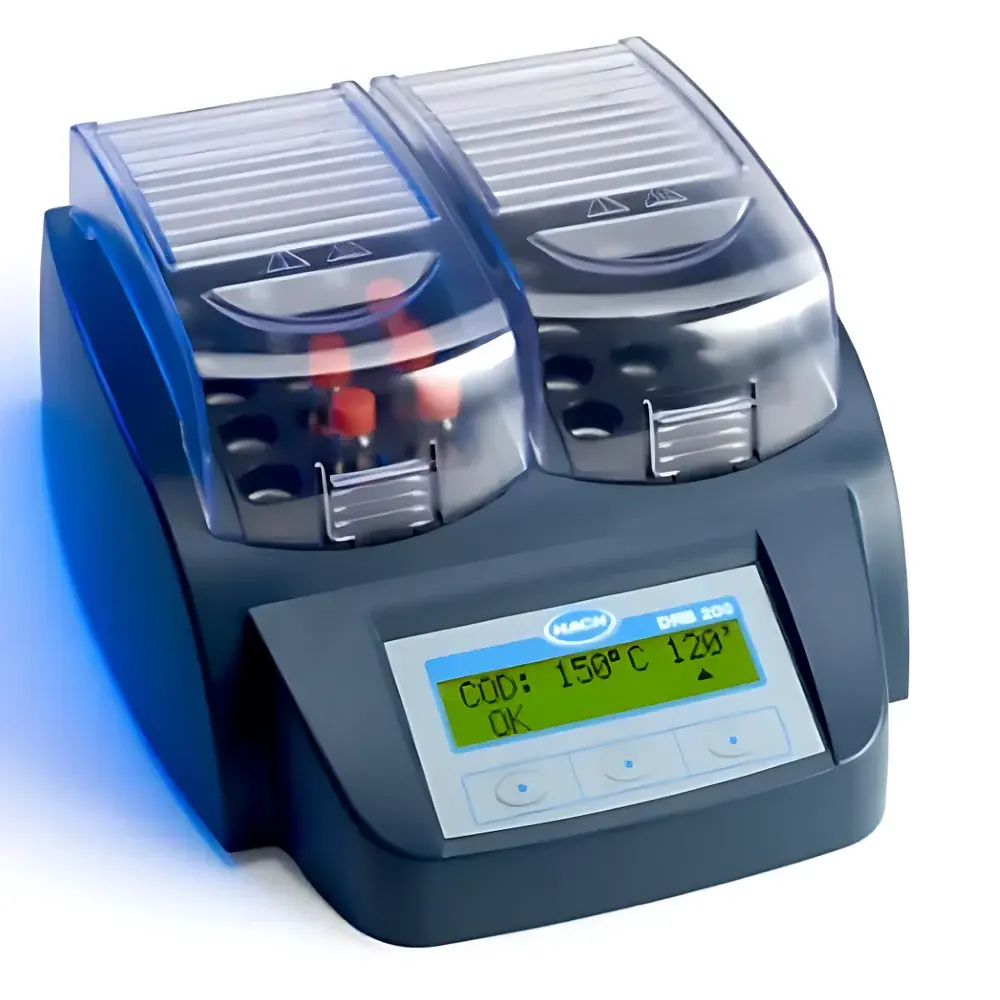
Hach DRB200 COD Digestion System
| Brand | Hach |
|---|---|
| Origin | USA |
| Model | DRB200 COD |
| Digestion Method | Rapid Digestion |
| Heating Modules | Dual Independent Heating Blocks |
| Batch Capacity | 30 samples (16 mm diameter tubes) |
| Temperature Range | 37–165 °C (98.6–329 °F) |
| Temperature Accuracy | ±2 °C (±3.5 °F) |
| Timer Accuracy | ±1 minute |
| Power Input (Dual Block) | 115 V: 600 VA |
| 230 V | 900 VA |
| Certifications | CE, GS, cTUVus |
| Protection Class | Class I |
| Operating Humidity | ≤90% RH (non-condensing) |
| Storage Temperature | −40 to +60 °C |
| Operating Temperature | 10 to 45 °C |
Overview
The Hach DRB200 COD Digestion System is a precision-engineered benchtop thermal digestion unit designed for standardized, reproducible sample preparation in water quality laboratories. It operates on the principle of controlled conductive heating within calibrated metal heating blocks, enabling rapid and uniform thermal decomposition of organic matter in aqueous samples—critical for accurate quantification of Chemical Oxygen Demand (COD), Total Organic Carbon (TOC), Total Phosphorus (TP), and Total Nitrogen (TN) via subsequent spectrophotometric or instrumental analysis. Unlike open-flame or oil-bath methods, the DRB200 employs solid-state, PID-regulated heating elements embedded in aluminum blocks, ensuring minimal thermal gradient across sample positions and high inter-run repeatability. Its dual independent heating block architecture allows concurrent digestion under two distinct temperature/time profiles—essential for laboratories processing heterogeneous sample matrices or running parallel EPA-compliant methods (e.g., EPA 410.4 for COD and EPA 365.4 for TP) without cross-contamination or scheduling conflict.
Key Features
- Dual independent heating blocks with fully programmable temperature (37–165 °C) and time (1–480 min) settings per block—enabling simultaneous digestion of multiple analyte classes under method-specific conditions.
- Precision-machined 30-position heating cavities sized for standard 16 mm diameter digestion vials, compatible with Hach’s pre-packaged TNTplus and LCK reagent vials as well as third-party COD/TP/TN kits.
- Integrated digital timer with auto-shutoff and audible/visual alarm—ensuring strict adherence to digestion protocols and eliminating operator dependency on manual timing.
- Thermally isolated modular design with insulated housing and transparent polycarbonate safety shield—preventing accidental contact and providing real-time visual monitoring while maintaining consistent ambient heat dissipation.
- Embedded factory-calibrated digestion programs for common Hach methods (e.g., COD High Range, COD Low Range, TP Auto, TN Auto), accessible via intuitive front-panel interface—reducing setup errors and supporting GLP-aligned workflow documentation.
- Over-temperature protection circuitry and thermal cut-off switch—complying with IEC 61010-1 safety requirements for laboratory electrical equipment.
Sample Compatibility & Compliance
The DRB200 supports standardized digestion protocols aligned with major regulatory frameworks including U.S. EPA Methods 410.4 (COD), 365.4 (TP), and ASTM D1252–12 (COD). Its temperature accuracy (±2 °C) and stability meet the stringent thermal control requirements of ISO 6060 (water quality — determination of chemical oxygen demand) and DIN 38409 Part 41. The system accommodates both acidic (e.g., K₂Cr₂O₇/H₂SO₄-based) and alkaline (e.g., persulfate-based) digestion chemistries. All heating blocks are corrosion-resistant anodized aluminum, validated for repeated exposure to concentrated sulfuric acid and oxidizing reagents. The device bears CE, GS, and cTUVus marks—certifying conformance with EN 61010-1 (safety), EN 61326-1 (EMC), and UL 61010-1 standards.
Software & Data Management
While the DRB200 operates as a standalone hardware platform with no onboard data logging or USB connectivity, it is fully interoperable with Hach’s suite of analytical instruments—including the DR3900, DR6000, and DR1900 spectrophotometers—via synchronized method selection. When paired with Hach’s AquaTrack™ or LabStation software, users can associate digestion parameters (temperature, duration, block ID) with final assay results, generating audit-ready electronic records compliant with 21 CFR Part 11 when deployed in regulated environments. The instrument’s repeatable thermal performance supports documented method validation per ISO/IEC 17025 requirements for calibration and uncertainty estimation of digestion-related bias.
Applications
The DRB200 serves as a core sample preparation tool across municipal wastewater treatment plants (for routine COD compliance reporting), industrial effluent monitoring (e.g., textile, pharmaceutical, food processing), environmental consulting laboratories (for field sample stabilization), academic research (kinetic digestion studies, method development), and regulatory testing facilities performing accredited analyses under NELAC or UKAS schemes. Its dual-block configuration is particularly advantageous for labs validating alternative digestion protocols or conducting inter-method comparisons—such as evaluating closed-reflux vs. open-reflux COD procedures—or managing high-throughput batch processing where staggered start times optimize instrument utilization.
FAQ
Does the DRB200 require external calibration or user recalibration?
No. The DRB200 is factory-calibrated and does not support end-user recalibration. Temperature verification should be performed periodically using traceable NIST-certified thermometers or thermocouples inserted into representative sample wells.
Can the DRB200 accommodate 20 mm or 25 mm vials?
No. The standard configuration accepts only 16 mm outer-diameter digestion vials. Adapters for larger diameters are not offered by Hach and are not validated for thermal uniformity or safety.
Is the DRB200 compatible with ISO 15705:2002 (COD micro-method)?
Yes—when operated at 150 °C for 120 minutes using 16 mm vials and appropriate low-volume reagents, the DRB200 meets the thermal profile requirements specified in ISO 15705.
What maintenance is required for long-term reliability?
Routine cleaning of the heating block wells with isopropyl alcohol and lint-free wipes is recommended after each use. Avoid abrasive cleaners or immersion. Annual inspection of thermal insulation integrity and safety interlock functionality is advised for GLP/GMP environments.
Does the DRB200 support remote monitoring or network integration?
No. It lacks Ethernet, Wi-Fi, or RS-232 interfaces. Integration with lab information systems (LIS) or electronic lab notebooks (ELN) must occur at the downstream analytical instrument level.
Related Products







