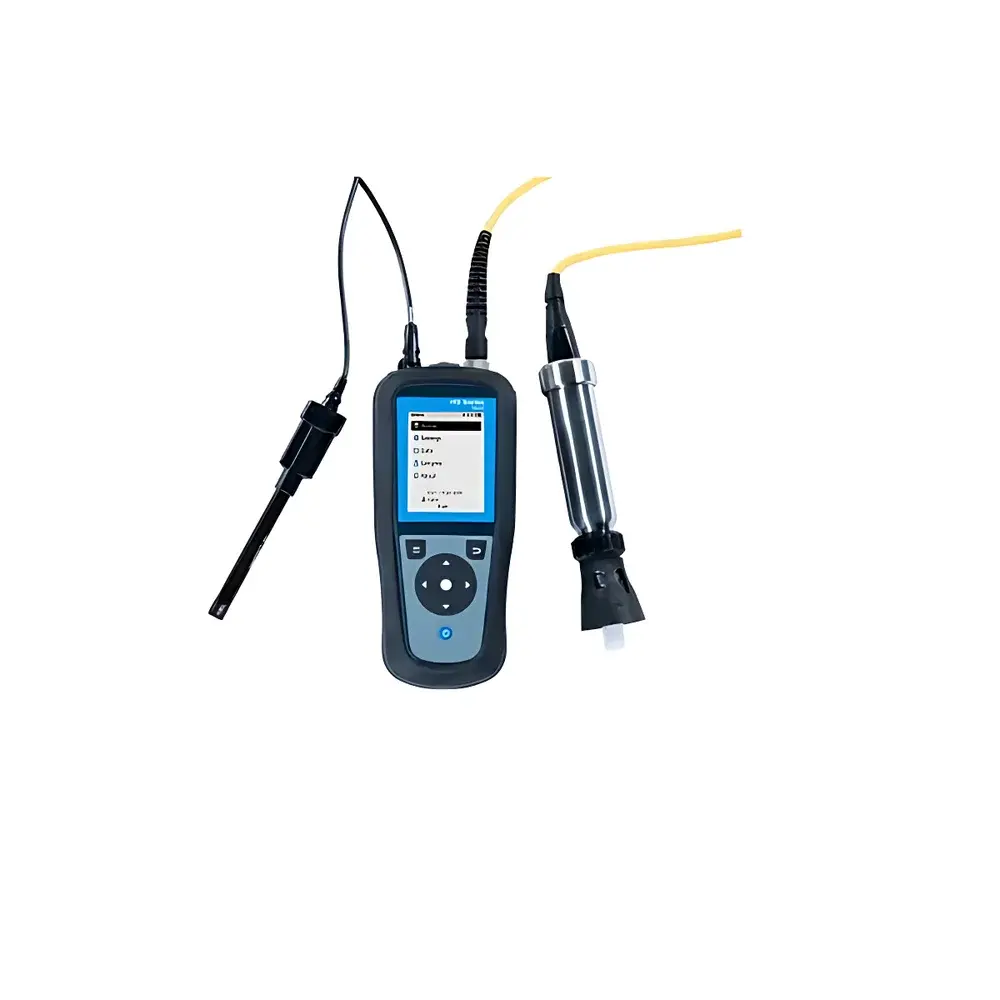
Hach LDO Portable Dissolved Oxygen Meter
| Brand | Hach |
|---|---|
| Origin | USA |
| Manufacturer Type | Authorized Distributor |
| Product Origin | Imported |
| Model | LDO |
| Price | Upon Request |
| Measurement Range | 0.01–20 mg/L (ppm) and 0–200% saturation |
| Resolution | 0.01 mg/L |
| Repeatability | ±0.1 mg/L (0–8 mg/L) |
| Temperature Compensation | Automatic |
| Dimensions | 20 × 10 × 5 cm |
Overview
The Hach LDO Portable Dissolved Oxygen Meter is a field-deployable, fluorescence-based analytical instrument engineered for precise, real-time measurement of dissolved oxygen (DO) concentration and saturation in aqueous samples. Unlike conventional electrochemical sensors relying on Clark-type amperometric or galvanic principles, the LDO employs optical luminescence quenching technology—specifically, phase-fluorometric detection of oxygen-dependent decay kinetics. A blue LED excites a proprietary ruthenium-based fluorophore immobilized on the sensor surface; molecular oxygen quenches the resulting phosphorescent red emission, shortening its lifetime in direct proportion to DO partial pressure. The meter precisely measures this nanosecond-scale decay time (phase shift), converting it into mg/L or % saturation via factory-established calibration curves traceable to NIST standards. This solid-state, membrane-free architecture eliminates diffusion-limited response, electrolyte depletion, and cathode fouling—making the LDO especially suitable for intermittent monitoring, wastewater effluents, natural waters, and process streams where reliability and minimal drift are critical.
Key Features
- Fluorescence-based sensing with no membrane, electrolyte, or polarizing voltage—eliminating pre-measurement polarization time and associated calibration drift.
- Factory-calibrated sensor with documented NIST-traceable calibration; zero user calibration required under standard operating conditions per ASTM D888-22 and ISO 5814:2012.
- Robust optical design featuring scratch-resistant fluorophore cap; maintains accuracy after mechanical abrasion or mild organic fouling—cleanable with deionized water or isopropyl alcohol.
- Automatic temperature compensation across 0–50 °C using integrated Pt1000 thermistor; ensures compliance with USP <41> and EP 2.2.47 oxygen solubility corrections.
- Compact ergonomic housing (20 × 10 × 5 cm) with IP67-rated enclosure; operates continuously for >100 hours on rechargeable Li-ion battery.
- High-resolution display showing simultaneous DO (mg/L), % saturation, temperature (°C), and measurement status indicators.
Sample Compatibility & Compliance
The LDO is validated for use in freshwater, seawater (with salinity compensation enabled), activated sludge, industrial cooling water, drinking water distribution systems, and aquaculture environments. It meets performance criteria outlined in EPA Method 360.1 (Dissolved Oxygen by Membrane Electrode) for comparative field validation, and complies with GLP data integrity requirements through timestamped, non-erasable measurement logging. Sensor output conforms to IEC 61290-1-3 for optical oxygen sensors and supports audit-ready documentation per FDA 21 CFR Part 11 when paired with Hach’s LabStation software (optional). No hazardous materials (e.g., lead, silver, potassium chloride) are present in the sensor assembly—ensuring safe disposal and RoHS/REACH compliance.
Software & Data Management
Data export is supported via USB-C interface to Hach’s LogPro desktop application (Windows/macOS), enabling CSV export, trend visualization, and batch report generation with metadata (operator ID, location tag, GPS coordinates if enabled via external module). All measurements include embedded timestamps, sensor serial number, firmware version, and temperature-compensated DO values. For regulated environments, optional secure user authentication, electronic signatures, and change-controlled audit trails are available through Hach’s Enterprise Data Manager (EDM) platform—fully aligned with ISO/IEC 17025:2017 clause 7.7 and EU Annex 11 computerized system validation guidance.
Applications
- Wastewater treatment plant optimization: monitoring DO in aeration basins, anoxic zones, and final effluent discharge points per NPDES permit requirements.
- Environmental field surveys: rapid assessment of hypolimnetic oxygen depletion in lakes/reservoirs and benthic DO profiling in estuarine ecosystems.
- Pharmaceutical water systems: routine verification of purified water (PW) and water for injection (WFI) storage loop DO levels per USP <1231>.
- Aquaculture and hatchery management: real-time DO control in recirculating aquaculture systems (RAS) to prevent fish stress and mortality.
- Industrial process water monitoring: boiler feedwater deaerator efficiency checks and corrosion risk assessment in closed-loop cooling systems.
FAQ
Does the LDO require recalibration during routine use?
No—factory calibration remains stable for ≥12 months under normal field conditions. Recalibration is only recommended after physical damage to the fluorophore cap or exposure to extreme pH (<2 or >12) or strong oxidants (e.g., >5 ppm chlorine).
Can the LDO measure dissolved oxygen in seawater?
Yes—with salinity input (0–45 ppt) manually entered or auto-detected via optional conductivity probe integration, the meter applies the Garcia & Gordon (1992) solubility model for accurate seawater DO reporting.
Is the sensor compatible with Hach’s existing data loggers or SCADA systems?
The LDO supports Modbus RTU over RS-485 (via optional adapter) and analog 4–20 mA output (0–20 mg/L range), enabling seamless integration into industrial automation platforms compliant with ISA-88 and ISA-95 standards.
How often does the fluorophore cap need replacement?
Under typical use (≤8 hrs/day exposure to municipal wastewater), the cap retains metrological integrity for ≥24 months. Replacement is indicated only when signal-to-noise ratio degrades below 15 dB or phase-shift variance exceeds ±2 ns across triplicate readings.
Related Products