
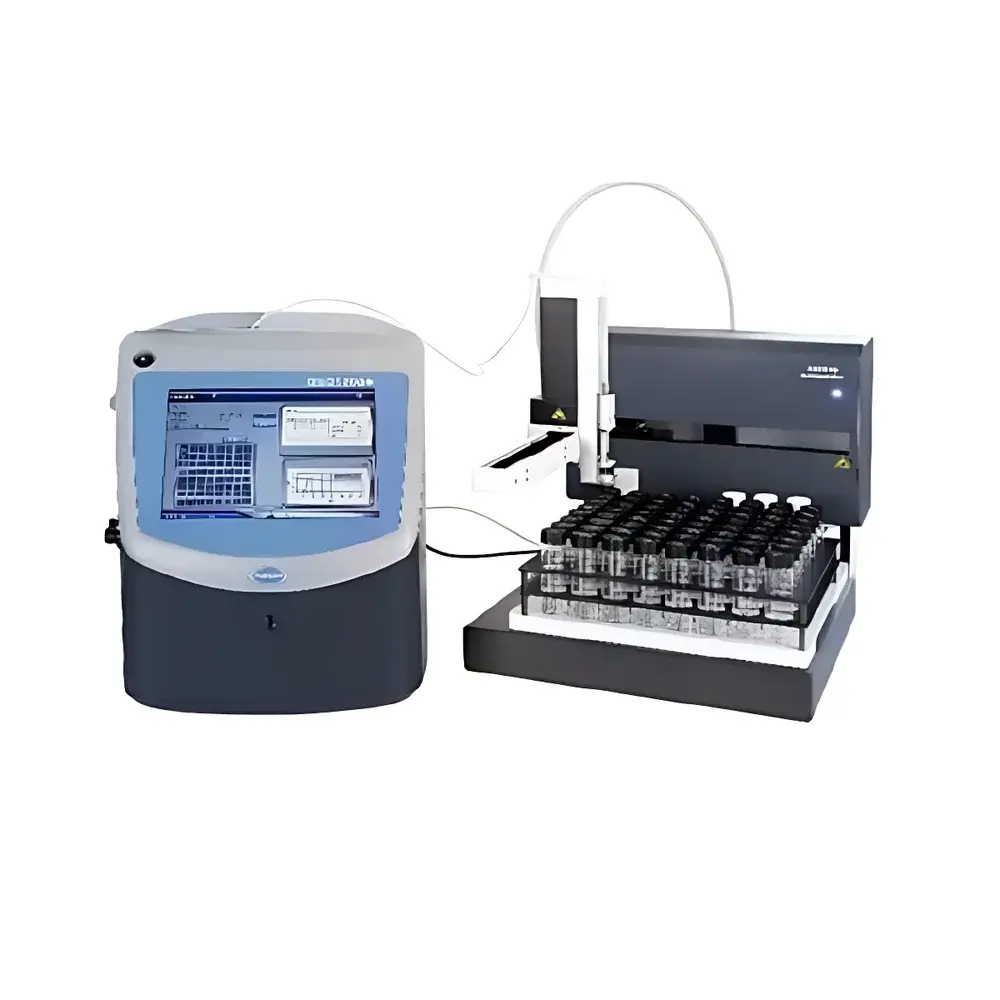
Hach QbD1200+ Laboratory Total Organic Carbon (TOC) Analyzer
| Brand | Hach |
|---|---|
| Origin | USA |
| Model | QbD1200+ |
| Oxidation Method | UV/Persulfate |
| Measurement Range | 0–100 ppm |
| Detection Limit | 3 ppb |
| Accuracy | ±3% |
| Precision (RSD) | <2% |
| Compliance | FDA 21 CFR Part 11, USP <643>, EP 2.2.44, JP 2.59, ISO 8245, ASTM D5903 |
| Operating System | Pre-installed Microsoft Windows 10 IoT Enterprise |
| Display | 10.4-inch capacitive touchscreen |
| Data Storage | 256 GB SSD |
| Sample Introduction | Manual or optional 64-position autosampler (40 mL vials) |
Overview
The Hach QbD1200+ Laboratory Total Organic Carbon (TOC) Analyzer is a high-performance, regulatory-compliant instrument engineered for precise quantification of total organic carbon in ultrapure water, pharmaceutical process streams, and environmental water matrices. It employs a dual-stage oxidation methodology—combining 185/254 nm low-pressure UV lamps with catalyzed sodium persulfate—to achieve complete mineralization of refractory organic compounds into CO₂. The liberated carbon dioxide is then measured via highly stable, non-dispersive infrared (NDIR) detection with temperature- and pressure-compensated signal processing. This principle ensures trace-level sensitivity, minimal memory effect, and robust performance across diverse sample matrices—including high-conductivity waters, saline samples, and low-carbon ultrapure water used in biopharmaceutical manufacturing and clean-in-place (CIP) validation.
Key Features
- UV/persulfate oxidation system with dynamic endpoint detection—monitors real-time CO₂ evolution kinetics to confirm complete oxidation and eliminate incomplete-reaction bias
- Integrated NDIR detector with dual-beam reference compensation, delivering sub-ppb detection capability (3 ppb LOD) and linear response from 0.4 ppb to 100 ppm TOC
- Automated system suitability testing (SST) preconfigured for USP <643>, EP 2.2.44, and JP 2.59—including automatic SDBS challenge, KHP calibration verification, and blank drift assessment
- Intelligent auto-ranging and on-board dilution capability: detects out-of-range samples and executes programmable 1:2 to 1:100 dilutions without manual intervention
- Three-tier user access control (Administrator, Supervisor, Operator) with full audit trail per FDA 21 CFR Part 11 requirements—including immutable timestamps, action logging, electronic signatures, and change history
- Self-diagnostic boot sequence verifying lamp intensity, reagent delivery pressure, detector stability, and fluidic integrity prior to analysis
- Durable construction: stainless-steel internal support frame, Φ3 mm corrosion-resistant flow paths, Peltier-cooled moisture trap upstream of the NDIR cell, and UV lamp rated for ≥8,760 hours cumulative operation
Sample Compatibility & Compliance
The QbD1200+ is validated for direct injection of aqueous samples with conductivity up to 5 mS/cm and total dissolved solids (TDS) ≤1,000 mg/L. It accommodates manual syringe injection or automated analysis via optional 64-position autosampler using standard 40 mL borosilicate TOC vials. The system meets stringent pharmacopeial requirements including USP <643>, EP 2.2.44, JP 2.59, IP 2.2.43, and ICH Q5A guidelines. Instrument qualification follows simplified IQ/OQ/PQ protocols aligned with ASTM E2500 and Annex 15, supporting GMP environments subject to routine regulatory inspection. All firmware, calibration routines, and report templates are version-controlled and digitally signed to ensure data integrity throughout the instrument lifecycle.
Software & Data Management
Running on Microsoft Windows 10 IoT Enterprise, the embedded software provides a validated, locked-down environment compliant with cybersecurity best practices for regulated laboratories. Data acquisition, processing, and reporting occur within a single integrated application featuring drag-and-drop method configuration, customizable report templates (PDF, CSV, XML), and secure export to network shares governed by Windows ACL policies. Raw chromatograms, SST logs, calibration curves, and audit trails are stored redundantly on the onboard 256 GB SSD with automatic daily backup scheduling. Electronic signatures are enforced for critical actions—including method modification, calibration acceptance, and report finalization—ensuring full traceability and accountability under GLP/GMP frameworks.
Applications
The QbD1200+ serves as a primary analytical platform in quality control laboratories across multiple regulated sectors. In pharmaceutical manufacturing, it supports routine monitoring of purified water (PW), water for injection (WFI), and clean steam condensate per USP/EP monographs; performs cleaning validation studies for equipment surfaces; and verifies TOC removal efficiency during purification system commissioning. In power generation, it monitors boiler feedwater and condensate return loops for organic fouling precursors. Environmental labs use it for compliance testing of drinking water, wastewater effluents, and groundwater remediation sites per EPA Method 415.3 and ISO 8245. Its low carryover (<0.5% from 500 ppb to blank) and rapid rinse cycle (<90 s) make it suitable for high-throughput QC environments requiring >60 samples per day.
FAQ
Does the QbD1200+ support both direct injection and acid-purge methods?
No—the QbD1200+ is designed exclusively for direct injection with UV/persulfate oxidation. It does not incorporate sparging or acidification modules.
Can third-party reagents be used with this analyzer?
Yes—while Hach-certified persulfate reagents are recommended for full regulatory compliance, the system accepts user-prepared or alternative vendor reagents provided they meet specified purity, concentration, and stability criteria outlined in the operator manual.
Is remote monitoring or integration with LIMS supported?
Yes—via OPC UA and HL7-compliant APIs, the QbD1200+ enables bidirectional data exchange with laboratory information management systems (LIMS) and enterprise MES platforms without compromising 21 CFR Part 11 integrity controls.
What is the typical maintenance interval for the UV lamp and NDIR detector?
The UV lamp requires replacement after 8,760 hours of cumulative operation (approximately one year at continuous use); the NDIR detector has no scheduled replacement interval and is verified during each SST cycle.
How is system contamination or carryover addressed during high-concentration sample analysis?
The instrument performs an automated post-run rinse sequence using ultra-pure water and nitrogen purge, followed by real-time blank verification—ensuring residual carbon is reduced to <3 ppb before initiating the next analysis.







