
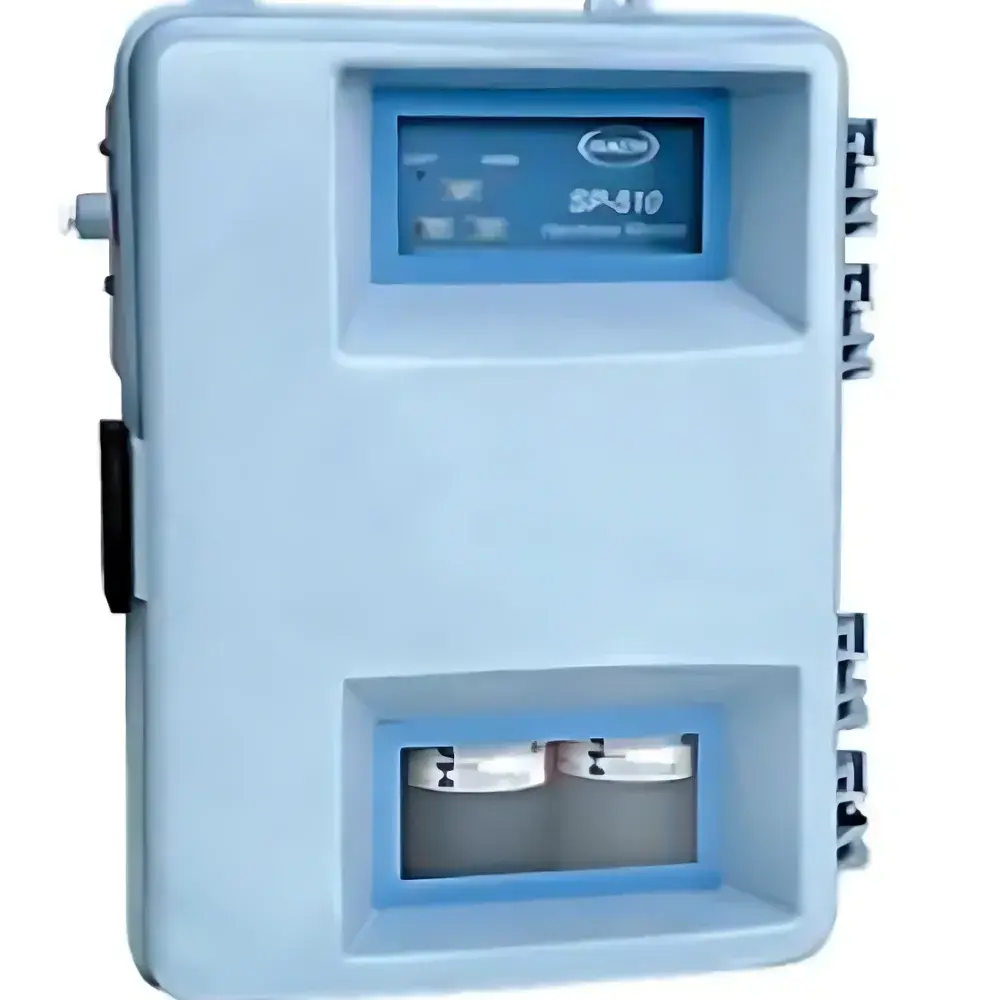
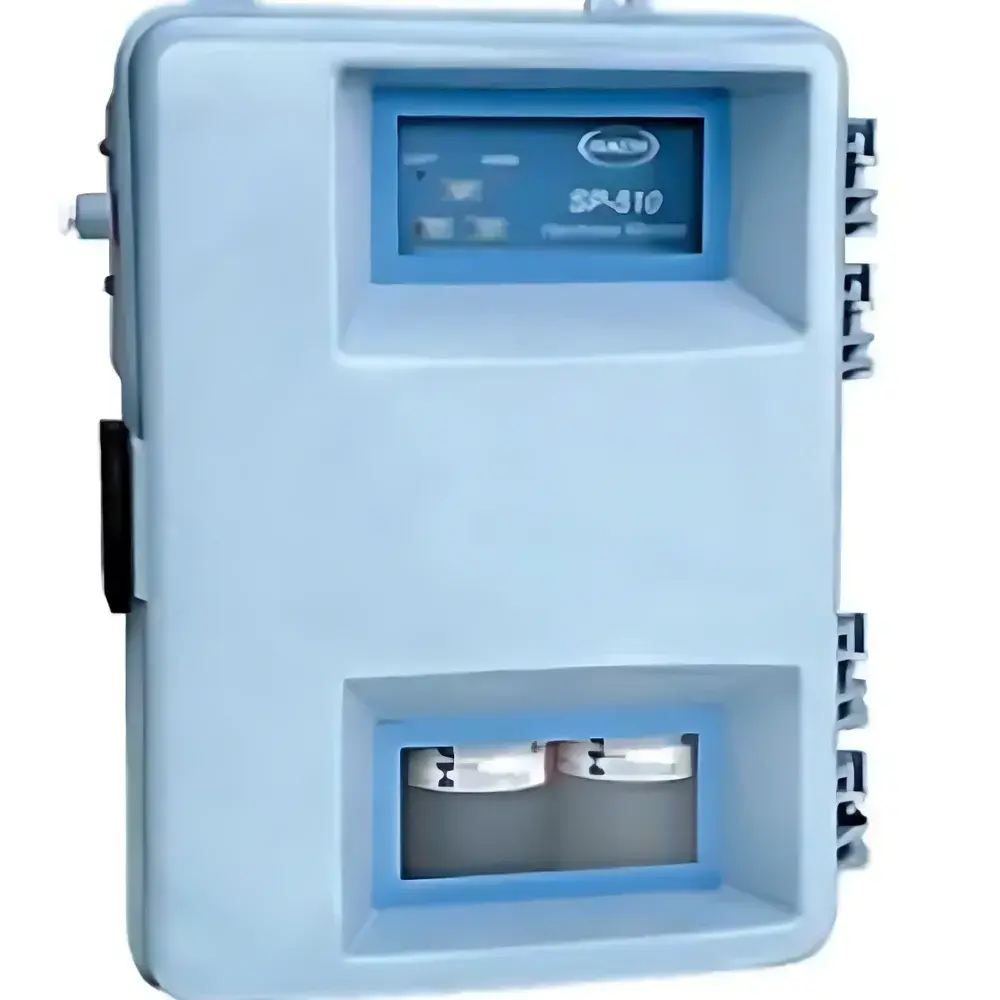
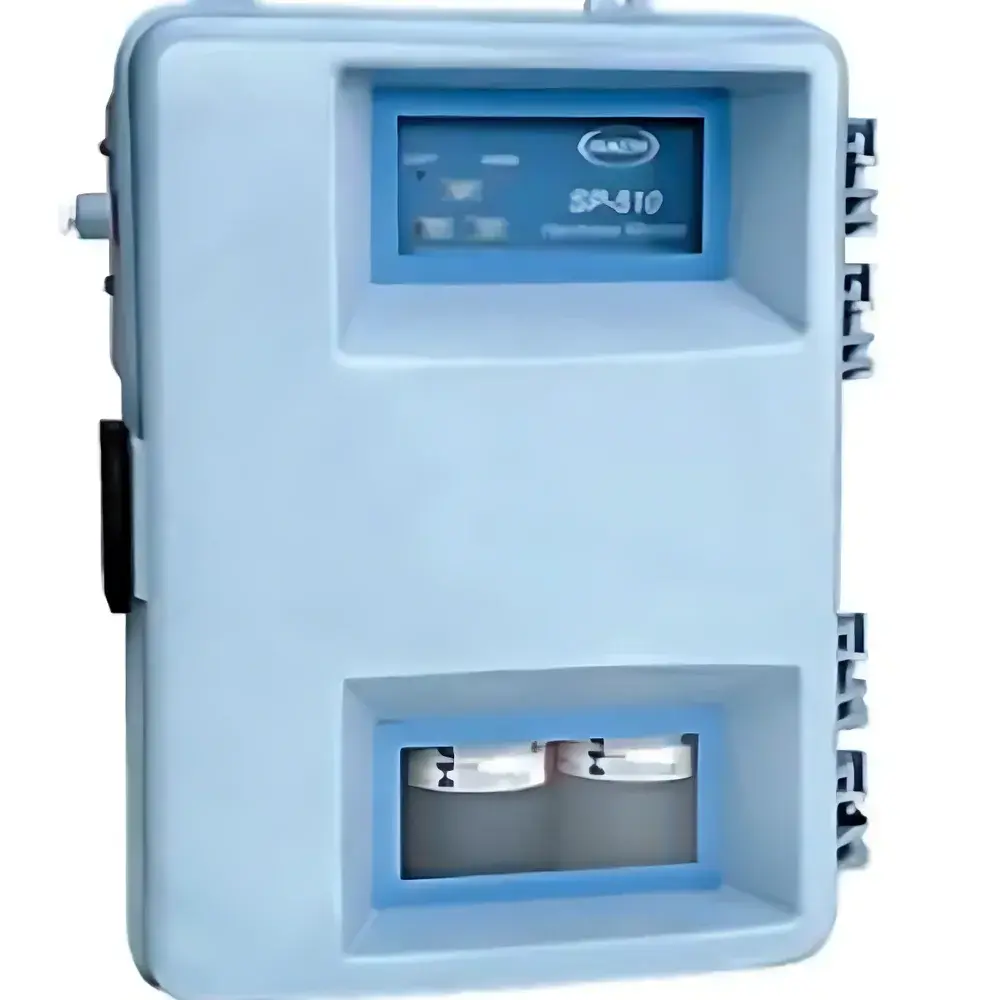
Hach SP510 Online Hardness Analyzer
| Brand | Hach |
|---|---|
| Origin | USA |
| Model | SP510 |
| Detection Principle | Colorimetric (EDTA Complexometric Titration) |
| Measurement Range | 0.3–100 mg/L as CaCO₃ |
| Accuracy | ±10% of setpoint (0.3–2 mg/L), ±4% of setpoint (5–100 mg/L) |
| Cycle Time | ~2 minutes per measurement |
| Alarm Output | 1 SPDT relay |
| Power Supply | 115/230 VAC, 50/60 Hz |
| Certifications | UL, CSA, CE |
| Reagent Consumption | Up to 2 months per reagent pack |
| Maintenance Interval | Pump tube replacement every 6 months |
| Calibration | Automatic on-demand and scheduled calibration |
Overview
The Hach SP510 Online Hardness Analyzer is an industrial-grade, colorimetric water quality analyzer engineered for continuous, unattended monitoring of total hardness—expressed as calcium carbonate (CaCO₃)—in low-hardness process and potable water streams. It operates on the standardized EDTA complexometric titration principle, where hardness-causing divalent cations (primarily Ca²⁺ and Mg²⁺) react stoichiometrically with ethylenediaminetetraacetic acid under controlled pH and temperature conditions. A photometric endpoint detection system measures absorbance change at 520 nm following reaction with a chromogenic indicator (e.g., Eriochrome Black T), enabling precise quantification across a validated range of 0.3 to 100 mg/L as CaCO₃. Designed for integration into closed-loop softening control systems—including ion exchange, lime softening, or membrane pretreatment—this analyzer delivers repeatable, traceable measurements with minimal operator intervention.
Key Features
- Real-time, fully automated hardness monitoring with a typical cycle time of approximately 120 seconds—enabling rapid response to feedwater excursions.
- Eight user-selectable alarm thresholds (0.3, 1, 2, 5, 10, 20, 50, and 100 mg/L as CaCO₃) configurable via front-panel interface or remote Modbus RTU communication.
- Integrated automatic calibration capability using factory-prepared standard solutions; supports both single-point verification and multi-point validation protocols.
- Robust fluidic architecture with peristaltic pumping and corrosion-resistant wetted materials (e.g., PTFE, PVDF, and borosilicate glass), ensuring long-term stability in chlorinated or low-pH municipal and industrial influents.
- Low-maintenance design: reagent packs support up to 60 days of continuous operation; only pump tubing requires scheduled replacement every 6 months—no optical alignment or electrode servicing needed.
- Compliance-ready architecture: firmware logs all measurement events, calibration actions, alarm triggers, and maintenance timestamps with non-volatile memory retention for GLP/GMP-aligned audit trails.
Sample Compatibility & Compliance
The SP510 is optimized for clear, low-turbidity (<5 NTU), non-oily water samples with chloride concentrations <500 mg/L and suspended solids <10 mg/L. It is routinely deployed in boiler feedwater monitoring, reverse osmosis (RO) pretreatment, drinking water distribution networks, and cooling tower make-up applications. The analyzer meets UL 61010-1 (Safety Requirements for Electrical Equipment for Measurement, Control, and Laboratory Use), CSA C22.2 No. 61010-1, and EU Directive 2014/30/EU (EMC) and 2014/35/EU (LVD). While not intrinsically certified for hazardous locations, it may be installed in Class I, Division 2 environments when housed in appropriate enclosures. Data integrity conforms to principles aligned with FDA 21 CFR Part 11 for electronic records, supporting secure user authentication and audit-log export.
Software & Data Management
The SP510 features embedded firmware with local LCD display and tactile keypad navigation. All operational parameters—including alarm setpoints, calibration schedules, and maintenance counters—are stored in non-volatile memory. Analog 4–20 mA output provides direct interface with DCS/PLC systems, while optional RS-485 Modbus RTU enables bidirectional communication for remote configuration, real-time data polling, and event-driven notifications. Hach’s System Manager software (Windows-based, optional) supports historical trend visualization, report generation (PDF/CSV), and batch export of calibration logs for regulatory submission. Firmware updates are performed via USB flash drive—no network connectivity required—to maintain air-gapped security in critical infrastructure settings.
Applications
- Automated regeneration triggering for sodium-cycle cation exchange softeners based on effluent hardness breakthrough.
- Performance verification of nanofiltration or low-pressure RO membranes in hardness-sensitive applications (e.g., pharmaceutical water for injection prep).
- Regulatory compliance monitoring for EPA Method 130.1 or ISO 6059 equivalents in municipal water treatment plants.
- Early-warning detection of resin exhaustion or valve leakage in high-purity water loops serving semiconductor fab tools or power plant condensate systems.
- Optimization of antiscalant dosing in industrial cooling circuits by correlating hardness trends with conductivity and pH profiles.
FAQ
Does the SP510 measure calcium hardness separately from total hardness?
No—the SP510 reports total hardness exclusively as CaCO₃ equivalent via EDTA titration. Calcium-specific measurement requires ion-selective electrode (ISE) or ICP-OES analysis.
Can the analyzer operate in wastewater with high iron or manganese content?
Elevated Fe²⁺/Mn²⁺ (>0.5 mg/L) may interfere with colorimetric endpoint detection; pre-filtration and oxidation/filtration pretreatment are recommended for such matrices.
Is remote firmware update supported over Ethernet or Wi-Fi?
No—firmware updates require physical USB access to ensure deterministic version control and eliminate cybersecurity exposure in OT environments.
What is the minimum sample flow rate required for reliable aspiration?
The system draws sample at ~30 mL/min via integrated peristaltic pump; inlet pressure must remain between 0–60 psi, with no backpressure tolerance above 5 psi.
How does the SP510 handle temperature fluctuations in outdoor installations?
It includes internal temperature compensation for photometric readings and maintains specified accuracy across 5–40°C ambient; external thermal shielding or enclosure heating is advised below 5°C.
Related Products







