
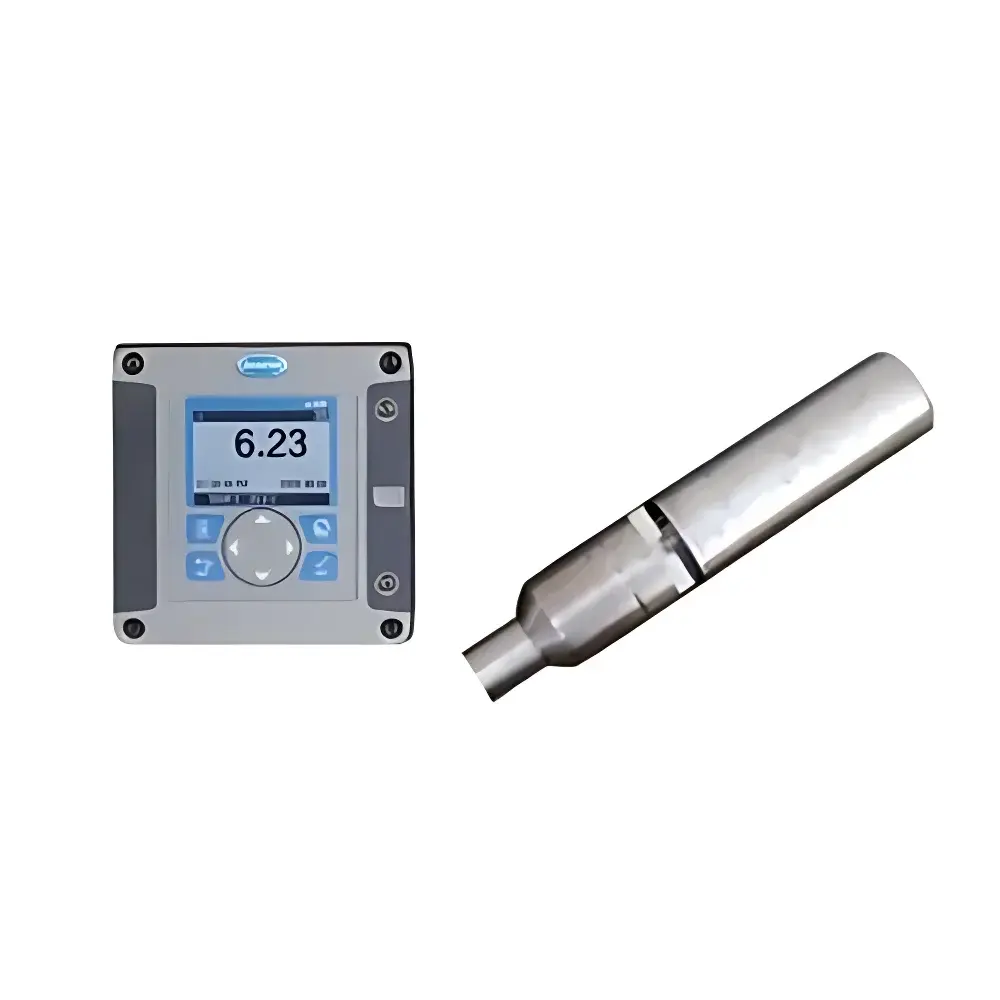
HACH UVAS eco sc UV Absorption Online Organic Matter Analyzer
| Brand | HACH |
|---|---|
| Origin | USA |
| Model | UVAS eco sc |
| Measurement Principle | UV Absorption at 254 nm |
| Output Parameter | Specific UV Absorbance (SAC₂₅₄) |
| Optical Design | Dual-beam |
| Probe Installation Options | Submersible or Flow-through |
| Automatic Cleaning | Integrated wiper system |
| Housing Material | Stainless steel (316L) |
| Compliance | Designed for ISO 7027-compliant turbidity compensation, supports EPA Method 415.3 principles, compatible with GLP/GMP data integrity workflows |
Overview
The HACH UVAS eco sc UV Absorption Online Organic Matter Analyzer is an industrial-grade, continuous-monitoring instrument engineered for the quantitative assessment of dissolved organic carbon (DOC)-related compounds in water matrices via ultraviolet absorbance spectroscopy. Operating at a fixed wavelength of 254 nm—where aromatic and conjugated organic structures exhibit strong absorption—the analyzer delivers SAC₂₅₄ (Specific Absorbance at 254 nm), a well-established surrogate parameter correlated with natural organic matter (NOM), humic substances, and anthropogenic organic contaminants. Unlike wet-chemistry methods requiring reagents or digestion, the UVAS eco sc employs a non-invasive, reagent-free optical measurement principle grounded in the Beer–Lambert law. Its dual-beam photometric architecture simultaneously measures sample and reference light paths, actively compensating for signal drift caused by lamp aging, voltage fluctuations, suspended solids-induced scattering, and fouling-related attenuation—ensuring long-term baseline stability without manual recalibration. The system comprises a ruggedized stainless-steel (316L) sensor probe and a dedicated controller unit, supporting both submersible deployment in open channels or tanks and pressurized flow-cell integration in piped distribution or treatment systems.
Key Features
- Dual-beam optical design with real-time turbidity compensation, minimizing interference from particulate matter and enabling reliable SAC₂₅₄ quantification in raw, clarified, and effluent waters.
- Integrated mechanical wiper system with programmable cleaning cycles, maintaining optical window clarity and reducing scheduled maintenance intervals to quarterly or semi-annual intervals under typical municipal conditions.
- Low-power electronics architecture compliant with 24 V DC operation, suitable for solar-powered remote monitoring stations and energy-constrained infrastructure.
- IP68-rated submersible probe with titanium-coated quartz optical windows, certified for continuous immersion up to 10 m depth and resistant to biofouling and chemical corrosion in chlorinated, saline, or sulfide-rich environments.
- Controller featuring a 5.7-inch resistive touchscreen interface, onboard data logging (≥1 year at 1-min resolution), and configurable alarm thresholds with relay outputs for process interlock integration.
- Modbus RTU/ASCII and optional Modbus TCP communication protocols for seamless integration into SCADA, DCS, and LIMS platforms—supporting audit-trail-enabled data export per FDA 21 CFR Part 11 requirements when paired with validated software configurations.
Sample Compatibility & Compliance
The UVAS eco sc is validated for use across diverse aqueous matrices including potable water, surface water (rivers, lakes, reservoirs), wastewater influent/effluent, and industrial process streams with turbidity ≤ 400 NTU and suspended solids ≤ 150 mg/L. It meets functional equivalency with ASTM D5907 (for DOC estimation), aligns with the theoretical basis of EPA Method 415.3 (UV Absorbance as Indicator of Disinfection Byproduct Precursors), and supports compliance reporting under EU Drinking Water Directive (2020/2184) Annex I parameters related to organic precursors. Its optical compensation methodology adheres to the measurement uncertainty framework outlined in ISO/IEC 17025:2017 for in-situ instrumentation, and its firmware architecture allows configuration for GLP-aligned electronic records—including user authentication, change logs, and time-stamped calibration verification events.
Software & Data Management
Data acquisition and configuration are managed via the HACH Instrument Manager (HIM) desktop application or embedded web interface (HTTP/HTTPS). All measurements are timestamped with microsecond precision and stored with metadata including probe temperature, lamp intensity, cleaning cycle status, and diagnostic flags. Raw absorbance values (A₂₅₄), pathlength-corrected absorbance, and calculated SAC₂₅₄ (L/m·mg C) are logged concurrently. Export formats include CSV and XML, with optional encryption and digital signature support for regulatory submissions. When deployed in validated environments, the system supports role-based access control, electronic signatures, and full audit trails—meeting foundational expectations for data integrity under FDA 21 CFR Part 11 and EU Annex 11 when operated within a documented quality management system.
Applications
- Drinking water treatment: Real-time tracking of NOM breakthrough post-coagulation, optimization of disinfectant dosing to minimize THM/HAA formation, and early detection of watershed contamination events.
- Municipal wastewater: Monitoring of biodegradable organic load in influent for aeration basin control, evaluation of secondary treatment efficiency via SAC₂₅₄ reduction ratios, and compliance verification for discharge permits.
- Industrial pretreatment: Continuous assessment of organic loading from food processing, pharmaceutical, or textile effluents prior to municipal sewer entry.
- Environmental monitoring: Long-term trend analysis of humic substance dynamics in reservoirs and rivers, supporting climate-resilience modeling and nutrient cycling studies.
- Recycled water schemes: Verification of advanced oxidation or membrane filtration performance through persistent organic signature tracking.
FAQ
What does SAC₂₅₄ represent, and how is it used in practice?
SAC₂₅₄ (Specific UV Absorbance at 254 nm) normalizes UV absorbance to both sample pathlength and dissolved organic carbon concentration. It serves as a robust indicator of aromaticity and molecular weight distribution of NOM—correlating strongly with disinfection byproduct formation potential and coagulant demand.
Can the UVAS eco sc replace TOC analyzers?
No—it provides a rapid, low-cost surrogate measurement—not a direct TOC quantification. However, site-specific calibration models can establish empirical correlations between SAC₂₅₄ and TOC for trending and process control where absolute accuracy is secondary to responsiveness.
Is periodic calibration required?
Yes—zero calibration using deionized water or air is recommended weekly; span verification with a stable NIST-traceable UV-absorbing standard (e.g., potassium hydrogen phthalate solution) is advised monthly or after major maintenance.
How does the system handle high-turbidity samples?
The dual-beam design inherently corrects for broadband scattering effects; however, samples exceeding 400 NTU may require inline filtration or flow-cell conditioning to prevent signal saturation and wiper inefficiency.
What cybersecurity features are included?
Firmware supports TLS 1.2 encrypted web access, password complexity enforcement, session timeout, and disabled default credentials—aligned with ISA/IEC 62443-3-3 SL1 requirements for Level 1 cyber-physical devices.






