
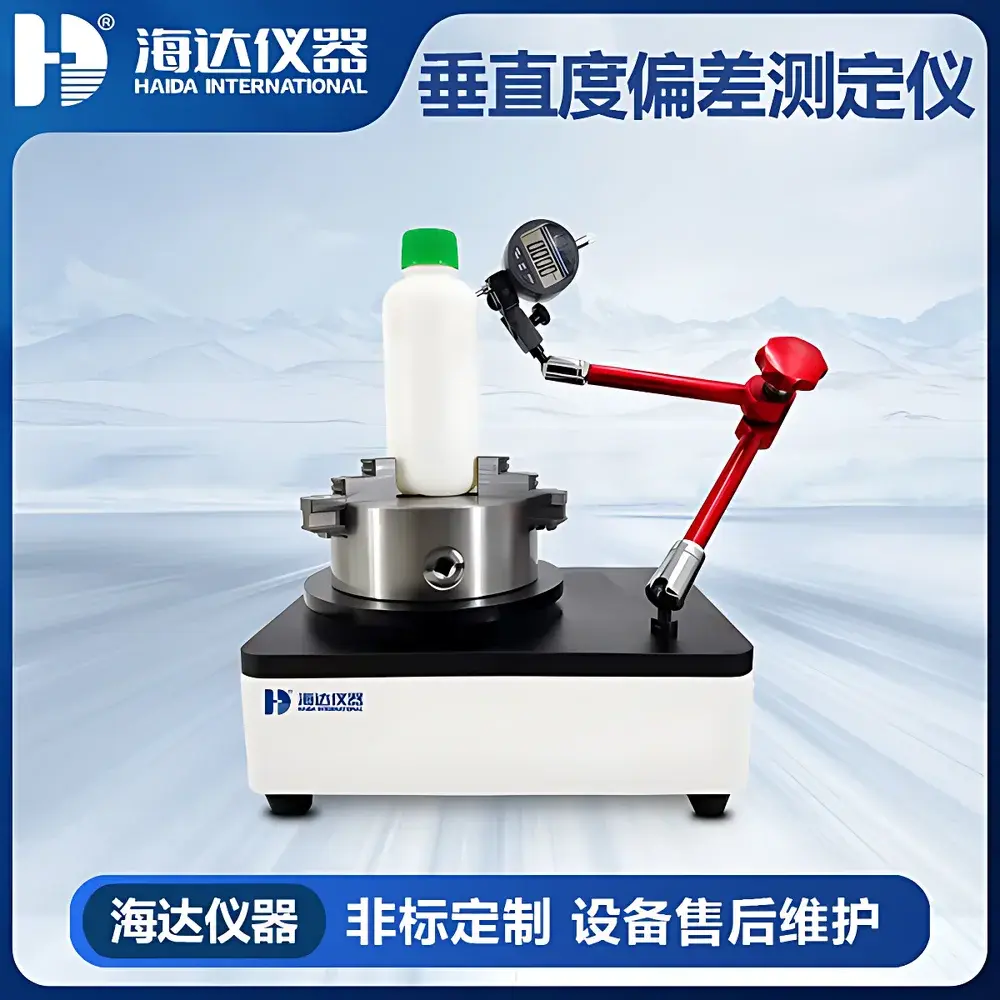
HAIDA HD-5078 Verticality Deviation Tester
| Brand | HAIDA INTERNATIONAL |
|---|---|
| Origin | Guangdong, China |
| Manufacturer Type | Direct Manufacturer |
| Product Origin | Domestic (China) |
| Model | HAIDA HD-5078 Verticality Deviation Tester |
| Pricing | Available Upon Request |
| Sample Diameter Range | 3–55 mm (4-jaw chuck, standard grip), 55–145 mm (reverse grip) |
| Chuck Type | Selectable 3-jaw or 4-jaw self-centering chuck |
| Measurement Range | 0–12.7 mm |
| Resolution | 0.001 mm |
| Indication Error | ±0.005 mm |
| Measurement Uncertainty | ≤ 0.05 mm (5 µm) |
| Adjustable Height Range | 5–400 mm |
| Positioning Mechanism | Universal adjustable bracket with multi-axis freedom |
| Data Output | USB/RS232 interface for real-time export to Excel or Word (optional) |
| Dimensions (L×W×H) | 330 × 240 × 240 mm |
| Net Weight | 20 kg |
Overview
The HAIDA HD-5078 Verticality Deviation Tester is a precision mechanical metrology instrument engineered for the quantitative assessment of vertical axis deviation—commonly referred to as “bottle uprightness” or “axial tilt”—in cylindrical pharmaceutical and consumer packaging containers. It operates on the principle of rotational contact measurement: a specimen is rigidly clamped at its base on a horizontal rotating platform; a calibrated dial indicator (or digital indicator, optional) is positioned to make axial contact with the container’s upper rim or neck. As the turntable rotates through 360°, the indicator records peak positive and negative deviations from the ideal vertical reference axis. The verticality deviation is calculated as half the difference between the maximum and minimum readings (i.e., Rmax – Rmin/2), conforming to standardized geometric tolerance evaluation methods defined in ISO 1101 and ASME Y14.5 for cylindricity-related orientation control.
Key Features
- High-precision 4-jaw self-centering chuck with concentricity ≤ 0.01 mm, ensuring repeatable radial alignment across diverse bottle geometries;
- Modular gripping system: Standard forward-grip range (3–55 mm) and reverse-grip extension (55–145 mm), supporting both narrow-neck vials and wide-body PET bottles;
- Multi-degree-of-freedom universal bracket enabling fine-tuned vertical, lateral, and angular positioning of the measuring probe relative to the specimen axis;
- Resolution of 0.001 mm and indication error within ±0.005 mm, traceable to national metrological standards;
- Adjustable height column accommodating specimens from 5 mm (e.g., small ampoules) to 400 mm (e.g., 2 L beverage bottles);
- Optional digital data acquisition module with USB/RS232 output for automated logging, statistical process control (SPC), and compliance-ready reporting;
- Robust cast-aluminum frame and hardened steel components ensure long-term dimensional stability under routine laboratory or QC floor use.
Sample Compatibility & Compliance
The HD-5078 is validated for use with glass, PET, HDPE, and PP containers—including ampoules, infusion bottles, cosmetic jars, and carbonated beverage bottles—regardless of wall thickness or shoulder geometry. Its mechanical design satisfies dimensional inspection requirements specified in multiple regulatory and industry standards: QB/T 2357 (carbonated soft drink bottles), QB/T 1868 (PET bottles), YY 0056 (pharmaceutical glass containers), YBB 00012012 and YBB 00332002 (Chinese Pharmacopoeia packaging monographs), GB/T 8452 (glass container tolerances), and GB 2637 (ampoule specifications). While not an electronic certification device, its measurement methodology supports GLP-compliant documentation workflows when paired with audit-trail-enabled software (e.g., HAIDA DataLink v3.2, optional).
Software & Data Management
The optional HAIDA DataLink software provides seamless integration with Windows-based laboratory systems. It captures real-time indicator readings during rotation, auto-calculates verticality deviation per ISO 1101 conventions, and stores metadata including operator ID, timestamp, sample ID, and environmental conditions (if external sensors are connected). Export formats include .CSV, Excel (.xlsx), and Word (.docx) templates pre-formatted for QA review and regulatory submission. All data files support version-controlled archiving and meet baseline requirements for FDA 21 CFR Part 11 compliance when deployed with user authentication, electronic signatures, and change history logging (configured separately).
Applications
- Pharmaceutical quality control: Verification of ampoule and vial verticality prior to lyophilization or filling, minimizing capping misalignment and seal integrity risks;
- Packaging R&D: Benchmarking mold performance and blow-stretch parameters by correlating verticality deviation with parison temperature and cooling rate;
- Contract manufacturing audits: Objective pass/fail assessment against client-specified verticality limits (e.g., ≤ 0.3 mm for parenteral dosage forms);
- Regulatory submissions: Generating reproducible test reports referenced in DMF filings or CMC sections of NDAs;
- Supplier qualification: Screening incoming container batches for conformance to ASTM D7329 (Standard Practice for Evaluation of Packaging Component Geometry).
FAQ
What standards does the HD-5078 comply with?
It supports testing protocols aligned with QB/T 2357, QB/T 1868, YY 0056, YBB series packaging monographs, GB/T 8452, and GB 2637.
Can the HD-5078 measure non-cylindrical containers?
No—it is optimized for rotationally symmetric specimens with stable base geometry. Irregular shapes require alternative methods such as coordinate measuring machines (CMMs).
Is calibration certification included?
A factory calibration report with uncertainty budget is provided; ISO/IEC 17025-accredited calibration services are available upon request.
Does the instrument require external power?
No—mechanical operation only. Optional digital readout modules operate on 100–240 VAC, 50/60 Hz.
How is repeatability verified?
Per ISO 5725-2, repeatability is assessed via ≥10 repeated measurements on a certified reference cylinder; typical coefficient of variation (CV) is <0.8% at 0.5 mm deviation level.



