
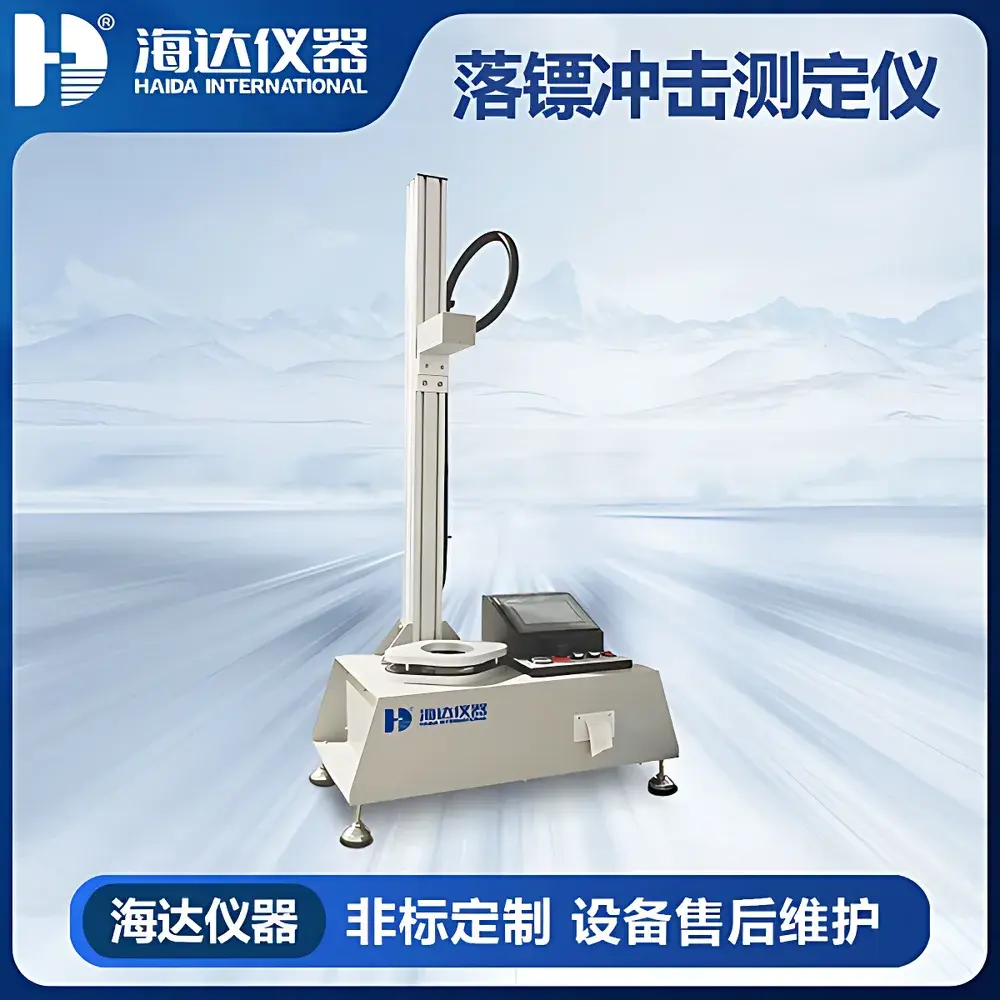
HAIDA HD-5085 Film Dart Impact Tester
| Brand | HAIDA INTERNATIONAL |
|---|---|
| Origin | Guangdong, China |
| Manufacturer Type | Direct Manufacturer |
| Product Origin | Domestic (China) |
| Model | HAIDA HD-5085 Film Dart Impact Tester |
| Pricing | Upon Request |
| Test Methods | ASTM D1709, ISO 7765-1:1988, GB/T 9639.1–2008, JIS K7124-1 |
| Drop Height | A-method 0.66 ± 0.01 m / B-method 1.50 ± 0.01 m |
| Dart Tip Diameter | A-method 38 ± 1 mm / B-method 50 ± 1 mm |
| Mass Range | A-method 50–2000 g, B-method 300–2000 g |
| Mass Resolution | 0.1 g |
| Pneumatic Pressure Requirement | 0.6 MPa |
| Specimen Size | >150 mm × 150 mm |
| Interface | RS232 serial port, built-in thermal printer |
Overview
The HAIDA HD-5085 Film Dart Impact Tester is a precision-engineered instrument designed to quantify the impact resistance of flexible packaging materials—including plastic films, laminates, thin sheets, and coated substrates—using standardized free-fall dart impact methodology. It operates on the fundamental principle of gravitational energy transfer: a calibrated dart is released from a fixed height onto a horizontally clamped specimen; the critical mass required to produce 50% failure probability (Mf) is determined through statistically robust sequential testing (either staircase or up-and-down method). This value, expressed in grams, is directly convertible to impact energy (in joules) via E = mgh, where *g* is gravitational acceleration and *h* is the precisely controlled drop height. The HD-5085 supports both Method A (38 mm tip, 0.66 m height) and Method B (50 mm tip, 1.50 m height), aligning with internationally harmonized test protocols essential for regulatory compliance and inter-laboratory comparability.
Key Features
- Electromagnetic dart release mechanism ensures consistent, zero-delay detachment—eliminating manual trigger variability and enhancing measurement reproducibility.
- Pneumatically actuated clamping system secures specimens ≥150 mm × 150 mm with uniform pressure distribution, minimizing edge effects and slippage during impact.
- Intuitive 7-inch color touchscreen interface with menu-driven navigation enables rapid configuration of test mode (A/B), mass increment, pass/fail criteria, and sample count—no programming expertise required.
- Dual activation options: manual button or footswitch—optimizing operator ergonomics and workflow integration in high-throughput QC environments.
- Integrated LED observation lamp illuminates the test zone for real-time visual confirmation of specimen alignment and post-impact damage assessment.
- Onboard thermal printer provides immediate hardcopy output of test logs, including date/time stamp, method selected, mass steps, failure counts, and calculated Mf.
Sample Compatibility & Compliance
The HD-5085 is validated for use with polyethylene (LDPE, HDPE), polypropylene (BOPP, CPP), polyester (PET), nylon (PA), aluminum-plastic laminates, metallized films, coated papers, and thin polymer-coated metal foils. Its mechanical design accommodates variable thicknesses (typically 12–250 µm) without requiring hardware modification. The instrument fully complies with the dimensional, procedural, and reporting requirements of ASTM D1709 (Types A and B), ISO 7765-1:1988, GB/T 9639.1–2008, and JIS K7124-1. All critical parameters—including drop height tolerance (±0.01 m), dart tip geometry (diameter and edge radius per standard), and mass calibration traceability—are verified against NIST-traceable reference weights and laser-aligned height gauges during factory certification.
Software & Data Management
The optional PC-based HAIDA Impact Analysis Suite (v3.2+) supports bidirectional RS232 communication for automated data acquisition, statistical analysis (probit regression for Mf calculation), and graphical visualization (cumulative failure curves, histogram distributions). Raw datasets are exportable in CSV and XML formats for integration into LIMS or enterprise QA systems. Audit trail functionality records user ID, timestamp, parameter changes, and result modifications—supporting adherence to GLP and FDA 21 CFR Part 11 requirements when configured with electronic signatures and role-based access control. Calibration logs, maintenance history, and instrument verification reports are stored within the software’s secure database.
Applications
This tester serves as a cornerstone tool in packaging R&D laboratories evaluating seal integrity under drop conditions, optimizing resin formulations for toughness enhancement, and validating shelf-life stability of pouches and sachets. In food and pharmaceutical manufacturing, it supports packaging validation per ICH Q5C and USP <1207> guidelines on container closure integrity. Quality assurance teams deploy the HD-5085 for incoming raw material inspection, in-process lot release testing, and supplier qualification audits. Academic institutions utilize it for polymer physics education—demonstrating energy absorption mechanisms, strain-rate dependence, and ductile-to-brittle transition behavior in thermoplastic films.
FAQ
What standards does the HD-5085 fully support?
ASTM D1709 (Types A and B), ISO 7765-1:1988, GB/T 9639.1–2008, and JIS K7124-1—covering all mechanical, procedural, and reporting requirements.
Is calibration certification included with shipment?
Yes—each unit ships with a factory-issued calibration certificate traceable to national metrology institutes, covering height, mass, and pneumatic pressure subsystems.
Can the instrument be integrated into an existing laboratory network?
Yes—via RS232 interface with optional USB-to-serial adapter; compatible with Windows-based LIMS platforms using standard SCPI command syntax.
What maintenance is required for long-term accuracy?
Quarterly verification of drop height alignment and annual recalibration of the mass loading system using certified weights; pneumatic filter replacement every 6 months under continuous operation.
Does the system support GLP-compliant data archiving?
When used with the full HAIDA Impact Analysis Suite and enabled audit trail settings, it meets core ALCOA+ principles (Attributable, Legible, Contemporaneous, Original, Accurate) and supports 21 CFR Part 11 compliance.



