
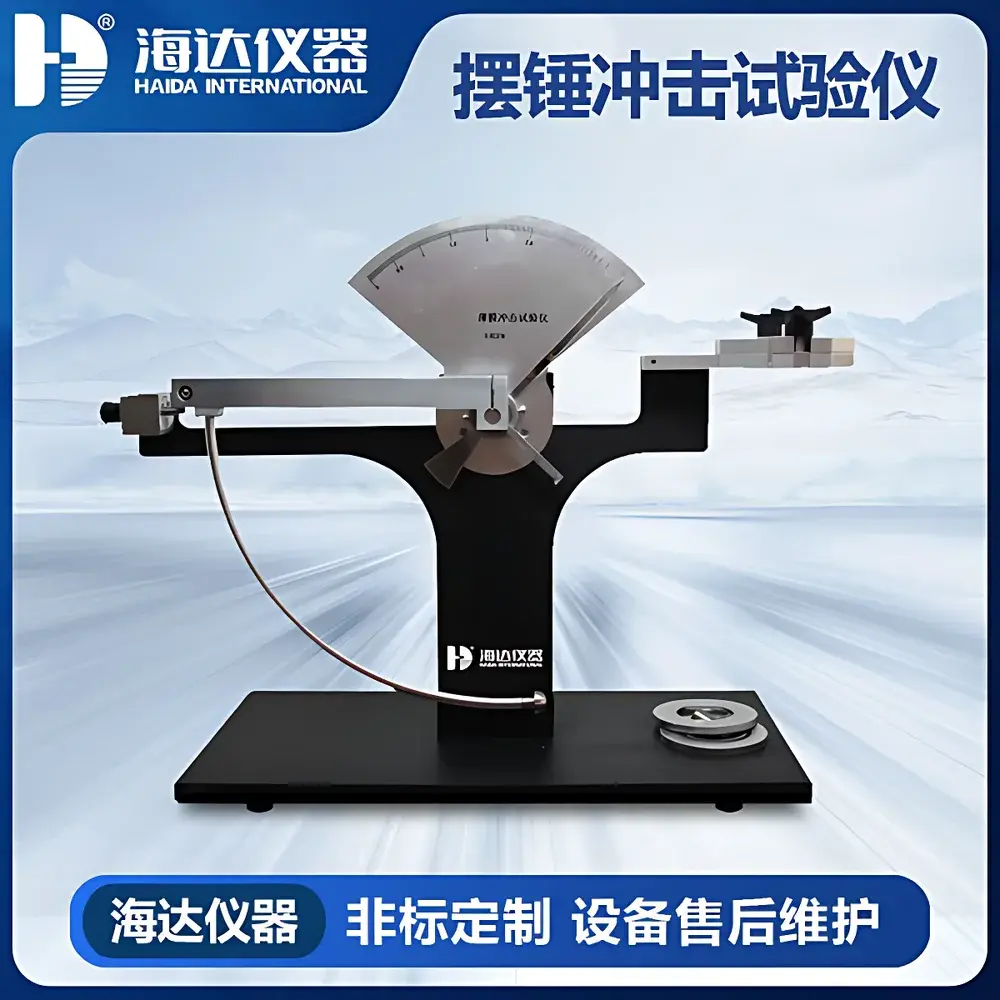
HAIDA HD-5086 Pendulum Impact Tester for Thin Films
| Brand | HAIDA INTERNATIONAL |
|---|---|
| Origin | Guangdong, China |
| Manufacturer Type | Direct Manufacturer |
| Model | HAIDA HD-5086 Pendulum Impact Tester for Thin Films |
| Impact Energy Range | 3 J |
| Scale Division | 0.01 J |
| Pendulum Radius | R280 mm |
| Release Angle | 90° |
| Impact Velocity | 2.5 m/s |
| Impact Tip Diameter | Φ12.7 mm |
| Clamp Aperture Options | Φ60 mm & Φ89 mm |
| Specimen Size | 100 × 100 mm |
| Dimensions (W×D×H) | 780 × 250 × 600 mm |
| Net Weight | 35 kg |
| Compliant Standard | GB/T 8809 |
Overview
The HAIDA HD-5086 Pendulum Impact Tester for Thin Films is a precision-engineered mechanical testing instrument designed to quantify the impact resistance of flexible sheet materials under controlled pendulum-driven loading conditions. Based on the principle of gravitational potential energy conversion—where a calibrated pendulum arm of fixed mass and radius is released from a defined angular position (90°) to deliver a reproducible kinetic impulse—the system measures the energy absorbed during specimen fracture. This method conforms strictly to the physical mechanics of Charpy-type impact testing adapted for low-thickness, high-flexibility substrates. Unlike drop-weight or instrumented impact systems, the HD-5086 employs a non-instrumented, analog energy-loss methodology: the difference between initial potential energy and residual swing energy—read via a calibrated angular scale—is directly reported as impact energy (in joules). Its design prioritizes metrological stability over high-speed data acquisition, making it suitable for routine QC laboratories where traceable, operator-independent pass/fail assessments are required per standardized protocols.
Key Features
- Fixed-radius pendulum mechanism (R280 mm) ensuring consistent moment arm and impact geometry across all tests.
- Dual-clamp configuration supporting both Φ60 mm and Φ89 mm aperture fixtures, enabling compliance with variant specimen constraint requirements in GB/T 8809.
- Interchangeable hemispherical impact tips (standard Φ12.7 mm; optional Φ25.4 mm) to accommodate differing thickness-to-stiffness ratios across polymer films, metallized laminates, and coated papers.
- Mechanically damped base frame and rigid cast-iron construction minimize vibration transmission and ensure repeatable energy transfer during impact event.
- High-resolution angular scale (0.01 J resolution) referenced to theoretical energy calibration curves derived from pendulum mass, radius, and release angle—fully traceable to SI units.
- No electrical power or software dependency: fully manual operation reduces maintenance overhead and eliminates firmware-related calibration drift.
Sample Compatibility & Compliance
The HD-5086 is validated for use with specimens ≤ 1 mm in thickness and ≥ 100 × 100 mm in planar dimension. It accommodates polymeric films (e.g., PE, PP, PET, nylon), metallized substrates (aluminized PET, foil-laminated composites), rubberized sheets, and fibrous packaging media including coated paperboard (e.g., aluminum-coated cigarette packaging, Tetra Pak®-type laminates). All testing procedures adhere explicitly to GB/T 8809–2015 “Plastics—Film and Sheet—Determination of Pendulum Impact Resistance”, which defines specimen conditioning (23 °C/50% RH, 4 h minimum), clamping force application, and energy calculation methodology. While GB/T 8809 is the primary reference, the instrument’s mechanical architecture is compatible with comparative assessments aligned with ISO 7765-1 (plastic films), ASTM D1709 (film impact by free-falling dart), and TAPPI T 801 (paperboard impact resistance), provided specimen geometry and support conditions are adjusted accordingly.
Software & Data Management
The HD-5086 operates as a standalone mechanical instrument without embedded microprocessors or digital output interfaces. Data recording is performed manually using the integrated angular scale and documented in laboratory notebooks or LIMS-compatible spreadsheets. For regulated environments requiring audit trails, users may integrate test records into electronic quality management systems (eQMS) compliant with 21 CFR Part 11 through external documentation workflows—e.g., scanned calibration certificates, signed test logs, and image-captured scale readings. Annual verification against certified reference pendulums (traceable to NIM or equivalent national metrology institutes) is recommended to maintain measurement uncertainty below ±1.5% (k=2) per ISO/IEC 17025 guidelines.
Applications
- Quality control of food and pharmaceutical packaging films—verifying seal integrity and pouch drop performance prior to sterilization or filling.
- Evaluation of barrier layer durability in multi-layer laminates subjected to transport-induced mechanical stress.
- Comparative assessment of aging effects (e.g., UV exposure, thermal cycling) on film toughness retention.
- Supplier qualification testing for metallized papers used in premium consumer packaging where embrittlement compromises opening functionality.
- Teaching laboratories demonstrating fundamental principles of impact energy absorption, plastic deformation, and fracture initiation in viscoelastic thin sections.
FAQ
Is the HD-5086 compliant with international standards beyond GB/T 8809?
Yes—while optimized for GB/T 8809, its mechanical parameters align with the test boundary conditions specified in ISO 7765-1 and ASTM D1709 when specimen dimensions and support configurations are adapted per clause requirements.
Can the instrument be recalibrated in-house?
Recalibration requires verification against a certified reference pendulum with known moment of inertia and center-of-mass offset; this must be performed by an accredited metrology service provider—no user-accessible adjustment mechanisms exist.
What environmental conditions are required for valid testing?
Testing must occur in a temperature-controlled environment (23 ± 2 °C) with relative humidity maintained at 50 ± 5% RH for at least 4 hours prior to specimen conditioning, per GB/T 2918.
Does HAIDA provide installation or operator training?
On-site installation verification and basic operational training are available upon request; documentation includes bilingual (English/Chinese) operating instructions, calibration log templates, and GB/T 8809 procedural checklists.



