
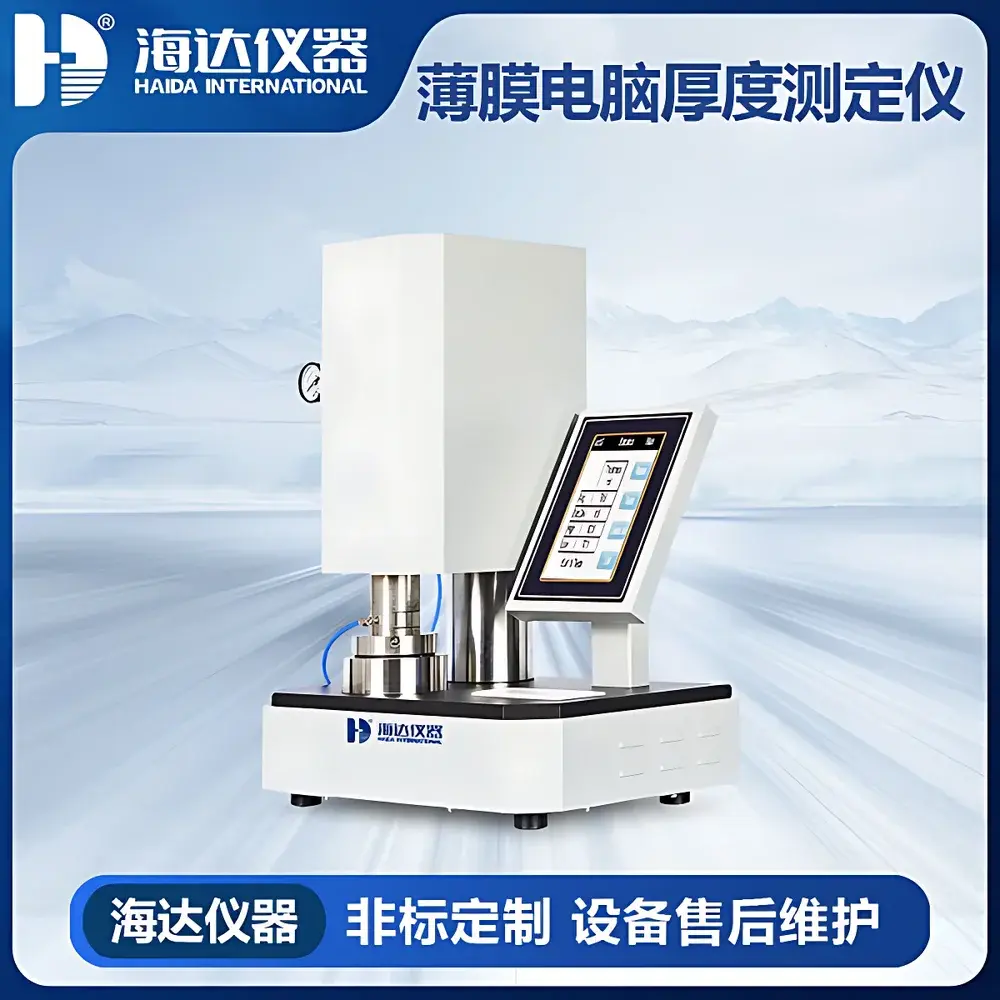
HAIDA HD-5095 Digital Film Thickness Gauge
| Brand | HAIDA INTERNATIONAL |
|---|---|
| Origin | Guangdong, China |
| Manufacturer Type | Direct Manufacturer |
| Country of Origin | China |
| Model | HAIDA HD-5095 Digital Film Thickness Gauge |
| Price | Upon Request |
| Power Supply | AC (100–240) V, 50/60 Hz, 50 W |
| Operating Environment | Temperature (10–35) °C, Relative Humidity ≤ 85 % RH |
| Display | 7-inch IPS capacitive touchscreen, 1024 × 600 resolution |
| Measurement Range | 0–2 mm |
| Resolution | 0.0001 mm |
| Accuracy (Indication Error) | ±1 µm |
| Repeatability | ±1 µm |
| Parallelism Between Measuring Surfaces | ≤ 0.002 mm |
| Contact Area | 50 mm² |
| Contact Pressure | (17.5 ± 1) kPa |
| Probe Descent Speed | Adjustable from 0.5 to 10 mm/s |
| Data Storage Capacity | Up to 50 test records |
| Data Export | USB flash drive |
| Built-in Thermal Printer | Yes |
| Communication Interfaces | USB 2.0, Wi-Fi (2.4 GHz) |
| Dimensions (W × D × H) | 365 × 255 × 440 mm |
| Net Weight | ~27 kg |
Overview
The HAIDA HD-5095 Digital Film Thickness Gauge is a precision mechanical thickness measurement instrument engineered for high-reproducibility non-destructive thickness evaluation of polymer films, foils, and thin sheet materials. It operates on the principle of contact-based mechanical displacement sensing—utilizing a calibrated, pneumatically stabilized measuring head with controlled contact pressure and parallelized anvil geometry to ensure uniform load distribution across the sample surface. Designed in strict compliance with ISO 4593:2016 (“Plastics — Film and sheet — Determination of thickness by mechanical scanning”) and GB/T 6672–2001 (“Plastics — Film and sheet — Determination of thickness”), the HD-5095 delivers traceable, metrologically sound results suitable for quality control laboratories, R&D centers, and production line verification environments where regulatory documentation and process consistency are critical.
Key Features
- Single-touch automated measurement cycle—initiates probe descent, contact detection, dwell stabilization, reading acquisition, and data logging without manual intervention.
- Cotex-M4 ARM-based embedded control system ensures deterministic real-time response, low-latency signal processing, and stable firmware execution under variable ambient conditions.
- Adjustable probe descent velocity (0.5–10 mm/s) enables optimization for delicate substrates (e.g., PET release liners or ultra-thin PE films) while maintaining measurement repeatability across material stiffness gradients.
- Non-volatile memory retention: All active test records and calibration metadata persist through unexpected power loss; system resumes operation at last valid state upon reboot.
- Integrated thermal printer supports on-demand hardcopy output with timestamp, operator ID (if configured), unit, and statistical summary (mean, SD, min/max) per test batch.
- Firmware and UI updates deployable via USB mass storage or over-the-air (Wi-Fi) using signed package files—ensuring version control and audit readiness in regulated environments.
- Modular communication architecture supports both local USB host connectivity and IEEE 802.11b/g/n (2.4 GHz) wireless pairing with optional HAIDA QMS LabLink software for centralized data aggregation.
Sample Compatibility & Compliance
The HD-5095 accommodates flat, flexible specimens up to 2 mm thick—including biaxially oriented polypropylene (BOPP), polyethylene terephthalate (PET), polyvinyl chloride (PVC), aluminum foil laminates, and coated paperboard substrates. Its 50 mm² circular contact area and precisely regulated (17.5 ± 1) kPa contact pressure minimize localized deformation while satisfying the minimum indentation depth requirements specified in ISO 4593 Annex A. The ≤ 0.002 mm parallelism tolerance between upper and lower platens guarantees uniform compressive loading across the entire measurement zone—critical for eliminating edge effects in heterogeneous or multi-layer films. Instrument validation documentation—including as-delivered calibration certificate, traceability statement to NIM (National Institute of Metrology, China), and conformance report against ISO/IEC 17025:2017 clause 6.5—is supplied with each unit.
Software & Data Management
Data handling follows ALCOA+ principles (Attributable, Legible, Contemporaneous, Original, Accurate, Complete, Consistent, Enduring, Available) when integrated with HAIDA QMS LabLink (sold separately). This Windows-based application provides full 21 CFR Part 11 compliance features—including electronic signatures, role-based access control, audit trail with immutable timestamps, and secure user authentication. Test records export natively to CSV, PDF, or XML formats; cloud synchronization utilizes TLS 1.2–encrypted HTTPS channels to HAIDA-hosted AWS S3 endpoints. Local data storage retains up to 50 complete test sessions (each containing up to 10 individual readings), with automatic overwrite protection enabled only after explicit user confirmation.
Applications
- QC release testing of extruded polyolefin films prior to slitting or converting operations.
- In-process thickness monitoring during cast film lines—used alongside gravimetric feeders to close control loops.
- Comparative analysis of coating thickness uniformity across solvent-based and UV-curable functional layers.
- Validation of calendering roll gap settings in synthetic rubber sheet manufacturing.
- Supporting ASTM D374, ISO 534, and TAPPI T411 test method execution for packaging substrate qualification.
FAQ
Is the HD-5095 compliant with FDA 21 CFR Part 11 for electronic records in pharmaceutical packaging labs?
Yes—when used with QMS LabLink v3.2 or later and configured with validated electronic signature workflows, the system meets Part 11 requirements for record integrity, audit trail generation, and access security.
Can the instrument measure non-planar or corrugated samples?
No—the HD-5095 requires flat, rigidly supported specimens. Curved, embossed, or textured surfaces introduce measurement bias due to inconsistent contact geometry and must be evaluated using optical profilometry or confocal microscopy instead.
What calibration standards are recommended for routine verification?
NIST-traceable stainless steel gauge blocks (10 µm, 100 µm, 500 µm, and 1 mm nominal thickness) are advised for daily performance checks; annual recalibration should be performed by an ISO/IEC 17025-accredited laboratory.
Does the built-in printer support label stock or continuous forms?
The thermal printer accepts standard 58 mm wide receipt paper only; custom label printing requires external thermal label printers interfaced via QMS LabLink.
Is remote firmware update via Wi-Fi supported in air-gapped lab networks?
No—Wi-Fi updates require internet connectivity for package signature verification and version manifest retrieval; offline updates must use USB media with pre-downloaded, cryptographically signed firmware binaries.



