
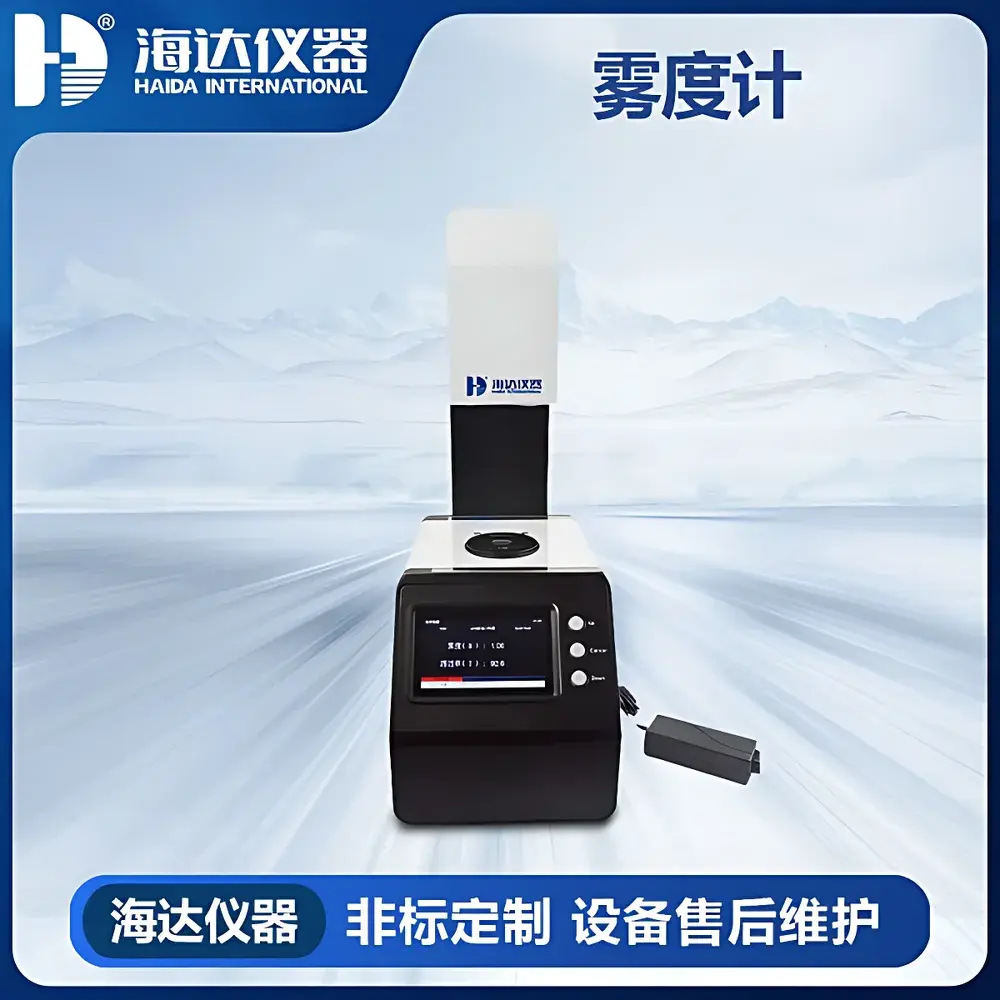
HAIDA HD-5096 Haze Meter
| Brand | HAIDA INTERNATIONAL |
|---|---|
| Origin | Guangdong, China |
| Manufacturer Type | OEM/ODM Manufacturer |
| Product Origin | Domestic (China) |
| Model | HD-5096 |
| Pricing | Available Upon Request |
| Compliance | ISO 9001:2015 Certified Manufacturing Facility |
| Standards Supported | ASTM D1003, ASTM D1044, ISO 13468, ISO 14782, JIS K 7105, JIS K 7361, JIS K 7136, GB/T 2410–2008 |
| Illuminants | CIE-A, CIE-C, CIE-D65 |
| Geometry | 0/d (Diffuse Transmission) |
| Measurement Aperture | 21 mm (standard), optional 7 mm |
| Sample Thickness Limit | ≤145 mm |
| Optical Response | CIE Y/V(λ) spectral luminous efficiency function |
| Range | 0–100% haze and total transmittance |
| Resolution | 0.01% |
| Repeatability | ≤0.05% (σ) for haze under controlled conditions |
| Measurement Time | 1.5 s per reading |
| Display | 7-inch capacitive touchscreen, Android OS |
| Data Storage | ≥100,000 readings (internal + USB export) |
| Interface | USB Type-B |
| Power Supply | DC 12 V / 3 A |
| Operating Temp. | 5–40 °C, RH ≤80% (non-condensing at ≤35 °C) |
| Storage Temp. | −20–45 °C, RH ≤80% (non-condensing) |
| Dimensions (L×W×H) | 310 × 215 × 540 mm |
| Weight | 6.0 kg |
| Standard Accessories | Haze QC PC software, calibration standard tiles (certified haze reference plates), alignment jig |
| Optional Accessories | Custom apertures, sample holders for curved/thick specimens, GLP-compliant audit trail module |
Overview
The HAIDA HD-5096 Haze Meter is a precision optical instrument engineered for quantitative assessment of haze and total transmittance in transparent and translucent materials—primarily plastics, films, glasses, and coated substrates. It operates on the principle of diffuse transmission photometry (0/d geometry per ISO 13468 and ASTM D1003), where incident light from a stabilized CIE-compliant LED source passes through the specimen, and the ratio of scattered (hazy) to total transmitted light is calculated using a calibrated silicon photodetector array conforming to the CIE Y/V(λ) luminous efficiency function. Unlike integrating sphere-based systems requiring thermal stabilization or warm-up, the HD-5096 employs a solid-state LED illumination system with negligible spectral drift over time—enabling immediate measurement without preheating. Its dual-standard compliance (ASTM and ISO) ensures data interoperability across global R&D, quality control, and regulatory submission workflows, particularly in sectors governed by FDA, ISO 9001, and IATF 16949 frameworks.
Key Features
- Simultaneous dual-standard evaluation: Direct calculation of haze (%) and total transmittance (%) per both ASTM D1003 (Method A) and ISO 13468–1/ISO 14782 protocols—no manual conversion required.
- Triple CIE illuminant support: Switchable CIE-A (tungsten), CIE-C (average daylight), and CIE-D65 (standard daylight) modes ensure consistency with material specification sheets and international test reports.
- Open-access measurement chamber: Accommodates samples up to 145 mm in thickness and unrestricted lateral dimensions—ideal for large-area panels, molded parts, and irregular geometries.
- Environmental immunity: Advanced ambient-light rejection algorithm compensates for stray illumination up to 500 lux, eliminating need for darkroom operation or light-shielding enclosures.
- Modular orientation design: Supports both vertical (benchtop) and horizontal (in-line QA station) configurations via reversible base mounting—optimized for integration into production lines or lab benches.
- Embedded Android platform: 7-inch high-resolution capacitive touchscreen with intuitive GUI, multi-language support (EN/DE/FR/ES/ZH), and real-time statistical overlay (mean, SD, min/max, CPK).
- Zero-maintenance illumination: High-stability LED source rated for >50,000 hours L70 lifetime—no recalibration or lamp replacement required within typical instrument service life.
Sample Compatibility & Compliance
The HD-5096 accepts rigid, semi-rigid, and flexible specimens—including acrylic sheets, PETG extrusions, polycarbonate glazing, laminated safety glass, optical films, and medical-grade packaging. Its 21 mm primary aperture meets ASTM D1003 minimum requirements; optional 7 mm aperture enables high-resolution profiling of microstructured surfaces or narrow-width tapes. All measurements adhere to GLP-aligned traceability: each result embeds timestamp, operator ID (login-enabled), illuminant mode, aperture selection, and firmware revision. The device’s manufacturing facility holds ISO 9001:2015 certification, and its optical calibration protocol references NIST-traceable haze standards (certified per ISO/IEC 17025). Regulatory documentation—including Declaration of Conformity, calibration certificate templates, and raw data export logs—supports FDA 21 CFR Part 11 readiness when paired with optional audit trail firmware.
Software & Data Management
Haze QC desktop software (included) provides full traceability and reporting: automated generation of ASTM/ISO-formatted PDF certificates, batch-level SPC charts (X̄–R, Cp/Cpk), outlier detection via Grubbs’ test, and CSV/XLSX export compatible with LIMS and MES platforms. Raw spectral data (if enabled via firmware update) supports custom spectral analysis in MATLAB or Python. USB interface enables direct firmware updates, configuration backup/restore, and secure offline data transfer—no cloud dependency or vendor-hosted servers. Audit trail module (optional) adds electronic signature capture, role-based access control, and immutable event logging compliant with EU Annex 11 and FDA Part 11 expectations.
Applications
- Plastics manufacturing: In-process haze verification for injection-molded automotive lenses, extruded signage sheets, and blow-molded containers.
- Display industry: Quality gate screening of cover glass, anti-glare films, and OLED encapsulation layers prior to lamination.
- Pharmaceutical packaging: Quantitative assessment of clarity in blister foil, IV bag films, and syringe barrel resins per USP <661.1> and EP 3.2.1.
- Architectural glazing: Certification testing of low-iron glass, switchable PDLC panels, and ETFE membrane structures.
- Academic research: Correlation studies between haze, surface roughness (AFM), and refractive index mismatch in nanocomposite polymer blends.
FAQ
Does the HD-5096 require annual recalibration?
While not mandatory, HAIDA recommends biannual verification against certified haze standards (NIST-traceable Class A tiles) to maintain metrological confidence—especially in regulated environments. Internal self-diagnostic routines run at power-on and before each measurement sequence.
Can it measure curved or textured surfaces?
Yes—via optional vacuum-assisted sample holder or custom-fitted jig (part number HD-JIG-CT). Flatness tolerance is ±0.1 mm over 21 mm aperture; results remain valid for radius-of-curvature ≥50 mm.
Is USB data export compliant with 21 CFR Part 11?
Native USB export is non-auditable. For Part 11 compliance, install the optional Audit Trail Module (HD-ATM-01), which enforces electronic signatures, change history, and encrypted database logging.
What is the uncertainty budget for haze measurement?
At 95% confidence (k=2), combined standard uncertainty is ±0.12% haze for values <10%, and ±0.25% for 10–100% range—based on repeatability, standard tile stability, and illuminant spectral match uncertainty.
How does it handle colored or UV-absorbing samples?
CIE-D65 mode minimizes metamerism errors in yellowed or UV-stabilized polymers. For highly absorbing materials (e.g., tinted automotive glass), ISO 14782 Mode B (with secondary detector normalization) is automatically engaged to correct for baseline drift.



