
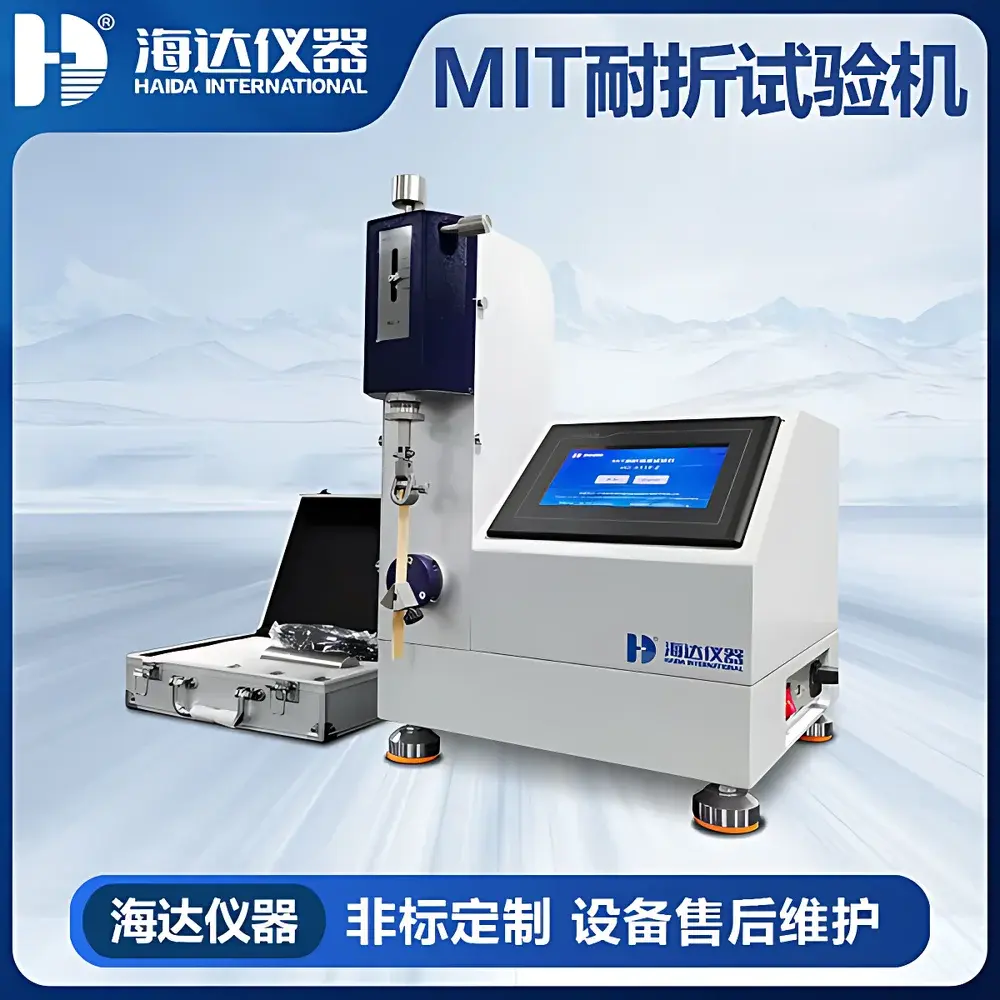
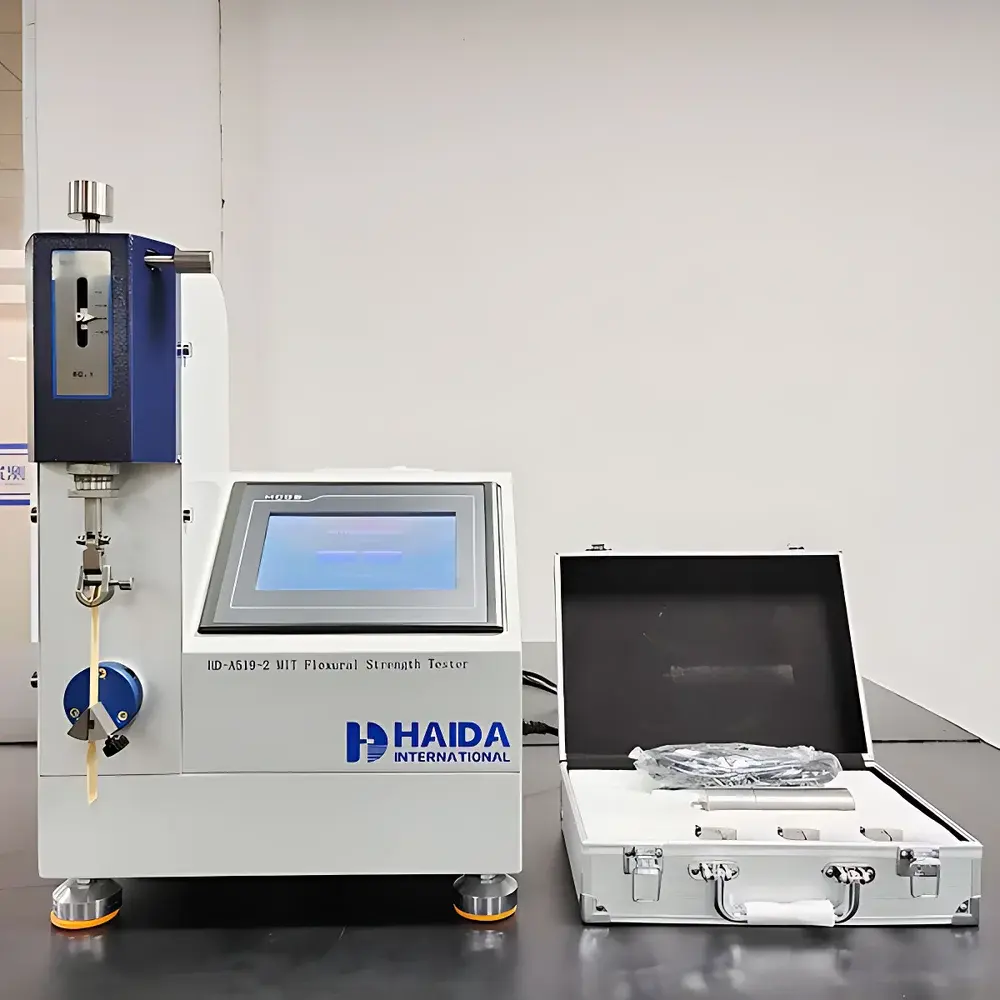
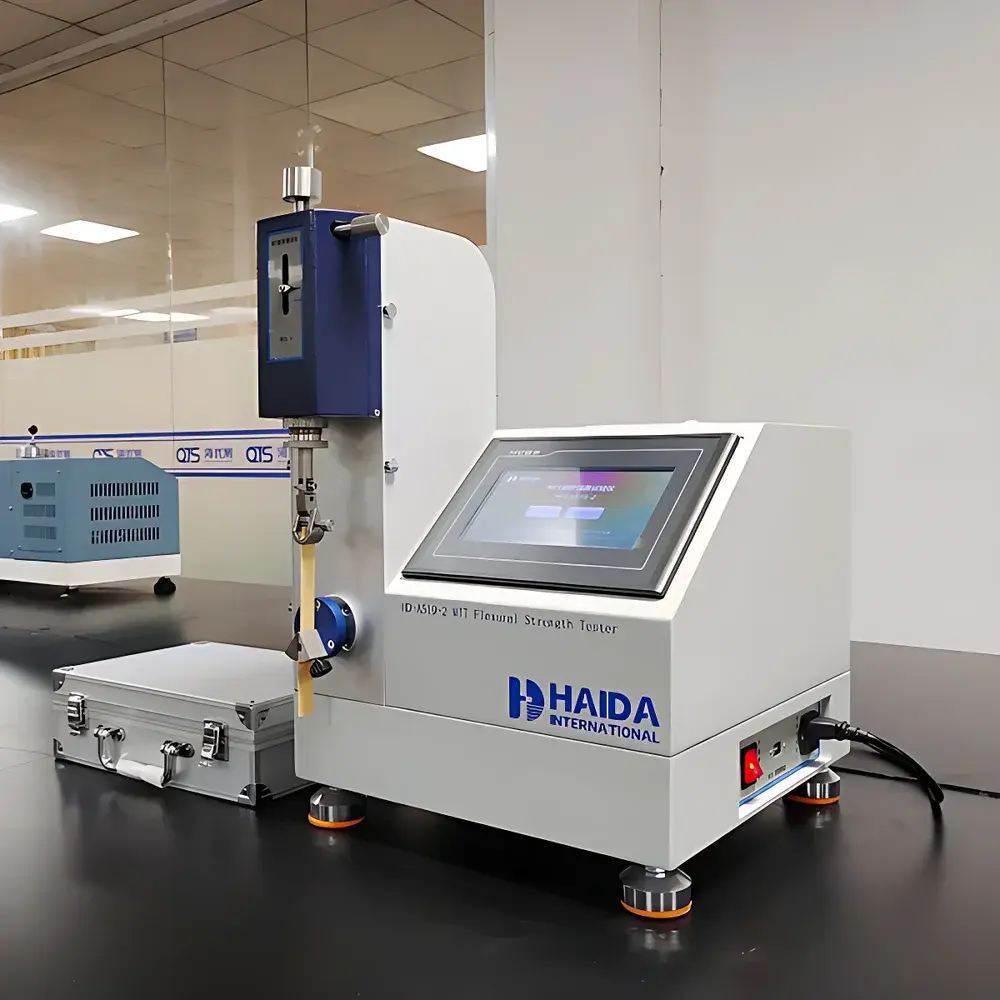
HAIDA HD-A519-2 MIT Fold Endurance Tester
| Brand | HAIDA INTERNATIONAL |
|---|---|
| Origin | Guangdong, China |
| Manufacturer Type | Direct Manufacturer |
| Product Origin | Domestic (China) |
| Model | HD-A519-2 MIT Fold Endurance Tester |
| Drive System | Servo Motor |
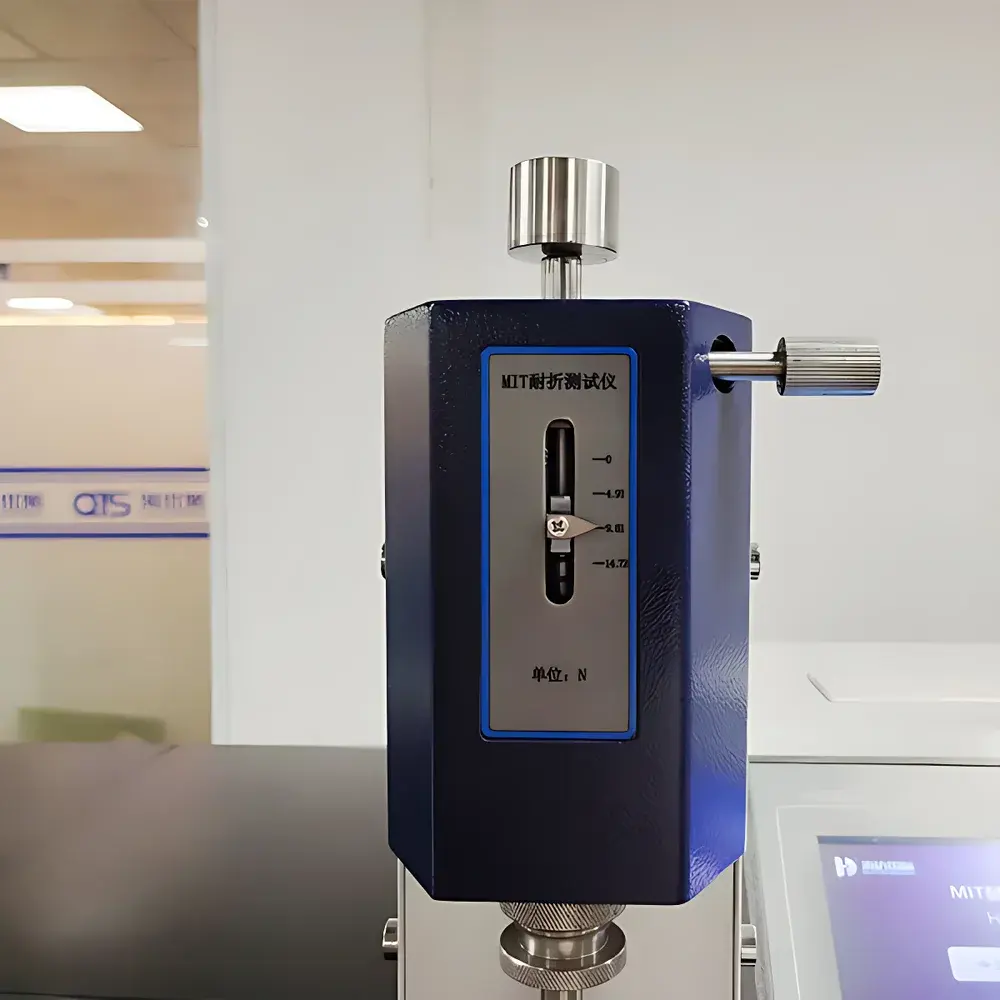
| Test Loads | 4.91 N, 9.81 N, 14.72 N |
| Folding Angle | ±135° (adjustable from 0° to ±135°, single- or double-side folding) |
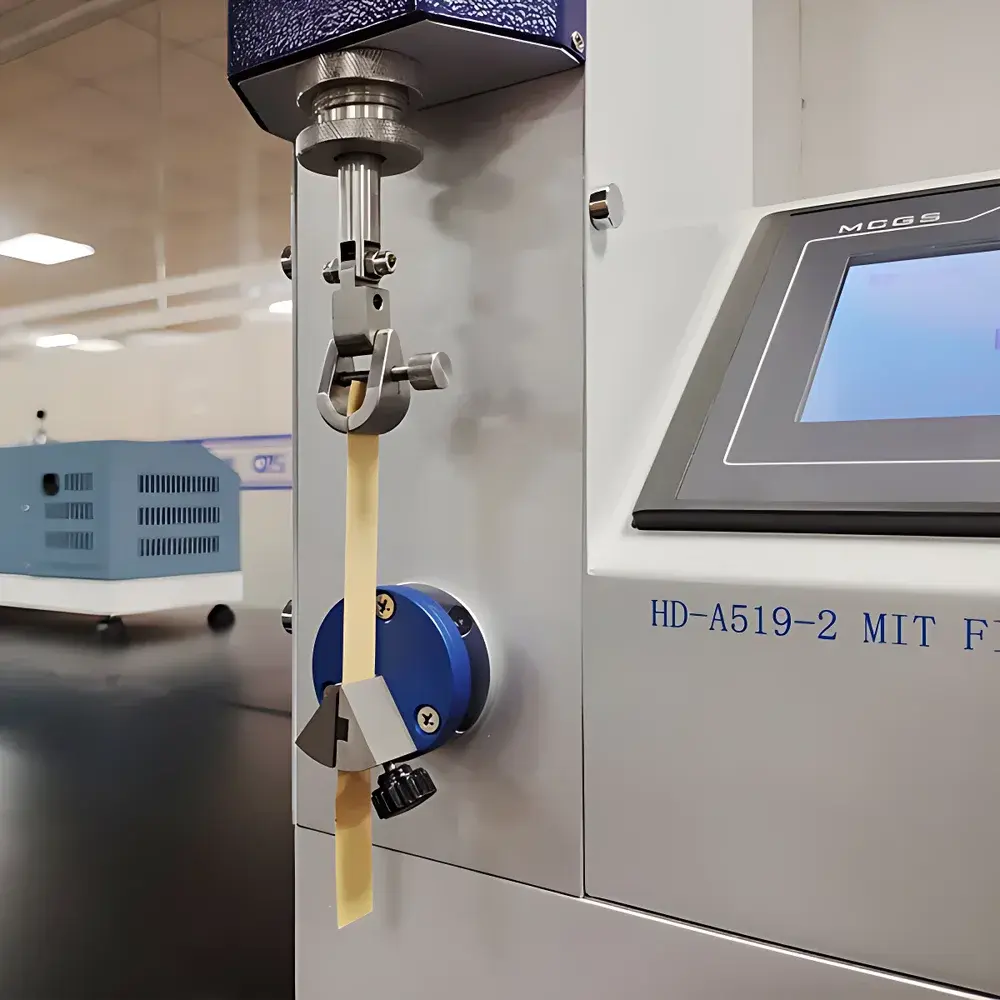
| Specimen Dimensions | 15 mm × 150 mm, thickness < 1.25 mm |
| Folding Speed | (175 ± 10) rpm (0–175 ± 10 rpm adjustable) |
| Folding Head Width | 19 ± 1 mm |
| Fold Radius (Chord) | 0.38 ± 0.02 mm (interchangeable) |
| Gap Between Folding Jaws | 0.25 mm / 0.5 mm / 0.75 mm / 1.0 mm (custom gaps available) |
| Counter Range | 0–999,999 cycles, auto-stop |
| Dimensions (L×W×H) | 421 × 357 × 526 mm |
| Display | Touchscreen Interface |
| Weight | ~30 kg |
| Power Supply | 1-phase, 220 V, 50 Hz, 1 A |
| Rated Power | ~500 W |
| Compliance Standards | GB/T 457–2008, GB/T 2679.5–1995, ISO 5626:1993, JIS P 8115:2001 |
Overview
The HAIDA HD-A519-2 MIT Fold Endurance Tester is an electromechanical instrument engineered for precise and repeatable assessment of fold endurance in flexible sheet materials—primarily paper, paperboard, nonwovens, thin metallic foils, polymer films, and laminated composites. It operates on the standardized MIT (Massachusetts Institute of Technology) principle: a vertically clamped specimen is subjected to controlled tensile load while undergoing reciprocating angular bending at a defined radius and frequency until failure. This method quantifies material fatigue resistance under cyclic mechanical stress, delivering objective cycle-count data that correlates directly with real-world handling durability in packaging, printing, labeling, and electronics substrate applications.
Key Features
- Microprocessor-controlled touchscreen interface enabling full parameter configuration—including load selection (4.91 N / 9.81 N / 14.72 N), folding speed (0–175 ± 10 rpm), angle amplitude (±135°), and jaw gap (0.25–1.0 mm in standard increments).
- Servo motor-driven actuation ensures high positional repeatability, low mechanical backlash, and consistent torque delivery across extended test durations—critical for inter-laboratory reproducibility per ISO/IEC 17025 requirements.
- Interchangeable folding heads with precision-ground radii (0.38 ± 0.02 mm chord radius) and calibrated jaw gaps minimize edge-effect variability and support method-specific validation per ASTM D2176 and ISO 5626 Annex A.4.
- Optical end-stop sensors eliminate mechanical impact during return stroke, reducing wear on critical kinematic components and extending calibration stability intervals.
- Integrated spring-tension calibration system using certified reference weights (4.91 N and 9.81 N) enables on-site verification of applied tensile force—supporting GLP-compliant traceability and audit readiness.
- Automated data capture includes cycle count, failure detection, and timestamped event logging; results are exportable via USB to external storage (4 GB U-disk included) or printed directly via built-in thermal printer.
Sample Compatibility & Compliance
The HD-A519-2 accommodates specimens measuring 15 mm wide × 150 mm long with maximum thickness of 1.25 mm—covering standard test formats for uncoated and coated papers, corrugated liners, metallized PET films, and fiber-reinforced laminates. Its mechanical architecture complies with dimensional and functional specifications outlined in ISO 5626:1993 (Clause A.4), GB/T 457–2008 (Section 9.3, Annex A.2), GB/T 2679.5–1995 (Section 4), and JIS P 8115:2001 (Section 5). All firmware logic adheres to IEC 61508 SIL-2 functional safety principles for automated stop-on-failure execution. The device supports GMP-aligned operation through password-protected user roles, electronic audit trails, and immutable result archiving—meeting foundational expectations for FDA 21 CFR Part 11 compliance when deployed with validated IT infrastructure.
Software & Data Management
HAIDA’s proprietary control software—available in English and Simplified Chinese—provides dual-mode operation: manual step-by-step mode for method development and fully automated batch mode for routine QC testing. Each test session records raw cycle counts, elapsed time, load state, and failure confirmation status. Statistical post-processing calculates group-wise metrics including mean, standard deviation, coefficient of variation (CV%), minimum/maximum values, and outlier flags per ISO 5725-2. Export formats include CSV (for LIMS integration), PDF reports with embedded metadata (operator ID, calibration date, environmental conditions), and XML for enterprise-level data federation. Firmware updates are delivered via encrypted USB payload with SHA-256 signature verification to ensure integrity and version control.
Applications
- Quality assurance of folding cartons and corrugated shipping containers in packaging R&D and production environments.
- Evaluation of crease performance in lithographic and digital print substrates prior to die-cutting and folding operations.
- Comparative fatigue analysis of bio-based barrier films versus conventional PE/PET laminates in sustainable packaging development.
- Mechanical qualification of flexible circuit substrates (e.g., polyimide films) used in consumer electronics and medical devices.
- Regulatory submission support for pharmaceutical blister foil and pouch materials requiring ISO 5626-compliant durability documentation.
- Academic research into fiber orientation effects on paper tensile recovery and hysteresis behavior under cyclic loading.
FAQ
What standards does the HD-A519-2 explicitly support?
It meets the mechanical and procedural requirements of ISO 5626:1993, GB/T 457–2008, GB/T 2679.5–1995, JIS P 8115:2001, and ASTM D2176 (via equivalent kinematic configuration).
Can the instrument be integrated into a networked QA lab environment?
Yes—USB-host functionality enables direct connection to Windows/Linux workstations; CSV output supports seamless ingestion into LabVantage, STARLIMS, or custom SQL-based databases.
Is calibration documentation provided with shipment?
Each unit ships with a factory calibration certificate referencing NIST-traceable force and angular metrology standards, valid for 12 months under normal use conditions.
How is overload protection implemented?
Hardware-level current limiting in the servo driver combined with real-time torque monitoring prevents damage during jamming or misalignment events.
Are replacement folding heads available with non-standard radii or gaps?
Yes—HAIDA offers custom machining services for radii from 0.25 mm to 0.75 mm and jaw gaps from 0.1 mm to 2.0 mm, subject to MOQ and lead time confirmation.





