
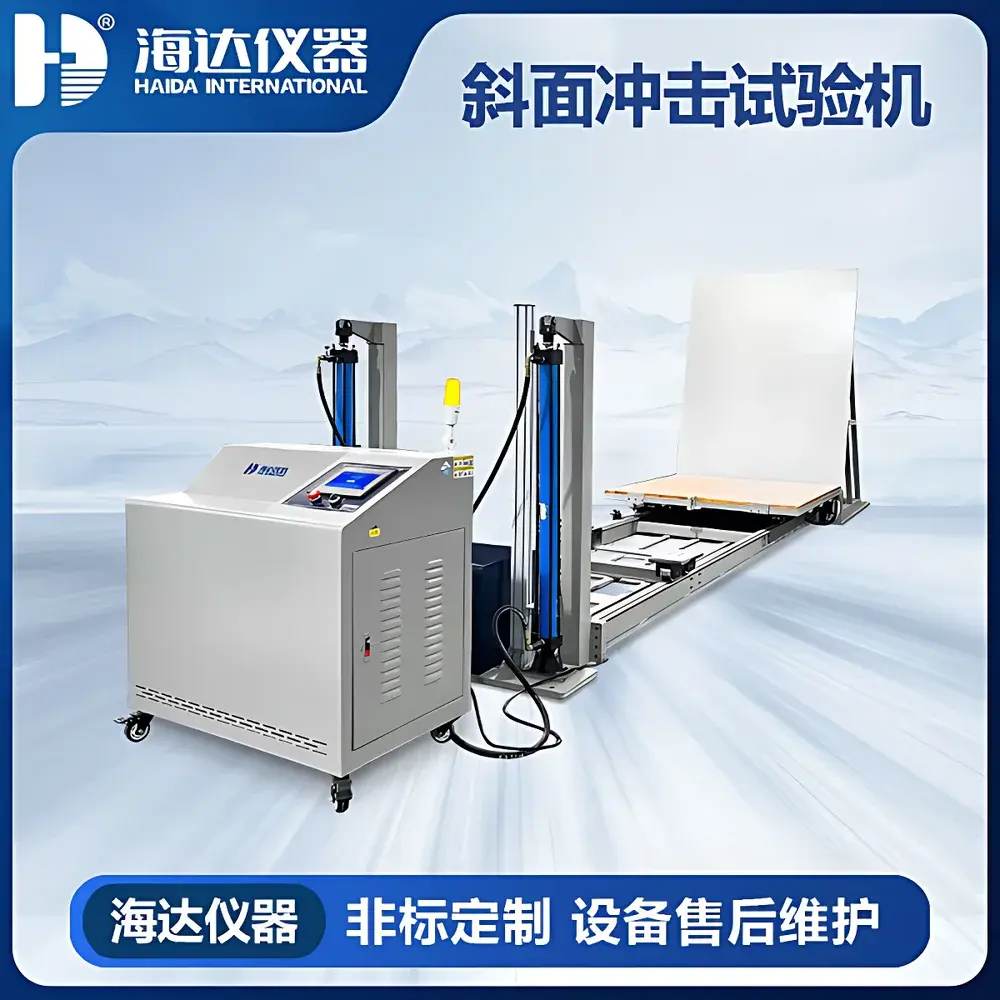
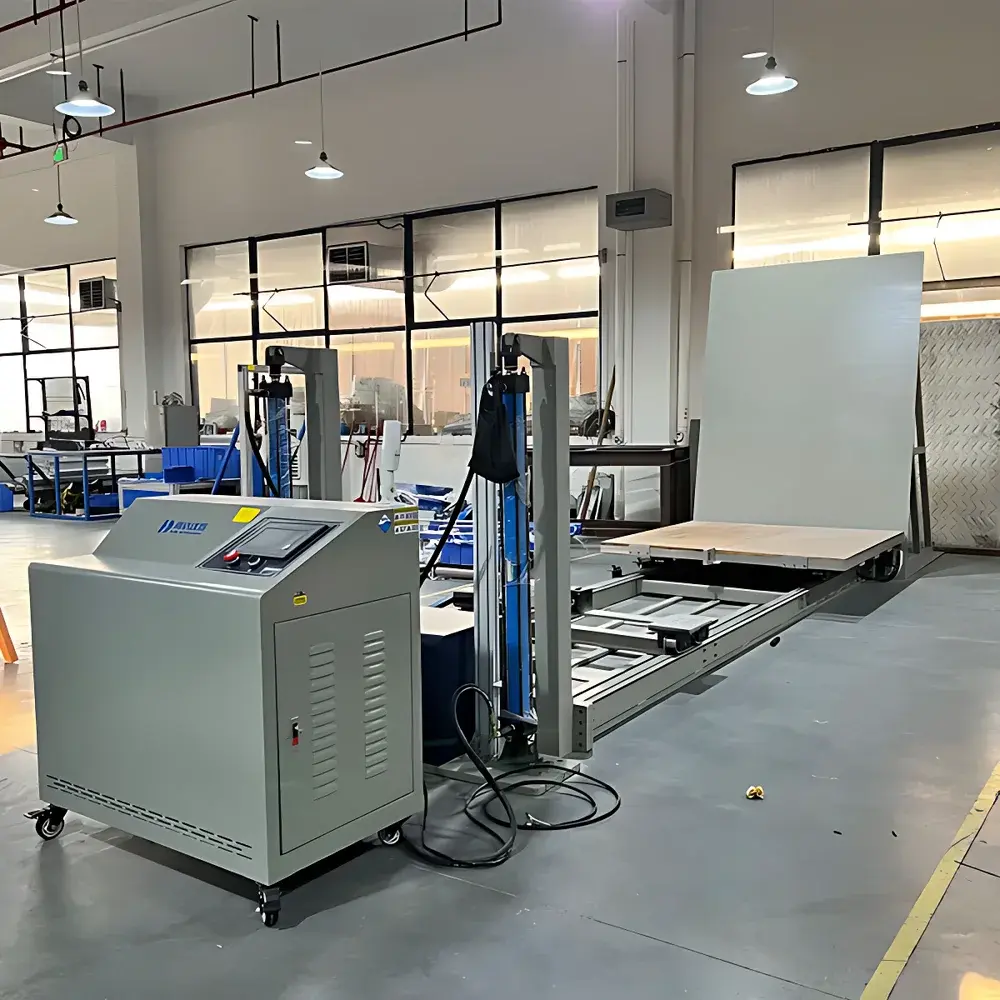
HAIDA HD-A523 Inclined Impact Tester
| Brand | HAIDA INTERNATIONAL |
|---|---|
| Origin | Guangdong, China |
| Manufacturer Type | Direct Manufacturer |
| Model | HD-A523 Inclined Impact Tester |
| Impact Energy Capacity | ≤500 kg·m (gravimetric equivalent) |
| Impact Velocity Range | 1.1–2.3 m/s |
| Velocity Accuracy | ±5% |
| Incline Angle | 10° |
| Impact Panel Dimensions | 1600 mm × 2000 mm (steel plate) |
| Max. Travel Length | 2000 mm |
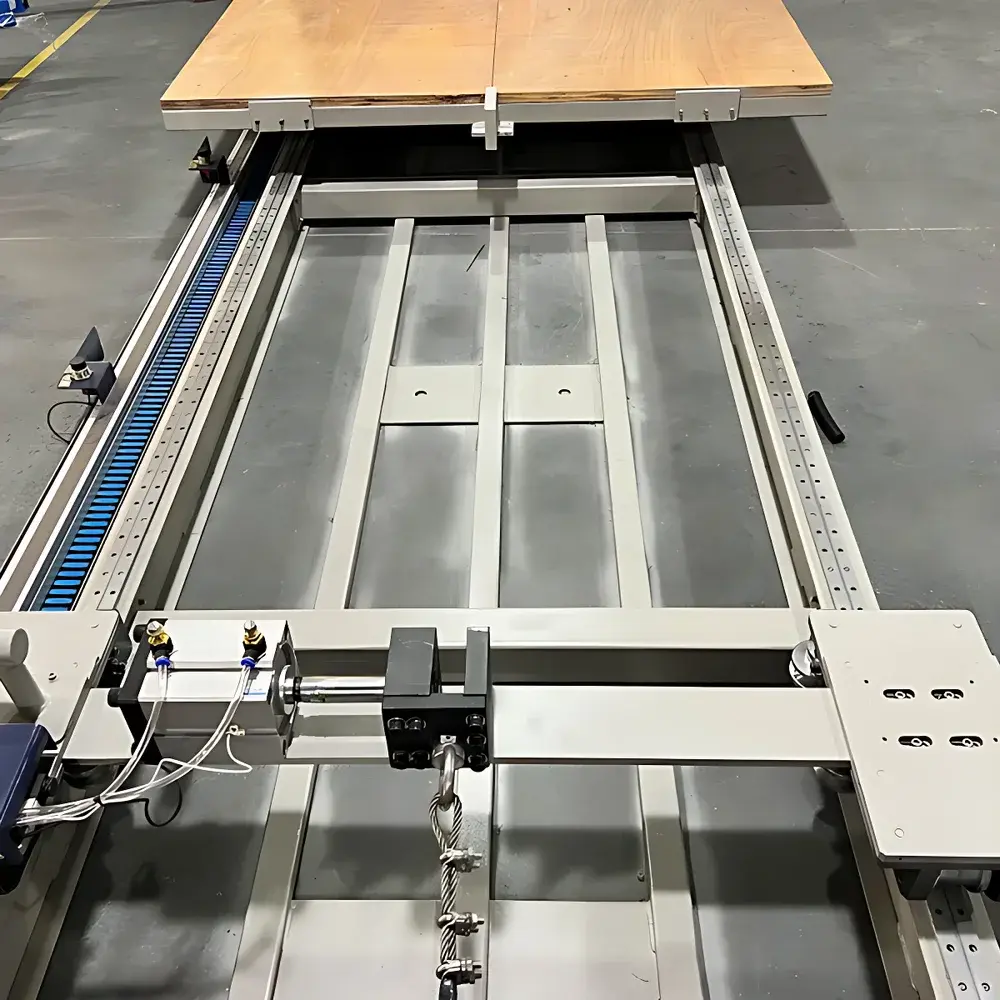
| Sled Platform Dimensions | 1500 mm × 1500 mm (hardwood) |
| Max. Specimen Size | 1500 mm × 1500 mm × 1500 mm (L×W×H) |
| Overall Dimensions | 6470 mm × 1600 mm × 1980 mm (L×W×H) |
| Weight | ~1900 kg |
| Power Supply | 3-phase AC 380 V |
| Total Power Consumption | ~3.1 kW |
| Lifting Motor Power | 1.5 kW |
| Hydraulic Unit | 1.5 kW (2 HP), 40 L oil reservoir |
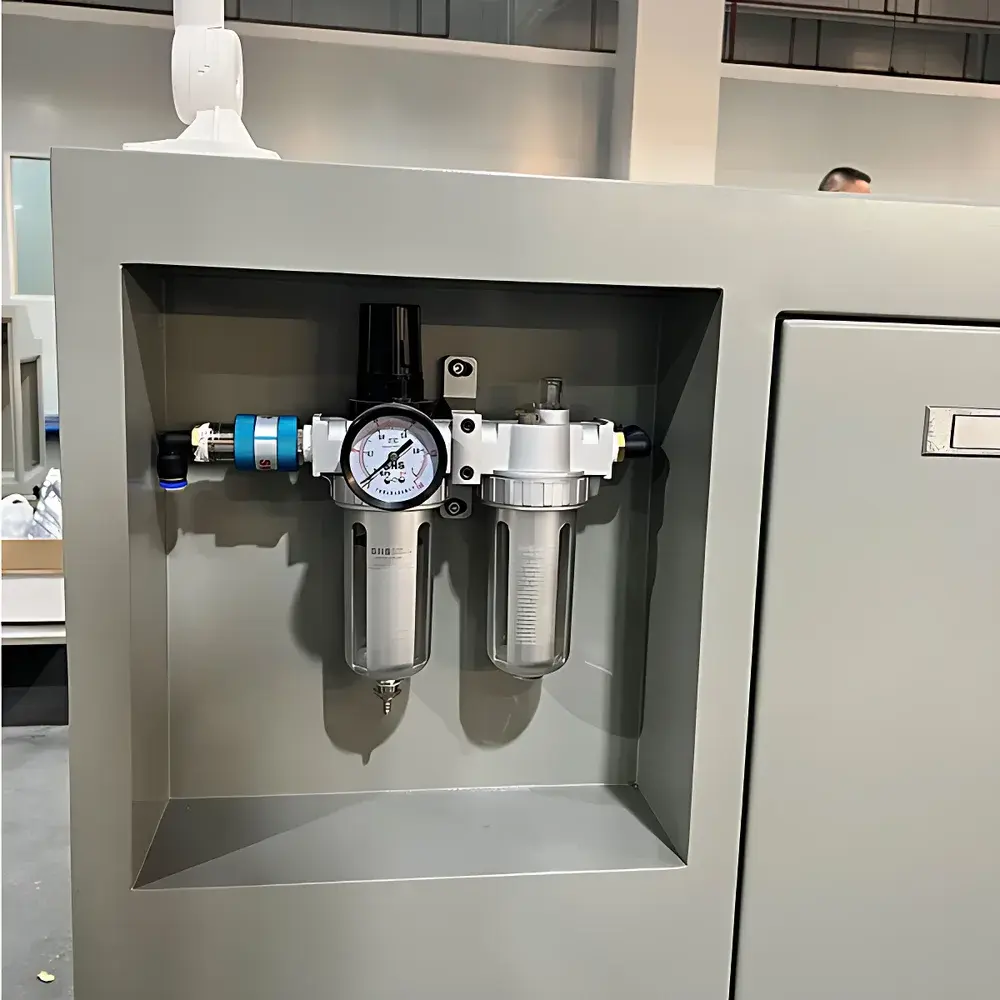
| Air Source Requirement | ≥0.6 MPa |
| Control System | PLC with 7-inch TFT touch HMI |
| Data Output | USB interface |
| Compliance Standards | GB/T 4857.11–2005, GB/T 1019–2008, EN ISO 2244:2002, ISTA 6-Series |
Overview
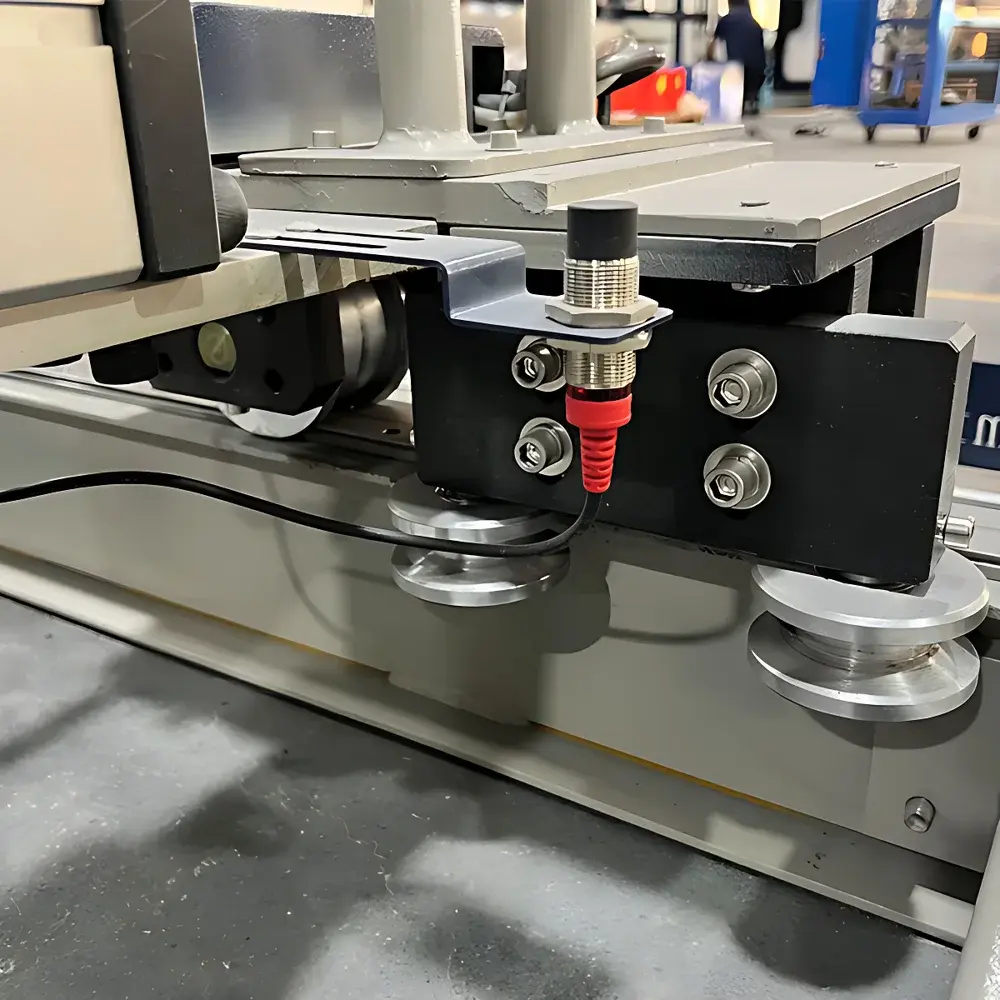
The HAIDA HD-A523 Inclined Impact Tester is a precision-engineered mechanical impact simulation system designed to evaluate the resistance of packaged goods and rigid products to controlled inclined-plane impacts—mimicking real-world handling hazards such as loading/unloading from trucks, palletized stacking, conveyor transfers, and manual handling on sloped surfaces. Unlike vertical drop testers or pendulum impact systems, the HD-A523 employs a gravity-driven sled mechanism operating on a fixed 10° incline, enabling repeatable kinetic energy delivery through controlled mass–velocity relationships. The device operates under deterministic mechanical principles: potential energy (m·g·h) is converted to translational kinetic energy (½·m·v²) along a calibrated steel rail, with velocity verified in real time via optical proximity sensors. This architecture ensures high reproducibility across test cycles and eliminates reliance on operator timing or manual release variables—critical for audit-ready quality control environments.
Key Features
- Structural integrity ensured by heavy-duty square tubing, I-beam framing, and solid steel base construction—designed to eliminate frame flexure or positional drift during high-load impact events (up to 500 kg payload).
- Dual hydraulic lifting cylinders provide synchronized, vibration-damped elevation of the impact sled—enhancing long-term mechanical stability and reducing maintenance frequency.
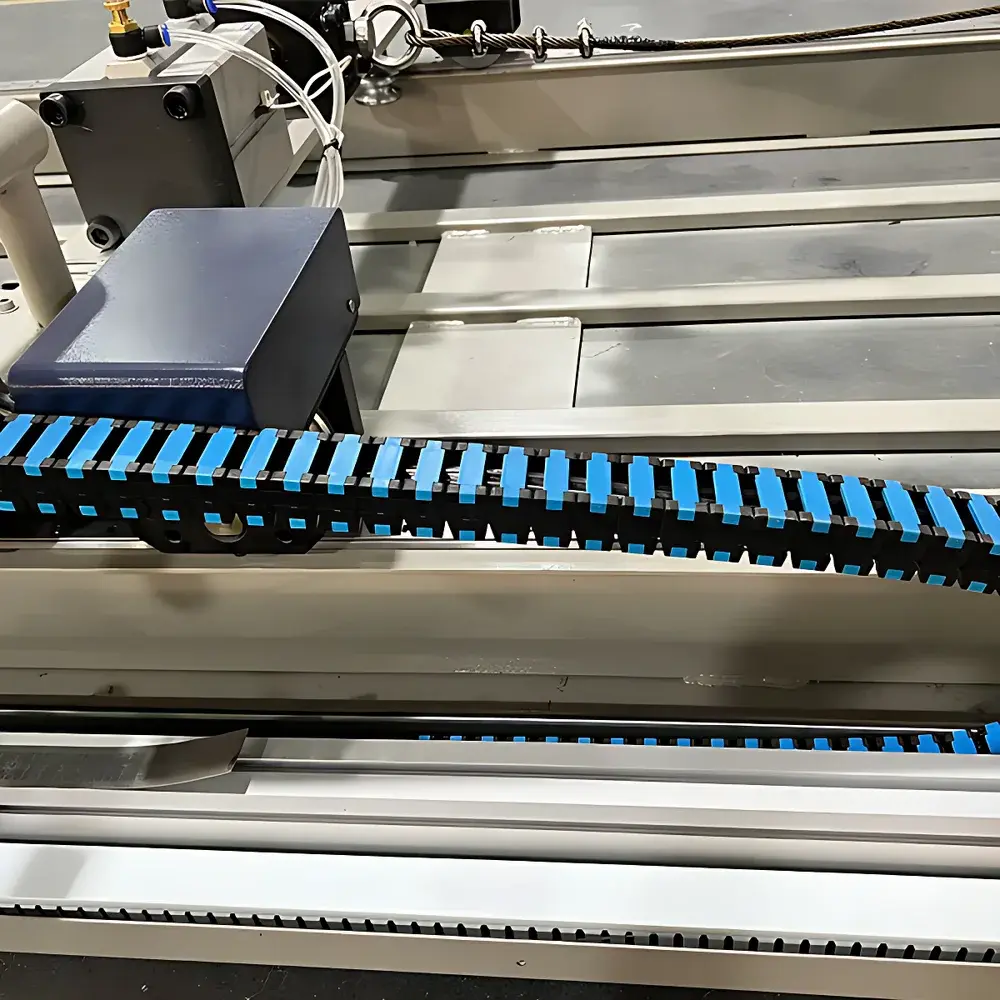
- Low-friction polyurethane-coated roller assembly on the impact sled minimizes parasitic rolling resistance, preserving velocity fidelity across the full 2000 mm travel path.
- Reinforced steel impact panel (1600 mm × 2000 mm) incorporates integrated secondary-impact dampening geometry to prevent rebound-induced measurement artifacts—ensuring single-event impulse capture per test cycle.
- PLC-based control system with 7-inch industrial touch HMI enables intuitive parameter setup (inclination angle, release height, specimen weight), real-time velocity monitoring, and automated pass/fail logic based on user-defined thresholds.
- Integrated fault-detection circuitry triggers audible/visual alarms for out-of-tolerance velocity deviation (>±5%), air pressure insufficiency (<0.6 MPa), or sensor signal loss—supporting ISO 9001-compliant operational safety protocols.
Sample Compatibility & Compliance
The HD-A523 accommodates a broad range of rigid and semi-rigid specimens up to 1500 mm × 1500 mm × 1500 mm (L×W×H), including refrigerators, office furniture, storage cabinets, industrial enclosures, and corrugated or wooden shipping containers. Its standardized 10° incline and validated velocity range (1.1–2.3 m/s) align directly with internationally recognized transport simulation standards: GB/T 4857.11–2005 (Clause 4.2 and 6.6), GB/T 1019–2008 (Clause 5.8), EN ISO 2244:2002 (Clauses 5.3 and 7), and ISTA 6-Series protocols for e-commerce and parcel carrier qualification. All mechanical components—including load-bearing rails, hydraulic actuators, and impact interface surfaces—are dimensionally traceable to NIST-traceable calibration references. The system supports GLP/GMP-aligned documentation workflows through timestamped USB data export (CSV format), enabling integration into LIMS or QMS platforms compliant with FDA 21 CFR Part 11 requirements for electronic records and signatures.
Software & Data Management
Control and data acquisition are managed via an embedded industrial PLC interfaced with a ruggedized touch-screen HMI. The firmware implements deterministic real-time velocity calculation using dual-channel optical interrupter feedback—sampling at 1 kHz—to compute instantaneous sled speed immediately prior to impact. Test parameters (mass, release height, target velocity) are stored in non-volatile memory with full audit trail functionality: each test record includes operator ID, timestamp, environmental conditions (optional external sensor input), raw sensor waveforms, and final impact velocity. Exported USB logs contain ISO 8601-formatted timestamps, numeric metadata, and status flags—structured for direct ingestion into statistical process control (SPC) software or Excel-based root-cause analysis. No proprietary drivers or cloud dependencies are required; all firmware updates are delivered via FAT32-formatted USB stick.
Applications
- Package integrity validation for logistics service providers (e.g., Amazon Frustration-Free Packaging, UPS SurePost, DHL Parcel Perfect).
- Design verification of structural rigidity in white goods (refrigerators, washing machines) and commercial furniture under simulated warehouse handling stress.
- Material qualification testing for corrugated board, honeycomb paperboard, molded pulp, and engineered wood substrates used in protective packaging.
- Regulatory pre-submission testing for CE-marked medical device transport packaging (per MDR Annex I, General Safety and Performance Requirements).
- Academic research in impact dynamics, energy absorption modeling, and finite element method (FEM) boundary condition validation.
FAQ
What standards does the HD-A523 explicitly support?
The HD-A523 is configured and validated for GB/T 4857.11–2005, GB/T 1019–2008, EN ISO 2244:2002, and ISTA 6-Series protocols. Calibration certificates include traceability to national metrology institutes.
Can the incline angle be adjusted beyond 10°?
No—the 10° angle is mechanically fixed per design to ensure compliance with referenced standards and maintain velocity repeatability. Altering the angle voids factory calibration and regulatory conformance.
Is third-party calibration available?
Yes. HAIDA provides optional annual calibration services performed by ISO/IEC 17025-accredited laboratories, including full uncertainty budgeting and certificate issuance per ISO 17025:2017.
What maintenance intervals are recommended?
Hydraulic oil replacement every 12 months or 1,000 test cycles (whichever occurs first); rail lubrication every 200 cycles; visual inspection of proximity sensors and impact panel weld integrity prior to each shift.
Does the system support remote diagnostics?
The HD-A523 includes Ethernet port (RJ45) for Modbus TCP communication, enabling integration with plant SCADA systems—but does not feature cloud connectivity or remote firmware update capability to preserve data sovereignty and cybersecurity compliance.



