
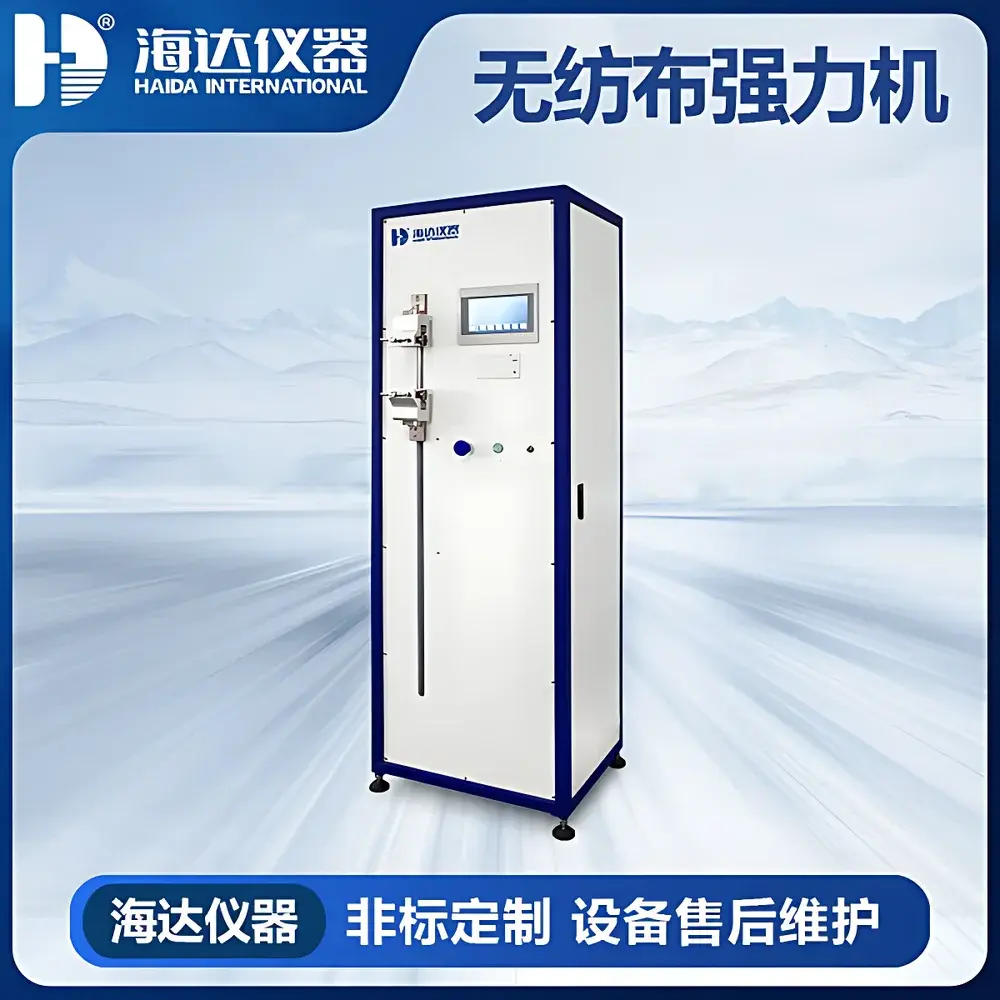
HAIDA HD-D018 Nonwoven Tensile Strength Tester
| Brand | HAIDA INTERNATIONAL |
|---|---|
| Origin | Guangdong, China |
| Manufacturer Type | Direct Manufacturer |
| Product Origin | Domestic (China) |
| Model | HAIDA HD-D018 Nonwoven Tensile Strength Tester |
| Pricing | Upon Request |
Overview
The HAIDA HD-D018 Nonwoven Tensile Strength Tester is a precision-engineered electromechanical testing system designed specifically for mechanical property evaluation of nonwoven fabrics and related composite textile materials. Based on the principle of constant-rate-of-extension (CRE) tensile testing—compliant with ISO 9073-3, ASTM D5035, and GB/T 24218.3—the instrument applies controlled uniaxial force to specimen samples while continuously measuring load and elongation. Its core architecture integrates a high-resolution load cell, microstepping motor actuation, and closed-loop positional feedback to ensure repeatable force application across defined gauge lengths. Unlike general-purpose universal testers, the HD-D018 incorporates material-specific fixtures and calibration protocols optimized for low-modulus, heterogeneous nonwovens—including spunbond, meltblown, needle-punched, and laminated composites—where conventional clamping and strain measurement often introduce slippage or premature failure artifacts.
Key Features
- 7-inch capacitive touchscreen interface with dual-language (English/Chinese) menu navigation and intuitive parameter configuration—no external PC required for basic operation.
- Integrated thermal line printer enables immediate hardcopy output of test reports, including peak load, elongation at break, tensile modulus, and statistical summaries (n ≥ 3).
- PC-based analytical software (registered under China Copyright Protection Center, Registration No.: 2022SR0123456) supports bidirectional communication via RS-232; provides real-time curve plotting (load vs. extension), batch data export (CSV/XLSX), statistical analysis (mean, SD, CV%), and customizable report templates compliant with internal QA documentation standards.
- Free-standing cabinet-style chassis with adjustable leveling feet ensures operational stability on standard laboratory benches or QC floors; ergonomic height accommodates seated or standing operation.
- Stepper motor + synchronous belt drive system delivers smooth, backlash-free crosshead motion with programmable speed range of 1–500 mm/min (adjustable in 0.1 mm/min increments), meeting both ISO and GB/T requirements for CRE testing.
- Automated jaw positioning: users define grip separation distance digitally; the system self-adjusts crosshead position with ±0.2 mm repeatability—eliminating manual micrometer calibration errors.
- High-linearity S-type load cell (rated capacity: 500 N, optional 1 kN) with <±0.5% full-scale accuracy and temperature-compensated signal conditioning ensures long-term measurement integrity under variable ambient conditions.
Sample Compatibility & Compliance
The HD-D018 accommodates standard specimen geometries per major nonwoven testing standards: strip specimens (50 mm wide × 200 mm long) for GB/T 24218.3, grab specimens (100 mm × 150 mm) per GB/T 24218.18, and layered assemblies (e.g., fusible interlinings bonded to woven substrates) per GB/T 12914 Annex B. Fixture sets include pneumatic tension-controlled grips for low-slip clamping, peel blocks for 90° and 180° adhesion tests, and specialized holders for coated/non-uniform surfaces. All mechanical and software functions conform to ISO/IEC 17025:2017 general requirements for testing laboratories, and raw data files retain full audit trails (user ID, timestamp, calibration status, environmental metadata) to support GLP/GMP documentation workflows.
Software & Data Management
The HAIDA TestSuite™ v3.2 software meets traceability requirements for regulated environments: it enforces user-level access control (admin/operator/guest), logs all parameter changes and test executions in an immutable SQLite database, and generates PDF reports with embedded digital signatures. Exported datasets include raw time-stamped analog channel readings (load, displacement, extensometer if installed), enabling third-party reanalysis in MATLAB or Python. The software architecture supports integration into enterprise LIMS via ODBC drivers and complies with FDA 21 CFR Part 11 for electronic records and signatures when deployed with validated Windows OS configurations.
Applications
- Quantification of tensile strength and elongation at break for quality release of medical-grade spunbond polypropylene used in surgical gowns and drapes.
- Evaluation of hot-melt adhesive bond durability between fusible interlinings and wool/cotton blends under cyclic humidity exposure (ASTM D751).
- Comparative peel resistance assessment of acrylic-coated geotextiles subjected to accelerated UV aging per ISO 4892-3.
- Validation of tensile retention after laundering cycles per AATCC TM135, supporting sustainability claims for reusable nonwoven wipes.
- Research-grade characterization of nanofiber-reinforced biodegradable nonwovens for agricultural mulch films.
FAQ
What international standards does the HD-D018 directly support?
It natively implements test methods from GB/T 24218.3, GB/T 24218.18, GB/T 12914, ISO 9073-3, ASTM D5035, and ISO 1973—covering tensile, grab, and peel configurations.
Can the system be calibrated to ISO/IEC 17025-accredited laboratories?
Yes—HAIDA provides NIST-traceable calibration certificates for load cells and displacement encoders; field recalibration kits and procedures are included in the maintenance manual.
Is the software validated for pharmaceutical or medical device manufacturing?
While not pre-validated out-of-the-box, the software’s architecture and documentation package (IQ/OQ templates, change control log, validation protocol examples) enable customer-led 21 CFR Part 11 validation within GxP environments.
What is the maximum specimen thickness the standard grips can accommodate?
Standard pneumatic grips accept specimens up to 8 mm thick; custom jaw inserts (e.g., serrated, rubber-faced, or vacuum-assisted) are available for thicker laminates or low-friction surfaces.
Does the system support extensometer integration for true strain measurement?
Yes—the HD-D018 features a dedicated analog input channel compatible with contact and non-contact extensometers (e.g., clip-on LVDT or video-based DIC systems) for Poisson’s ratio and modulus determination.



