
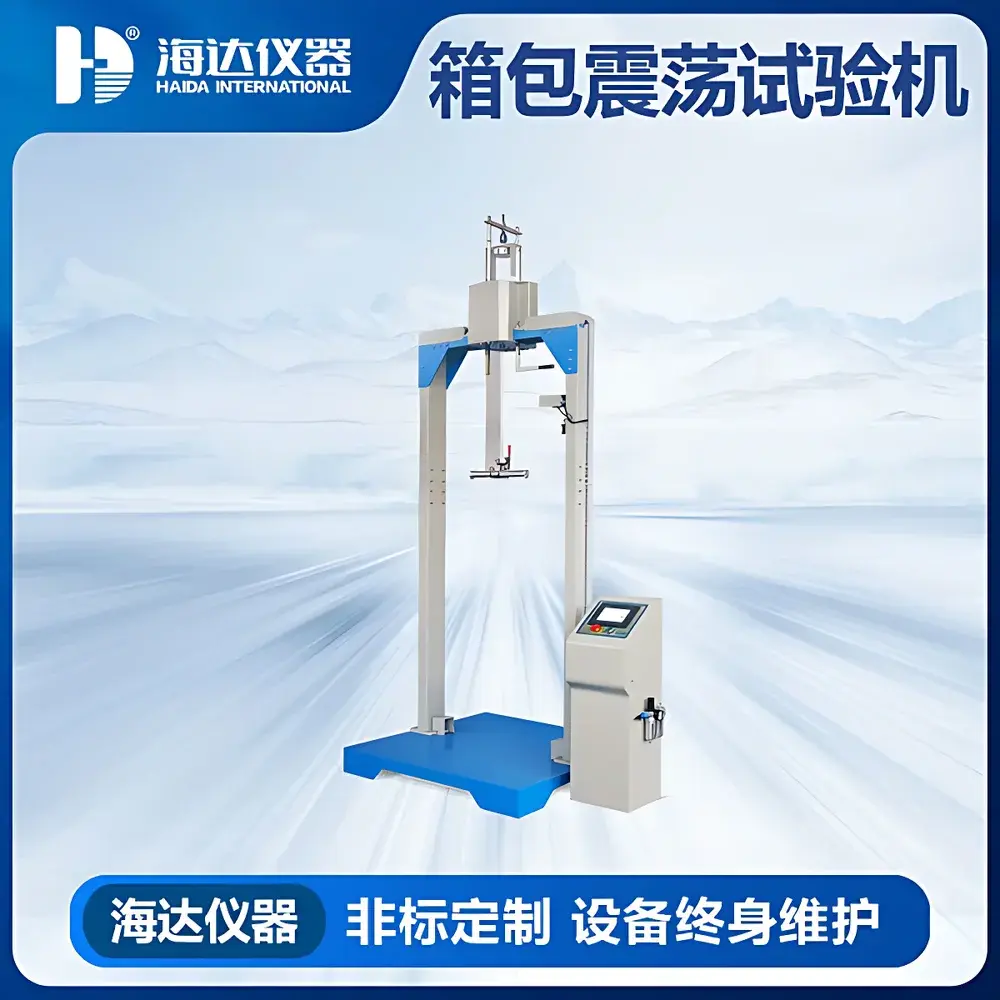
HAIDA HD-D114-2 Luggage Oscillatory Impact Tester
| Brand | HAIDA INTERNATIONAL |
|---|---|
| Origin | Guangdong, China |
| Manufacturer Type | OEM/ODM Manufacturer |
| Country of Origin | China |
| Model | HAIDA HD-D114-2 Luggage Oscillatory Impact Tester |
| Test Speed | 10–30 cycles per minute (c.p.m.) |
| Control System | PLC-based with Touchscreen HMI |
| Display | 7-inch TFT color touchscreen |
| Data Output | USB flash drive export (CSV/Excel-compatible) |
| Load Capacity | ≤50 kg |
| Stroke Adjustment Range | 50–150 mm (digitally settable via touchscreen) |
| Oscillation Mechanism | Precision-calibrated helical compression spring (17.54 ± 0.88 N/mm) |
| Impact Mass | 8.1 ± 0.2 kg |
| Sample Dimensions (Max) | 700 × 700 × 1200 mm (L×W×H) |
| Overall Dimensions | 1300 × 1200 × 3300 mm (L×W×H) |
| Weight | ~390 kg |
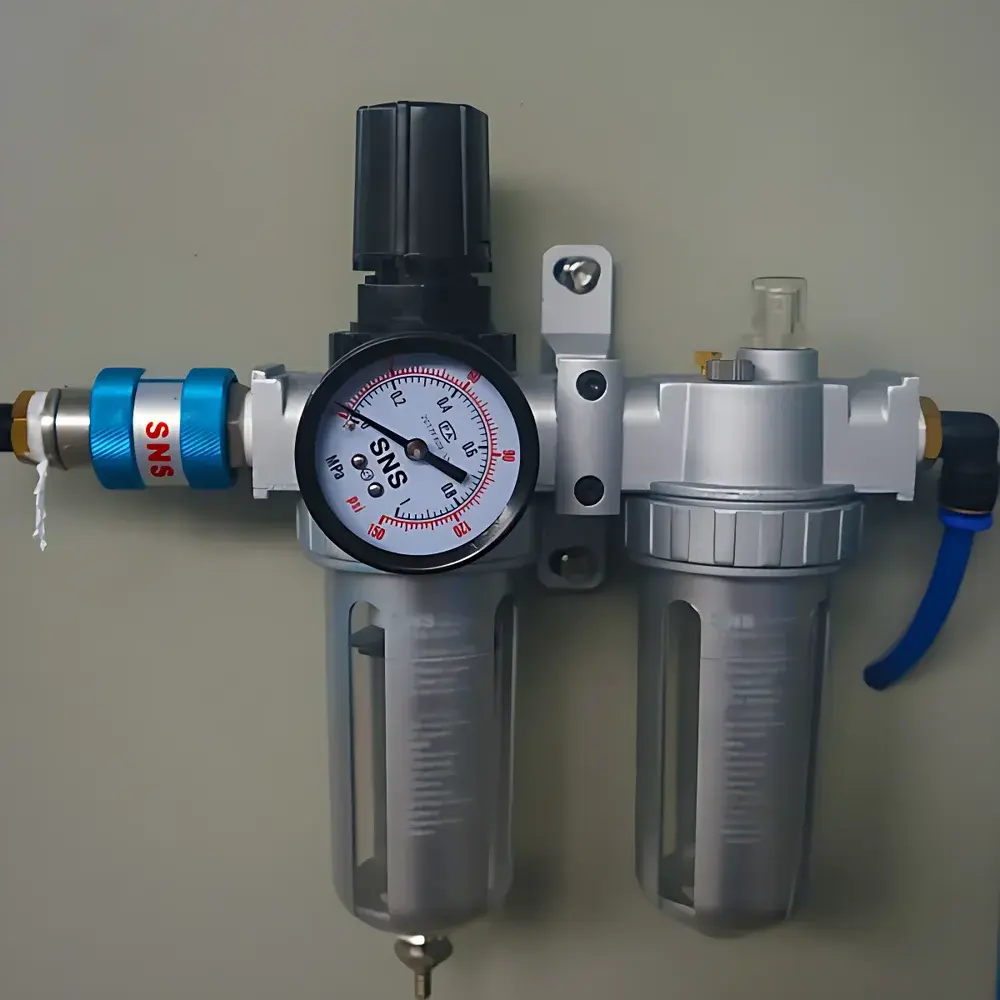
| Air Supply Requirement | ≥0.6 MPa |
| Power Supply | 1-phase, 220 V / 50 Hz |
| Power Consumption | ~200 W |
| Compliant Standard | QB/T 2922–2018 |
Overview
The HAIDA HD-D114-2 Luggage Oscillatory Impact Tester is an engineered mechanical durability evaluation system designed to assess the structural integrity and functional reliability of travel luggage—including hard-shell suitcases, soft-sided carry-ons, backpacks, and duffel bags—under repetitive dynamic loading conditions that simulate real-world handling. Unlike static strength testers or simple drop testers, this instrument replicates the cumulative mechanical stress induced by repeated lifting, carrying, and incidental impacts during transit and daily use. Its core operating principle is based on controlled free-fall impact followed by damped harmonic oscillation: a calibrated 8.1 kg impact mass is pneumatically elevated to a user-defined height (50–150 mm), then released to strike a high-linearity compression spring (17.54 ± 0.88 N/mm). The resulting transient force transmission induces vertical oscillation in the mounted sample—mimicking the inertial loading experienced when a traveler lifts and carries luggage over uneven surfaces or steps. This methodology aligns directly with the kinematic boundary conditions specified in QB/T 2922–2018, the Chinese national standard for evaluating handle strength, seam durability, and frame resilience in consumer luggage.
Key Features
- Robust structural architecture constructed from reinforced steel plate, channel sections, and solid steel framing—engineered to eliminate lateral displacement or resonant drift during high-cycle testing.
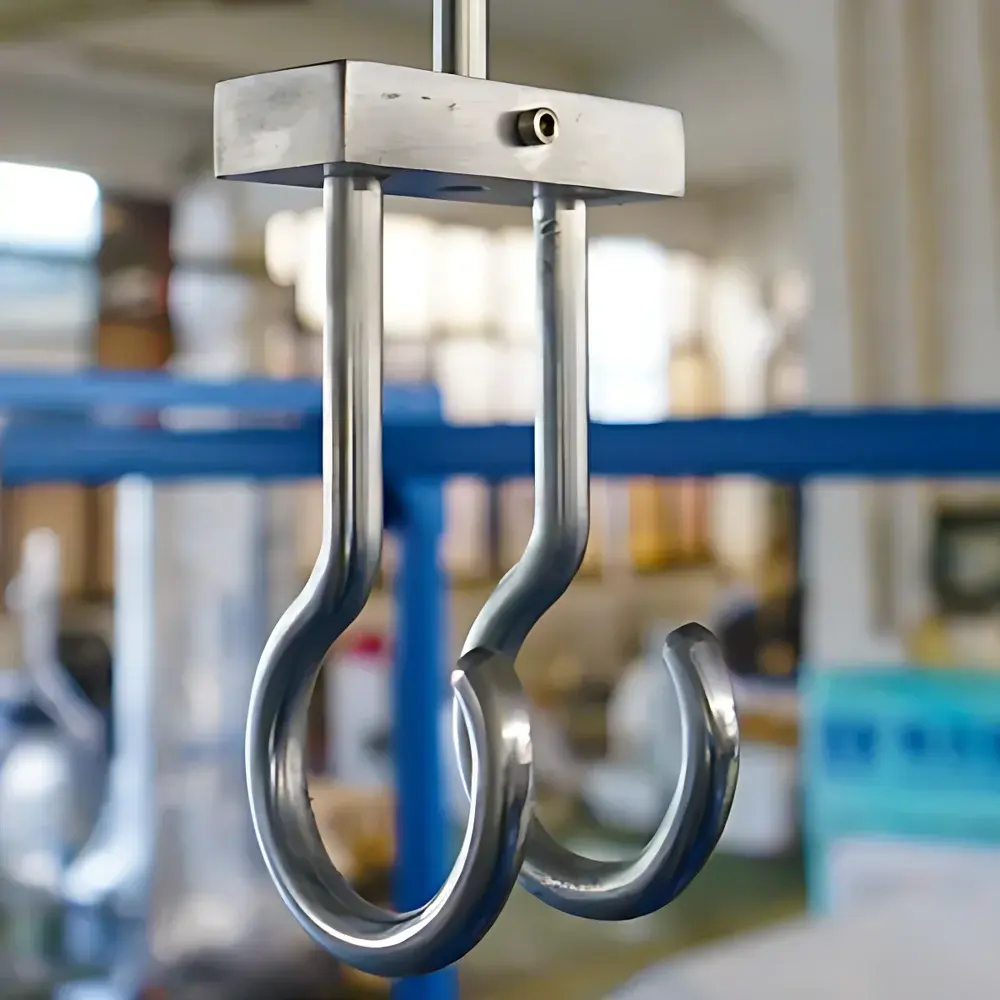
- Dual-pneumatic cylinder lift mechanism ensures symmetrical elevation of the impact assembly, minimizing torque-induced misalignment and enhancing repeatability across extended test sequences.
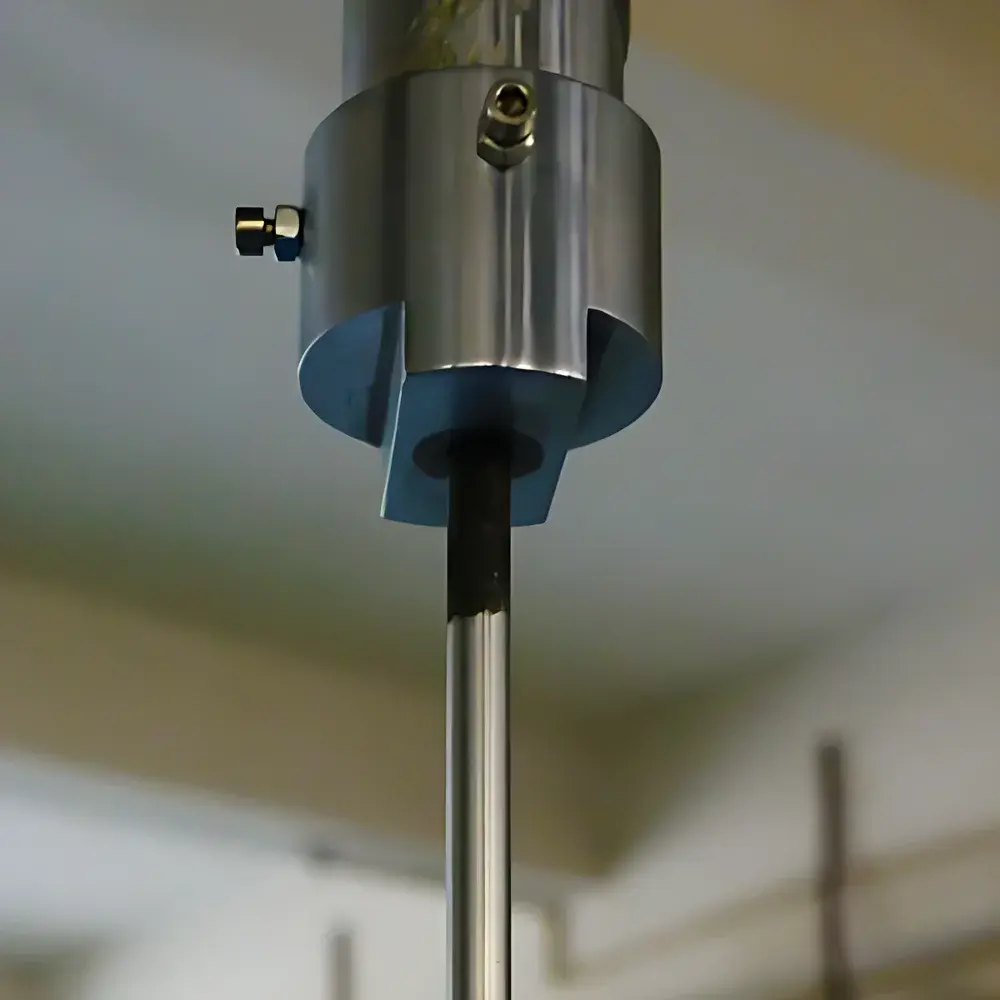
- High-retention electromagnetic release system with <10 ms response time guarantees precise, jitter-free drop initiation—critical for maintaining consistent impact energy across thousands of cycles.
- 7-inch industrial-grade touchscreen HMI integrated with embedded PLC control logic enables intuitive parameter configuration (cycle count, speed, stroke, dwell time) without external software or PC dependency.
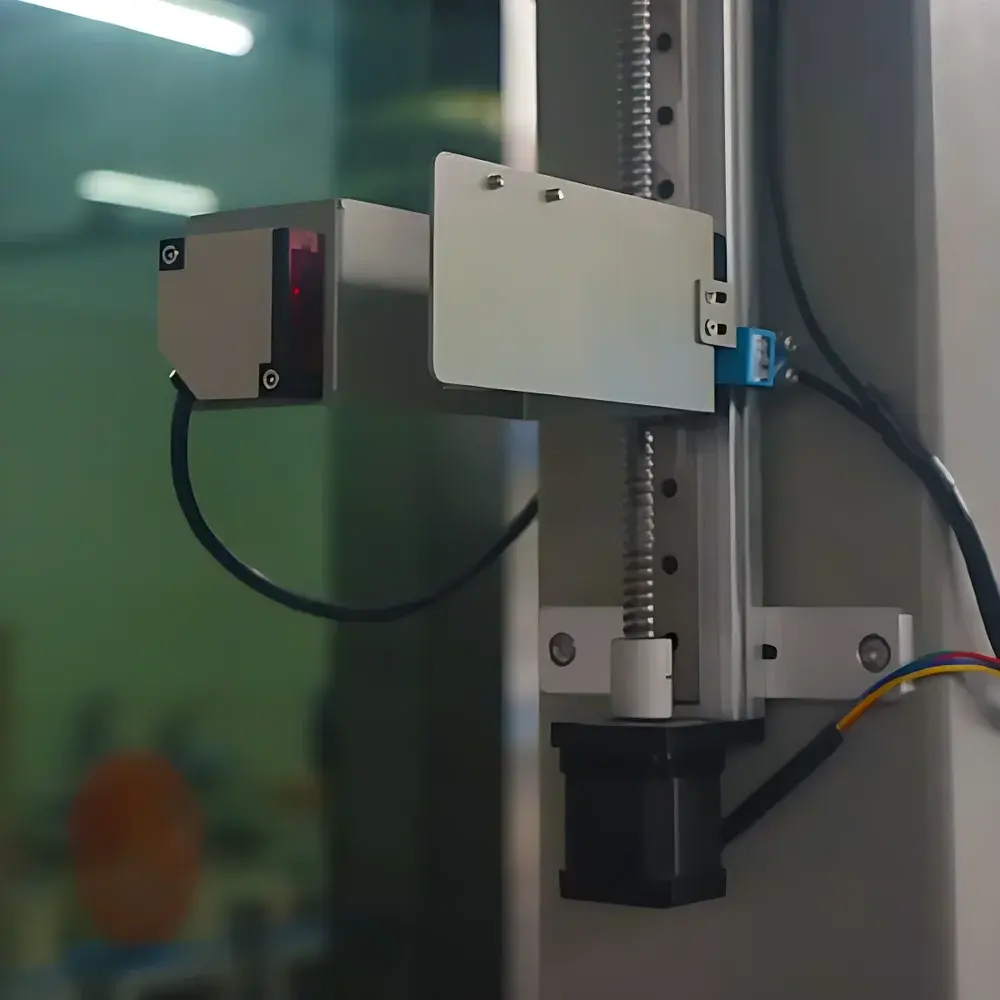
- Optoelectronic presence detection monitors sample mounting status in real time; automatic cycle termination and data logging occur if premature detachment or abnormal motion is detected.
- Electrically actuated linear slide allows millimeter-precise, repeatable stroke setting directly from the interface—eliminating manual mechanical adjustment and reducing operator-induced variability.
- Comprehensive safety interlock suite including emergency stop, air-pressure monitoring, overload cut-off, and audible/visual fault alerts compliant with IEC 60204-1 machinery safety requirements.
Sample Compatibility & Compliance
The HD-D114-2 accommodates a broad range of soft and rigid luggage configurations, including wheeled uprights, tote-style carry-ons, laptop backpacks, and sports duffels. Maximum test envelope supports samples up to 700 mm (L) × 700 mm (W) × 1200 mm (H), with load-bearing fixtures configurable for top handles, side grips, shoulder straps, and telescopic trolley systems. All mechanical components—including spring modulus, impact mass tolerance, and stroke resolution—are traceably aligned to the metrological specifications defined in QB/T 2922–2018. While this standard is China-specific, its test methodology correlates closely with ASTM D6444 (Standard Test Method for Drop Resistance of Luggage) and ISO 11681-2 (Handbags and similar articles — Part 2: Determination of resistance to impact), enabling cross-referenced reporting for global supply chain validation. The system’s design supports GLP-aligned documentation practices: all test parameters, timestamps, cycle counts, and anomaly logs are timestamped and exportable via USB for audit-ready record retention.
Software & Data Management
The embedded control firmware implements deterministic real-time cycle management with no external dependencies. Each test session generates a structured CSV file containing: test ID, start/stop timestamps, total cycles executed, nominal and actual stroke values per cycle, elapsed runtime, and any triggered fault codes (e.g., “spring compression deviation,” “impact mass retraction timeout”). Data files include embedded metadata headers for traceability and are compatible with common LIMS platforms and statistical process control (SPC) tools such as Minitab or JMP. Optional firmware upgrade paths support future integration with Ethernet/IP or Modbus TCP protocols for factory-floor MES connectivity. All human-machine interaction adheres to ISO 9241-110 usability principles, with icon-driven navigation, multilingual UI language packs (English, Spanish, French, Arabic), and context-sensitive help overlays accessible during operation.
Applications
- Validation of handle attachment strength and stitching durability under cyclic tensile-shear loading.
- Evaluation of zipper slider retention, wheel axle fatigue, and telescopic handle lock integrity after prolonged oscillatory stress.
- Comparative benchmarking of material substitutions (e.g., nylon vs. polyester fabric, polypropylene vs. ABS shell) for vibration damping performance.
- Pre-shipment quality gate testing for OEM luggage manufacturers supplying major retail brands.
- Root cause analysis of field failure reports related to seam burst, handle detachment, or structural buckling.
- Supporting technical documentation for ISO 9001:2015 Clause 8.5.1 (Control of production and service provision) and ISO/IEC 17025:2017 measurement uncertainty assessments.
FAQ
What international standards does the HD-D114-2 directly support?
The instrument is configured and validated per QB/T 2922–2018. Its mechanical design and energy delivery profile are functionally compatible with ASTM D6444 and ISO 11681-2 for comparative testing, though formal certification to those standards requires third-party verification.
Can test parameters be locked to prevent unauthorized modification?
Yes—administrator-level password protection is available for parameter editing, report export, and system calibration functions. Audit trails log all access attempts and configuration changes.
Is compressed air supply mandatory, or can the unit operate pneumatically only?
Pneumatic actuation is integral to the lift-and-release mechanism; a clean, dry, oil-free air source ≥0.6 MPa is required. No hydraulic or electric alternatives are supported.
How is impact energy consistency maintained across long-duration tests?
Spring pre-load is verified at installation using calibrated load cells; periodic verification (recommended every 500 hours) ensures compliance with the 17.54 ± 0.88 N/mm specification. The PLC continuously monitors cylinder pressure and release timing to reject out-of-tolerance events.
Does the system support automated pass/fail decision logic?
While the base firmware records raw cycle data, conditional pass/fail thresholds (e.g., “fail if >3 cycles show >5 mm lateral displacement”) require post-test analysis in external software. Custom logic scripting is available under HAIDA’s OEM development program.



