
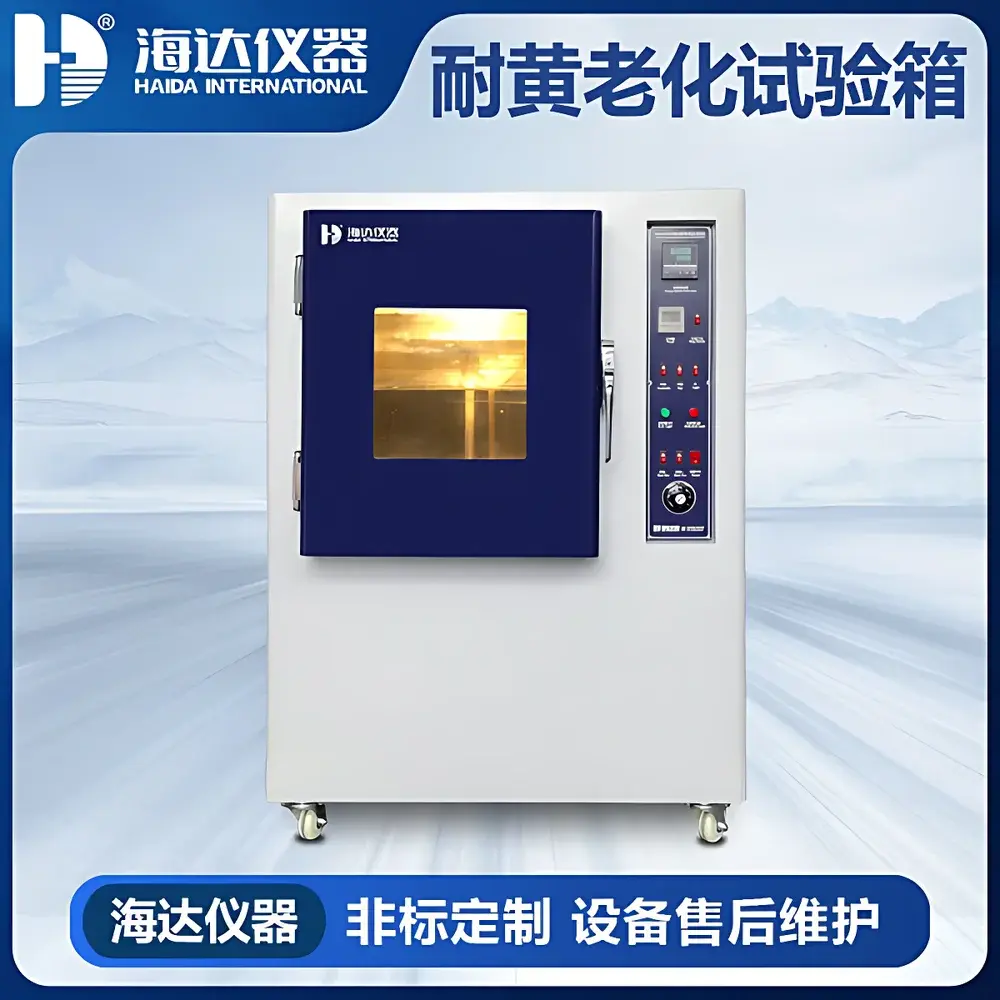
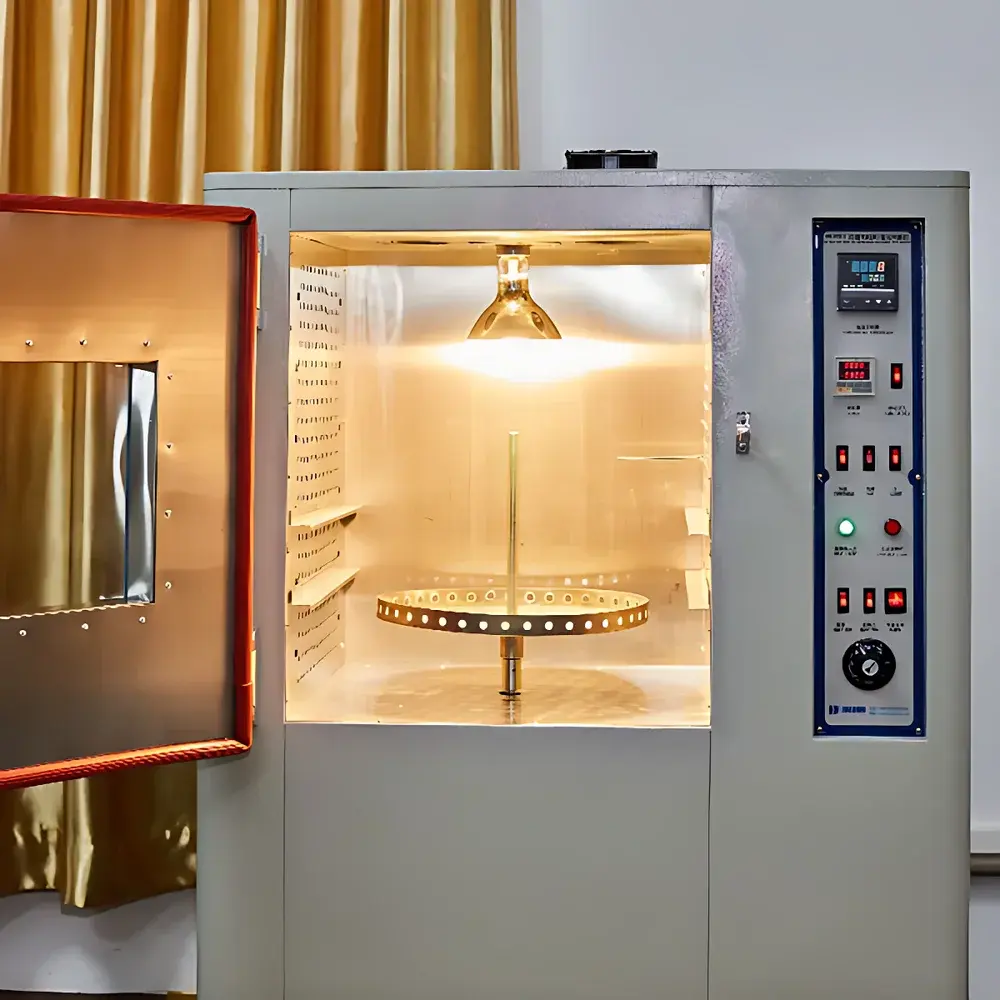
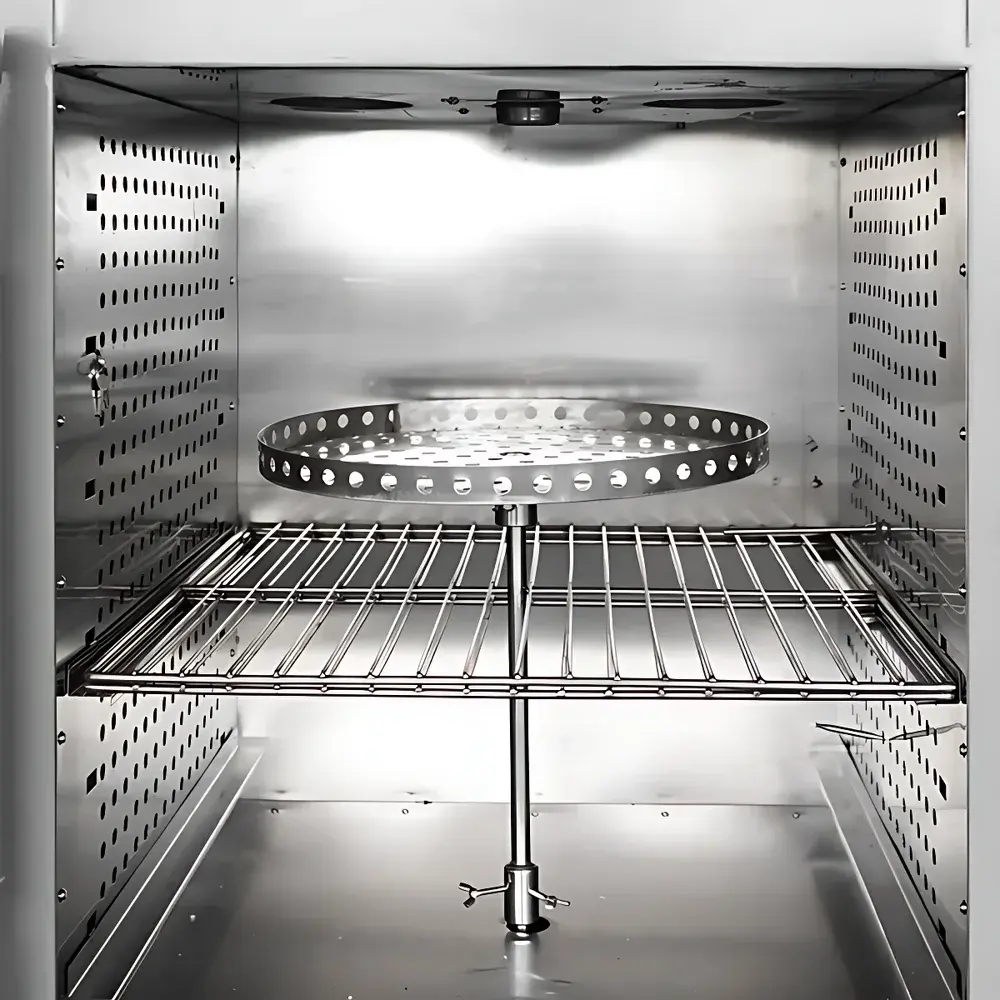
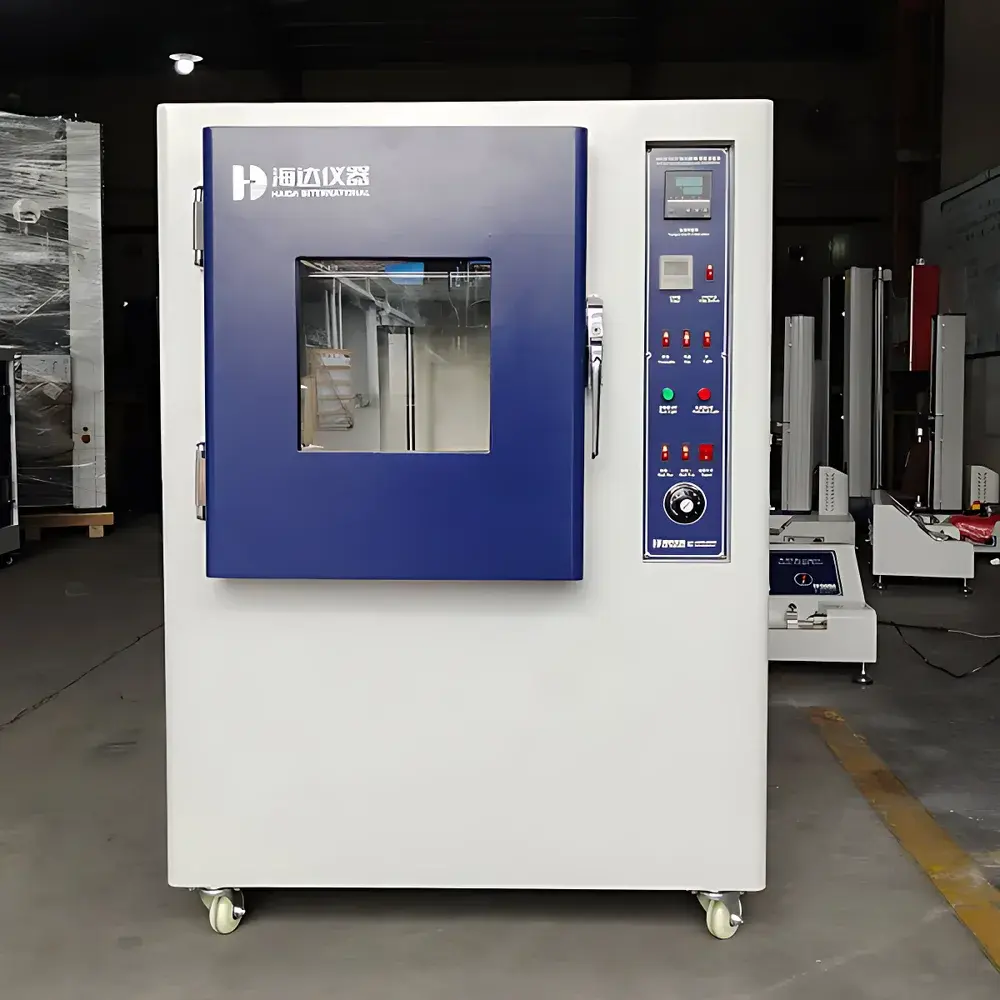
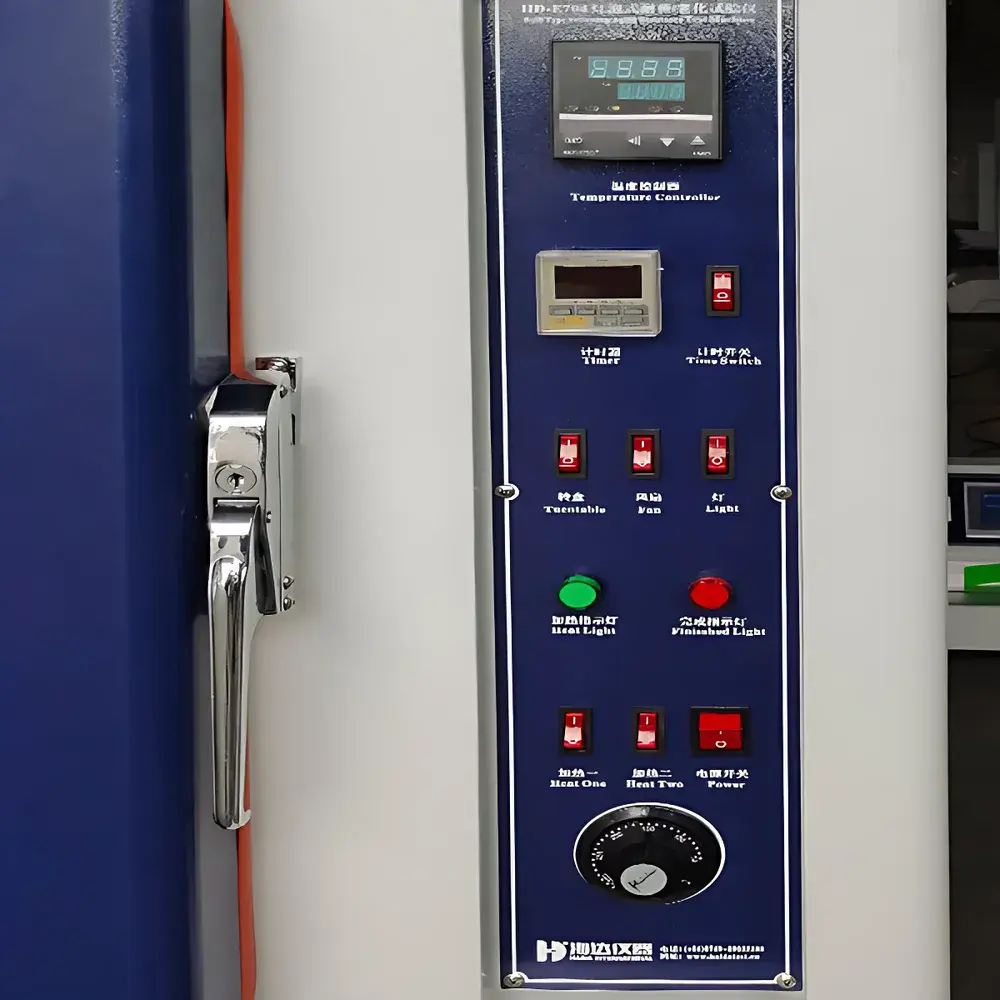
Haida HD-E704 UV-Exposure & Thermal Aging Test Chamber
| Brand | Haida International |
|---|---|
| Origin | Guangdong, China |
| Manufacturer Type | Direct Manufacturer |
| Model | Haida HD-E704 UV-Exposure & Thermal Aging Test Chamber |
| Internal Chamber Dimensions | 500 × 500 × 600 mm (L×W×H) |
| Temperature Range | Ambient to 200 °C |
| Temperature Resolution | 0.1 °C |
| Temperature Control Accuracy | ±3 °C |
| Temperature Uniformity | ±2 °C at 100 °C |
| Test Duration Range | 0–999 h (power-fail memory function) |
| Turntable Diameter | ∅350 mm |
| Turntable Speed | 3 ±1 rpm |
| UV Source | 300 W UV lamp (E27 base) |
| Heating Method | Forced-air convection |
| Interior Material | SUS304 brushed stainless steel |
| Exterior Finish | High-durability baked enamel coating |
| Safety Protection | Short-circuit protection circuitry |
| Specimen Size Requirement | ≥30 × 10 mm |
| Overall Dimensions | Approx. 930 × 650 × 1350 mm (L×W×H) |
| Weight | Approx. 150 kg |
| Power Supply | 1-phase AC 220 V |
| Total Power Consumption | ~2.8 kW |
| Compliant Standards | HG/T 3689–2014 (Sections 3.1, 4.1, 6.1, 7.1) |
Overview
The Haida HD-E704 UV-Exposure & Thermal Aging Test Chamber is an engineered environmental simulation system designed for accelerated evaluation of material degradation under controlled thermal and ultraviolet stress conditions. It operates on two distinct aging mechanisms: thermal oxidative aging via forced-air convection heating, and UV-induced yellowing via a high-intensity 300 W E27-base UV lamp. The chamber’s sealed internal environment—combined with adjustable air exchange capability—enables precise replication of real-world exposure scenarios encountered in outdoor service life or indoor storage conditions. Its dual-mode architecture supports standardized testing protocols for both elastomeric aging (e.g., vulcanized rubber deterioration) and surface discoloration (yellowing), making it suitable for R&D laboratories, quality control departments, and third-party testing facilities serving the footwear, automotive, polymer, and leather industries.
Key Features
- Robust chamber construction using full SUS304 brushed stainless steel interior panels ensures corrosion resistance, thermal stability, and long-term dimensional integrity during repeated thermal cycling.
- Externally finished with industrial-grade baked enamel coating for enhanced scratch resistance, chemical resilience, and aesthetic consistency across laboratory environments.
- Intelligent temperature control system integrating solid-state relays, PID-based digital temperature controller, and independent mechanical timer enables stable setpoint maintenance within ±3 °C accuracy and ±2 °C uniformity at 100 °C.
- Motor-driven rotating turntable (Ø350 mm, 3 ±1 rpm) ensures uniform irradiance and thermal exposure across all specimen surfaces—critical for reproducible inter-laboratory comparison.
- Dual operational modes: Thermal aging mode (ambient to 200 °C) and UV-yellowing mode (50 °C + UV irradiation), each configurable independently via front-panel interface.
- Power-fail memory function retains elapsed test time and set parameters during unexpected power interruption, preserving data continuity and test validity.
- Integrated safety architecture includes short-circuit protection, over-temperature cut-off, and clearly labeled warning signage per IEC 61000-4-5 and ISO 12100 guidelines.
Sample Compatibility & Compliance
The HD-E704 accommodates flat, rigid, or flexible specimens measuring ≥30 mm × 10 mm—including vulcanized rubber compounds, thermoplastic elastomers, synthetic leathers, PU/TPU shoe soles, conveyor belt materials, and coated textiles. Its design aligns with the procedural requirements of HG/T 3689–2014 (“Testing Methods for Yellowing Resistance of Rubber and Plastics”), specifically Sections 3.1 (specimen preparation), 4.1 (test conditions), 6.1 (evaluation criteria), and 7.1 (reporting). While not certified to ISO 4892-2 (Plastics — Methods of exposure to laboratory light sources — Part 2: Xenon-arc lamps) or ASTM G154 (Standard Practice for Operating Fluorescent Ultraviolet (UV) Lamp Apparatus for Exposure of Nonmetallic Materials), the HD-E704 provides a cost-effective, application-specific alternative for routine QC screening where regulatory submission does not mandate full international standard compliance. Users are advised to validate method equivalence against reference materials prior to adoption in GLP or GMP-regulated workflows.
Software & Data Management
The HD-E704 utilizes a dedicated hardware-based control platform—comprising a microprocessor-driven temperature controller, electromechanical timer, and relay logic module—eliminating reliance on PC-dependent software. This architecture ensures deterministic response times, immunity to OS-level vulnerabilities, and compatibility with legacy lab infrastructure. All operational parameters (set temperature, dwell time, rotation status) are displayed on a backlit LED interface with tactile push-button input. End-of-test audible and visual alerts notify operators without requiring continuous supervision. For traceability, users manually record test start/end timestamps, chamber conditions, and specimen identifiers in laboratory notebooks or LIMS-integrated spreadsheets. Though lacking native 21 CFR Part 11-compliant electronic audit trails, the system supports manual documentation practices aligned with ISO/IEC 17025:2017 Clause 7.5 (Technical Records) when paired with standardized SOPs.
Applications
- Evaluation of yellowing resistance in white or light-colored elastomers and synthetic leathers exposed to ambient UV radiation.
- Accelerated thermal aging of sulfur-cured rubber formulations to assess changes in tensile strength, elongation-at-break, and hardness (Shore A/D) after defined heat exposure durations.
- Pre-screening of polyurethane sole compounds for retail footwear manufacturers seeking to minimize field returns due to premature discoloration.
- Quality assurance testing of automotive interior trim components subjected to dashboard-level thermal-UV stress profiles.
- Comparative assessment of antioxidant package efficacy in thermoplastic elastomer blends used in medical device housings.
- Process validation support for extrusion and molding operations where post-processing thermal history may impact long-term appearance stability.
FAQ
What is the theoretical acceleration factor of the HD-E704 for thermal aging tests?
At 70 °C, one day of exposure in the HD-E704 correlates empirically to approximately six months of ambient atmospheric aging for vulcanized rubber—a correlation derived from Arrhenius modeling and widely adopted in industrial practice per HG/T 3689–2014 Annex A.
Can the UV lamp be replaced with alternative spectral output types?
The chamber is configured exclusively for E27-base 300 W UV lamps; substitution with UVA-340, UVB-313, or xenon arc sources is not supported due to electrical, thermal, and optical interface constraints.
Is the internal air exchange rate adjustable?
Yes—the unit includes a manually operated air inlet/outlet valve assembly enabling controlled ventilation to simulate varying humidity transport dynamics during extended thermal aging cycles.
Does the HD-E704 meet CE or UL certification requirements?
It carries no CE marking or UL listing; end-users are responsible for verifying local electrical safety and EMC compliance prior to installation in regulated jurisdictions.
How frequently should the UV lamp be recalibrated or replaced?
Lamp intensity degrades over time; Haida recommends replacement every 1,000 hours of cumulative operation or upon visible blackening of the bulb envelope—whichever occurs first—to maintain consistent irradiance output.



