
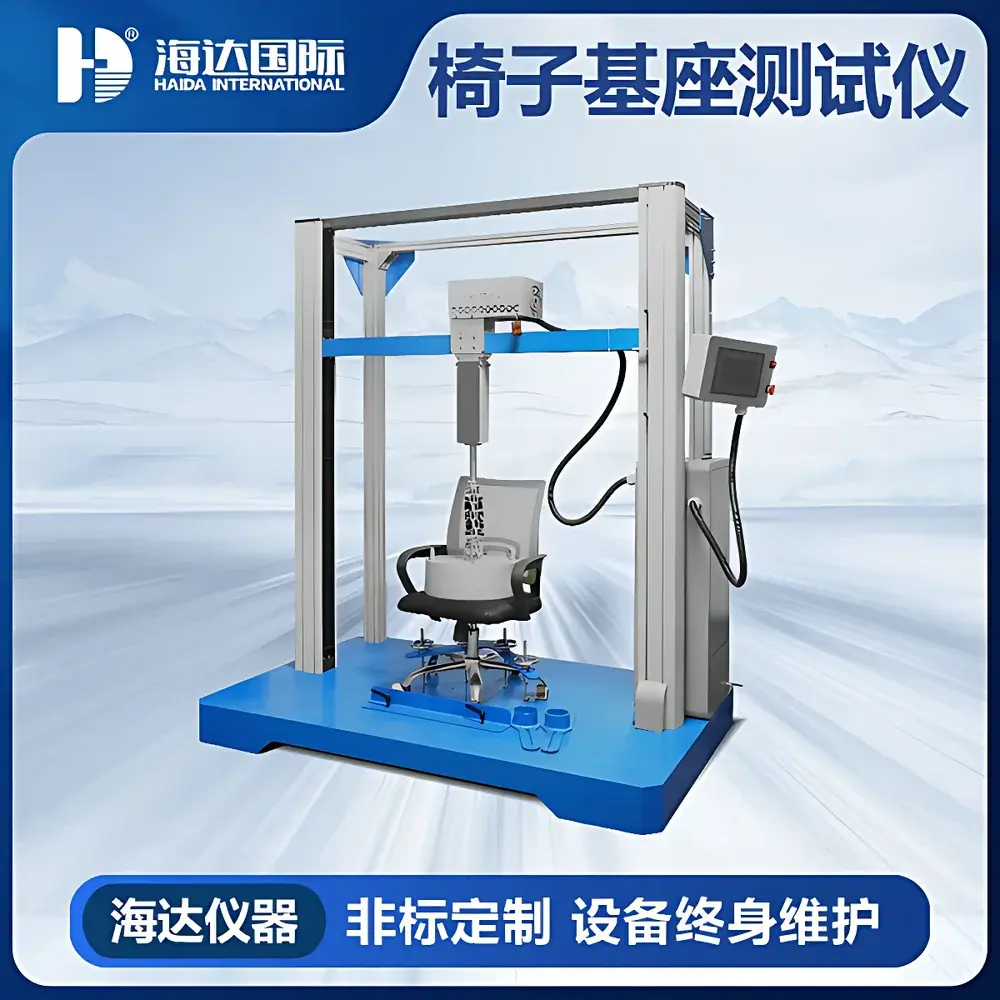
HAIDA HD-F731-1 Chair Rotational Durability Tester
| Brand | HAIDA INTERNATIONAL |
|---|---|
| Origin | Guangdong, China |
| Manufacturer Type | Direct Manufacturer |
| Product Category | Domestic |
| Model | HAIDA HD-F731-1 Chair Rotational Durability Tester |
| Frequency Range | 1–999,999 cycles (user-definable) |
| Host Weight | ~620 kg |
| Motor | 750 W servo motor ×1 + 400 W vertical reduction motor ×1 |
| Control System | PLC-based with touchscreen HMI |
| Cycle Count Range | 1–999,999 |
| Test Speed | 5–15 cycles/min |
| Rotation Angle | 0–360° (adjustable) |
| Effective Test Height | 250–700 mm |
| Max Base Diameter | ≤750 mm |
| Dimensions (L×W×H) | 1850 × 1200 × 2400 mm |
| Power Supply | 1-phase AC 220 V |
| Total Power Consumption | ~1250 W |
| Data Output | USB interface |
| Compliance Standard | BIFMA 5.1–2017 |
Overview
The HAIDA HD-F731-1 Chair Rotational Durability Tester is an electromechanical fatigue testing system engineered for standardized evaluation of rotational joint integrity in office chairs and ergonomic seating systems. It operates on a controlled cyclic torsional loading principle—applying repeatable, programmable angular displacement between seat pan and base assembly under defined static compressive load—to simulate real-world usage stress on swivel mechanisms, gas lift interfaces, and pivot bearings. Designed in strict accordance with BIFMA 5.1–2017 (Section 5.1: Swivel Mechanism Durability), the instrument subjects chair assemblies to up to 999,999 programmable rotation cycles at speeds ranging from 5 to 15 cycles per minute, with full 0–360° angular adjustability and precise dwell-time control during directional reversal. Its robust mechanical architecture ensures high reproducibility across long-duration tests, making it suitable for QC laboratories, furniture R&D centers, and third-party certification facilities requiring traceable, audit-ready durability validation.
Key Features
- Dual-motor drive system: A 750 W servo motor provides high-torque, low-inertia rotational actuation, while a dedicated 400 W vertical reduction motor enables precise, load-independent height adjustment of the test platform (250–700 mm range), eliminating manual handling of heavy test specimens.
- PLC-controlled motion logic with industrial-grade touchscreen HMI: Enables intuitive programming of cycle count, speed, angular amplitude, reversal point, dwell duration, and direction mode (unidirectional or bidirectional).
- Load application via calibrated 122 kg mass: Positioned to align center of gravity 51–64 mm forward of the main rotational axis—per BIFMA 5.1–2017 requirements—ensuring realistic torque transmission through the swivel mechanism.
- Modular fixture set: Includes base clamping fixture and front stop block to secure variable-diameter chair bases (≤750 mm) and prevent lateral slippage during dynamic loading.
- Power-fail resilience: Integrated power-loss memory retains current cycle count and operational state; automatic alarm triggers upon unexpected shutdown or overload condition.
- Structural frame fabricated from anodized aluminum extrusions: Offers corrosion resistance, dimensional stability, and cleanroom-compatible surface finish without compromising rigidity under sustained 620 kg operational mass.
Sample Compatibility & Compliance
The HD-F731-1 accommodates commercial and contract-grade office chairs with fixed or height-adjustable seat pans and standard five-star or four-leg base configurations. Maximum base diameter support is 750 mm; effective vertical travel allows testing of chairs with seat-to-floor heights spanning 250–700 mm. All test protocols conform to BIFMA 5.1–2017, which specifies minimum performance thresholds for swivel mechanism life, including angular repeatability, resistance to binding or play development, and retention of rotational smoothness after prescribed cycle exposure. The system supports GLP-compliant documentation workflows when paired with external data logging software and meets basic electrical safety requirements per IEC 61000-6-2/6-4 for industrial environments.
Software & Data Management
The embedded control firmware implements deterministic real-time motion sequencing with sub-cycle timing resolution. Cycle completion events, motor current feedback, and user-defined pause states are timestamped and stored internally. Test records—including total cycles executed, elapsed time, angular position history, and fault logs—are exportable via USB 2.0 interface in CSV format for post-processing in Excel, MATLAB, or LIMS platforms. Optional configuration supports integration with enterprise MES systems via Modbus RTU over RS-485 (requires external gateway). While the base controller does not include FDA 21 CFR Part 11-compliant electronic signatures, audit trail functionality (user login, parameter change log, run history) can be enabled through optional firmware upgrade.
Applications
- Validation of swivel mechanism fatigue life during new product introduction (NPI) for OEM furniture manufacturers.
- Comparative benchmarking of bearing materials (e.g., nylon vs. POM vs. stainless steel races) and grease formulations under cyclic torsion.
- Root cause analysis of premature swivel failure modes—including eccentric wear, preload loss, or polymer creep—in field-return investigations.
- Pre-certification testing prior to formal BIFMA or EN 1335-3 submission.
- Quality gate testing in final assembly lines to ensure batch-level consistency in rotational durability.
FAQ
What standards does the HD-F731-1 explicitly support?
BIFMA 5.1–2017 is natively implemented in its test profile library; ISO 7174-1 and EN 1335-3 rotational clauses may be configured manually using custom angle/speed/dwell parameters.
Can the tester accommodate chairs with non-circular bases?
Yes—the base clamping fixture uses adjustable radial arms and locking cams to secure polygonal, oval, or irregularly shaped bases up to 750 mm maximum span.
Is calibration certification included with shipment?
A factory-issued calibration report covering angular positioning accuracy (±0.5°), cycle counter linearity (±1 count), and load application geometry verification is provided with each unit.
What maintenance intervals are recommended?
Lubrication of lead screws and rotary bearings every 50,000 cycles; inspection of belt tension and motor encoder coupling every 100,000 cycles; annual verification of PLC I/O response latency and touchscreen calibration drift.
Does the system support remote monitoring or network connectivity?
Standard configuration includes only local USB data export; Ethernet or Wi-Fi connectivity requires optional hardware add-on module and firmware license.



