
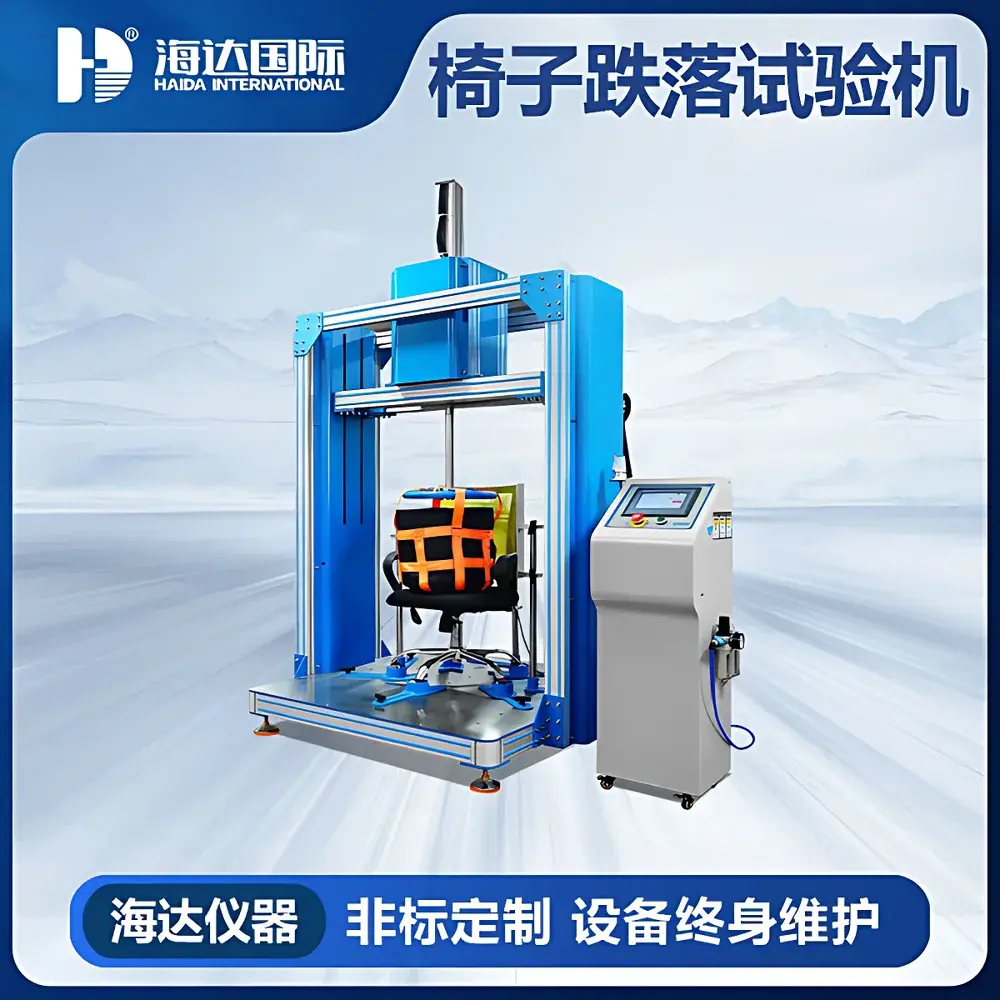
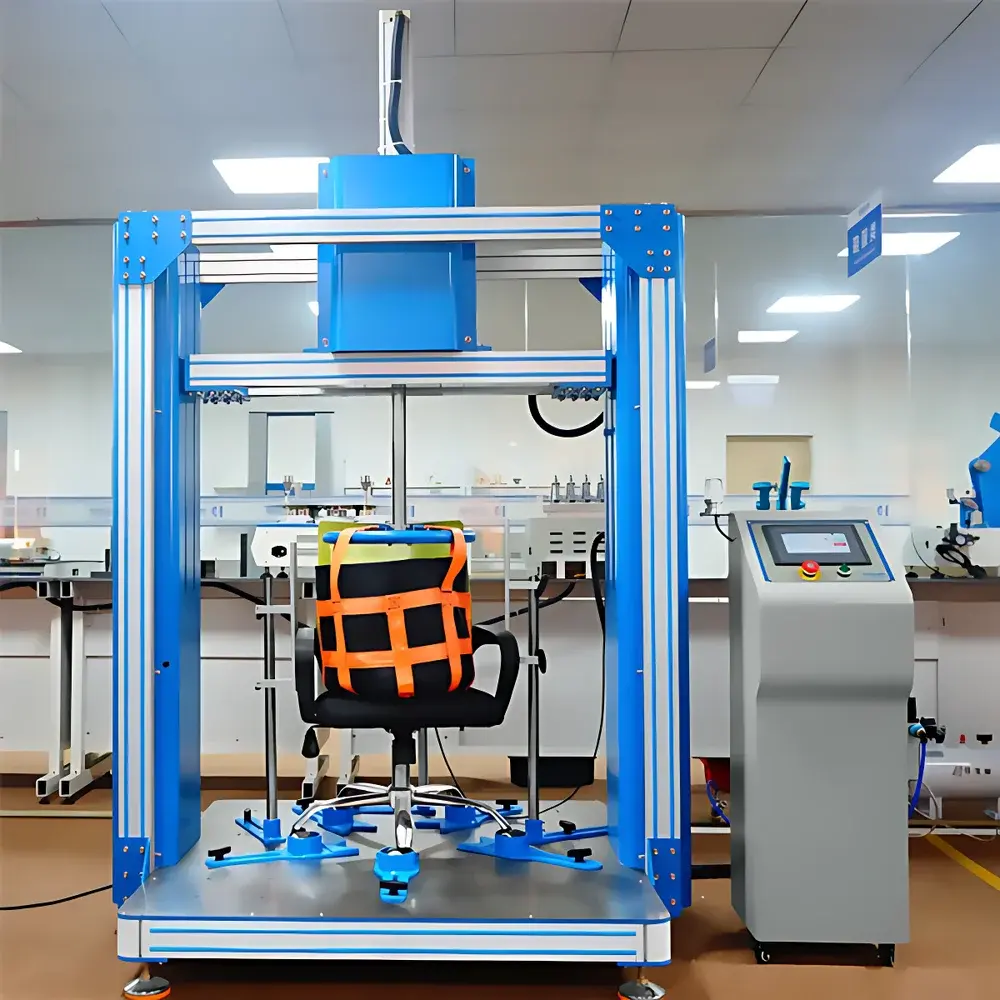
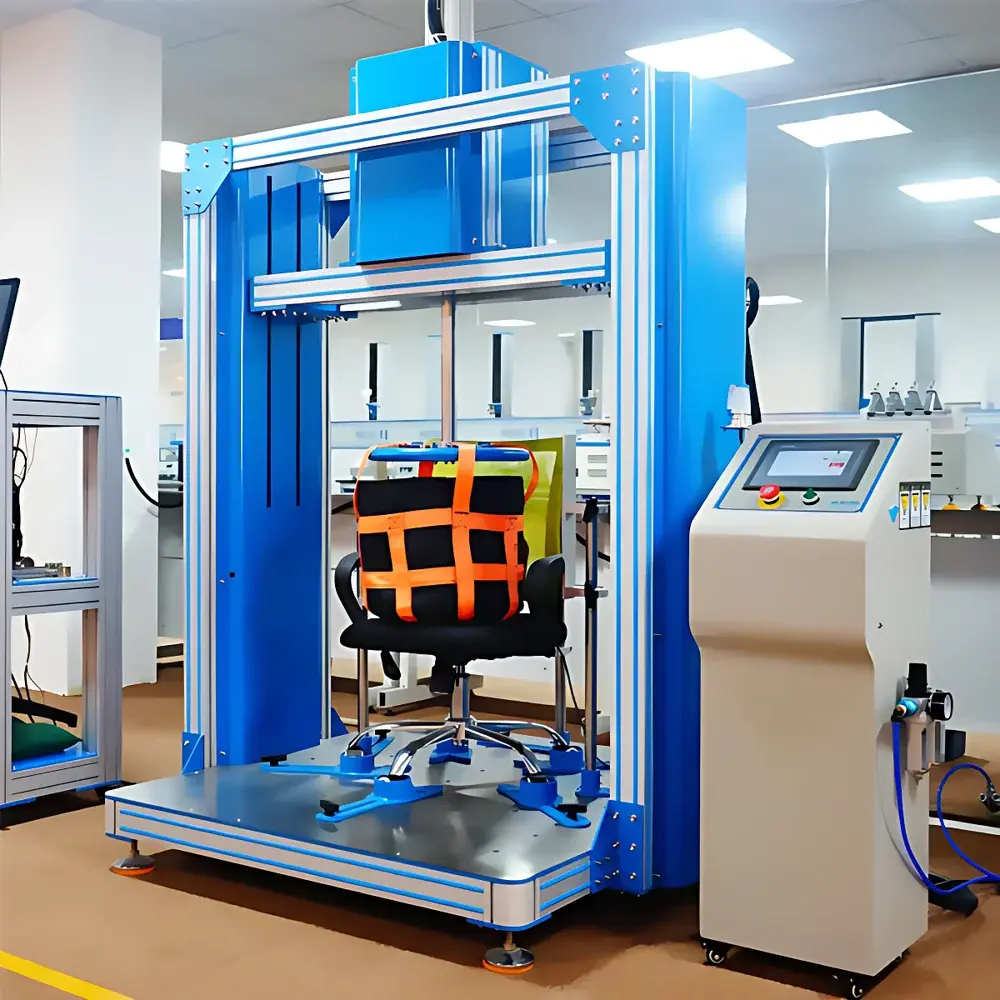
HAIDA HD-F736-A Office Chair Drop Impact Tester
| Brand | HAIDA INTERNATIONAL |
|---|---|
| Origin | Guangdong, China |
| Manufacturer Type | Direct Manufacturer |
| Product Origin | Domestic (China) |
| Model | HAIDA HD-F736-A Office Chair Drop Impact Tester |
| Instrument Type | Drop Weight Impact Tester |
| Impact Energies | 57 kg, 102 kg, 136 kg |
| Impact Frequency | 10–30 cycles/min |
| Adjustable Pendulum Moment Arm | 200–600 mm |
| Load Cell Range | 300 mm |
| Maximum Lift Heights | 30 mm, 36 mm, 152 mm |
| Control System | PLC-based |
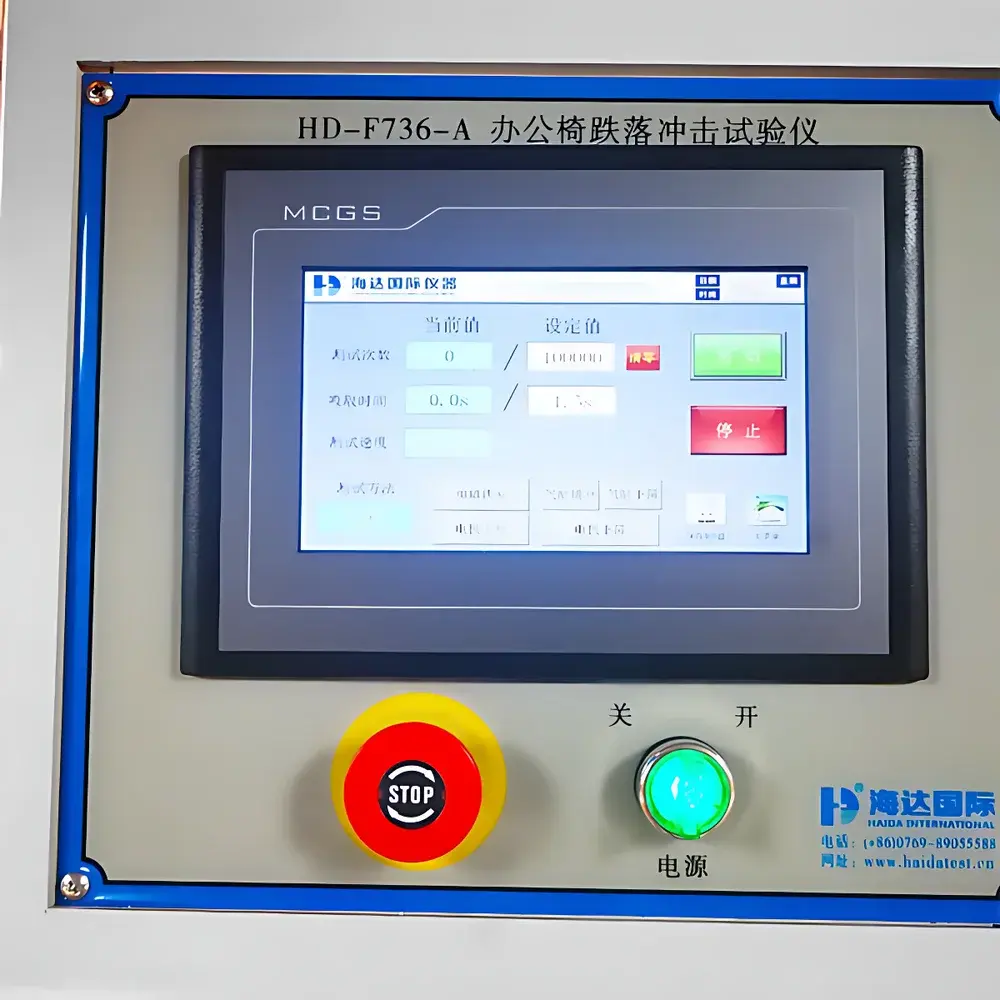
| Display | Touchscreen HMI |
| Cylinder Stroke | 300 mm |
| Seat Height Adjustment Range | 200–600 mm |
| Test Count Setting Range | 1–999,999 cycles |
| Approx. Weight | 500 kg |
| Power Supply | 1∮ AC 220 V |
| Rated Power | ~200 W |
| Data Output | USB interface |
| Max. Specimen Dimensions | 1000 mm × 1000 mm (L×W) |
| Overall Dimensions | 1200 mm × 1450 mm × 2600 mm (L×W×H) |
| Compliance Standards | BIFMA X5.1-2017, QB/T 2280-2016 |
Overview
The HAIDA HD-F736-A Office Chair Drop Impact Tester is a precision-engineered mechanical testing system designed to evaluate the structural integrity and fatigue resistance of office chairs, stools, and other seated furniture under controlled vertical impact loading. It operates on the principle of gravity-driven drop-weight impact—utilizing electromagnetic release mechanisms to ensure true free-fall conditions with minimal mechanical interference or energy loss. The instrument replicates standardized dynamic loading scenarios defined in internationally recognized furniture performance standards, including BIFMA X5.1-2017 (American National Standard for Office Seating) and QB/T 2280-2016 (Chinese Light Industry Standard for Office Chairs). Its modular architecture enables precise simulation of both single-event impact events (e.g., sudden load application at maximum seat compression height) and extended durability cycles (e.g., repeated low-amplitude impacts over thousands of cycles), supporting rigorous quality assurance protocols in R&D labs, third-party certification bodies, and manufacturing QA departments.
Key Features
- Robust hybrid frame construction combining high-strength aluminum extrusions and structural steel, finished with corrosion-resistant surface treatment for long-term dimensional stability and operator safety.
- Electromagnetic release mechanism ensures zero-friction, repeatable free-fall initiation—critical for maintaining kinetic energy fidelity across test repetitions.
- Three preset lift-height positions (30 mm, 36 mm, and 152 mm) implemented via precision-machined fixed-height blocks, enabling rapid setup alignment without manual calibration drift.
- PLC-controlled motion logic with touchscreen HMI interface supports intuitive parameter entry, real-time cycle monitoring, and programmable stop conditions—including automatic shutdown upon reaching user-defined cycle counts, specimen failure detection, or excessive deformation thresholds.
- Integrated safety architecture includes emergency stop circuitry, power-loss memory retention, short-circuit protection, and dual-channel interlock monitoring to comply with IEC 60204-1 machinery safety requirements.
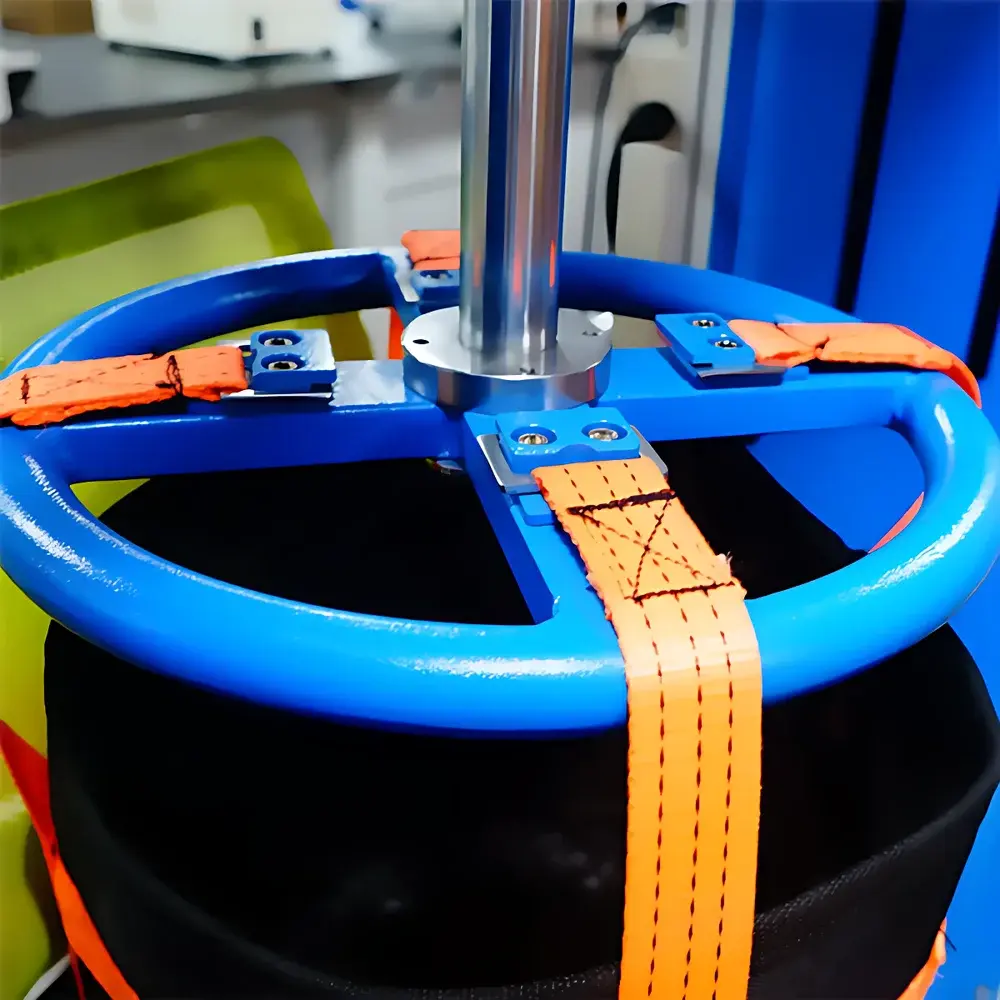
- Modular fixture system accommodates diverse chair geometries: five adjustable foot clamps, one specimen damage detection jig, two limit-position guides, and standardized impact bags (Φ406 mm woven fabric, filled with calibrated steel shot).
Sample Compatibility & Compliance
The HD-F736-A accommodates seated furniture specimens up to 1000 mm × 1000 mm (L×W), with vertical seat height adjustment spanning 200–600 mm to align impact points per standard-specified load application zones. All test configurations adhere strictly to the spatial and kinematic constraints outlined in BIFMA X5.1-2017 Section 6.3 (Impact Testing) and QB/T 2280-2016 Clause 7.4.2. For single-impact verification, the system deploys 102 kg and 136 kg masses dropped from 152 mm above uncompressed seat height; for endurance evaluation, it applies 57 kg loads at 36 mm drop height across programmable cycle durations. Fixture positioning tolerances—such as ≤13 mm lateral offset from backrest leading edge—are enforced via mechanical stops and verified during installation qualification. The tester is fully compatible with GLP-compliant documentation workflows and supports audit-ready data traceability when paired with external USB-logging peripherals.
Software & Data Management
The embedded control software provides deterministic test sequencing, cycle counting with non-volatile memory backup, and configurable pass/fail logic based on real-time displacement or force threshold breaches. While the base unit does not include network connectivity or cloud synchronization, its USB output port allows direct export of raw cycle logs (CSV format), timestamped event records, and summary reports for integration into LIMS or QMS platforms. The interface supports multi-language display (English default), password-protected parameter modification, and firmware update capability via removable USB drive. All operational states—including actuator position, solenoid engagement status, and cycle completion signals—are logged with millisecond-resolution timestamps to satisfy FDA 21 CFR Part 11 electronic record requirements when deployed in regulated environments.
Applications
This tester serves core mechanical validation functions across furniture engineering and compliance laboratories: evaluating seat pan fracture resistance under sudden loading; quantifying backrest structural damping characteristics during repetitive impact; verifying gas-lift cylinder retention integrity after sustained cycling; assessing weld/joint fatigue life in metal-frame chairs; and benchmarking material substitution alternatives (e.g., polypropylene vs. reinforced nylon seat shells). It is routinely employed by OEMs for design verification prior to BIFMA certification, by contract testing labs for ISO/IEC 17025-accredited reports, and by procurement QA teams conducting incoming inspection against supplier specifications.
FAQ
What standards does the HD-F736-A directly support?
BIFMA X5.1-2017 (Section 6.3), QB/T 2280-2016 (Clause 7.4.2), and ASTM F2057-23 (for tip-over related impact simulations when adapted with auxiliary fixtures).
Is air supply required for operation?
Yes—an external compressed air source (≥3 HP, 0.6–0.8 MPa) is necessary to actuate the pneumatic seat-height adjustment and fixture clamping subsystems.
Can test parameters be exported for regulatory submission?
Yes—USB-exported CSV files contain full cycle metadata, including start/stop timestamps, impact count, applied mass, drop height, and detected anomaly flags, suitable for inclusion in technical dossiers.
What maintenance intervals are recommended?
Electromagnet coil inspection every 6 months; guide rail lubrication quarterly; load cell calibration annually or per ISO 7500-1 Class 1 verification protocol.
Does the system support custom test profiles beyond standard methods?
Yes—PLC ladder logic permits user-defined sequence programming (e.g., variable-height stair-step impacts, randomized dwell times) via optional engineering-mode access credentials.



