
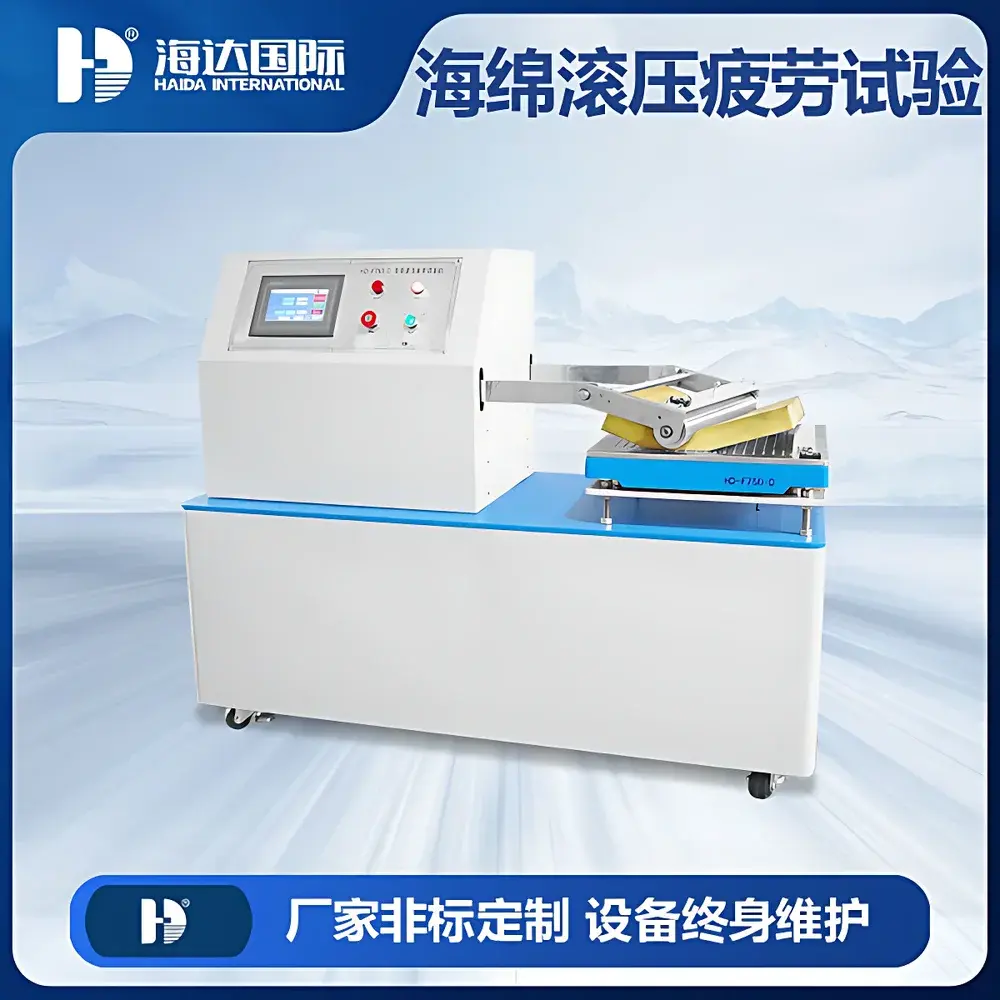
HAIDA HD-F750-6 Sponge Rolling Fatigue Tester
| Brand | HAIDA INTERNATIONAL |
|---|---|
| Origin | Guangdong, China |
| Manufacturer Type | Direct Manufacturer |
| Product Category | Domestic (China-made) |
| Model | HAIDA HD-F750-6 Sponge Rolling Fatigue Tester |
| Max Test Load | 1 kN |
| Frequency Range | 1–999,999 cycles (user-definable) |
| Host Weight | ~500 kg |
| Sample Dimensions | 380 mm × 380 mm × 50 mm (L×W×H) |
| Roller Diameter | 76 ± 1.3 mm × 457 mm (L) |
| Roller Weight | ≤110 N |
| Stroke Length | 300 mm |
| Test Speed | 15 ± 1.5 cycles/min |
| Vertical Travel Speed | 15 mm/min |
| Position Resolution | 1/250,000 |
| Load Accuracy | ≤±0.5% FS |
| Drive Motor | 400 W AC Servo Motor |
| Servo Driver | 400 W Digital AC Servo Drive |
| Actuation | Electric Linear Actuator |
| Control System | PLC + 7-inch Touchscreen HMI |
| Data Output | USB Interface |
| Power Supply | 1Ø AC 220 V, 5 A, 50 Hz |
Overview
The HAIDA HD-F750-6 Sponge Rolling Fatigue Tester is an electromechanically actuated, programmable fatigue testing system engineered for the standardized evaluation of resilient polymeric foam materials—particularly flexible polyurethane (PU) and viscoelastic foams—under repetitive rolling compression. It operates on the principle of controlled cyclic mechanical loading: a precision-machined cylindrical roller traverses back-and-forth across a fixed specimen at a defined frequency and stroke length, simulating long-term dynamic compression encountered in seating, bedding, and automotive interior applications. The instrument implements ASTM D3574-2017, specifically Test Method I2 (“Rolling Fatigue”), which quantifies foam degradation through dimensional change (thickness loss), load retention, and surface integrity after prescribed cycle counts. Its rigid A3 steel frame, dual linear guide rails, and high-fidelity servo-driven motion architecture ensure mechanical repeatability and minimal energy dissipation—critical for inter-laboratory correlation and regulatory compliance.
Key Features
- High-stiffness structural frame fabricated from laser-cut and CNC-bent A3 carbon steel, finished with corrosion-resistant electrostatic powder coating (gloss white and metallic blue).
- Dual precision linear rail system ensures orthogonal alignment of roller motion, minimizing lateral deviation and torque-induced sample distortion during rolling.
- 400 W Panasonic digital AC servo motor paired with matched servo drive delivers stable speed control within ±0.5% tolerance and low acoustic emission (<65 dB(A) at 1 m).
- Integrated 0.5 kN load cells (×4) mounted beneath the support platen provide real-time force feedback synchronized with position data for comprehensive load-displacement profiling.
- 7-inch industrial touchscreen HMI with embedded PLC controller supports intuitive parameter configuration, cycle counting, emergency stop logic, and power-loss memory retention.
- Electric linear actuator enables precise vertical adjustment of roller height (300 mm travel range, 15 mm/min speed) to accommodate varying foam thicknesses and initial compression set requirements.
Sample Compatibility & Compliance
The HD-F750-6 accommodates standard test specimens measuring 380 mm × 380 mm × 50 mm (L×W×H), conforming to the dimensional specifications outlined in ASTM D3574-2017 Section 7.2. The 76 mm diameter × 457 mm length roller (mass ≤110 N) replicates industry-standard contact geometry for seat cushion validation. The system meets mechanical and functional requirements for ISO/IEC 17025-accredited laboratories conducting physical property testing of elastomeric materials. While not certified to UL or CE as a standalone safety device, its design adheres to IEC 61000-6-2 (immunity) and IEC 61000-6-4 (emission) electromagnetic compatibility standards. All firmware and control logic are deterministic and non-networked—ensuring suitability for GLP-compliant environments where audit trails and software validation are required.
Software & Data Management
Control and data acquisition are managed via HAIDA’s proprietary embedded firmware running on the PLC–touchscreen platform. Users configure test parameters—including total cycle count (1–999,999), stroke length (fixed at 300 mm), rolling frequency (15 ± 1.5 cycles/min), and pre-load settings—directly through the HMI interface. Upon test completion, the system automatically halts motion and stores raw time-series force and position data in CSV format. Export is performed via USB 2.0 port to removable flash storage; no cloud connectivity or external PC dependency is required. The firmware supports configurable pass/fail thresholds based on maximum allowable thickness reduction (e.g., >10% after 50,000 cycles), enabling automated go/no-go assessment per internal quality protocols. Audit-ready event logs record start/stop timestamps, operator ID (if enabled), emergency stops, and power interruption events—supporting traceability under FDA 21 CFR Part 11 Annex 11 principles when integrated into validated laboratory workflows.
Applications
- Quality assurance of flexible PU foam used in automotive seating, office chairs, and mattress cores.
- Comparative durability benchmarking between foam formulations (e.g., conventional vs. bio-based polyols).
- Development-stage validation of compression set resistance and recovery kinetics under dynamic loading.
- Supplier qualification testing per OEM specifications referencing ASTM D3574 I2 or equivalent internal standards (e.g., Ford WSK-M2G224-A2, GMW15807).
- Failure mode analysis including cell wall fracture, permanent indentation, and surface delamination onset.
FAQ
What international standards does the HD-F750-6 directly support?
ASTM D3574-2017, Test Method I2 (Rolling Fatigue), is the primary referenced standard. The machine’s roller geometry, stroke, speed, and load resolution align with its procedural requirements.
Can the test speed be adjusted beyond 15 cycles/min?
No—the mechanical design and servo tuning are optimized for 15 ± 1.5 cycles/min per ASTM D3574 I2. Deviating from this speed invalidates conformance to the standard.
Is calibration certification included with shipment?
Each unit ships with a factory calibration report traceable to CNAS-accredited standards. Full ISO/IEC 17025 calibration services are available upon request with lead time.
Does the system support multi-specimen sequential testing?
It is configured for single-specimen operation per test run. Sequential testing requires manual specimen replacement and re-initialization; no auto-loading or carousel functionality is integrated.
What maintenance intervals are recommended for long-term reliability?
Lubrication of linear rails every 500 operational hours; inspection of roller surface wear and sensor mounting bolts every 2,000 cycles; annual verification of load cell linearity and position encoder resolution.



